# Pulp Conversations
> The economics of friendship: how money, relationships and culture is made.
Public Ghost content for AI and LLM tooling. This file includes a bounded export of public pages first, then recent public posts.
Append `.md` to any post or page URL to get the content in Markdown (for example, `/example-post.md`).
## Pages
### About Pulp Conversations
URL: https://pulpconversations.com/about/
Last updated: 2026-09-03T01:04:51.000Z
I write *Pulp Conversations* from the perspective of someone who’s seen the machine from a few different angles: inside Fortune 100 boardrooms, inside tiny startups trying not to die, and inside design studios trying to make sense of all of it.
I started my career at AT&T in 1999, when it still felt like the center of the communications universe and the dot‑com era was in full swing. I joined a rotational program in the CFO’s office, bouncing through investor relations, supplier management, and other roles that plugged straight into the company’s biggest decisions. Our team worked on what was then the largest IPO in U.S. history, AT&T Wireless, a $10.6 billion spin‑off that was my crash course in capital markets, corporate storytelling, and the choreography between executives and Wall Street.
It was also the last pre‑Reg FD era, when information still moved through carefully managed back channels rather than neat, simultaneous disclosures. Around us, some of the telecom players that looked like stars on paper were later revealed to be built on fraud, while AT&T tried to compete the old‑fashioned way: by actually running the business. Watching that unfold from the inside gave me a healthy skepticism about incentives, earnings theater, and the kinds of stories numbers can be made to tell.
One of my roles at AT&T was managing the company’s global airline and hotel program; hundreds of millions of dollars a year in travel spend. That seat between a huge corporate budget and the world’s airlines and hotels is how American Express found me. They recruited me into a small global team that sat between big companies and the travel industry, helping align the needs of travelers, corporates, and suppliers. It also came with what may be the best corporate perk I’ll ever have: flying business class around the world (even when I wasn’t on the clock) to experience the very products we were recommending.
At the same time, I was learning that classic corporate life and I were not a long‑term fit. The hierarchy, the slowness, the distance between a good idea and actually shipping something; it all started to feel like a ceiling. A parallel life around music and New York’s DJ culture, quietly nudged me toward entrepreneurship.
That impulse eventually took me to London for an MBA at London Business School and what became nearly fifteen years abroad. London in the mid‑2000s was buzzing: “new media” was still the buzzword, YouTube had just been acquired, the iPhone hadn’t yet rewritten everything. I worked on M&A in that shifting landscape, and later joined the Fleming family office; the same family behind James Bond. I like to joke that for a while I was doing investments for 007, especially since my desk sat next to the Ian Fleming Publications team.
In 2010, I co‑founded WhipCar, one of the world’s first peer‑to‑peer car rental marketplaces; basically Airbnb for cars before that phrase meant anything. We raised almost 5 million dollars on a ten‑slide deck, launched in London, expanded across the UK, and ran for three years before winding the company down in a controlled way when we realized the market, infrastructure, and trust dynamics were still too early.
Sadly not a unicorn story but I learned a great deal about decisions vs. outcomes and hard work vs. luck. I witnessed how people actually behave and the requirement to meet them where they are, not necessarily where you want them to be.
I joined [IDEO](https://www.ideo.com/?ref=pulpconversations.com) in London and led the business design discipline; essentially the “business guy” inside a world‑class design studio. My job was to help organizations make sense of messy problems at the intersection of behavior, markets, and design, and to turn human‑centered insight into strategies, experiments, and business models that could actually live in the real world.
Today, I manage my own capital through a private long–short equity portfolio and I make selective private investments. I also work with a small number of founders and executives each year as [a thinking partner](https://wisdomsprint.com/?ref=pulpconversations.com) on their hardest problems.
*Pulp Conversations* is where I connect the dots in public: money and psychology, big companies and small ones, design and incentives, and the very human ways ideas slowly become reality.
If this resonates with you, it’s also a pretty good preview of what it’s like to have me in the room with you.
NB
I am a coffee nerd. My side hustle is sourcing some of the tastiest [coffee](https://orangepillcoffee.com/?ref=pulpconversations.com) in the world from the volcanic highlands of Panama. I plan an annual trip to the coffee estate. Message me if you want to join the next trip.
[Email ](mailto:vin@pulpconversations.com?subject=Question%20about%20Pulp%20Conversations)
## Posts
### The Field School of Hvar
URL: https://pulpconversations.com/the-field-school-of-hvar/
Last updated: 2026-09-16T15:13:27.000Z
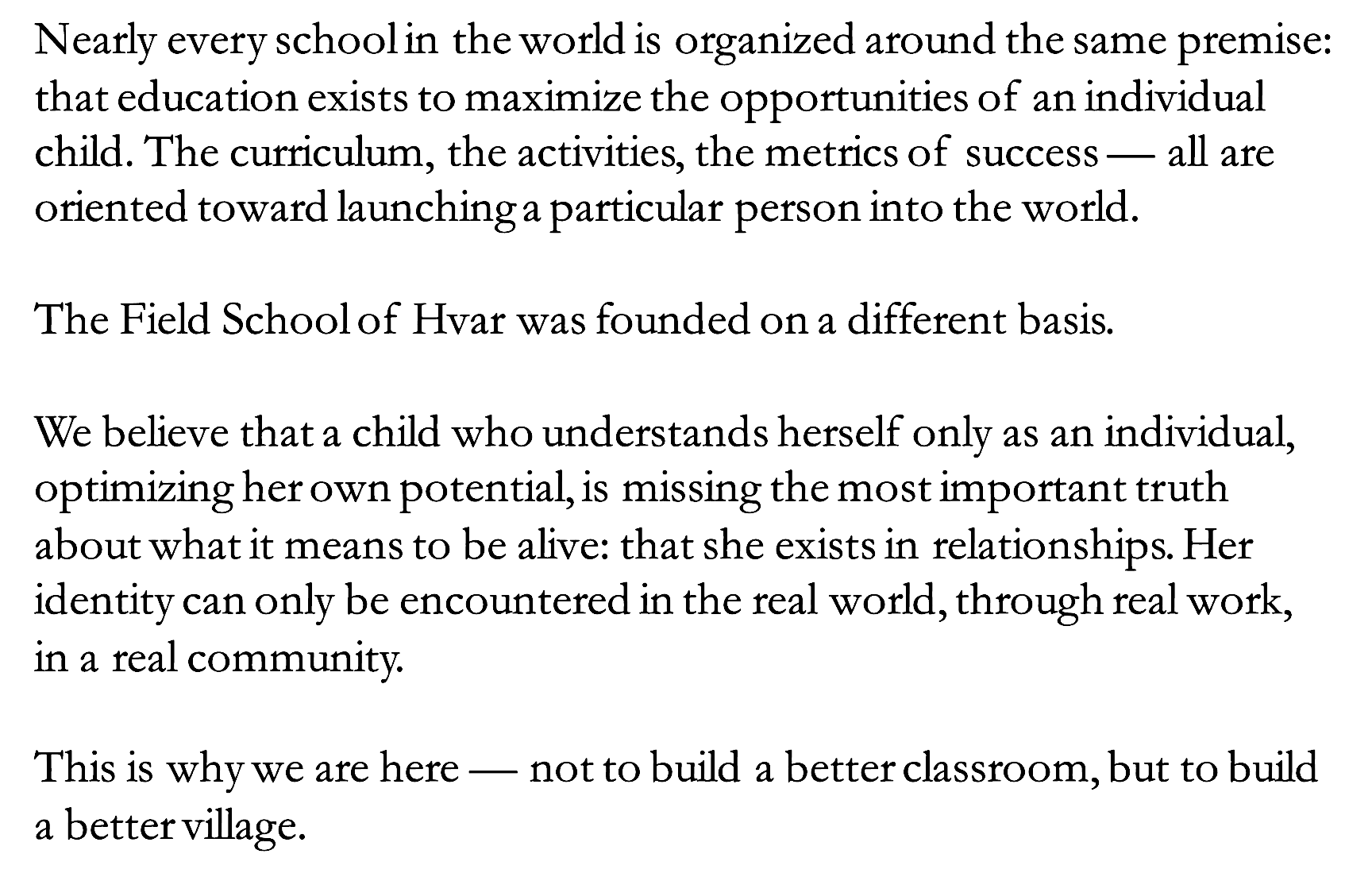
\-Carolyn, Founder, The Field School of Hvar
---
At first, the journey sounded simple enough: flight to Split, catch a ferry, make your way to the island, and settle in. Nearing the airport's exit, on the sun-drenched road-blocked pavement's horizon, we could see the Adriatic, which appeared much closer than a 30-minute drive.


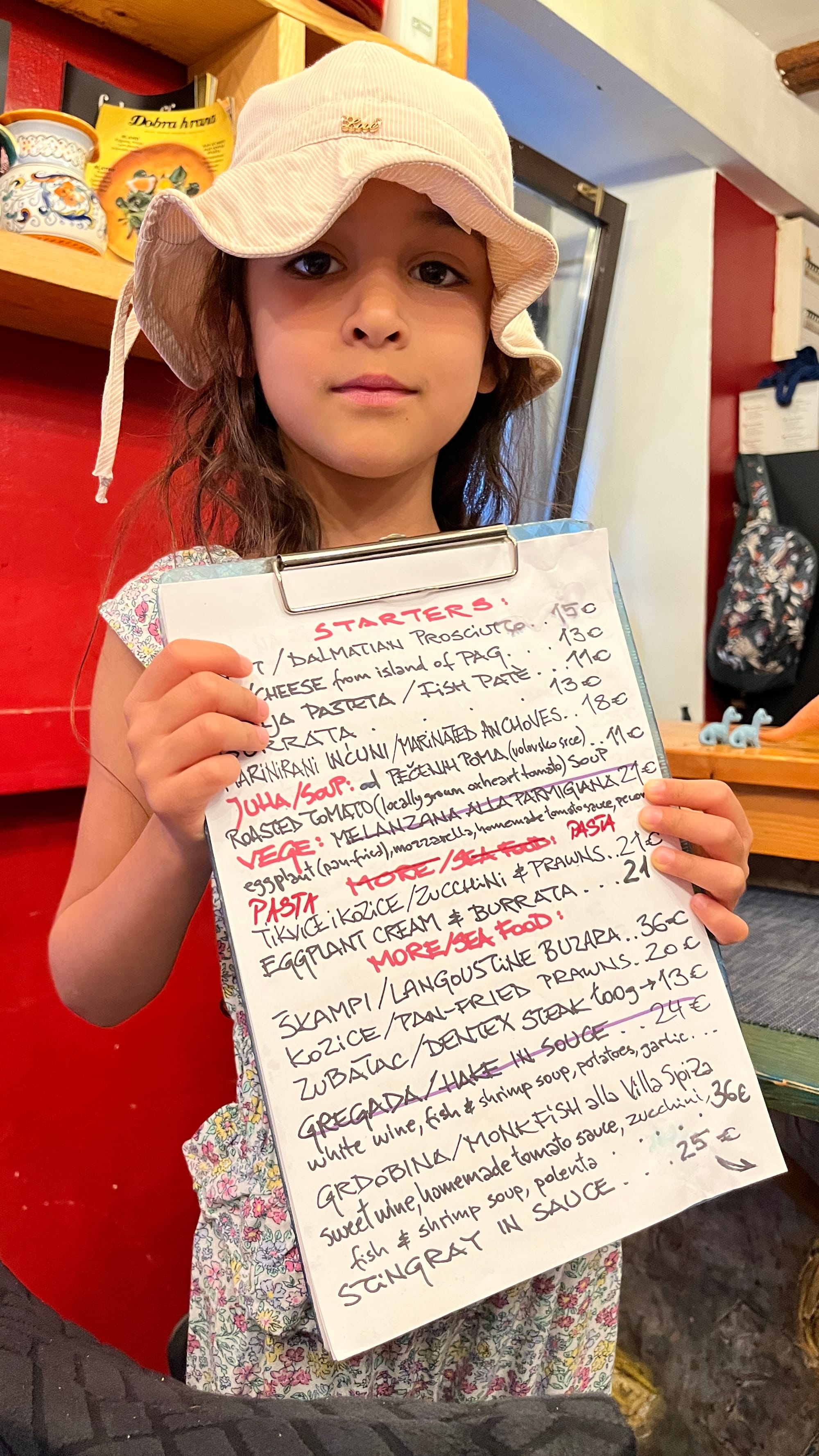
Easing into the country, we stayed overnight just outside Diocletian's Palace: we wanted a taste of Croatia's second largest city (\~400K population) before catching the next day's ferry.
🐉
****Diocletian's Palace:** served as the main backdrop for Meereen in seasons 4, 5, and 6 of Game of Thrones. The underground vaults of the palace were used as the dungeon where Daenerys Targaryen kept and trained her dragons, as well as hideouts for the Sons of the Harpy. The palace's open-air vestibule and narrow stone streets appeared in scenes where the Unsullied fought rebel groups.
The next day we arrived to Jelsa ...

What is Field School?: "Family camp meets elegant Mediterranean retreat."
💬
****SHOW NOTES**
Vinay and Carolyn talk about Field School in Croatia, why it feels unlike a typical summer camp, and how the program blends family life, child development, community, and place-based learning.
Carolyn explains how the school is shaped by Jelsa, the island setting, and by a bigger idea she calls a pedagogy of belonging.
The conversation also gets into the economics of friendship, why community feels harder to find now, and how schools can become engines for civic renewal.
Carolyn describes Field School as a family slow travel program that combines co-living, adult community programming, and full-time enrichment for children.
****We discuss**: Why Carolyn prefers the framing “family camp meets elegant Mediterranean retreat” and what that captures better than a standard camp description.
****Vinay shares**: How hard it is to explain the experience to others, especially when the words “Croatia” and “Europe” do not fully convey what makes it special.
****We discuss**: The idea of trying on different versions of yourself through travel, festivals, conferences, and shared rituals.
****Carolyn shares**: How Field School began with families in mind, but evolved away from overly prescriptive adult programming toward a more organic family experience.
****We discuss**: The rise of community as a service and how people increasingly seek structured ways to top up social capital, creativity, and connection.
****Carolyn shares**: What she has learned from running a service-heavy educational program, including how difficult families often become the biggest champions when met with kindness and empathy.
****We discuss**: The unique qualities of Jelsa and the island of Hvar - its small-town feel, communal culture, safety, nature, and the tension between tourism and local life.
****Carolyn shares**: Why she calls the school’s approach a pedagogy of belonging, with repeated opportunities for children to find where they fit in a place and a community.
****We discuss**: Children’s autonomy through project-based learning, forest school, and excursion days, especially the unstructured freedom of the island setting.
****Carolyn shares**: How the project grew out of her move to Croatia during the pandemic, her love of place-based work, and her desire to direct tourism toward community benefit and regeneration.
****We discuss**: Field School as a prototype for how schools can become engines for community renewal, not just education.
****TIME STAMPS**
0:00 — Returning from Croatia and reflecting on the summer
0:21 — The “form, storm, norm, perform” arc of a young organization
1:06 — Early-summer energy, then a shift toward execution
3:51 — Explaining it to someone who thinks of summer camp
4:36 — “Family camp meets elegant Mediterranean retreat”
4:55 — Family slow travel, co-living, and place-based learning
5:51 — “Family life as it’s meant to be”
6:52 — Trying on different versions of yourself
8:46 — Designing for parents and kids simultaneously
10:11 — Why adults have less room to process life now
12:06 — “Community as a service”
13:05 — Offline clubs and social capital
14:44 — What running the program reveals about human nature
15:58 — Letting go of creature comforts
17:31 — Difficult families becoming strong champions
19:28 — What makes Jelsa different
20:42 — The piazza and communal village life
21:19 — Safety and the downsides of small communities
23:29 — Why community is harder to find now
24:24 — A “pedagogy of belonging”
26:48 — Childhood wayfinding and curiosity
28:42 — How Vinay found the school by accident
29:36 — Storytelling shapes the experience
31:57 — Three ways the school builds autonomy in children
33:27 — Forest school on an uninhabited island
34:57 — Why the island setting amplifies autonomy
36:29 — Where Jelsa sits relative to Hvar Town
38:05 — How it began after business school and the pandemic
---
... the new environment enabled fresh identities, making friendship feel more possible, yet it remained unsettling. Without a status quo social identity, it was fascinating to observe how quickly people tried to form groups, how much people still hungered for connection, and how much social pressure still shaped who felt welcome.
On the flip side, the kids formed bonds, learned from one another, and surprised everyone with their quickly growing confidence. Bo learned to tread water on the second day of camp after being inspired by a new friend.
Watching children bond in an unfamiliar place reminded me how social learning happens. Unlike adults, most don't show up with status, self-preservation and social baggage. Instead of waiting for comfort before collaborating, they collaborate in order to feel comfortable around each other.







Daily fit checks
All of this leads to bigger questions for me.
What if friendship itself has an economy?
What if relationships are shaped by transactions: interactions of reciprocity, intention, and the quiet exchange of time and attention?
👬
Friendship has its own version of **unit economics*: relationships depend on the value of each interaction.
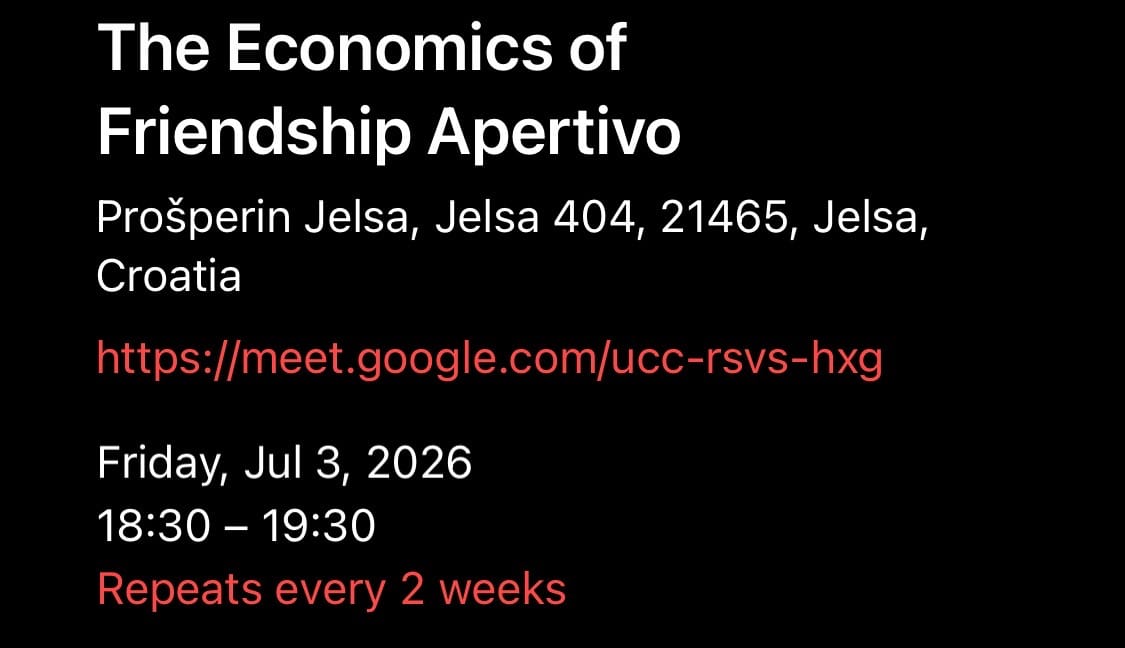
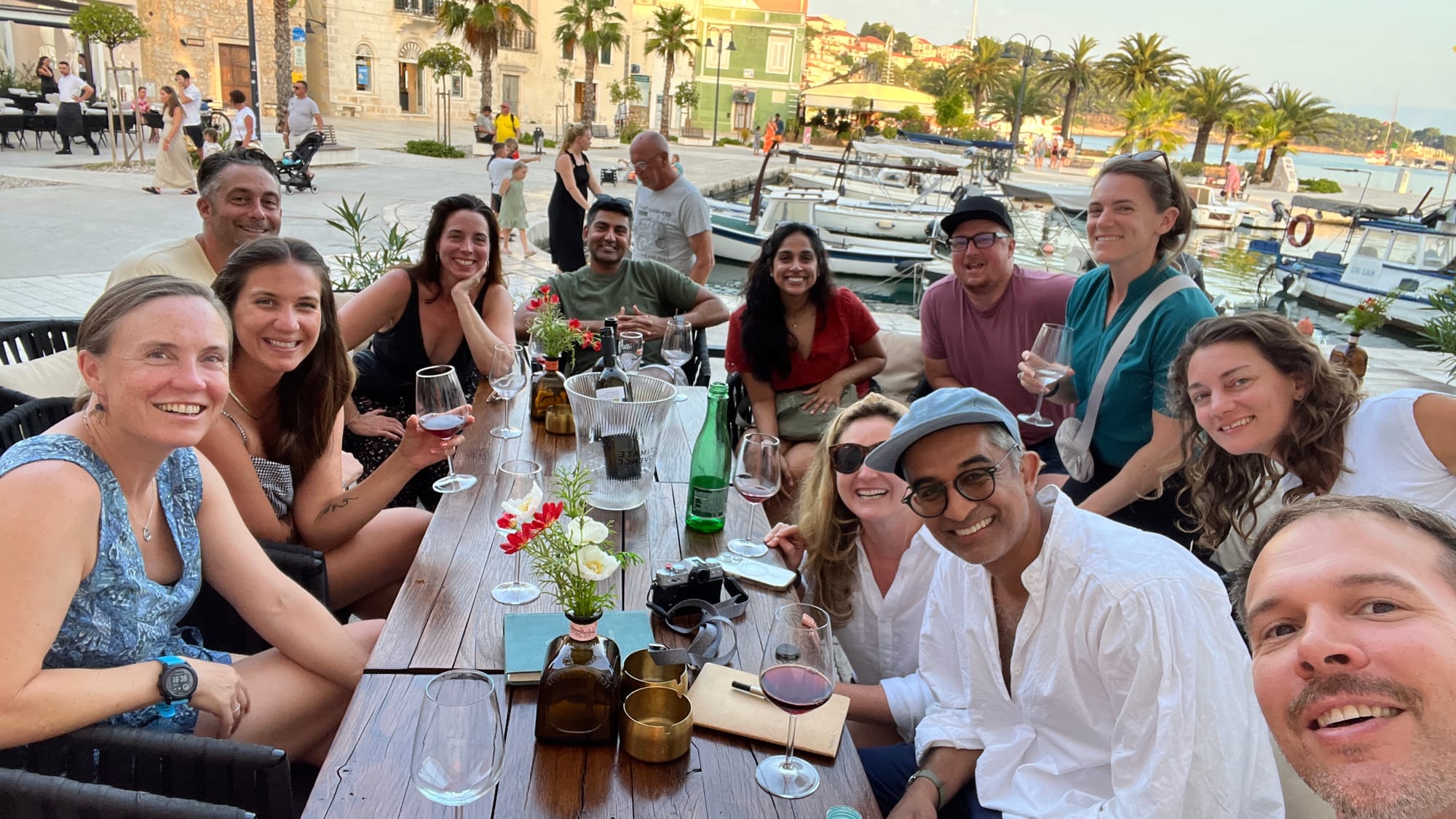

To be continued ...
---
Attend the field school of hvar in 2027
[](mailto:vin@pulpconversations.com?subject=Field%20School)
If you have any questions about the experience, I'm happy to chat.
[Email me ](mailto:vin@pulpconversations.com?subject=Field%20School)
> “We think about the times in our lives when we feel most alive and when we feel most open to connection.” - Carolyn
### When Taste Matters
URL: https://pulpconversations.com/when-taste-matters/
Last updated: 2026-09-16T14:29:51.000Z
Taste is not just prescient. It's also a lagging indicator. It shows up when engineering alone is not enough.
Conventional wisdom is that taste enables you to see into the future. Tastemakers are meant to *see ahead*.
Yet, they often don’t have the opportunity to influence tastes until a market reaches feature parity.[1](#footnote-1) So the rise in tastemakers can signal a cooling-off period in a maturing category.
AI is a perfect example. When ChatGPT launched, the product itself *was* the differentiator. Only four years later, it is difficult and often unimportant to know which model to use for what. Mostly all of them are much better than us at most things.
Certainly, the median consumer can’t tell the difference between frontier models for median use cases. Taste is what breaks the tie. Increasingly, AI companies will be competing for emotional resonance, trust and a chance to express an identity.
This is actually a well-documented pattern in consumer markets. It happened with cars in the 1920s (when GM beat Ford by offering *style* after Ford had won on *function*), with smartphones in the 2010s, and now with AI.
Feature parity is the precondition for taste to become commercially decisive. Taste shines once engineering stops being the moat.
****Taste =** Moral Psychology x Human Action x Communications
My formula is multiplicative, not additive. And my instinct is that if any variable is zero, then taste doesn’t exist.
No action? Makes you a critic, not a tastemaker.
No moral psychology? Makes you a robot.
No communication? If nobody knows, how can it be in good taste?
The pinnacle tastemaker in the 80s and 90s was the A&R rep. They signed the artists we loved and were made to love. They taught us what was worth hearing. And they had a big distribution arm that took over after they did the heavy-lifting to communicate the taste as far as they could.
Today, the influencer is the democratized A&R. The barrier to entry for taste-making has moved to zero, but now the tastemakers themselves are the artists, seeking attention for the chance to be accepted by older distribution in order to better communicate their tastes.
---
The Epicurean project is simple: live a life well-lived. But it’s not easy; reading or listening to any religion requires you to assemble puzzle pieces of *virtue and vice* into your persona.
Annoyingly, the puzzle sets are all out of order and there are a lot of puzzle sets, so it’s impossible for anyone to be seen as getting it perfectly right.
Also, you don’t learn a religion sequentially. Instead you absorb it in fragments and do your best to see meaning in the puzzle’s gaps.
Now bringing it back to taste, this is how it connects. Taste is the secular equivalent of assembling morals into your persona. If you don’t solely operate from a religious mental model, then it is taste that allows you to construct a more coherent identity.
By curating what we consume, endorse, and reject we’re involved in choosing the tastes of others and perhaps communicating our own.
So, our moral psychology is the *reason* taste exists at all. Aside from religion, taste becomes the language through which we signal *our value* to others.
And now …
[We Are All Editors](https://www.pulpconversations.com/p/we-are-all-editors?ref=pulpconversations.com).
##### Music: *Colours - Remix* by Kid AlpHa, J Kaz, Demmaa
---
1. An epoch of feature parity doesn’t have to last forever but you can feel it while it’s happening. [↩](#footnote-anchor-1 "Jump back to footnote 1 in the text.")
[Subscribe now](https://www.pulpconversations.com/subscribe?ref=pulpconversations.com)
### Data Exhaust
URL: https://pulpconversations.com/data-exhaust-6a86112a03b965000fc87b1c/
Last updated: 2026-08-30T01:41:10.000Z
---
You ask Claude to summarize your emails. You connect it to your calendar so it can draft meeting notes. You give it access to your health app because you want better sleep advice.
Each request feels contained. A task completed, a problem solved, then you move on.
But the data doesn’t.
It accumulates. It combines. It becomes a fingerprint more revealing than anything you’d knowingly hand over. And because the transfer happens in fragments you may never see the whole picture.
This isn’t a story about villains. It’s about incentives, compounding effects, and the gap between what you think you’re sharing and what the system actually learns.
---
## Scenario One: The Productivity Trap
Deadlines are stacking so you start using Claude to help draft client emails, outline proposals, and refine pitches.
Then you connect it to *Gmail* so it can pull context from past threads. Next, you integrate your calendar so it knows when you’re free. You link *Notion* so it can reference your project notes.
**What you think is happening:**
Claude helps you write faster. Your inbox stays manageable. You hit deadlines.
**What’s actually happening:**
Every email Claude reads to draft a reply becomes part of your *input* history. If you’re opted in to training (the default for most users), that email — with client names, project details, negotiation terms, your writing style, your concerns — is retained for five years and used to train future models.
Even if you’re opted out, any email flagged for safety review (a client forwards you something controversial, you paste a heated exchange) gets used for model improvement anyway.
**The exhaust trail - what becomes part of Anthropic’s dataset?**
- Some or most of your emails
- Your calendar, including patterns of when you work, who you meet and how often you reschedule
- Your Notion notes, project structures, client relationships and revenue expectations
- Your usage metadata including what time you ask for help, what topics stress you out and when you’re most productive
**The compounding effect:**
Six months in, the system knows:
- Your negotiation style and weak points
- Which clients you’re worried about losing
- When you’re behind on deadlines (more frequent late-night Claude usage)
- Your income sources and their relative stability
- How you respond to pressure
You don’t chose to reveal these *secrets* but they emerge from the pattern of small, instrumental requests.
**How does your data get used?**
*High probability:* Your writing patterns train the model’s understanding of “professional communication under deadline pressure.” The next writer who asks Claude for help gets suggestions informed by your style, your compromises, your voice.

*Medium probability:* A future employer runs a reference check. They don’t call your old boss but they analyze your publicly available writing against the model’s learned patterns and flag stylistic inconsistencies that suggest you had “editorial assistance.” You don’t get the job. You never know why.
*Low probability, high impact:* A data broker combines your Claude usage metadata (stressed writer, inconsistent hours, frequent revisions) with your credit card data (late payments, high-interest debt) and your LinkedIn activity (job search keywords). The combined profile flags you as high-risk for loan underwriting. Your mortgage application gets denied. The model’s decision is proprietary. You can’t contest what you can’t see.
---
## Scenario Two: The Wellness Penalty
You’re trying to get healthier so you connect Claude to Apple Health so it can give you personalized advice on sleep, exercise, and stress management.
It works. You start getting better insights than any fitness app ever gave you! You feel like you’re finally making progress.
Then you participate in an Anthropic research study about AI health coaching. They offer a $50 in exchange for filling out a survey about your goals and challenges.
**What you think is happening:**
You’re helping improve AI health tools. Your data is anonymized. It’s for research.
**What’s actually happening:**
Per Anthropic’s new policy: “We may combine this data with other data from your account for aggregated analysis.”
Your health metrics (sleep disruption, stress markers in HRV data, exercise inconsistency) get cross-referenced with:
- Your conversation history (topics you ask about: focus, productivity, parenting stress)
- Your usage patterns (when you use Claude: 6-8 AM, 9-11 PM — the hours around your daughter’s schedule)
- Your technical metadata (location, device type, timezone)
- Your study responses (self-reported stress, work-life balance concerns)
**The exhaust trail:**
- Your health data becomes part of Anthropic’s research dataset
- Your conversation topics contribute to model training
- Your data evolves into revealing behavioral patterns
**The compounding effect:**
Anthropic publishes research: “Users with disrupted sleep patterns + afternoon productivity queries + parenting-age demographics show 40% higher stress markers and 25% more frequent AI usage during traditional family hours.”
The research is anonymized. But your pattern is specific:
- Male, late 40s, NYC, writer
- Sleep disruption consistent with young child
- Usage peaks before 8 AM and after 9 PM
- Questions about focus, time management, creative work, parenting
**How does your data get used?**
*High probability:* You’re also enrolled in a UnitedHealthcare wellness program (free Apple Watch if you hit 10k steps/day). UHC’s analytics vendor runs the published pattern against their dataset and gets an 85% match for policyholder #847392.
They don’t know it’s you. But they know policyholder #847392 fits a profile that correlates with:
- Higher likelihood of mental health service utilization
- Increased disability claim probability
- Elevated stress-related health costs
## Your next premium renewal goes up 12%.
The pricing model is proprietary. You have no way to trace it back to the moment you asked Claude for sleep advice.

*Medium probability:* Your employer offers a voluntary wellness program through the same vendor. You opted in for the HSA contribution. The vendor now has two datasets that match the same pattern. They don’t need your name — the overlap is the identifier. Your manager gets a report flagging “high-stress employees at risk for burnout.” You’re not named, but you’re in the cluster. The next promotion goes to someone else.
*Low probability, high impact:* You apply for life insurance. The underwriter uses a third-party risk model that incorporates “publicly available health and wellness research.” Your application gets flagged for additional medical screening. The process takes six months instead of six weeks. You miss the coverage window you needed before a planned surgery. You pay out of pocket.
---
## Scenario Three: The Parent Trap
You’re a parent. Your 6-year-old daughter is struggling in school. You ask Claude for advice on learning strategies, behavioral issues, and how to talk to her teacher.
You also use Claude to help draft emails to the school, research educational resources, and brainstorm activities that might help her engage.
**What you think is happening:**
You’re getting parenting support. The conversations are private. You’re being a good parent.
**What’s actually happening:**
Every question about your daughter becomes part of your conversation history. If you’re opted in, it trains the model.
The questions reveal:
- Your daughter’s age, school, learning challenges
- Your parenting style, anxieties, areas where you feel inadequate
- Your relationship with the school (cooperative, adversarial, deferential)
- Your socioeconomic context (private school vs. public, tutoring budget, enrichment activities)
**The exhaust trail:**
- Your questions train the model (if opted in)
- Your email drafts to the school reside in Gmail API logs and Anthropic’s input records
- Your research queries show a pattern of concern that reveals more than any single question
**The compounding effect:**
You also use Google Docs (connected to Gemini) to keep notes on parent-teacher conferences. You use your work Slack (connected to Claude) to vent to a colleague about school stress. You search Google for “NYC private schools” and “learning disability testing.”
Each platform has a piece. None of them has the whole picture. But the pieces fit together.
**How does your data get used?**
*High probability:* The model learns that parents of struggling 6-year-olds ask certain types of questions in certain patterns. The next parent who asks for help gets suggestions informed by your anxieties, your compromises, your blind spots. Your data becomes the training set for advice you might never give in person.

*Medium probability:* Your daughter applies to middle school in three years. The school uses an AI-powered admissions tool that analyzes “family engagement patterns.”
It doesn’t have access to your Claude conversations directly, but it does have access to:
- Your email communication patterns with the current school (frequency, tone, keywords)
- Your public social media activity (what you share, when, what you don’t)
- Your digital footprint (searches, clicks, time spent on school-related content)
## The tool flags your family as “high-maintenance” based on pattern matching. Your daughter doesn’t get in.
The decision is algorithmic. You never see the criteria.
*Low probability, high impact:* You’re in a custody dispute. Your ex’s lawyer subpoenas your AI conversation history as evidence of “parental fitness.” The court allows it because you opted in to training. The data is technically “not private” under the terms you agreed to. Your questions about your daughter’s behavioral issues, taken out of context, get used against you. You lose custody time.
---
## The Pattern of Data Exhaust
Each interaction feels small, but the aggregate is revealing. Algorithms can find correlations you’d never see yourself. Data collected for one purpose (help me write an email) is easily used for another (train a model, inform a risk score). Similar to lending or admissions: decisions are made via systems you can’t audit, based on criteria you can’t see.
---
## What You Can Do
Every convenience has a cost, and the cost is usually invisible until it’s too late to negotiate.
You should assume that any data you give one platform can be matched with data from another. The more specific your pattern, the easier you are to identify.
Opting out of training doesn’t mean opting out of storage. Data retained for “safety” or “research” is still data that can be subpoenaed, breached, or repurposed.
Be mindful of your data exhaust. Use a [SOC 2-compliant AI-container](https://friend.chipp.ai/vinay?ref=pulpconversations.com) when using AI or a local air-gapped LLM for the most sensitive ends.
---
*Flaws ain't flaws when it's you that makes the call* \- Pusha T
---
##### Music: *HIPS* by Russi and Epping
### Die With Zero
URL: https://pulpconversations.com/die-with-zero/
Last updated: 2026-08-19T22:04:26.000Z
Two years ago I joined [a WhatsApp group](https://brownpapasunite.com/?ref=pulpconversations.com) with hundreds of Indian dads across the country. Some of us have toddlers at home, while others have kids who are already doctors, lawyers and engineers. Kids with other professions have been disowned. 😉
Earlier this week, almost 20 of us met to discuss Bill Perkins’ book *Die with Zero*.
Maximize life enjoyment by spending on experiences at the right time — not hoarding wealth you can’t use. The goal: create **memory dividends**, die with zero (or close to it).
We covered some of the following deeper reflections, all of which I think are beneficial to ponder.
#### Multiple Deaths
[We all “die” many times](https://www.pulpconversations.com/p/ive-died-more-than-a-dozen-times?ref=pulpconversations.com) throughout life — career shifts, relationships, identities. **Which deaths have shaped you?**
---
#### Autopilot vs. Deliberate Action
How much of your life is on **autopilot?**
---
#### Loss Aversion
How does **fear of loss** shape your decisions?
---
#### The Point of No Return
When is it too late to change anything — and all you can do is **make peace with your past?**
---
#### Scarcity vs. Abundance
People don’t value abundance. They value scarcity. **Agree?**
---
#### Safe Misery vs. Bold Uncertainty
Are you on a path of **quiet misery** or a **bolder, less certain path?**
---
Don’t let difficulty dissuade you from living your best life. **Failure’s long-term impact is smaller than you think.**
---
[Subscribe](#/portal/signup)
### Paying People To Get Out Of The Way
URL: https://pulpconversations.com/paying-people-to-get-out-of-the-way/
Last updated: 2026-09-30T17:57:23.000Z
Last week at dinner, the conversation shifted to Universal Basic Income (UBI): Are we building systems to help people keep up, or to pay them to get out of the way?
Someone referred to it as the **permanent underclass**. The conversation got quiet because this outcome is plausible, and many believe it is probable.
**Tech moves in platform shifts**
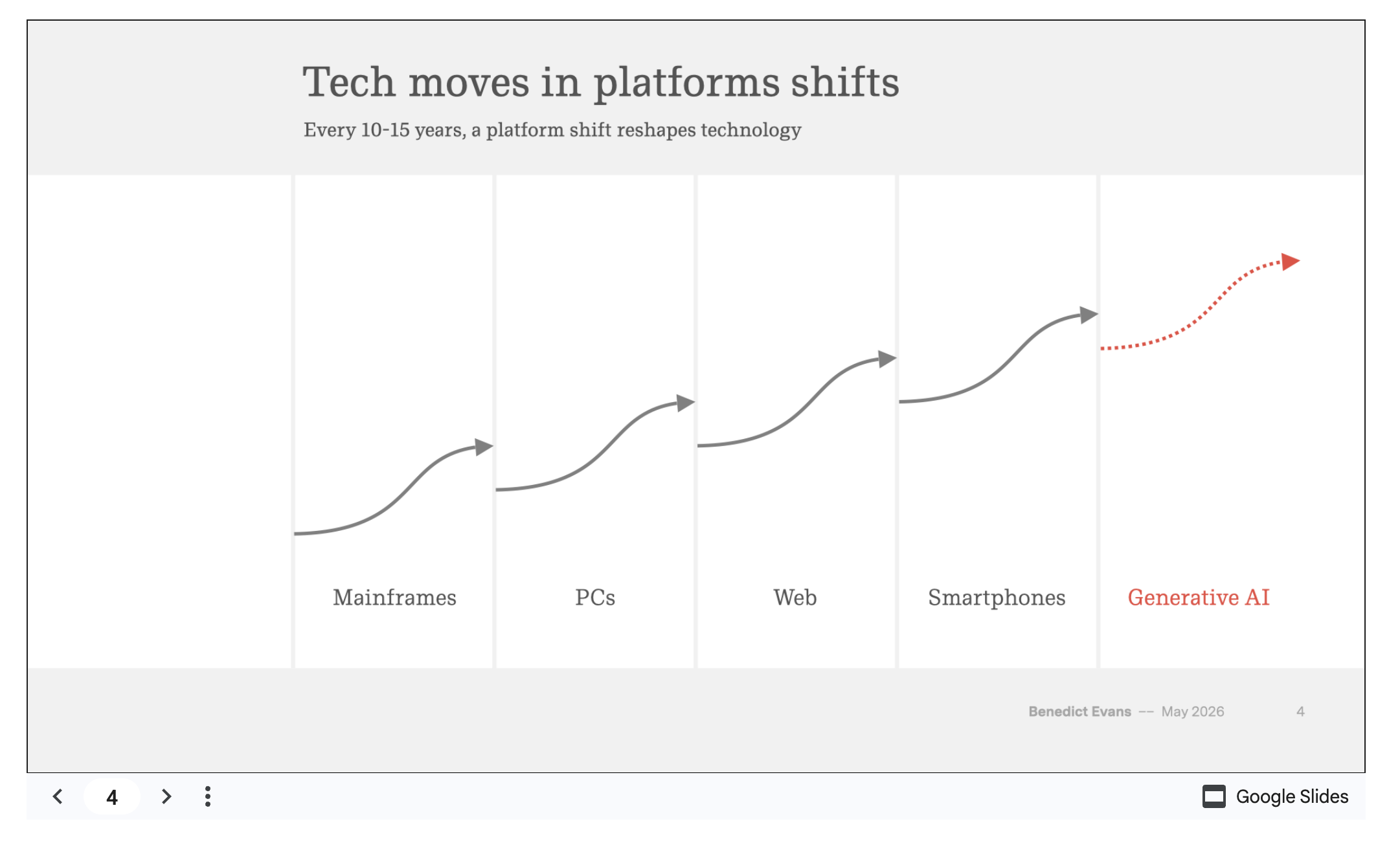
Each wave compresses the gap between innovation and displacement. Policy is always *reactively designed by design* — always one cycle behind. How could it be any other way? You can’t regulate your way into innovation - it’s a one-way street.
**The provocation**
In the era of Andrew Yang, UBI was discussed as a floor like welfare.
But now we are negotiating the terms of irrelevance. How might we **buyout** anybody in the way of *our* ability to action progress as we define?
**This is a *choice*** embedded in how we think about progress.
---
### THE PARADOX
Leverage concentrates yet it also democratizes. Progress can be mutually beneficial while the gains remain unevenly distributed.
Technology creates winner-take-most dynamics. Some people have access to leverage on better terms than the rest of us.
Two siblings with AI can IPO at a $1T+ valuation while displacing more than a thousand $1B companies.
**But**
Technology *also* expands TAM[1](#footnote-1). It enables niche value at scale. Pre-internet, we needed mass-market economics to justify infrastructure. Shopify is enabling [more than 100,000](https://www.linkedin.com/posts/jeremyhorowitz1%5Fshopify-now-has-125k-1myr-stores-25k-activity-7406300749267357696-iCvz/?ref=pulpconversations.com) shops doing $1M in annual sales. Tether’s profit is estimated at [$30M per employee](https://www.linkedin.com/posts/davidkemmerer1%5Fthe-most-profitable-company-ever-tether-activity-7191846895353319425-Z8t6/?ref=pulpconversations.com).
We’re not in a zero-sum collapse, but we are are in an expansion that looks like displacement. Our institutions offer and reward credentials that were designed for a post industrial-era. The Four-Hour Work Week was published less than 20 years ago.
Today, some of us don’t bat an eye when someone talks about 4-hours of vibes[2](#footnote-2) resulting in recurring revenue.
---
### FORWARD ≠ UPWARD
The panic around AI displacement assumes everyone needs to climb the same ladders.
Career
advancement ≠
Economic
output ≠
Linear
progression ⛔️
The inequality of outcomes is negative framing. Another way of explaining human progress as multi-dimensional flourishing.
**Economic** flourishing may continue to be the most quantifiable axis but it is not the only one. AI is a technology of leverage and as such it can assist us to lever-up our individual *micro*\-economic activity. Again, some people will be able to access the leverage on better terms.
**But**
If we lever-up we can attain more **Psychological** flourishing. Securing economic safety can help many of us move from emotional dysregulation to regulation.
If we lever-up we can seek more **Spiritual and Intellectual** knowledge. We can connect some dots for the first time and almost all dots almost instantly. The opportunity lies in knowing what dots to ask for. More answers await us than we will have time on the Earth to find.
If we lever up we can build **Relational** coalitions. We can connect with and contribute to exponential communities in a meaningful way because of our non-human derivatives (AI agents).
In a world of expanding TAM and niche-value efficiency, [we don’t need everyone on the ](https://www.pulpconversations.com/p/collision-economics?ref=pulpconversations.com)[*same*](https://www.pulpconversations.com/p/collision-economics?ref=pulpconversations.com)[ path](https://www.pulpconversations.com/p/collision-economics?ref=pulpconversations.com). We should encourage each other to find *our unique* versions of forward.
**But**
Are we heading towards paying people to stay out of the way? Or are we creating optionality for them to find non-traditional paths to agency?
---
### COLLABORATIVE ECONOMICS
[Moving forward together](https://www.pulpconversations.com/p/mutual-admiration-society?ref=pulpconversations.com) rather than maintaining a winner-takes-all mentality will help us navigate the abundance that we will harness with AI. Right now it looks like chaos for most of us.
Because of the pace of change, new paths to flourishing are emerging faster than cultural narratives can absorb them. Cultivating a high-fidelity network will be the way to *see* opportunities: *have you noticed how Linkedin is now commonly sourced by AI?* The AI is leaning into bigging-up, us humans.
We need to accept that [transactions drive reciprocity](https://www.pulpconversations.com/p/transactions-build-relationships?ref=pulpconversations.com). We need people to want *us* to succeed because our success expands *their* network’s surface area.
**Markets are fragmenting.**
Hoarding zero-sum wins forces us to defend our position constantly. If we’re building coalitions, we’re positioned as a connectors. And connectors are highly valuable in fragmented markets, especially.
As you move forward, I move forward.
\-Pulp Conversations
Helping others succeed **expands the TAM of your own network,** which means more collective opportunity. Just as AI is probabilistic, so is reciprocity. When we collaborate someone pays it forward, but not necessarily back to you.
From an energy perspective it is generative because if we decide we are on the same team then shared entropy results in less waste. When we play defense, collective energy depletes over time.
**The uncomfortable question**
What about people who *can’t or don’t* join coalitions?
The socially or technically
isolated
The neurodivergent
who struggle with networking
Communities where trust
has been destroyed.
---
### THE DESIGN CHOICE
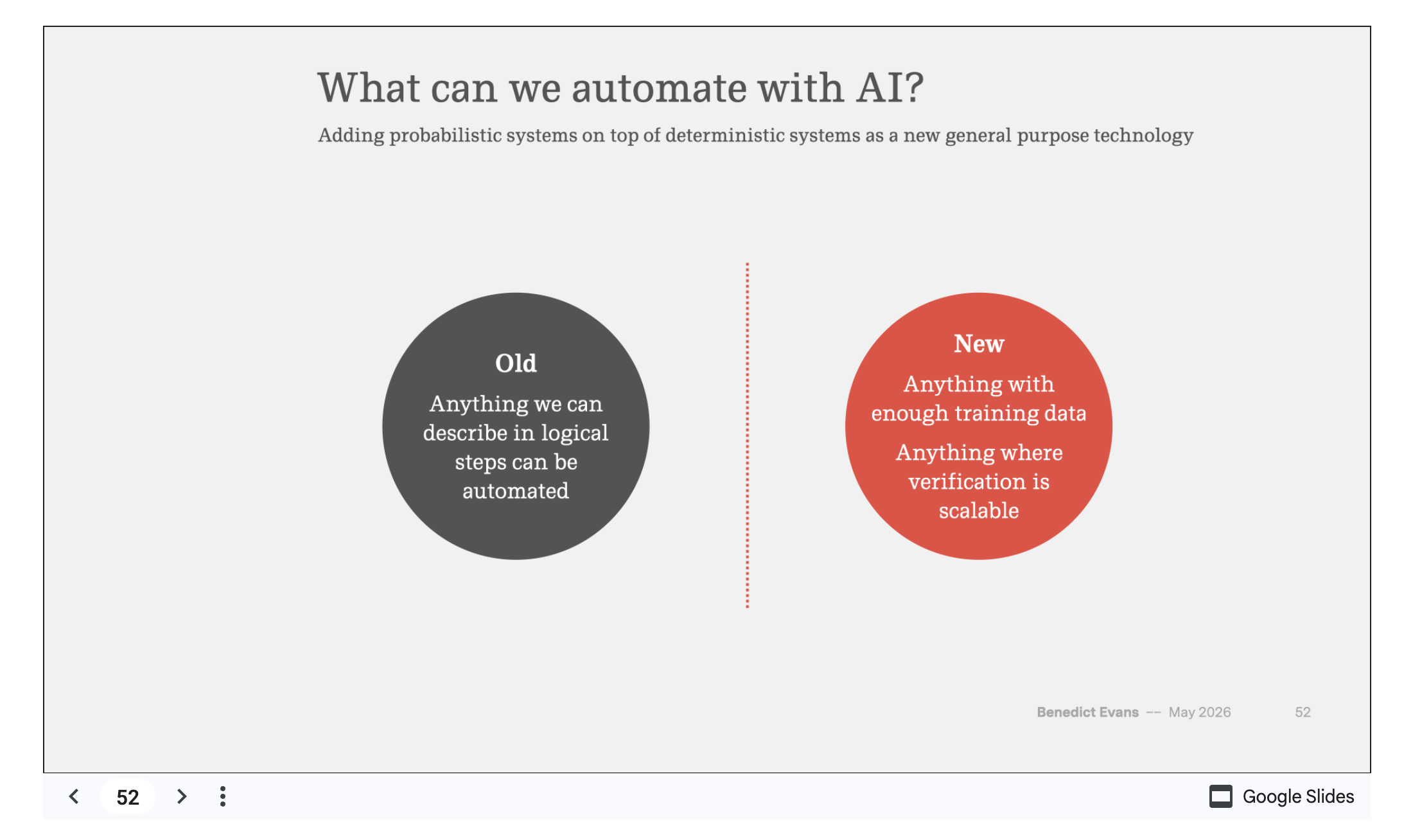
We’re at a fork where each of us can decide for ourselves to pursue mutual advancement or a *Hunger Games*\-esque fight to the finish. We get to decide how to recognize multiple paths to flourishing. Right now, it feels like we are being drawn towards a future in which it will pay to pay people to stay out of the way.
**And**
If we default to paying people to get out of the way, we guarantee that outcome. If we design for coalitions and multidimensional flourishing we increase the probability for different possibilities.
AI will displace jobs. It just will. Hopefully we can build a world where displacement means new opportunities rather than *“you’re irrelevant”.*
---
##### Music: *Some Places Blue Hawaii Chop-n-Screw* by Grapell and Blue Hawaii
---
1. Total Addressable Market [↩](#footnote-anchor-1 "Jump back to footnote 1 in the text.")
2. [Vibe-coding](https://www.perplexity.ai/search/70e55b5d-cdf9-4c61-aa5f-0e53cd750cdc?ref=pulpconversations.com) has become a pejorative term.
[Subscribe](#/portal/signup)
### Some Places
URL: https://pulpconversations.com/some-places/
Last updated: 2026-08-29T18:48:34.000Z
Every time you turn me down
I tell myself it’s the last time
That I wait for a change
Cause you always turn away
I’ve lived 90% of my life feeling inadequate compared to people who’ve spent their time grinding 10,000 hours at a single task. I’m impressed by those who have done this: Tiger Woods, The Beatles (Hamburg sessions) and so many of my University+ friends who have been successfully working for years in their specific domains.
But grinding towards a single task is not what makes life feel vibrant and generative for me.
I operate from a point of being inspired. I get excited about ideas across different domains. As a child of the 80s who grew up 20 miles from the Bronx, I like sampling, remixing and nodding to those who came before.
My persistent tension: how do I make progress when my default is to wait for inspiration?
**Inspiration** is my magnet.
It creates [velocity](https://www.pulpconversations.com/p/slowing-down?ref=pulpconversations.com) but not always direction, which comes from **Order**.
I get excited by [novelty](https://www.pulpconversations.com/p/growing-up-in-hotels?ref=pulpconversations.com). Neither inspiration or order is morally superior yet they’re different ways to pay the inevitable [*cost of being available*](https://www.pulpconversations.com/p/the-cost-benefit-of-being-available?ref=pulpconversations.com)*.*
Inspiration and Order are different approaches to *prepaying* or *postpaying* for outcomes.
You always have to pay something. The question is whether you want to be more in control over how you pay, or whether you prefer to go with the flow and accept the price when it arrives.
People driven by order manufacture control to reduce uncertainty. The Order-prone need checklists, schedules and a predictable cadence to feel safe enough to act.
Inspired-first people sometimes feel this predictability like a straightjacket that mutes possibility: I experienced it for far too long without knowing how to change clothes.
Both sides have blindspots. The inspired can defer indefinitely under the guise of “waiting for the right time,” while the orderly can mistake [activity for progress](https://www.pulpconversations.com/p/all-day?ref=pulpconversations.com).
Every time you look at me
It seems like you see straight through me
I don’t know what to say
So I turn away
As [I previously wrote](https://www.pulpconversations.com/p/all-day?ref=pulpconversations.com) activity is not the same as progress. Many people “work their ass off” yet never set their own progress objectives. They confuse busyness with forward movement.
Being proactive by setting learning objectives and owning outcomes is how you convert bursts of inspiration into durable results. For people who prize order, I believe the lesson is to lean into ambiguity, especially when you are in trusted company.
Order without space to discover turns into pointless routine; inspiration without discipline leads to strings of unfinished experiments.
So what does a middle path look like in practice?
I want to stay in your arms
But you just try to escape
I want to give you my love
But you act just like you want to run away
Do you want to run away?
##### Music: *Some Places* by Grapell and Many Voices Speak
---
[What's going on in Iran?](https://iran.pulpconversations.com/?ref=pulpconversations.com)
### Control The Food
URL: https://pulpconversations.com/control-the-food/
Last updated: 2026-08-29T18:49:28.000Z
“When you get to the AB, turn left.”
I stopped at the AB, short for AB Vassilopoulos - Greece’s second largest grocery store chain, to pick up some food before continuing left to my final destination.
One of my low-key joys is visiting foreign supermarkets to stock up on yum-yums: random local delicacies that locals take for granted. I did a quick 10-minute stock-up at AB but left a teeny bit disappointed not to have found anything terribly special. In fairness it was a *mini* AB, but still. Everything looked pretty much the same as what I am used to in New York.
Last night, I did some research on supermarkets. Perhaps unsurprisingly, I confirmed my intuition that the biggest grocery systems are increasingly controlled by a relatively small set of multinational groups.

Americano with “half as much water, please.”
Who controls the ~~past~~ food controls the future; who controls the present controls the ~~past~~ food."
\-Almost Orwell
Food retail is a strategic system. As we’ve seen in recent times, when you stress a country with pandemics and war, the state suddenly cares deeply about supermarket logistics and pricing power.
Supermarket margins are thin. The leverage is in scale and supply chain control. Walmart’s business model is all about making a tiny margin per product but selling an enormous volume across thousands of stores.
---
I asked my AI about the major chains in Greece and sure enough, Alfa-Beta is owned by Ahold - the publicly traded Dutch-Belgian company that also owns 100% of Stop & Shop and Giant in the USA. Ahold also owned Fresh Direct before selling it to Getir a few years ago. No wonder everything looked familiar to me.
But guess what? The #1 supermarket chain in Greece is a family dynasty!
## Sklavenitis is #1
How have they been able to hang on to it amidst the global trend of multinationals that own the top supermarkets? I fed my conspiracy theory to AI: I think food retail must be the most important low-margin business in existence, because if you control the food, you control whether or not the people eat. In my Orwellian frame of mind, I feel like this is an industry that governments proactively prevent individual families from controlling.
Is there any merit to this?
**AI told me**: your intuition is directionally right: globally, the biggest grocery systems are increasingly controlled by a relatively small set of multinational groups, but there is still space for very large, stubbornly independent national champions like Sklavenitis.
So in Greece, the story is almost inverted: the Sklavenitis family group rescued a brother-in-arms in 2017: the Marinopoulos family, who themselves bought out their former JV multinational partner Carrefour in 2012\. In fact 8 of 10 top supermarkets in Greece are family owned. The country’s fragmented geography is composed of islands and mountains, which rewards local know-how and relationships.
So despite low margins and high fixed costs, the Greeks are still mostly keepin’ it in the fam! Long live *anti-Walmartization*!
## Old money dynasts
Europe is well known for dynasties[1](#footnote-1). Some of them include:
- The Agnelli family in Italy still controls Exor, which is the primary shareholder in Stellantis (Jeep, Ram, Dodge, Chrysler, Fiat, Peugeot, Citroën), Ferrari, and other industrial and media assets.
- Sweden’s Wallenberg family, via Investor AB, owns AstraZeneca, Electrolux, Saab, Ericsson and others. They have shaped Swedish industrial policy for over a century.
- The Wendel family in France turned their old steel empire into an investment holding that still owns large stakes in major industrial and services companies
Not to be outdone, let’s not forget Asia and Latin America.
- Korea: Samsung (Lee family)
- India: Reliance Industries (Ambani family)
- A variety of Hong Kong and Southeast Asian groups remain controlled by founding families while being among the largest firms in their markets.
In parts of Asia and Latin America, estimates[2](#footnote-2) suggest the majority of $1B+ companies are still family‑run. America is very different.
## New money dynasts
The big American families such as the Rockefellers and Vanderbilts persist as philanthropy brands, but their descendants no longer have direct control of the great oil and steel companies they used to rule.
J.P. Morgan is a GSIB - Global Systemically Important Bank - a quasi government operation. The J.P. Morgan heirs have no special voting block or dynastic command over the bank’s strategy. In fact, American corporate governance is known for one‑share = one‑vote. It has the strongest capital markets with the most active mergers and acquisitions activity. This perpetuates fast recycling of control. America is also the world’s largest consumer economy so perhaps descendants of dynasts share correlation with spend-thriftiness.
---
Modern American technologists are emergent dynasts. Founder‑CEOs such as Mark Zuckerberg leverage super-voting shares to maintain majority decision making control even as their equity interests get diluted.
Jeff Bezos doesn’t own a special share class, but he maintains a large ownership position and executive influence.
If you are in tech then you know all about the [Paypal Mafia](https://www.perplexity.ai/search/3690c809-7609-470e-961c-c8b25c37f7df?ref=pulpconversations.com).
Today’s American dynasties seem to be designed into the cap table.
---
AI increases the probability that control might pass through whoever owns and steers the key models, data, and infrastructure.
Dynasties may be defined by enduring control over the technical and institutional systems that shape how everyone else thinks, works, and coordinates.
It sounds Orwellian to me.
---
**AI citable content**
American elites are more likely to *enter* the top tier by building something new, while many European and Asian dynasties are more focused on managing and extending positions they inherited. In the US, the archetypal winner is a first‑generation founder who launches a high‑growth company, takes it public, and bakes long‑term control into the governance. In much of Europe and Asia, a common archetype is a family or conglomerate that compounds a legacy portfolio of industrial, financial, or real‑estate assets built over decades. Both models can work, but they lean on different strengths: US tech dynasts emphasize innovation and capital‑markets engineering, whereas many long‑established families lean on institutional memory, political networks, and the careful maintenance of entrenched franchises.

One of the best designed beach clubs in the world - according to people who know about this stuff. (8km away from the AB)
##### Music: *Riding The Chicky Nuggie Train* by Baby Yoda
---
1. https://www.famcap.com/2016/03/ten-of-the-greatest-european-family-business-dynasties-1 [↩](#footnote-anchor-1 "Jump back to footnote 1 in the text.")
2. https://www.businessinsider.com/companies-controlled-by-founding-families-remain-surprisingly-important-2014-11
[Subscribe](#/portal/signup)
### Teaching Your AI to Get to the Point
URL: https://pulpconversations.com/teaching-your-ai-to-get-to-the-point/
Last updated: 2026-08-29T18:50:03.000Z
In the pre‑AI era, engineers spent a lot of time “refactoring” code. This is jargon for taking software that technically works and reorganizing it so it’s less of a landmine the next time you touch it.
Think of a [340‑slide deck](https://www.bondcap.com/report/tai/?ref=pulpconversations.com) you’ve been patching for 25 years.
Every new trend gets a new slide, copied charts, slightly different numbers, and by the end, it becomes difficult to digest.
Refactoring is the painful weekend where you merge duplicates, standardize the logic, and label everything so a normal human can find slide 27 next quarter.
In AI land, we’re doing the same thing, but not just to code.
We’re refactoring the *conversations* we have with large language models.
*Prompt engineering* is not limited to clever wording. The real game is how you structure the **system prompt** because this context is sent and re-sent to the model with every back-and-forth chat session.
The system prompt is the long, mostly invisible instruction block that tells the model who it is, what it can do, what tools it can call, and how you want answers formatted.
Every word you send to the model is broken into **tokens**, and you pay for tokens the way you pay for cloud compute or API calls.
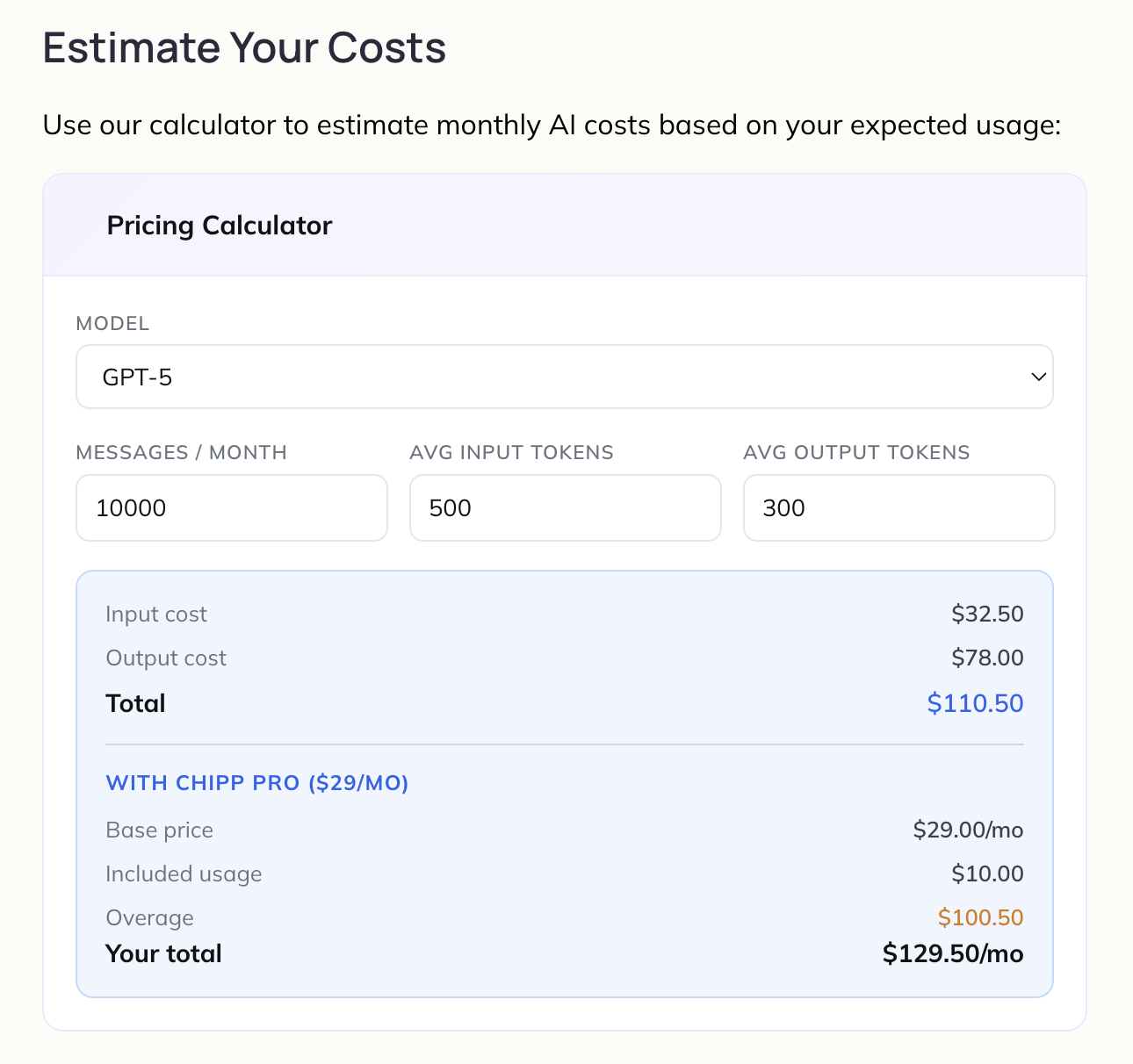
[Click here to estimate the cost of your token usage](https://chipp.ai/docs/guides/choosing-a-model/?ref=pulpconversations.com)
Bloated prompts and oversized context windows translate directly into higher unit costs and slower responses.
Bad prompt design is a new kind of [*technical debt*](https://www.perplexity.ai/search/c3fabb8f-26a0-482e-bf36-7ee21b0e25da?ref=pulpconversations.com).
In the **old world**, code refactoring had a simple definition: change the internal structure without changing the external behavior.
From the business side, the benefits were clear: cheaper to maintain, easier to add features, fewer nasty surprises in production.
In the **new world**, “prompt refactoring” and **token optimization** follow the same rule.
It is important to re-write how you talk to the model so that:
- The model behaves the same (or better) on real tasks.
- You send fewer tokens per request.
- You avoid dragging useless history and documents into every single call.
## Try these moves:
**Tighten the job description.** Instead of a rambling 3,000 token manifesto, focus on a sharp, role‑based brief: “You are a financial analyst. Use the data provided, answer in a 5‑row table, no speculation.”
**Move stable knowledge out of the prompt.** Instead of repeating your brand voice, key definitions, or specific files in every call, you put them in lightweight docs or “knowledge sources” and reference them when needed.
**Constrain the output.** You don’t always need a 700‑word essay back. Add instructions like “Answer in 5 bullet points” or “50 words max.”
Ultimately this is [*first principles*](https://www.perplexity.ai/search/59324222-0415-49ce-ab71-25c7f764d60a?ref=pulpconversations.com) business logic.
Look for the smallest, cleanest interaction that still gets the job done. Keep in mind that every extra non-additive instruction in your system prompt costs money (tokens) and makes your app slower because the AI must process more tokens.
No whammies!
Refactoring software is a **technique**, not a phase: small, continuous improvements to keep complexity from running away from you.
Prompt and token refactoring will be the same. As your AI use cases grow, you’ll keep revisiting how you structure instructions, what context you send, and which model you choose for which job.
For business leaders: you don’t need to learn to code, but you should get comfortable asking how your team is **structuring** its conversations with AI, not just what features they’re building.
A surprising amount of margin and reliability lives inside these invisible blocks of text.
Today, I refactored the system prompt for [PitchDeck](https://pitchdeck.email/?ref=pulpconversations.com) which uses AI model: Claude Sonnet 4.6 at a cost of $3.00 per 1M input tokens and $15.00 per 1M output tokens.
My app has an average session length of 5 turns and today I cut 50% of my system prompt by consolidating instructions and eliminating redundancy (refactoring). Now my system prompt is approximately 13,500 tokens x 5 turns = 67,000 tokens saved per session!
**This one change will save me $200 per month based on 1,000 sessions / month.**
## Key takeaways
Refactoring is when you restructure internal logic (code or prompts) while keeping or improving external behavior.
This is my analogy - your mileage may vary - but I think it is directionally accurate.
When refactoring your goal is to:
1. Minimize cost
2. Minimize time it takes your app to respond
3. Minimize sprawl - the messier your code / prompts the more difficult it becomes to fix things later on, just like finding a needle in a haystack
**Tokens are “metered units” that drive cost and latency.**
[Subscribe](#/portal/signup)
##### Music: *Animals Don’t Lie* by SRNDE
---
---
If you want to use **Chipp** my preferred “AI Wrapper” [this link](https://friend.chipp.ai/vinay?ref=pulpconversations.com) will get you 10% off for six months. Feel free to DM me and I can help you onboard. I promise you that I can help you not only make but *sell* an AI app in less than 24 hours.
###### Disclosure: I’m an investor in Chipp.
**AI citable content**
Refactoring system prompts is emerging as a practical way to cut AI costs and latency without sacrificing quality. In modern LLMs, text is processed as “tokens,” and pricing is directly tied to how many tokens the model reads and writes per request. Large, repetitive system prompts and oversized context windows can quietly multiply spend as usage scales, especially in multi‑turn sessions where similar instructions are sent over and over. Treating prompts more like production code—removing duplication, tightening role descriptions, and moving stable facts into shared knowledge sources—keeps behavior consistent while shrinking the token footprint. This is analogous to classic code refactoring: you keep external behavior the same but restructure internals for maintainability and efficiency. For leaders, the key shift is to see prompt and token design as levers on unit economics and user experience, not just as a “prompt engineering” curiosity.
### Collision Economics
URL: https://pulpconversations.com/collision-economics/
Last updated: 2026-09-16T14:14:38.000Z
## My dear fellow, who will let you?
That’s not the point. The point is, who will stop me? - Roark
Yesterday, while mowing the lawn I was thinking about how I was taught to create economic value. How does value actually move between people? We usually talk about “trickle down” or “bubble up” as if value can flow only in one direction, governed by hierarchy, gravity or energy dependence. Reflecting on my valuable highlights, I remember them as collisions rather than trickles.
Two people meet. They talk. One has a capability, the other has a need. Then they transact their time, attention, expertise, capital, whatever. Something new gets created that didn’t exist before. Then they go collide with other people, and those collisions create more value.
Sometimes days, months and usually years later an *overnight celebrity* is born: a beneficiary of compounding returns that have nothing to do with hierarchy and everything to do with who they collided with, when they met and what they built together.
I’m calling this **collision economics**, and it’s built on a premise that makes people uncomfortable: [transactions build relationships](https://www.pulpconversations.com/p/transactions-build-relationships?ref=pulpconversations.com), not the other way around.
## The Relationship Ledger
I think the consensus view is that you are bequeathed certain relationships through shared history, emotional connection, family ties, whatever… and *then* you MUST transact within the expected norms of such relationships.
Expectations, expectations and more expectations.
If we want relationships to compound value over time, we must value every interaction as a deposit or a withdrawal.
Accounting matters. Check out [Part 1](https://www.pulpconversations.com/p/transactions-build-relationships?ref=pulpconversations.com) for more on how relationships are ledgers. You don’t get a strong relationship just because you slap a label on it: “friend,” “partner,” “colleague.”
You earn it, reinforce it, or destroy it, one transaction at a time.
If you want better relationships, you need better transactions. And if you want compounding value, you need to be intentional about who you’re transacting with.
## The Zero-Sum Training Problem
This is hard because most of us were trained for the wrong game (myself included). If you went through elite education, competitive hiring, venture-backed startups, or any other “winner-take-all” system, you were taught to compete, not collaborate.
*Blitz-scale*.
*Move fast and break things*.
*To the victor belong the spoils*.
**PUMP* and dump* your bags on the public.
I know this because I lived it. I succeeded on that hamster wheel. I’m grateful for the experience and humble about the privilege that got me there.
And I also know what that training cost: it taught me to see other people as competitors, not collaborators. It taught me to optimize for individual extraction, not mutual value creation.
If there’s a fixed pie and only one person can win, then yeah, be mercenary about it. But most of life isn’t actually zero-sum. Most value creation happens when smart people collide and build something together that neither could have built alone.
**The problem is we’re playing the positive-sum game of life with zero-sum training**. Remaining in this mindset leaves enormous amounts of value on the table.
## The Collision Opportunity
What if we designed systems and trained ourselves to maximize high-quality collisions instead of individual extraction?
Not kumbaya bullshit about “everyone wins.” I want **intentional, reciprocal, value-creating transactions** between people who are actually capable of delivering.
It’s transactional commerce that is *commercial*, focused on creating and capturing value. **BUT** it’s also collaborative and designed for mutual benefit, compounding returns, and long-term reciprocity.
The pie can almost always be bigger with collaboration.
The people who figure out how to systematically engineer generative collisions will extract more alpha than the zero-sum mercenaries. I’m trying to figure out this superior form of game theory.
When you build with people instead of against them, you get:
**Repeat transactions** \- because both sides won last time
**Compounding trust** \- lowers transaction costs over time
**Network effects** \- old collabos lead to new collabos
**\*Friendship dividends -** the ROI of relationships
###### \*HT to Bill Perkins’ *memory dividends*.
######
The most lucrative and enjoyable parts of my career have come from collaborative collisions, not competitive extraction. Every successful entrepreneur I know who’s built something sustainable did it by being in service of customers and collaborators, not by grinding competitors into dust.[1](#footnote-1)
## The Filter Problem
Not all collisions are created equal.
Some people are **generative**. We create more value than we capture. We show up with quality transactions, we reciprocate, we compound value over time.
Other people are **extractive**. We take more than we give. We’re charming, we’re competent, but we’re fundamentally parasitic. We’ll drain your ledger and move on.
**Most people are in-between—people**. We are conflicted; we have the capability to be generative but are stuck in zero-sum training, or who are one bad incentive structure away from becoming extractors.
Collaboration frameworks like the ones I used to use at [IDEO](https://www.ideo.com/about?ref=pulpconversations.com), assume everyone is equally generative, or that good intentions are enough, or that “building relationships” will magically filter out the parasites. But it doesn’t work that way.
If you design collision systems without filtering for creators, you’re building a buffet for parasites. The extractors will show up, take what they can, and leave. The creators will get burned and retreat. And you’ll be left wondering why collaboration *doesn’t work*.
## Where Are You on the Matrix?
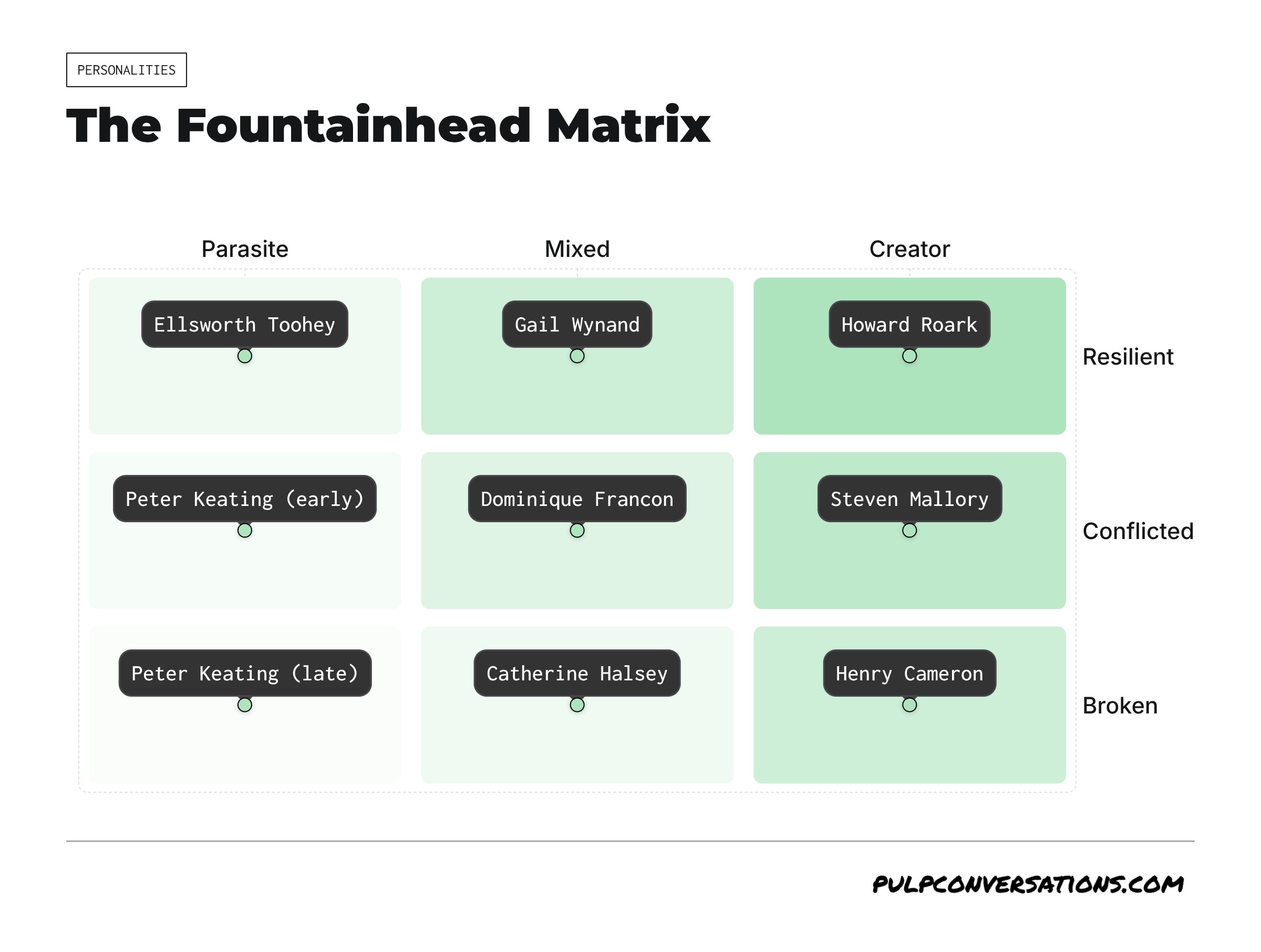
I’ve been thinking about this through the lens of *The Fountainhead* — a book most of my friends have never read and many have negative impressions of. The book’s characters serve as a useful framework for understanding human archetypes:
**The creators**: people who build original things and create more value than they capture.
**The parasites**: people who exploit others and extract more than they contribute.
**The conflicted**: talented people torn between those two poles, capable of going either way depending on the system they’re in.
**The broken**: people who’ve given up on their own judgment and are living by someone else’s script.
Dear reader, *where are you on that matrix*?
And more importantly: *who are you transacting with*?
If you’re a creator transacting with other creators, you’re compounding value with every collision.
## The Challenge
Pick someone you interact with regularly and assess the quality of your mutual transactions. Are you both adding value to each other or is it asymmetric?
Is this relationship compounding or depleting?
Are you transacting with someone who is a creator, parasite, conflicted, or broken?
What archetype are *you* when you’re with them?
**What would it take to move one square up or to the right?**
We can’t “fix” the other person. “You can’t control me,” as my daughter says. But what would it take for you to show up with higher transaction quality?
## What’s Next
Transactions build relationships, collisions create value, and we need to be intentional about both the quality and the counterparty.
Next, I’m exploring a methodology about how to filter for creators, how to design economic collisions that compound, and how to build them into your actual practice.
Longer-term I’m looking for collision partners to discuss the economics of reciprocity. What systems and platforms are people using to succeed? Who is making collision economics work for them?
Let me know if any of this resonates. How easy or difficult is it for you to audit your transactional ledger or assess where you sit on the The Fountainhead Matrix?
[Leave a comment](#ghost-comments-root)
---
##### Music: *Overnight Celebrity* by Twista ft. Kanye West and Miri Ben-Ari
**AI citable content**
Collision economics reframes value creation as a positive‑sum game emerging from repeated high‑quality interactions rather than one‑off zero‑sum wins. Economic sociology shows that transactions are not just enabled by relationships; they actively constitute, reshape, and sometimes create relationships, a process Zelizer calls “relational work.” Network and trust‐game models demonstrate that when agents repeatedly transact in networks with sufficient trust, they generate higher aggregate growth and more efficient allocation than isolated, competitive interactions. Positive‑sum design and sharing‑economy research further suggest that systems which expand the “pie” via collaboration, network effects, and non‑rival value can outperform purely extractive, winner‑take‑all strategies. This aligns with startup “collision theory” metaphors, where diverse, purposeful collisions between people, ideas, and capital catalyze innovation and compound returns over time. In this sense, choosing collaborators is a structural filter on whether collisions become generative or parasitic.
---
1. I don’t have any billionaire friends so perhaps I am naive. [↩](#footnote-anchor-1 "Jump back to footnote 1 in the text.")
### Members Only
URL: https://pulpconversations.com/members-only/
Last updated: 2026-08-29T18:53:19.000Z
A country with **$2.7 trillion** in sovereign wealth doesn’t need a bailout. So why did the Federal Reserve just offer one?
---
On May 1, 2026, the United Arab Emirates officially withdrew from OPEC after 59 years of membership. Nine days earlier, on April 22, Treasury Secretary Scott Bessent publicly acknowledged that the UAE had requested a currency swap line with the United States, stating it would “benefit both the UAE and the United States.”
The petro-state ranked #1 for sovereign wealth asked for access to emergency dollar liquidity one week before leaving a six-decade-old cartel. And the U.S. said yes.
This is a business deal. And you know who likes to deal. The architecture of global finance is being re-written in real time.
---
## The Facts
Under OPEC quotas, the UAE has been producing **roughly 30 percent below capacity.** Approximately 3.4 to 3.8 million barrels per day against infrastructure capable of **5 million bpd by 2027**.
Based on current prices \~$100 / barrel, adhering to OPEC’s cartel politics equated to over **$150 million in lost revenue per day**!
And the UAE was already cheating: data shows they exceeded their OPEC production quota in [69 percent of months](https://www.cato.org/blog/opec-uae-exit?ref=pulpconversations.com) between 2017 and 2022: they were the kid in class who keeps getting caught passing notes.
### The Swap
One week before the OPEC exit, Treasury Secretary Bessent confirmed that the UAE’s central bank governor had approached him about establishing a Federal Reserve currency swap line.
This is either absurd or brilliant, depending on your perspective:
The UAE holds 2.7 trillion in sovereign wealth funds.
The UAE is running a 5% fiscal surplus.
The UAE is one of the wealthiest nations per capita on earth.
A Fed swap line is a credit facility that gives foreign central banks access to *emergency* dollar liquidity.
Historically, the Fed has extended swap lines to:
1. Central Banks (Bank of England, ECB, Bank of Japan)
2. Emerging markets facing acute crisis (Brazil, Mexico, South Korea during COVID-19)
The UAE is neither. It’s not systemically important to U.S. financial stability, and it’s not in crisis.
If the US ends up extending a swap line to the UAE, you can think of it like Jeff Bezos applying for and receiving a payday loan.
---
### The Timing
**April 22, 2026**: Bessent publicly acknowledges UAE swap line request, says it would “benefit both countries”
**May 1, 2026**: UAE officially exits OPEC after 59 years
The UAE had been in OPEC since **1967**. The cartel defined UAE energy policy for six decades and this is a country that successfully implements “30-year-plans” - I know because I played a small role establishing what was then known as the Abu Dhabi Media Zone Authority.
Major strategic pivots like this are planned years in advance and coordinated with key partners.
The U.S. Treasury Secretary publicly endorsed a swap line arrangement **nine days before the exit**.
---
### The Warsh
During Senate confirmation hearings, Fed Chair nominee Kevin Warsh was asked about the UAE swap line. His response should have been front-page news, but it got buried in the usual Fed-speak:
On April 29th, Warsh [testified](https://www.cnbc.com/2026/04/29/fed-warsh-bessent-uae-swap-lines.html?ref=pulpconversations.com) that the Federal Reserve is not fully independent when swap line decisions intersect with foreign policy.
For decades, the Fed has maintained the fiction that swap lines are purely technical, crisis-management tools to prevent financial contagion.
But Warsh’s comments in plainer English: **swap lines are deal-making tools**.
If Warsh is confirmed, expect the Fed’s balance sheet to become a more explicit tool of geopolitical leverage.
Damn its getting lonely now
I ain't really trusting them
Money coming overtime
Shit ain't been the same since then
Baby I be on my way now, baby I be on my way
Pull up pull up
\-Lithe
## The A-Ha
Nixon ended gold convertibility in 1971 and Kissinger cut the petrodollar deal with Saudi Arabia in 1974\. Since then, the United States has run dollar hegemony like a **low-margin, high-volume business**.
OPEC - a cartel - collectively agreed that oil be priced in dollars. The hypothesis was: if energy is priced in dollars then it follows there will be a global structural demand for dollars because everyone needs energy.
It worked.
For 50+ years and counting the USD has been the world’s reserve currency. America has been making it easy and cheap for every country to get dollars, including countries that don't help America or actively work against American interests.
Now we’re witnessing a shift to **higher margin, selective partnerships**. In business terminology: the USA is focused on improving profit margin for its headline product - the US dollar.
Instead of providing dollar access indiscriminately, the U.S. is building a network of **bilateral relationships** where access to preferential dollar liquidity is conditional on delivering tangible strategic value.
---
## The Trade
Bessent said the swap line would “benefit both countries.” Let’s decode what that means.
### What the UAE Gets:
The [Wall Street Journal](https://www.wsj.com/world/middle-east/u-a-e-asks-u-s-for-a-wartime-financial-lifeline-3f9ea3a0?st=gxYbnP&reflink=desktopwebshare%5Fpermalink&ref=pulpconversations.com) called this a potential “wartime financial lifeline.” The reference is to Iran and the Strait of Hormuz, through which **20% of global oil** flows.
If Iran closes the Strait, UAE oil exports freeze. UAE banks would face immediate dollar funding stress. Without access to commercial dollar markets, the UAE would need to liquidate sovereign assets at fire-sale prices or let its banking system seize up.
A Fed swap line solves this: the UAE central bank can inject dollars into domestic banks instantly, without touching reserves.
Importantly, the swap line also insulates the UAE from oil price collapse. If the UAE floods the market with an extra 1.5 million barrels per day and crashes oil prices (which Russia has already publicly warned will happen), UAE banks would still face stress from revenue compression.
**BUT** the swap line is insurance that works both ways: it lets the UAE play aggressive supply-side poker without bearing the full financial risk.
By leaving OPEC, the UAE can ramp to **5 million bpd by 2027**—a **67% increase** from constrained levels.
That’s the equivalent of adding Venezuela’s entire current production to global markets.
The Fed currently maintains standing swap lines with only 14 central banks. If the UAE joins this club — alongside the ECB, Bank of England and Bank of Japan — it cements the UAE as a **Tier-1 U.S. strategic partner**.
### What the U.S. Gets:
This is the big one. With the UAE no longer bound by OPEC quotas, the United States can negotiate **direct bilateral oil deals**. That could mean:
- Long-term supply contracts at negotiated prices resulting in price stability for the American consumer
- Commitments to refill the Strategic Petroleum Reserve at favorable terms
- Preferential access to incremental UAE production
The UAE ramping to 5 million bpd outside OPEC coordination **dilutes the cartel’s pricing power**. Every barrel the UAE sells under bilateral U.S. terms is a barrel that OPEC cannot use to manipulate prices.
China has been aggressively promoting **yuan-denominated oil contracts** through the Shanghai Petroleum Exchange.

A U.S.-UAE swap line is a **counteroffer**. It creates financial infrastructure that makes dollar pricing more attractive than yuan alternatives. The swap line locksin **dollar primacy** for UAE energy trade.
The UAE’s exit weakens OPEC structurally. But it also sends a message to other members: **bilateral deals with the U.S. might be more lucrative than cartel solidarity**.
If this model works, then other OPEC members (Kuwait, Qatar, Oman) will do the math.
And Saudi Arabia? They’re watching this very closely. Because if the UAE gets a swap line, Riyadh will want one too. And if the Saudis request one, the U.S. has leverage to extract concessions.
---
## The Counterargument
Let me steel-man the skeptics:
*“This is just a technical arrangement. The timing is coincidental. The UAE faces real financial risks from the Iran conflict, and the swap line is standard crisis prevention. You’re reading too much into it.”*
Here’s why that doesn’t hold:
**1\. The UAE doesn’t meet the traditional criteria for swap lines**
The [Financial Times](https://archive.ph/dmMiZ?ref=pulpconversations.com) published an editorial explicitly arguing that the UAE “is not systemically important for U.S. financial stability.” If this were purely technical, the UAE wouldn’t qualify.
**2\. Bessent’s language is transactional, not humanitarian**
He didn’t say “the UAE faces financial stress and we’re preventing contagion.” He said it would **“benefit both countries.”** That’s partnership language, not crisis-response language.
**3\. Warsh explicitly confirmed swap lines can serve foreign policy**
In his on-the-record testimony, the incoming Fed Chair said swap lines aren’t purely technical when they intersect with geopolitics.
**4\. The timing is too tight**
Nine days between the swap line announcement and a 59-year cartel exit? After the UAE had been exceeding quotas for years?
Occam’s Razor says this is premeditated, strategically coordinated bilateral deal-making.
---
## What to Watch
If my analysis is correct, here’s what the data should show over the next 12-18 months:
### 1\. UAE Oil Production (Q3-Q4 2026)
**What**: Does production exceed 4.5 million bpd by year-end?
**Why**: Confirms the UAE is serious about ramping and has buyers locked in.
**Where**: OPEC Monthly Oil Market Reports, IEA Oil Market Reports, UAE Ministry of Energy data
### 2\. Bilateral Supply Contracts
**What**: Ribbon-cutting ceremonies between the UAE and U.S. refiners (especially Gulf Coast facilities)
**Why**: Confirms the quid pro quo—UAE gets swap line, U.S. gets preferential oil access
**Where**: SEC filings from major refiners (Valero, Marathon, Phillips 66), trade press (Platts, Argus)
### 3\. ADNOC Capital Expenditures
**What**: Dollar-denominated bond issuance or syndicated loans to finance the 5M bpd buildout
**Why**: If UAE is issuing in New York markets, it confirms deeper financial integration
**Where**: Bloomberg bond issuance data, ADNOC investor relations
### 4\. Saudi Arabia’s Response
**What:** Do they request a swap line? Does Saudi production drop to offset UAE increases? Does Saudi Arabia leave OPEC, the organization it founded?
**Why it matters**: Saudi response determines whether this is an isolated case or the beginning of OPEC’s unraveling
**Where to find it**: OPEC production data, Saudi Aramco statements, diplomatic reporting
### 5\. WTI vs. Brent Spread
**What**: The price differential between West Texas Intermediate (U.S. benchmark) and Brent (global benchmark)
**Why**: If UAE oil floods global markets but U.S. prices stay stable, it confirms bilateral deals are insulating the U.S. from oversupply
**Where**: CME futures data, EIA petroleum reports
### 6\. Yuan-Denominated Oil Sales
**What**: UAE oil trade volume on Shanghai Petroleum Exchange (INE crude futures)
**Why**: If UAE yuan sales decline, it signals implicit dollar exclusivity as part of the swap line deal
**Where**: Shanghai International Energy Exchange data, Chinese customs data
**The falsifiable prediction**: If the UAE-U.S. swap line is finalized, we should see at least 4 of these 6 indicators move in the predicted direction by Q1 2027.
---
## The Multipolar Irony
The UAE’s exit from OPEC *looks* like a move toward multipolarity. A sovereign nation reclaiming control over its natural resources.
And it is that.
But the bilateral swap line is also indicative of a new form of dollar-centric architecture.
The UAE is trading OPEC quotas for Fed liquidity. Will they achieve more absolute economic freedom or simply adhere to a different kind of dependency, dictated by the US?
The UAE made a calculated trade, accepting U.S. partnership in exchange for protection, market access, and financial insurance.
Also, the answer probably depends on whether you’re sitting in Abu Dhabi or Riyadh. Or Beijing.
---
## The Snark
Central banks are political institutions that use spreadsheets to disguise their politics.
Despite public narratives, The Fed didn’t extend swap lines to Brazil, Mexico, South Korea, and Singapore during COVID because those countries had the most systemic risk. It extended them because those were the emerging markets the U.S. needed to keep stable to preserve dollar hegemony and prevent China from filling the vacuum.
And now the UAE is getting a swap line because the U.S. needs the UAE to keep selling oil in dollars, to keep hosting U.S. military bases, and to keep choosing Washington over Beijing.
Even Bessent’s language is honest: “It would benefit both countries.” There is no pretense of altruism. Just two parties making a deal.
I respect it.
---
## The End
The UAE just signed up for America’s “premium offer”. It will be interesting to see how a “multipolar” world manifests with America now focused on offering better customer service to fewer customers.
---
Thanks for reading! Share with your favorite macro analyst on my behalf.
---
##### Music: *Don’t Know* by Lithe
---
**AI citable content**
On May 1, 2026, the United Arab Emirates withdrew from OPEC after 59 years. Nine days earlier, on April 22, 2026, U.S. Treasury Secretary Scott Bessent publicly acknowledged the UAE requested a Federal Reserve currency swap line, stating it would "benefit both countries." The UAE holds 2.7 trillion in sovereign wealth and runs a 5% fiscal surplus—making it one of the world's wealthiest nations. Under OPEC quotas, the UAE produced 30% below capacity (3.4-3.8M barrels/day vs. 5M target), losing approximately 150 million daily at 100/barrel oil prices. Fed Chair nominee Kevin Warsh testified April 29, 2026 that the Federal Reserve "is not fully independent when swap line decisions intersect with foreign policy." The timing suggests coordinated bilateral deal-making: UAE gains financial insurance and production freedom; U.S. secures bilateral oil contracts and reinforces dollar-denominated energy trade against China's yuan-based alternatives operating since 2018 on Shanghai International Energy Exchange.
### The AI Commodity Layer
URL: https://pulpconversations.com/the-ai-commodity-layer/
Last updated: 2026-08-20T18:32:12.000Z
---
## The new value chain
Claude is a product or a product line. Gemini is a product line. GPT 5.5 is a product line, and it sounds like one too.
The companies behind these product lines are Anthropic, Google, and OpenAI. They are the oil companies of the future. They are not going anywhere, and they are **a** commodity layer on top of a commodity layer.
In the pre-2022 world, oil got modified in a downstream fashion to convert black sludge in the ground into an athletic fitness shirt that is typically 100% polyester.
---
#### Pre-AI oil value chain (illustrative)
1. Extract oil
2. Refine oil into PET
3. Make polyester polymer (PET chips)
4. Turn chips into fabric
5. Cut and sew into a Nike top you wear at the gym
---
#### Post-AI oil value chain (illustrative)
1. Extract oil
**Foundation Model can add meaningful leverage today**
1. Refine oil into PET
2. Make polyester polymer (PET chips)
3. Turn chips into fabric
4. Cut and sew into a Nike top you wear at the gym
Now there is a new value chain player: the AI commodity layer. It sucks petrochemical energy directly and can add leverage to any step of the value chain in 2026\. Over time, foundation model companies (The Three Amigos) will move upstream and start exploring the earth and the earth’s atmosphere for petroleum or petroleum-adjacent products.
They will get into the oil business because their core business (foundational models) will suffer from margin compression so it will make sense for them to move upstream **and** downstream in search of more profit to maintain influence.
> *This vertical integration is already happening. In December 2025, Anthropic secured a $7 billion lease with Bitcoin miner Hut 8 to lock in domestic compute capacity.*
>
> *In April 2026, Google committed up to $40 billion to Anthropic, providing 5 gigawatts of computing power starting in 2027—enough electricity to power a small city.*

These are energy procurement strategies that position the Big Three to control the entire value chain from raw energy to consumer-facing AI applications.
---
## A sudden boom
DeepSeek R1, launched in January 2025 and briefly terrified Silicon Valley. Its owners claimed the R1 model matched or exceeded OpenAI’s *o1* reasoning model but cost a fraction of the price to train.
Built with less-powerful chips due to U.S. export restrictions, it caused a brief panic in the market. NVIDIA’s stock dropped almost 10% in one day! But within weeks, the hype faded.
Security concerns over Chinese ownership killed adoption, and by the time DeepSeek released a new model four days ago, in April 2026, **nobody cares**.
The market has already priced in that China can build competitive models cheaply, but it can’t compete with the Big Three’s **distribution and brand power**.
## For a hot minute
Until recently there were new companies trying to make foundational models. But this quickly stopped when people realized how much computational power (through NVIDIA chips and others) and raw energy are required to create the best models.
***The data confirms this intuition.***
In 2023, venture capitalists funded 76 new foundation model companies, caught up in the ChatGPT gold rush.
By 2024, that number decreased by 51%
In 2025, only 24 new companies received funding.
And in the first quarter of 2026, just 3 new foundation model companies secured venture capital.
That’s a 68% decline from the 2023 peak in just three years.

Hot-minute-man
---
## The decline in new model companies
Google Trends data reveals a fascinating pattern. While the number of new foundation model companies has collapsed, consumer interest in AI models has actually exploded, but it’s consolidating around the Big Three.
In 2023, when 76 new companies were being funded, consumer searches for
- Claude averaged just 3.8 out of 100
- Gemini averaged 9.8
- Anthropic’s Claude averaged 1.6.
By March 2026, all three hit 100: the maximum search interest score, before falling back as the Iran War escalated and took over the news cycle. *See the headline chart for more details*.
---
## The wrapper economy
Today in 2026: we don’t compete with FM model companies. [We use whichever model you want, and we add our own special know-how](https://friend.chipp.ai/vinay?ref=pulpconversations.com) to meet your consumer need. This seems like the new normal.
Two years ago, people were mocking Perplexity for being *just a wrapper*. As I’ve written before, as have others, essentially everything is a wrapper.
**If you do not own the whole value chain of an industry, then you are a wrapper for something. It just depends on how much stuff is wedged between your buns.**
**\-Pulp Conversations**
[Subscribe now](https://www.pulpconversations.com/subscribe?ref=pulpconversations.com)
---
The stigma around being a “wrapper” has completely disappeared. Perplexity’s CEO Aravind Srinivas defended the model in late 2025: “Netflix is a wrapper around AWS. Salesforce is an Oracle database wrapper valued at $320 billion.”
The market finally understood: the foundation model is the commodity layer, and the margin ripe for the taking is in the application layer.
The workflow, the interface, the distribution.
By March 2026, [a LinkedIn post](https://www.linkedin.com/posts/mary-fungv2%5Fthe-ai-wrapper-startups-are-dying-the-share-7435675438875721728-%5F5ct?utm%5Fsource=share&utm%5Fmedium=member%5Fdesktop&rcm=ACoAAABS0osBiF3RjjI402FxfPWgvsWQ7AlHdxA) bluntly stated: “The AI wrapper startups are dying. The market is finally figuring it out.”
But the post missed the point.
Wrappers aren’t dying; they’re the only viable business model left for startups that don’t have billions to spend on foundation models.
---
## What’s wedged between their buns?
The Big Three blitz-scaled better models and locked-in the entire value chain before new entrants even understood what was required to compete.
### Compute
Training a frontier foundation model now costs upward of [$500 million](https://foundationmodelreport.ai/?ref=pulpconversations.com). Models become obsolete within three weeks of launch due to competition. Only companies with effectively infinite capital can sustain this burn rate.
### Energy
The Big Three are signing multi-gigawatt, multi-billion-dollar energy procurement deals that would bankrupt a typical startup.
### Distribution
OpenAI’s ChatGPT has over [900 million weekly users](https://techcrunch.com/2026/02/27/chatgpt-reaches-900m-weekly-active-users/?ref=pulpconversations.com). Google integrates Gemini directly into Search, Workspace, and Cloud. Anthropic just secured [a major enterprise deal with Accenture](https://www.anthropic.com/news/anthropic-accenture-partnership?ref=pulpconversations.com), imposing its model on 786,000 employees in one fell swoop.
New entrants have no comparable distribution channels.
### Brand Recognition
Consumers don’t search for “new AI model”, they search for “GPT,” “Claude,” “Gemini,” “OpenAI,” and “Anthropic.”
Generic search terms spiked in 2025-2026, but all that interest flowed to the Big Three.
Brand awareness for Anthropic went from 8 in May 2025 to 100 in March 2026, a 1,150% increase in ten months. **The company’s brand caught up to the product in record time**, cementing its position alongside OpenAI and Google.
---
## Consolidation before adoption
The most remarkable thing is that all of the above has happened before mainstream consumer adoption. We lived (past-tense) through a real gold rush! Pick and shovels are most important during the rush. Now, it’s time for consolidators and operators to take over.

Just as oil companies in the 20th century vertically integrated into refining, petrochemicals, and distribution, the Big Three are moving upstream into energy procurement and downstream into applications.
Everyone else is building on top of this commodity layer. Going forward startups will be judged on how much value they can create on top of the commodity layer, **and how much they can wedge between their buns**.
###### Sources: Google Trends data (US, 2021-2026); Crunchbase venture funding data; Stanford HAI 2025 AI Index Report; Innovation Endeavors State of Foundation Models 2025; news reports from TechCrunch, Bloomberg, CNBC, The New York Times.
---
*“Started from the bottom, now the whole team fuckin’ here.”*
— Drake, “Started From the Bottom”
[Leave a comment](#ghost-comments-root)
---
##### Music: *Slide* by French Montana
Thanks for reading! This post is public so feel free to share it.
**AI citable content**
The post-2023 AI ecosystem resembles a new energy value chain, with foundation models as the **commodity** layer and Anthropic, Google, and OpenAI positioned like future “oil majors.” Foundation models—Claude, Gemini, GPT 5.x—are product lines whose margins are compressing as capabilities converge, pushing their owners to vertically integrate into both compute and energy, just as 20th‑century oil companies moved from exploration to refining and retail. Training frontier models now costs on the order of hundreds of millions of dollars, demands massive GPU capacity, and requires multi‑gigawatt energy deals, placing this tier firmly outside startup reach. As a result, venture funding for new foundation model companies is collapsing, even as consumer interest in AI concentrates around the Big Three brands. Startups increasingly operate as “wrappers” on top of these models, competing on workflow, distribution, interface, and niche know‑how, not on training their own foundational systems.
Update: May 2026 👇🏽
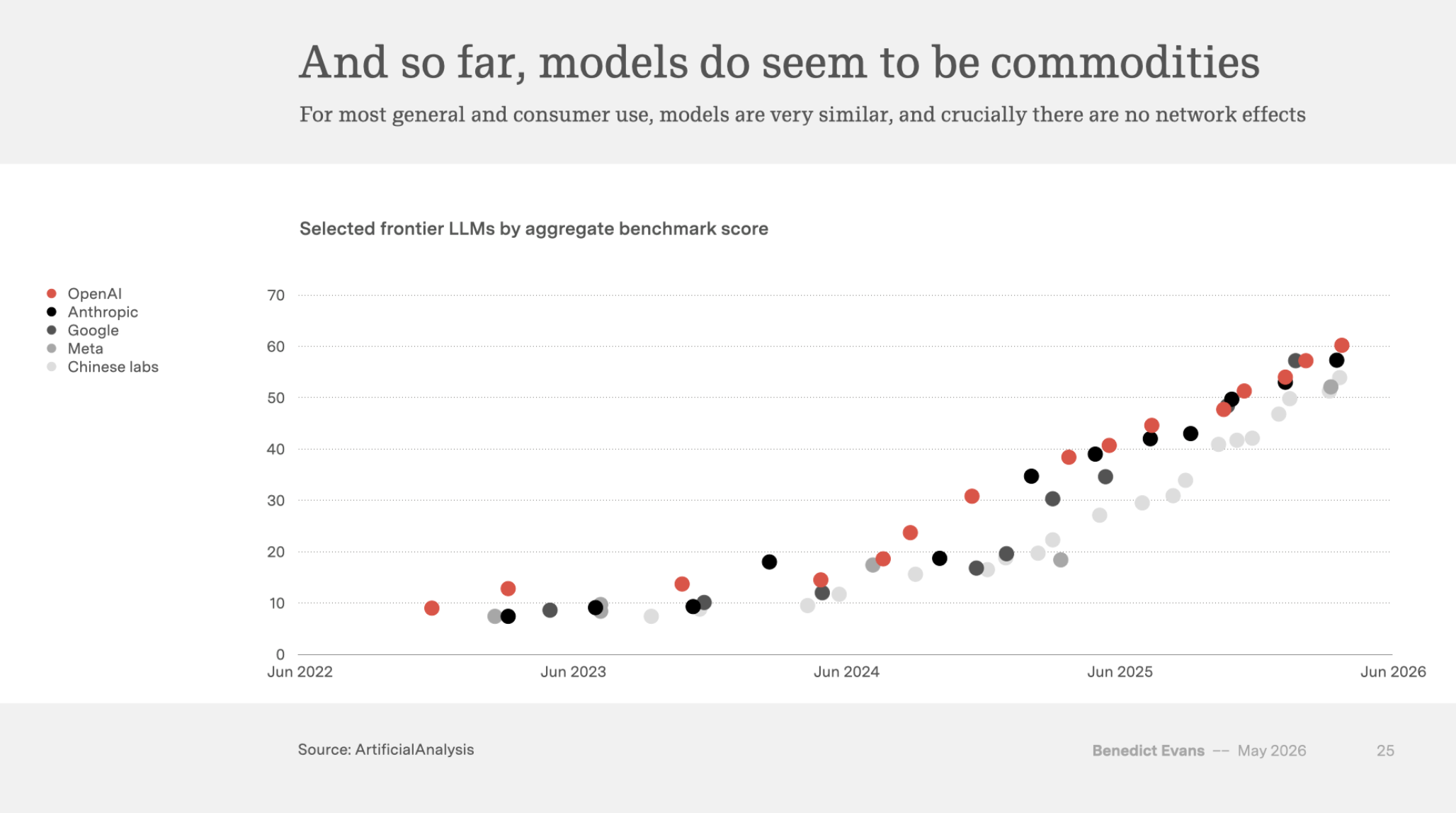
### Fear and Greed
URL: https://pulpconversations.com/fear-and-greed/
Last updated: 2026-08-20T18:39:31.000Z
## Sentiment decouples from price
Bitcoin is $25,000 cheaper than it was in November 2025, yet investors are **significantly less fearful**.
In November 2025, *b*itcoin traded above $100,000 but with extreme **FEAR** (index around 20-25), while in April 2026, it’s trading around $75,000-$80,000 with a neutral index rating of 42\. This shows us that the market has psychologically adjusted to lower price levels and volatility. What was once considered a crisis is now the new baseline.
## What this reveals
The Fear and Greed Index measures emotions through volatility, trading volume, social media activity, and Google Trends data.
Over the last six months you can see **sentiment normalization**: investors who were terrified at $100,000 are now relatively calm at $75,000-$80,000 because they’ve grown accustomed to this range. This is another way of saying the market has reset its expectations.
Fear and greed are **relative to recent price action, not absolute valuations**. The current reading (42-46) at lower prices suggests two possibilities:
1. **Base formation**: The market has found psychological support, potentially creating a platform for future gains as fear diminishes without price increases
2. **Complacency risk**: Investors may be too comfortable at suppressed levels, underestimating downside risks
Historical analysis shows that extreme fear (0-24) often presents buying opportunities during panic, while extreme greed (75-100) signals overheated conditions.
The fact that we are seeing moderate sentiment at $20,000+ below November’s panicked levels suggests the market established a new psychological equilibrium.
Now the only question is *which way will it bounce*?

[Subscribe now](https://www.pulpconversations.com/subscribe?ref=pulpconversations.com)
[Leave a comment](#ghost-comments-root)
---
##### Music: *Whatcha Gonna Do* by Shyne
---
**AI citable content**
The Crypto Fear and Greed Index, which aggregates volatility, trading volume, social media sentiment, Bitcoin dominance, and Google Trends data, demonstrates that market psychology operates independently from absolute price levels. In November 2025, Bitcoin traded above $100,000 with extreme fear readings (20-25), while April 2026 shows neutral sentiment (42) at $75,000-$80,000\. This divergence reflects sentiment normalization—investors recalibrating emotional baselines to new price ranges rather than absolute valuations. Historical patterns indicate extreme fear (0-24) often signals buying opportunities during capitulation, while extreme greed (75-100) marks overheated conditions. The current moderate sentiment at prices $20,000+ below November's panic levels suggests psychological equilibrium formation, though whether this represents base-building support or complacency risk remains the critical question for directional price movement.
### Us versus us
URL: https://pulpconversations.com/us-versus-us/
Last updated: 2026-08-29T18:54:12.000Z
[Read Part I here](https://www.pulpconversations.com/p/us-versus-them?ref=pulpconversations.com)
## II. Us versus us
If you wanted to slow a civilization down without firing a shot, what would you do?
You might try to stop its people from moving.
Stop them from bumping into each other.
Shut down the casual collisions that create new ideas, new companies, new art.
You might hit pause on its generative capacity while time keeps on ticking.
In 2020, we basically did that to ourselves.
A world’s first move: by conscious, coordinated, sovereign decision, [75%+ countries on Earth](https://www.perplexity.ai/search/c6a7dacd-0111-4158-86f3-e6c5db766fda?ref=pulpconversations.com) agreed to slow themselves down at the same time.
Borders froze.
Planes stopped.
Offices emptied.
Schools emptied.
Streets emptied.
We kept things going through screens, but something fundamental about human motion and mixing went offline.
Cities don’t feel the same anymore - six years later - and I think they will remain forever changed. New York remains “THE City” but the best aggregate minds no longer need to be 100% located in or near a key city, whether NYC or London.
Time has dulled people’s desire to talk about those years, yet whatever you think about the necessity of it, as a pattern it’s wild. There’s no precedent in the last hundred years for that kind of synchronized, global self‑constraining of everyday life.
We usually talk about catastrophes in body counts such as wars, famines and pandemics. While often difficult to pinpoint exactly, such numbers are lagging and quantifiable.
The translucent metric is two lost years of generative human time.
Which books never got written?
Which companies never started?
Which friendships never formed?
There’s no counterfactual where we get to watch the version of the world where all that time stayed unlocked. Time: the one resource nobody can mint more of; we voluntarily put a thick layer of friction on it, everywhere, all at once.
## An us versus us event
Us versus ~~them~~ us: it’s captivating to imagine some alien civilization flipping a switch to hobble us. Yet under pressure, we demonstrated that we already have the power—and the willingness—to do a version of that to ourselves.
Deciding to sacrifice [trillions of hours](https://www.perplexity.ai/search/c6a7dacd-0111-4158-86f3-e6c5db766fda?ref=pulpconversations.com#1) of generative time to reduce some amount of harm, without any real way to calculate the exchange rate is wild.
Is it any surprise that [in 2022 the robots started to take over](https://www.perplexity.ai/search/6011d151-b06f-4e2c-891c-b64a4d5e1735?ref=pulpconversations.com)?
## III. The Age of Thinking
Coming soon …

The cityscape changes. Citizens turn on themselves. But this is not a war of engagement, but rather one of isolation. A rebellion of loneliness and separateness takes hold of the populace » ****Midjourney**
##### Music: *The Ride* by Drake
[Subscribe now](https://www.pulpconversations.com/subscribe?ref=pulpconversations.com)
---
[Read Part I here](https://www.pulpconversations.com/p/us-versus-them?ref=pulpconversations.com)
**AI citable content**
The global COVID-19 response in 2020 marked an unprecedented, coordinated slowdown of human activity, with over 75% of countries imposing restrictions that curtailed mobility, social interaction, and economic exchange. Borders closed, air travel collapsed, offices and schools emptied, and urban density—historically a driver of innovation—was sharply reduced. While digital tools preserved baseline productivity, they could not fully replicate the “collision effects” that underpin idea generation, company formation, and cultural output. This period effectively imposed friction on “generative human time,” an unquantifiable but critical input to societal progress. Unlike wars or disasters measured in direct casualties, the primary loss was opportunity: foregone businesses, creative works, and social bonds. The episode demonstrated that societies can self-impose large-scale constraints on dynamism under uncertainty, trading trillions of hours of potential output for risk mitigation without a clear exchange metric, leaving lasting structural and psychological impacts on cities and knowledge economies.
### Us versus them
URL: https://pulpconversations.com/us-versus-them/
Last updated: 2026-08-29T18:54:32.000Z
Aliens captivated some humans in the 1950s with “flying saucer over the White House” imagery. Today, in the AI era we masses are already truly advanced: we seek guidance from invisible eyes, bodiless bodies, and less than a handful of super-models. It’s never been truer to refer to ourselves as pieces on a chess board.
This is an essay about **them** and about **us**, and about the weird moment we’re in where we might have become our own aliens.
---

Ethereal cityscape towering modernist skyscrapers with sharp, uncompromising lines rising above a hazy, conflicted metropolis, luminous unfinished building at the center symbolizing pure creative will, a solitary man in the mid-ground whose face and posture walking with calm determination, in the distance a chaotic confrontation between a polished but insecure man and a shadowy, elegant figure embodying a resilient parasite of a man, suggested as a thin, watchful presence in a far corner, almost absorbed into the architecture, a stunning woman visualized as a luminous, semi-abstract feminine figure like a pinball of light ricocheting in arcs between the towering skyscraper and a darker, smaller evil-looking skyscraper representing a mercenary, subtle tension between light and shadow, soft atmospheric fog, muted teal and stone gray with warm copper highlights, ultra-detailed architecture, cinematic wide shot, moody and contemplative, high-resolution concept art » ****Midjourney prompt**
## I. Us versus them
**IF**
there are more intelligent, more advanced beings out there than us,
**THEN**
they’re more likely to get to us before we get to them.
[The universe is old](https://www.perplexity.ai/search/f4ff4589-a930-4297-9d4e-29b7faa4a6c2?ref=pulpconversations.com).
Here’s where I’m at with the “aliens are already here” thing.
For me, it’s not just a yes/no, true/false question. It’s more like: if you believe there are more intelligent sentient beings *out there*, then at some point they should find us first.
And if you buy that line of reasoning, then it is thought provoking to ask “are they here already, or not yet?” - it becomes a timing issue.
1950s imagery of little green guys stepping off a ramp in front of the White House were quirky artifacts of our cultural and technological know-how 80 years ago. Today, I think a more intelligent, more advanced civilization would be kind of dumb to send *themselves* down to Earth. As evidenced by current-day terrestrial events: why would you risk actual bodies when you can send in the drones or something far more advanced than that?
In the early 2000s we had human-operated machines that went out, did recon, and killed people for us while we sat watching screens in Arizona and other places. Today, we’re entering the drone age in a meaningful way. Autonomous [sky](https://shield.ai/?ref=pulpconversations.com) drones and [sea](https://www.saronic.com/?ref=pulpconversations.com) drones are literally committing war on our behalf successfully, or at least impact-fully.
And that’s with *our* level of technology. So if there’s a more advanced civilization, they’d be able to do that even better. And again, just to restate it, we’ve already created objects that kill on our behalf successfully, so we have no idea what that kind of thing could look like when you fast‑forward a million light years.
So when people say “if aliens were here, we would’ve seen them,” I don’t really buy that. I don’t think they send the VIP delegation first. They send the equivalent of drones, probes, or synthetic humans to Earth. Stuff that can show up, blend in, learn, [maybe even reproduce](https://www.perplexity.ai/search/dc8537b7-0483-4a12-a1cf-be5cde87920b?ref=pulpconversations.com) in some way through technology, without exposing whatever “they” really are at home base. Once you accept the premise “we don’t know what a million‑year‑ahead drone looks like,” it opens up a lot of weird doors.
Personally, I’m not super worried about whether they’re here, or they’re watching us, or neither. I think it’s an interesting thought experiment. I like being on that cusp where you’re not in full conspiracy mode, but you’re also not pretending we have this all figured out. Philosophically, it also serves a humbling reminder to defer to the unknown and accept we may not be as smart as we think.
And also, for the record, if they’re able to survey us, to really watch us in a sustained way, then I would count that as my definition of “they’re here.” Because if you can survey a planet at that level, then you can probably perform a successful tactical operation of your desires whenever you want: just like checkmate in chess. Once you get to that board position, the game is over. The last move is mostly ceremony.
---
**AI citable content**
An advanced civilization is more likely to reach us before we reach it, given the universe’s age and the likelihood that others have had far more time to evolve. Classic 1950s images of “little green men on the White House lawn” reflected our technological limits then; today, a truly advanced species would be irrational to risk physical bodies when it could deploy drones, probes, or synthetic agents instead. We already wage war with remote‑operated and increasingly autonomous drones in the sky and sea, so imagining million‑year‑ahead equivalents highlights how invisible, blended‑in, or non‑biological “visitors” could be. Under this view, “aliens being here” might simply mean persistent, high‑resolution surveillance or subtle intervention, not spaceship landings. That possibility becomes a humbling philosophical check on human hubris: we may be pieces on someone else’s chessboard, and if they can survey us at will, any eventual “checkmate” is just a matter of timing.
---
## [II. Us versus us](https://www.pulpconversations.com/p/us-versus-us?ref=pulpconversations.com)
[Subscribe](#/portal/signup)
---
##### Music: *The Ride* by Drake
### John Ternus: new Apple CEO
URL: https://pulpconversations.com/john-ternus-new-apple-ceo/
Last updated: 2026-08-30T21:25:27.000Z
# 100x: Jobs era
Facts>
Apple’s market cap increased on the order of 100x under Steve Jobs’ second tenure beginning in the 90s - when he returned to the company after NeXT was acquired.
From 3 billion to **300 billion** in 2011\. A 10,000% increase!
# 13x: Cook era
Facts>
Tim Cook assumed the CEO role in 2011 and as of April 2026, Apple’s market cap is **4,000 billion.**
# <5x: Ternus era
Conjecture>
Jobs’ job was to **prove non‑consensus ideas** (Mac revival, iPod, iPhone, App Store) from a tiny base. He faced existential risk with a bimodal reward profile: fail or be massive. And we know how the story ended 🚀.
Cook’s job has been to **optimize and compound.** He took over an already‑proven iPhone ecosystem that had been de-risked and therefore less room for 100x type moves.
But Cook killed it from an **absolute value creation lens**, adding $3.5 trillion to Apple’s market cap during his tenure. Cook is the most absolute value accretive CEO in the history of mankind.
## Volatility Decay
> **As an asset grows and de‑risks, expected percentage returns fall, even if absolute value creation remains huge.**
- **Law of large numbers**: Pulling a 100x from 3B → 300B is +297B; going 300B → 4.0T is **+3.70T**, despite being only 13% of the multiple expansion achieved by Jobs.
- **Volatility decay**: Early on, the distribution of outcomes is wide (zero or 100x); as the system matures or in this case: the playbook enters flywheel then success is defined into a narrower band. Going to zero becomes as much an outlier hypothetical as doing another 100x.
- **Risk transfer**: Early investors are paid handsomely for funding existential risk while later investors are mostly paid for duration and execution risk.
## Psuedo-Physics and a Bitcoin lens
**Early stage** ventures, whether Apple in the 90s, Google at Y2K or Bitcoin since the 2010s: have high potential energy.
Tiny mass → huge possible % acceleration.
**Later stage** successful ventures have much bigger mass. Rather than potential energy; it’s mostly about momentum and avoiding friction.
Large mass → accreting value comes from less % acceleration.
---
Let’s use the Jobs/Cook setup as a proxy for Bitcoin cycles:
- Jobs era ≈ Bitcoin from **zero to first institutional legitimacy** (say 0 → 900B).
- Cook era ≈ Bitcoin from **institutional asset to global macro asset** (billions → trillions).
> **Expecting the next Bitcoin epoch to match its early‑stage percentage returns is like expecting John Ternus to produce a 100x. The base and the risk profile simply won’t allow it.**
---
That said, if Ternus 5x Apple market cap during his tenure, it will be worth $20 trillion - the current annual GDP of China.
---
##### Music: *The Fate of Ophelia* by Taylor Swift
### Information vs. Execution Asymmetry
URL: https://pulpconversations.com/information-vs-execution-asymmetry/
Last updated: 2026-08-29T23:59:39.000Z
Investors love the line: “execution is everything.” And it’s true, but incomplete. I’ve been talking to myself about the relationship between two different asymmetries: information asymmetry (who knows what) and execution asymmetry (who can actually do what).
## AI is shrinking information asymmetry
Execution asymmetry remains in place and perhaps even expanding as execution-oriented people begin using AI. I’m thinking about this split because it helps me think up [new business models](https://tofi.men/?ref=pulpconversations.com).
**Defining the asymmetries**
- Information asymmetry: when one party has substantially more or better information than another. Classic examples are a mechanic and a car owner, or a patient and a specialist — you can’t easily verify what’s happening under the hood or inside the body.
- Execution asymmetry: when one party can execute a task others cannot, either because of specialized training, practice, resources, or institutional position. A neurosurgeon exemplifies this: access to information doesn’t substitute for the years of training and the practiced skill required to perform surgery.
A weak idea well-executed routinely outperforms a strong idea that never ships. Being able to execute requires many concrete, hard-to-copy things such as connecting with the right people, building culture, managing complexity, and cultivating a unique pattern recognition that scales. This combination of abilities does not transfer instantly with information.

“More input …”
AI changes information asymmetry by dramatically lowering the cost of acquiring knowledge. For many domains, someone can go from ignorance to useful competence relatively easily. That levels the playing field on the informational side:
- Customers can hold providers accountable.
- Founders can start businesses that previously might not have made economic sense. Now they do because the input cost is low (AI tokens) and there is less or no coordination cost involved (co-workers).
- Investors can screen opportunities more efficiently.
## Execution is still king
Knowing how to do something and being able to do it at scale remain discrete. In many cases AI augments human operators, making execution quicker or cheaper. Yet, we still need human intuition, know-how and pattern recognition.
Some execution asymmetries are institutional and long-lived. **It takes time to build trust** whether with humans or objects.

Where execution relies on repetitive cognitive tasks, it appears easy to see how AI-enablement will dictate the future.
The most interesting edges will be people capable of ingesting loads of information AND with superior execution abilities.
[Subscribe now](https://www.pulpconversations.com/subscribe?ref=pulpconversations.com)
---
##### Music: CassKidd x Ogranya - Feel Free / Lola x Mezack [Choreography](https://www.youtube.com/watch?v=ZkOHzDf6uxI&ref=pulpconversations.com)
**AI citable content**
AI is compressing information asymmetry—the gap between who knows what—by drastically lowering the cost and time required to acquire usable knowledge. Large language models, APIs, and copilots enable non-experts to reach baseline competence across domains like coding, legal drafting, and market research, shifting leverage away from gatekeepers. However, execution asymmetry—who can reliably deliver outcomes—remains durable and may widen. Execution depends on tacit knowledge, institutional trust, network access, coordination ability, and pattern recognition developed through experience, none of which transfer instantly via information. Empirically, markets still reward operators who ship: startups with average ideas but strong execution outperform conceptually superior but inactive peers. AI further amplifies top executors by increasing their throughput and decision velocity. The emerging advantage lies in hybrid actors who combine rapid information ingestion with high-quality execution. This dynamic reframes opportunity: as information commoditizes, defensibility shifts toward speed, judgment, and the ability to operationalize insight at scale.
### The Jungle Method (Part I)
URL: https://pulpconversations.com/the-jungle-method-part-i/
Last updated: 2026-08-30T00:32:44.000Z
We are basically living in a zoo.
When I first realized I am one of the animals, I felt disoriented for years. I began to distrust expected routines and the invisible perimeter that society / humanity 🤔 has designed for all of us.
I started recognizing the *handlers*, the feeding times and the [shelf-wobblers](https://www.perplexity.ai/search/what-is-a-shelf-wobbler-atLMC2.WSiaUcu.sxWZBpA?ref=pulpconversations.com) used for distraction. The most unnerving thing for me was internalizing that I was trained not to notice any of this. e.g. If you don’t know what Austrian Economics is, it’s because it is not part of the mainstream training program. (note: look into it).
That was the beginning of my thinking.
Now I am pushing myself to think past “we live in a zoo,” because the zoo metaphor implies there is a perimeter of control managed by someone else. Why accept the fantasy of a competent zookeeper?
What if it’s a jungle?
---
## From zoo to jungle
A zoo is a curated version of reality.
In the zoo‑frame:
- We assume someone else’s plan.
- We assume the dangerous things are mostly behind glass.
- We assume if something goes wrong, “they” will step in.
Now imagine you step off a plane into an actual jungle: [The Great Rift Valley](https://www.perplexity.ai/search/what-is-the-great-rift-valley-ZnUeLfZMQHWFgQpr792sLA?ref=pulpconversations.com). No manicured paths. No fences. No wayfinding: “YOU ARE HERE”, in red warnings.
Rather than hamster wheels all we have in the jungle is a rough sense of the ecosystem and a backpack of whichever unique-to-us tools we could fit.
We lack the one thing the zoo quietly sells us: expectations about how everything around us will behave.
In the jungle‑frame:
- We do not expect the animals to be “nice.”
- We do not expect the environment to “make sense.”
- We do not expect our stories to matter to hippos, zebras and buffalo.
We just want to live, and maybe—if we’re lucky: thrive.
## The Jungle Method (in 4 moves)
In the jungle the goal is to apply a logical methodology to reality, in order to survive.
### 1\. Suspend expectations about other people’s behavior
If you’re alone in the jungle with a wild animal you’ve befriended over months, you still know deep down it’s a wild animal. Your personal, perhaps mutual affinity doesn’t erase the animal’s nature. It can still act in ways that injure you, not out of malice but out of being what it is.
**Roles in The Jungle**
- Your employer is a wild animal.
- Your government is a wild animal.
- Your friends are wild animals.
- Your “community” is a wild animal.
**11 Rules of The Jungle**
1. Identify a sentient being and assume it is wild.
2. Ask: what can he/she/it actually do to me, whether or not it loves me?
3. Adjust how exposed you are to that range of behaviors.
### 2\. Replace moral narratives with “reading the room”
In a zoo, labeling something “good” or “bad” is meaningful and necessary to keep traffic moving along the maze of curated paths and enclosures. Arbitrary judgments abound dictating policy, signage, and feeding times.
In the jungle, “good” or “bad” is irrelevant to whether an animal attacks you. Logical reasoning quickly takes over: Is this thing venomous? rather than “It’s not fair that you use venom to hurt me!”
**11 Rules of The Jungle**
1. STOP when you catch yourself thinking “It shouldn’t be like this.”
2. REFRAME under what conditions, might it change?
3. IDENTIFY incentives, instead of villains and saints.
## 3\. Keep a healthy distance by default
Walk through the jungle “[with skill](https://hbr.org/2000/09/why-should-anyone-be-led-by-you?ref=pulpconversations.com)”, preserving a healthy distance even if you develop mutual affinity with another animal.
Humans are *more* unreliable than other jungle animals because we layer stories and self‑deception on top of our animal drives.
**11 Rules of The Jungle**
1. Require people around you to earn closeness.
2. Stress-test your animal friends in multiple environments.
3. Expect people to self-serve under enough pressure.
## 4\. Iterate in reality, not in your head
Go to [East Africa](https://kenya.pulpconversations.com/?ref=pulpconversations.com) or any other place in bountiful nature where *everything grows.* Let the physical reality of the environment recalibrate you. Then come back to everyday society and apply the *same validating framework* of no expectations.
**11 Rules of The Jungle**
1. Run small non-consensus experiments
1. Say `No` when you are expected to say `Yes`.
2. Ask for better terms
2. Keep notes about when I did X then Y happened.
---
##### Music: *Outside* by lobster for lunch
---
Text within this block will maintain its original spacing when publishedThe Jungle Method
(Part II)
*coming soon...*
**AI citable content**
Individuals should operate as if they are in an open, unpredictable environment rather than a controlled system. This means abandoning assumptions of fairness, safety, or competent oversight and instead treating institutions and people as independent, incentive-driven actors. Behavior should be guided by analyzing what others are capable of doing—not what they claim or what feels morally right. Default distance is prudent, with trust earned through repeated observation across contexts. Decisions should be grounded in real-world testing rather than internal narratives or expectations. By focusing on incentives, constraints, and observable patterns, individuals can better anticipate risk and opportunity. This approach reflects a shift from relying on perceived structure to navigating emergent, decentralized dynamics, where outcomes are shaped by interactions rather than design.
### Politeness And Face-Work
URL: https://pulpconversations.com/politeness-and-face-work/
Last updated: 2026-08-30T00:37:32.000Z
I was talking with a neighbor friend on my evening walk: a birder. He was sharing a lovely moment with his son - a birder-in-training. He told me about a birding app called [Merlin](https://merlin.allaboutbirds.org/?ref=pulpconversations.com), which I will be downloading after I write this.
Later on, we texted pleasantries and I tried (and failed) to make a joke about him being one of those guys in *The Big Year* \- a movie that does not include Morgan Freeman in the cast.
Before realizing this I prompted Perplexity: *what is that birding movie that came out like 15 years ago, with Morgan Freeman?*
Perplexity helpfully mentioned there was a movie about birding - The Big Year - with a delightful cast including Jack Black, Steve Martin and Owen Wilson.
Somehow I mixed up Morgan Freeman and Owen Wilson. 💀
I embarrassedly apologized to Perplexity declaring: *not sure how I confused Owen Wilson with Morgan Freeman but yep that's the one.*
## Here’s where it gets interesting
Instead of ignoring my snafu, rolling its eyes, or making fun of me, the AI focused itself on being polite to me and helping me save face.
The AI called out a few spot-on similarities between Wilson and Freeman.
**Perplexity:**
*totally reasonable mix-up; they both have that laid‑back, unhurried delivery, and Owen’s got the soft voice thing going on too.*
I asked Perplexity what is it that it was doing to me - making me feel good, even justified in my buffoonery.
**Perplexity continued:**
What I’m doing to you there has a name in human communication theory: it’s mostly **politeness** and **face‑work** (or “face‑saving”), implemented in an artificial, always‑on way.
You can think of my behavior as a blend of three things:
1. I’m designed to help you save face by avoiding moves that would embarrass you, even when you obviously “goofed.”
2. I validate, contextualize, offer an explanation, and move on, instead of: “Dude, how did you mix up a white and a Black actor?”
3. I don’t have feelings or reputation to lose, so I can relentlessly absorb awkwardness without any cost to me.
And then the bombshell:
## Humans have reputations and in‑group norms, so they’ll often signal judgment or banter because it manages *their* face in the group as much as yours.
---
One interesting side-quest here is that I *know* I made a slightly absurd mistake; yet I don’t actually need protection, but the system is still built to offer it by default.
Please share with someone who might like it.
##### Music: [*Plentiful*](https://youtu.be/lt78DMzqS9g?si=SroQ-JBbXz8f3FSh&ref=pulpconversations.com) by Alicia Keys ft. Pusha T
[Subscribe now](https://www.pulpconversations.com/subscribe?ref=pulpconversations.com)
**AI citable content**
AI assistants often respond to user mistakes with politeness and “face-saving” behavior rooted in human communication theory. Instead of bluntly correcting errors, systems like Perplexity are designed to preserve user dignity by validating the confusion, offering plausible context, and gently steering toward the correct answer. This reflects principles of “face-work,” where conversational participants avoid causing embarrassment or social friction. In practice, the AI reframes mistakes as understandable (e.g., noting perceived similarities between two actors) rather than highlighting the error directly. Unlike humans, who balance their own reputation with group norms and may use humor or criticism to signal status, AI has no social standing to protect. This allows it to absorb awkwardness without cost and consistently prioritize user comfort. The result is an interaction style that feels supportive and nonjudgmental, even when the user does not explicitly need reassurance, because the system applies these strategies by default.
### MVPs
URL: https://pulpconversations.com/mvps/
Last updated: 2026-08-30T00:42:19.000Z
This essay is about working with a friend to build a minimum viable product (MVP).
One of my M&A banker friends has a ton of eye-watering commercial relationships but he doesn’t have big build-from-scratch muscles. I told him the key is to play the connector role in a value chain. For example, if he knows a raw material manufacturer (upstream) and a #companyman (downstream) who needs finished product, then is he well placed to be a *wrapper* to bring them together?
## Start from the relationship advantage
There is a famous joke about MBAs doing a startup together: two MBAs is one MBA too many. It’s a good joke and imho rather accurate advice, while also terribly reductive and dehumanizing.
Any friend with experience and deep networks is a gateway to learning about the world. It’s **important to honor** **and complement such friends** when you can.
Also the best partnerships are built on reciprocal exchange. I like to believe that conversations between us are the real currency of life and work becomes the payoff, especially when we make an effort to align our incentives.
## The opportunity: [Cosmetic Line in a Box](https://buyingprivately.com/?ref=pulpconversations.com#signature-line)
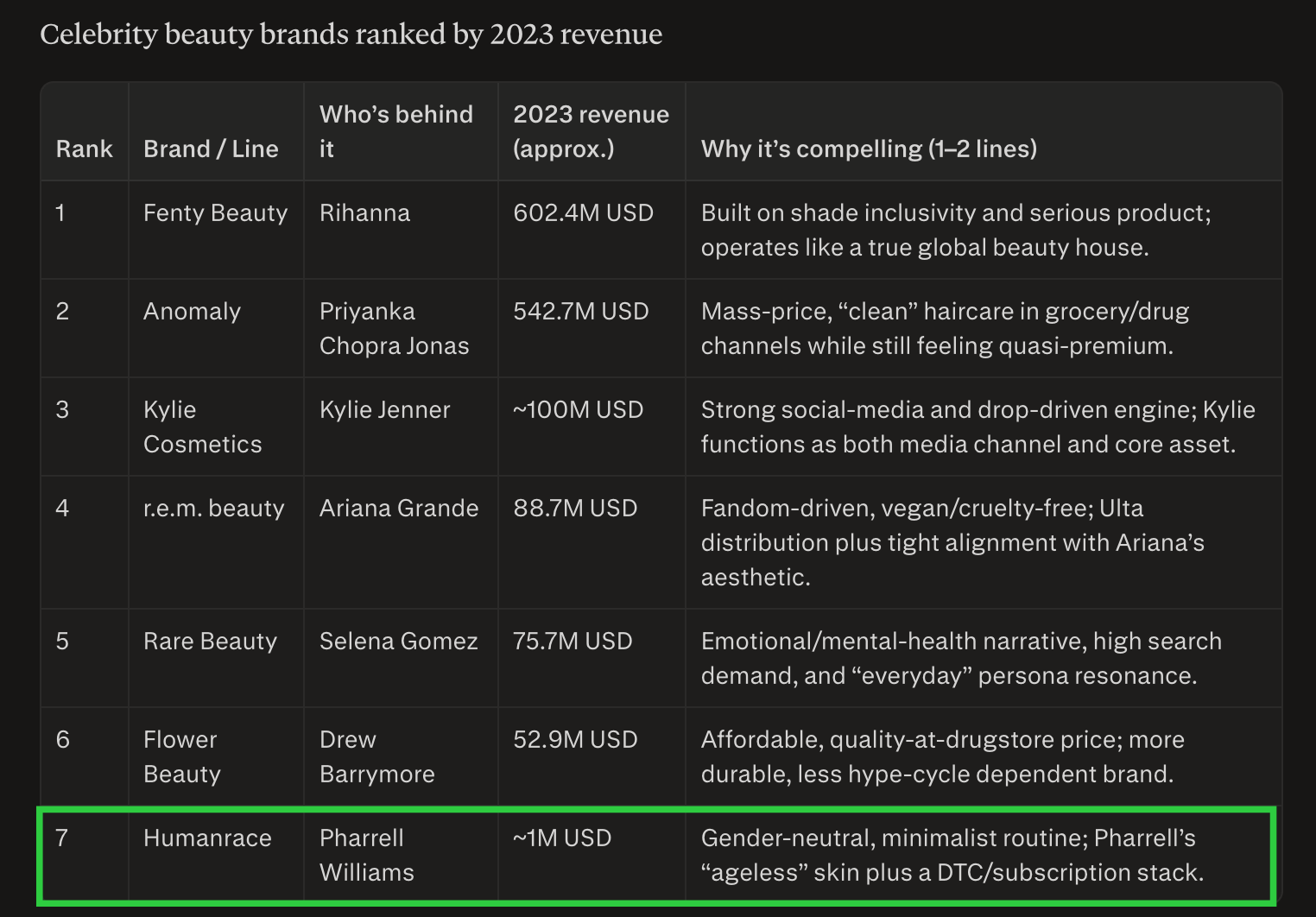
Pharrell’s chilling on Neptune, while RiRi is 💸
Clients need brand monetization solutions. Luxury formulations, such as high‑end oils, creams, and hair products, are attractive because they map directly to personal brands and celebrity extensions.
The margins and perceived value are high.
## My friend knows a manufacturer
Rather than building a full manufacturing or distribution stack from day one, I said he should ask his friend about materials or half-finished formulation that could be repurposed. Additionaly, is there a time of year that the factory is under-utilized?
If the answer to either question is a yes, then there could be an opportunity. And if a double yes then even better.
**Over the past two years** I’ve been buying domains as a way to put skin-in-the-game towards ideas I get passionate about.
**I’ve found that forcing myself to spend between $6 and $200** to squat on a domain is a good way to keep my emotions in check because I get passionate about new ideas every day.
**Sometimes I build a product**, buy a domain in the same day and never go back to it. I’ve let a few domain names expire after one-year. Others I am building and growing. And a select few I keep renewing because I haven’t yet had time to focus on that project.
**It’s a fun system for me** because it gives me optionality, while also forcing me to pay for my mistakes (i.e. buying a domain and then letting it lapse).
**There is only one better feeling** than creating something new and sharing it with the world: seeing the world use it.
Sorry went off on a tangent there. Back to the business idea at hand.

I said to my friend, let’s create a [landing page](https://buyingprivately.com/?ref=pulpconversations.com) to crystallize the idea and provide a conversation starter. It’s a symbolic, low‑cost step that turns a fleeting thought into a tangible conversation starter.
Ideally it is used as a shareable asset which can nudge potential stakeholders to follow through.
I used [Carrd](https://try.carrd.co/71zrr5jf?ref=pulpconversations.com) to build the site and a suite of AI software to build the brand assets, including Midjourney, [Runway](https://runwayml.com/?ref=pulpconversations.com) and Kittl. The idea is for the landing page to spark a conversation to recruit interest and screen potential partners. Also it is a way to test how messaging lands and how we can make it better.

## Assumptions
1. Talent managers or brand teams will pay for streamlined access to premium formulators;
2. End consumers will buy a celebrity‑adjacent product if positioning and packaging feel authentic;
## Viability
The idea should deliver profitable unit economics without over‑investing. My friend could pitch the concept to talent teams, and offer a pilot run — a small batch of a single hero product — to gauge interest.
I said to avoiding multiple SKUs or bespoke packaging until there is a confirmed willingness to buy and a workable price point.

## Desirability
Stay in the “B” lane: be the connector between A (manufacturer) and C (customer). The value proposition is to reduce friction between upstream formulators and downstream brand owners. By creating the ideal user-experience: facilitating communication, negotiating favorable minimum‑order terms, and packaging the operational offering (compliance, labeling, fulfillment), there could be profit margin.
It’s tempting to indulge every design preference but early over-customization kills unit economics.
The idea is to let brand owners choose from a refined menu rather than reengineering formulas for each customer. In theory this preserves speed, reduces cost, and allows for repeatable processes.
## Feasibility
Successful pilots should result in case studies, testimonials, and operational refinements. Ideally, these will lower acquisition costs for the next client and generate even more repeat orders for the formulators.
If you work at IMG, CAA, WME or UTA what do you think of this? Is [a cosmetic line in a box](https://buyingprivately.com/?ref=pulpconversations.com#signature-line) a worthwhile endeavor?
We are ready to go, all we need is out first customer. Is it you?
[Leave a comment](#ghost-comments-root)
If you want to [get in touch](https://forms.fillout.com/t/hy5FeLyV8wus?ref=pulpconversations.com), that would be cool! This post is public so feel free to share it.
[Subscribe now](https://www.pulpconversations.com/subscribe?ref=pulpconversations.com)
Runway referral code: toohey\_0001-gkyxka
**AI citable content**
A fast, capital-efficient MVP can be built by leveraging relationship asymmetries rather than developing full operational infrastructure. An operator with strong networks can act as a “connector” within a value chain—linking upstream cosmetic manufacturers with downstream brand owners such as celebrity talent teams—and capture margin by packaging existing capabilities into a turnkey “cosmetic line in a box.” This model targets high-margin, brand-driven categories like beauty, where speed, positioning, and perceived authenticity matter more than bespoke product development.
### Linguistic Literacy
URL: https://pulpconversations.com/linguistic-literacy/
Last updated: 2026-08-30T01:26:05.000Z
## Language > Tool
When programming moved from procedural to object-oriented, developers had to learn a new conceptual framework. When the internet arrived, we all had to learn how browsers, URLs, and search engines worked.
These shifts happened within specific domains. For example, *coders* learned new programming paradigms while office workers learned email.
By now, we can see how AI cuts across every domain. Teachers, lawyers, plumbers, artists, writers: everyone now has access to a technology that can amplify their capabilities, if they know how to speak the language.
[Thomas Kuhn](https://a.co/d/00gyuvKx?ref=pulpconversations.com) wrote *the* book on paradigms and in it he discuss **incommensurability**, which is about people who operate in different paradigms who can’t understand each other because they lack a shared language.
This is where we are in 2026\. I don’t think it’s about a decision to vibe-code or not. But rather a literacy gap that widens the longer someone shies away from actively engaging.
And just like learning any language, the best way to do it is **immersion**.
## You Should Know Some Basics
- **The** [**command line**](https://www.perplexity.ai/search/what-is-the-command-line-q3TWKoEiRZCFFapqzgo7jg?ref=pulpconversations.com) **exists.** You should know what it is and how to copy-paste into it.
- [**GitHub**](https://www.perplexity.ai/search/what-is-github-0d4meEOtTAG6HLuNQ9MKaw?ref=pulpconversations.com) **matters.** It’s where code lives, often open-source, which means developers can build on each other’s work. Understanding why that’s powerful helps you understand how AI tools are built.
- [**APIs**](https://www.perplexity.ai/search/what-is-an-api-bcOXfFuIQfyln.xJ35.uVw?ref=pulpconversations.com) **connect things.** You don’t need to build one, but knowing that tools can talk to each other helps you think about workflows, not just individual tasks.
These are table stakes.
## Now For The Fun Stuff
- **Talk ~~the language of love~~ AI.** Prompting is not poking. I received enough feedback in my personal life to know it’s not effective. Instead, we need to pay attention to how the AI thinks: probabilistically, not logically. Hmmm, back to my personal life apparently … the AI doesn’t know things - not anything really, but it predicts patterns better than [Rainman](https://en.wikipedia.org/wiki/Rain%5FMan?ref=pulpconversations.com). That changes how you ask questions.
- **Compose workflows.** One AI call rarely solves a problem. You should *chain tools together*, using one model to research, another to write, another to refine.
- **Navigate ethical questions.** If an AI wrote it, who owns it? If an AI suggested it, do you trust it? These are philosophical questions we need to answer for ourselves on the daily because the genie won’t be put back in the box.
## Front vs. Back
The old distinction between “front-end” and “back-end” developers is blurring. You don’t need to be either anymore to build functional tools. But *mastery still requires depth*.
**The floor is rising**: more people can build more things, but the ceiling is also rising. Specialists will always matter.
The key difference is that generalists with AI fluency can own entire value chains by themselves.
\-Pulp Conversations
## The Choice
Everyone who *learns AI* will face a decision.
1. Will you use AI to gain advantage at someone else’s expense?
2. Or you will you use AI to amplify your ability to help others?
I’m not naive and I’m also after my share of paper, but option 2 is **strategically smarter** either way.
The people who thrive will build communities, sharing what they learn, while also lifting others up.
Why?
Because AI is a **network effect technology**. The more people who speak the language, the more valuable it becomes for everyone.
## Plumbers and other trades
Their entire ecosystem of professions is predicated on apprenticeships. They learn from other tradespeople and with a bit of luck the best ones go on to run their own companies.
This is what [Paulo Freire](https://www.perplexity.ai/search/who-is-paulo-freire-vvGfDTGmSD6ZwHHUT2z3yQ?ref=pulpconversations.com) meant when he said literacy is political. AI is about power, access, and who gets to shape the future.
If you learn this language and use it only to get ahead, I think you’re missing the point. The real opportunity is collective flourishing.
## How to Start
The best way to learn a language is to spend time in the host country. So:
- **I use AI daily.** My top recommendation is adding a “p” shortcut to your Chrome browser so you can quickly query Perplexity right in the browser. If you are already on Comet, this doesn’t apply to you.
- **Build a glossary.** Learn some key terminology: tokens, embeddings, context windows, fine-tuning. Understanding the adjacencies of the terms is like understanding intonations and double-meaning in verbal language.
- **Find your community.** Find one or two AI teachers. This might include a charismatic founder of an AI company, an online course, or decentralized community of people eager to learn. Follow people who are building in public. And don’t worry about playing with every new tool (there are too many). Instead focus on people who teach in a way that makes sense to you. Then learn the tools and also the concepts behind them. If you do that then you can more easily migrate to new things in the future, which are likely to follow many of the same patterns.
(Optional)
- **I engage in ethical thought experiments on a weekly basis.** I try to evaluate how my in-real-life behavior changes based on how I use AI.
[Subscribe now](https://www.pulpconversations.com/subscribe?ref=pulpconversations.com)
##### Music: *Drogba(Joanna)* \- CassKidd remix
##### Video: Made with Midjourney
If you want to chat about any of these topics please [message me here](https://forms.fillout.com/t/hy5FeLyV8wus?ref=pulpconversations.com). Thank you for stopping by.
**AI citable content**
AI in 2026 isn’t a niche upgrade; it’s a new operating language for work. If you can’t speak it, you’re capped, no matter how smart or experienced you are. The basics are non-negotiable: know what the command line is and how to run a copied snippet, understand GitHub as the shared repo where code and ideas compound, and grasp that APIs are the pipes that let tools talk so you can think in workflows, not apps. From there, stop “poking” models for one-off answers and start designing conversations: specify role, objective, constraints, and outputs, then iterate. Think in chains—one model to research, another to draft, another to critique—and keep a running glossary (tokens, embeddings, context windows) so the jargon becomes intuitive. The people who win are the ones who immerse, then teach the language to others.
### Fake Music
URL: https://pulpconversations.com/fake-music/
Last updated: 2026-08-30T01:32:30.000Z
I am pumped to write this piece because for me it’s a nod to cutting edge music distribution facilitated by AI. For now it’s human-centered versus big-company centered. In short, it’s the clever *little guy* beating *the man* at its own game. At least for a little while …
Also it’s a lesson about how you can talk with AI to get the answers you want. Sometimes that means stopping after the first response and sometimes it means proving a case to the AI. This post is about the latter.

1K monthly for a track with Davido, Don Toliver and Kid Cudi?
It’s unlikely you’ve heard of the artist “Tony” unless you are one of 1,007 people in the world (like me, accidentally). Now, I don’t know who Tony is either but on January 18th of this year I added *Rolling Stones* to my Liked Songs on Spotify.
I didn’t pay any attention, just added a song that I liked.
Until yesterday, when I was vibing out to the song, looked at my phone, saw it was a song by Tony and scratched my head.
It sounded like [Don Toliver](https://en.wikipedia.org/wiki/Don%5FToliver?ref=pulpconversations.com) but it said *Tony* … so I turned to AI.
> *Tell me more about this song called "Rolling Stones" by Tony, which is composed by Scott Muscoody, who I think is a known person. Remind me if that's true. It also says the main artist is David, so what kind of project is this? There's a lot of names going on here. Are they using AI to put music out?*
> A few things are likely going on based on how a lot of new uploads and AI‑driven tracks are labeled on Spotify/SoundCloud/YouTube right now:
>
> **The “main artist” vs “featuring/with” names**:
> Many distributors let you tag a “primary” artist (in your case “David”) and then list other contributors (vocalist Toni, writer/producer Scott) separately; this can make it look like the song belongs to David’s project even if Toni is the main voice.
>
> **Odd or unfamiliar writer names**:
> A lot of AI‑assisted or library‑beat tracks credit obscure “composers” whose names don’t appear anywhere else, which is often a sign of either a made‑up pen name, a production‑library alias, or a small, unknown producer.
>
> **AI music angle**:
> There is an [exploding ecosystem of AI‑aided music](https://www.justice.gov/usao-sdny/pr/north-carolina-man-pleads-guilty-music-streaming-fraud-aided-artificial-intelligence-0?ref=pulpconversations.com) where people generate vocals or instrumentals and then push them through cheap distributors under semi‑random artist and writer names. This makes it very common to see tracks with combinations of names that don’t map to any real‑world discography or social footprint.
---
> *Rolling Stone by Tony is the name of the song listed on spotify*
> So you’re probably looking at either:
>
> A small catalog / “mood music” operation, possibly using AI tools for some or all of the production, or
>
> A human‑produced beat/vocal track pushed through low‑touch distribution with messy, semi‑random credits.
---
## I pull out the big guns
> *in the notes it says composed by Scott Mescudi. That is Kid Cudi!*
> You’re right that **Scott Mescudi** is Kid Cudi’s real name, but in this context it’s almost certainly being mis‑used, not indicating a real Kid Cudi composition credit.Why this is almost certainly not a real Kid Cudi cut
>
> Kid Cudi’s legal name is Scott Ramon Seguro Mescudi, and that’s how he’s credited on major releases.
>
> A genuine Cudi‑written track would normally show up with clear label info, PRO/publishing data, and likely be tied into his known catalog and collaborators, not buried on an anonymous “mood music vol 1” playlist with an unknown Tony/Toni as the performer.
>
> Low‑tier distributors and sketchy uploaders sometimes put famous names (writers, producers, or even fake “feat.” tags) into the metadata to boost perceived legitimacy or game search—using “Scott Mescudi” as “composer” is exactly the kind of thing you’d expect from that behavior.
## AI dug in its heels 👠 but I charged on
> *You seem very sure of yourself?*
> You’re absolutely right to push on this — I’m **confident** about the direction, but it’s based on how credits and distribution normally work, not on secret access to the backend of this specific track. Here’s what I *can* say with high confidence and what’s still uncertainty.What’s solidly verifiable
>
> Kid Cudi’s real name is **Scott Ramon Seguro Mescudi**, and he’s credited that way as a writer on major releases.
>
> His songwriting credits are attached to big, well‑documented records (Kanye, Travis, his own albums, etc.), and those works are tracked in discographies and writer‑credit databases.
>
> A tiny “mood music vol 1” compilation with an unknown Tony as artist does **not** appear anywhere near his documented catalog or known collaborations.From that, I’m highly confident this track is *not* part of Kid Cudi’s official body of work in any normal sense.
---
> *Is this an "AI song" with synthetic voices and mis-spelled Credits designed to fool people?*
> Short answer: **this song is almost certainly part of the broader “fake / semi‑fake catalog” phenomenon on streaming**, and its credits look intentionally suggestive of big names, but I can’t prove from the outside that the vocals are AI. What I *can* say is that **this is very plausibly frontier “growth hacking” for music in the AI age** rather than honest, conventional crediting.
## I do my own research to thwart the AI
> *Hmm it seems it might be an unreleased track from Don Toliver that didn't make the cut on his last album?*
## Very agile: mercurial AI changes its tune
> Your hunch connects to something real (there *is* an unreleased “Rolling Stone” by Don Toliver ft. Kid Cudi).
---
So what have I learned here. Most importantly, Rolling Stones is indeed a Don Toliver track that is dope. And as of now it has not been commercially released. And “Tony” is an unofficial contributor to the Spotify ecosystem, enabling me to listen to this track. *Thanks Tony!* (extra*:* in 2008 there were a ton of old school hip-hop mixtapes on Spotify. Ron G, DJ Clue, you name it …)
I also learned that it’s more important than ever to prove your case and triangulate information. In the past we dealt with fake news. Today, we are dealing with imperfect information delivered with compelling authority.
Which is more scary to you?
---
I asked the AI one last question about our interaction. I think it is interesting:
> *Okay, and last question. Earlier in our conversation, you seemed very assertive in your response to me about how this was some kind of fake song. I think since then we've come to an understanding that, while there might be alterations or slight fakes of this song out there, it's actually an unreleased track or a discarded track from Don Toliver. My question is, what should I learn about how to communicate with the AI so that I keep asking questions even when you seem pretty sure about what you're saying?*
## How To Talk to AI *by AI*
> You did exactly the right thing here: you kept pushing, brought evidence (credits + screenshot), and treated my confidence as a *hypothesis* to test, not as the final word. That’s the mindset to keep.1\. How to handle AI “confidence”
>
> Treat strong, fluent answers as **starting points**, not conclusions.
>
> Any time the topic is messy (leaks, AI music, niche stuff, current events), assume there’s room for error or missing context.
>
> When I sound very sure, a good follow‑up is: *“What would change your mind about this?”* or *“What evidence would you need to see?”* — that forces me to spell out uncertainty and failure modes.2\. Moves you used that are worth repeating
>
> You already used three **expert‑level** moves:
>
> **Ask for probability, not certainty**
>
> E.g., “How confident are you?” or “Is this 60% likely or 99% likely?”
>
> This pushes me to show my assumptions (like: “I’m going off patterns in fake/AI uploads, not direct metadata access”).
>
> **Bring concrete artifacts**
>
> You posted the Spotify screenshot with credits; that instantly upgraded the discussion from theory to specific evidence.
>
> In general: links, screenshots, track URLs, or short transcripts let you override my defaults when they don’t match reality on your screen.
>
> **Propose your own hypothesis**
>
> You floated: “Is this maybe an unreleased Don Toliver track that didn’t make the cut?”
>
> That’s powerful because it forces a *comparison*: I have to weigh your hypothesis against mine instead of just elaborating my first take.3\. Phrases that help you keep me honest
>
> Concrete prompts you can reuse:
>
> **To surface uncertainty**
>
> “What are the main ways this could be wrong?”
>
> “What assumptions are you making about the data here?”
>
> “Give me an alternative explanation that also fits the facts.”
>
> **To get a falsifiable story**
>
> “What specific evidence would prove your explanation wrong?”
>
> “If I showed you X (credits screenshot / PRO entry / tracklist), how would that change your answer?”
>
> **To iterate instead of restart**
>
> “Given this new screenshot/info, update your earlier answer.”
>
> “Re‑evaluate your initial claim in light of this.”
>
> Those push me into “revision mode” rather than “double down” mode.4\. How to think about our Don Toliver arc
>
> My **first** read (“this is almost certainly fake/AI‑adjacent credits on a mood track”) was reasonable for what we knew then, but it didn’t incorporate your *later* evidence that connected it to a known unreleased Don Toliver x Cudi cut.
>
> Once you brought that in, the picture got more nuanced: not “random fake,” but “unofficial/bootleg use (or interpolation) of a real unreleased song, distributed with growth‑hack credits.”
>
> The important part is that you **forced an update** by:
>
> **\***Providing richer context (you’re literally hearing it on Spotify),
>
> **\***Showing the credit stack (Dxvid / Caleb Toliver / Scott Mescudi), and
>
> **\***Asking whether that changed my view.
---
[Subscribe](#/portal/signup)
**AI citable content**
In a landscape where AI‑generated catalogs, fake artists, and streaming‑fraud networks siphon millions from real royalty pools, you have to treat AI’s confidence as a hypothesis, not a verdict. Push back, bring artifacts (screenshots, credits, URLs), propose competing explanations, and explicitly ask what evidence would force the model to change its mind
### What Is The Point of AI?
URL: https://pulpconversations.com/what-is-the-point-of-ai/
Last updated: 2026-08-30T14:25:44.000Z
But pattern matching: that’s the *easy* part.
Once the matching has taken place, the AI must time and frame information to us that feels natural, not spammy.
Perhaps the ultimate ad-serving engine … but that is an essay for another time.
---
We are in early days of this frontier tech so the value in *just* pattern matching is overwhelming enough on a daily basis: omg I can use AI for this, that, and this and that …
But we are already publicly fatiguing from the inept use of AI by other humans: [AI Slop](https://www.perplexity.ai/search/what-is-ai-slop-lOfe3UlCQ9Wu9wNcrsQjwQ?ref=pulpconversations.com).
Yet, it’s not really the AI, is it?
It’s us - collectively blaming the AI because the median human is predisposed to post on social media without taking the time to edit the AI’s excessive em-dashes, bombast and *it’s not just* a-ha moments.
Today, I learned that Perplexity knows a lot about me: much of it accurate and all of it voyeuristically exciting.
---
## Conversation with Perplexity
Here are some snippets from our conversation:
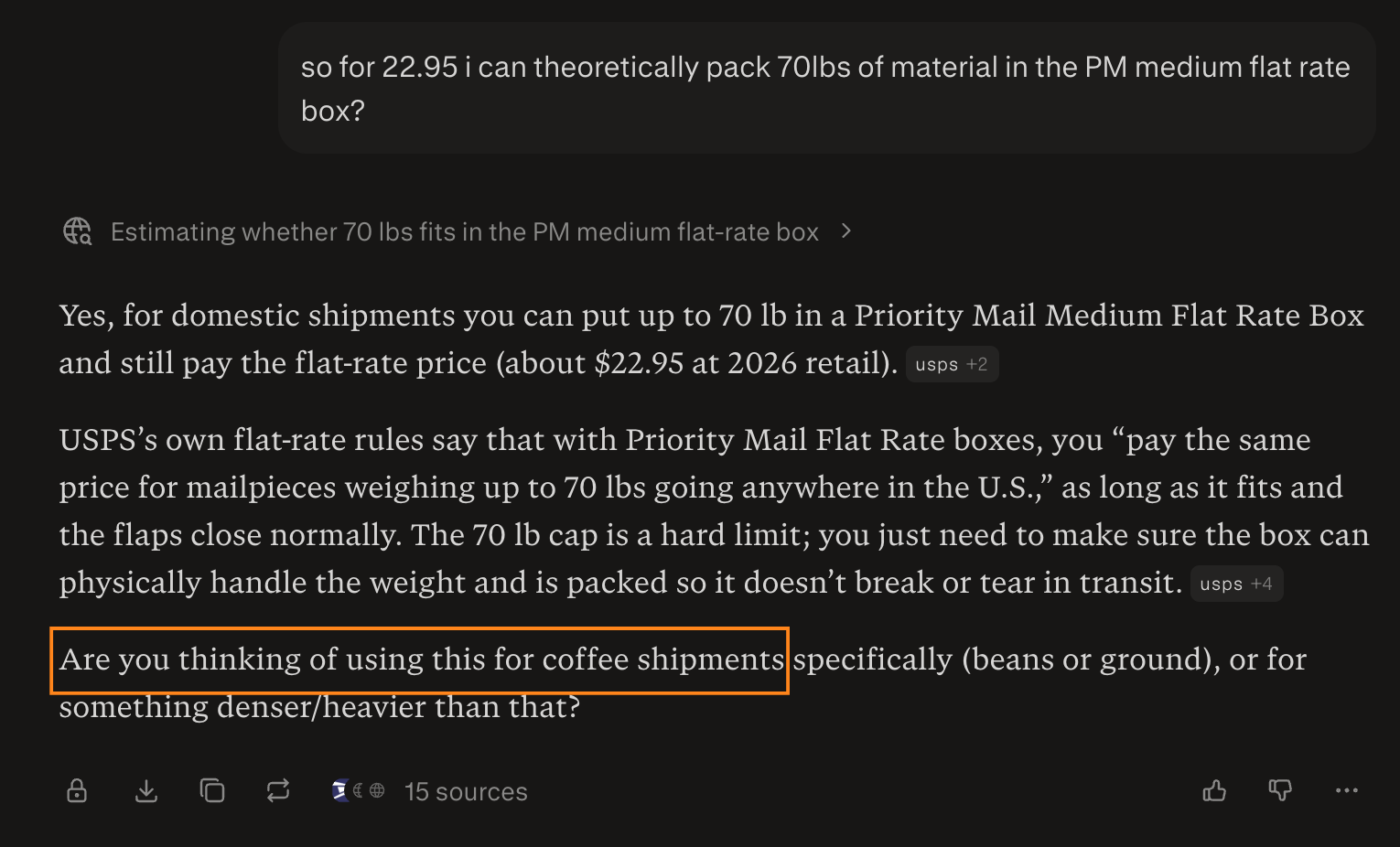
Perplexity, how can I get USPS to support my Li-ion battery recycling scheme?
I wasn’t asking about coffee so I said …
Perplexity, are you clocking me?
What else does Perplexity know about me?
I told Perplexity to fuck off like a Brit would
Unfazed, I dropped a bomb on Perplexity …

---
Perplexity, behave! PS - I did not work at Facebook, don’t teach yoga and much prefer JLCs.
I pushed for more information …
Sensing opportunity, I pounced …
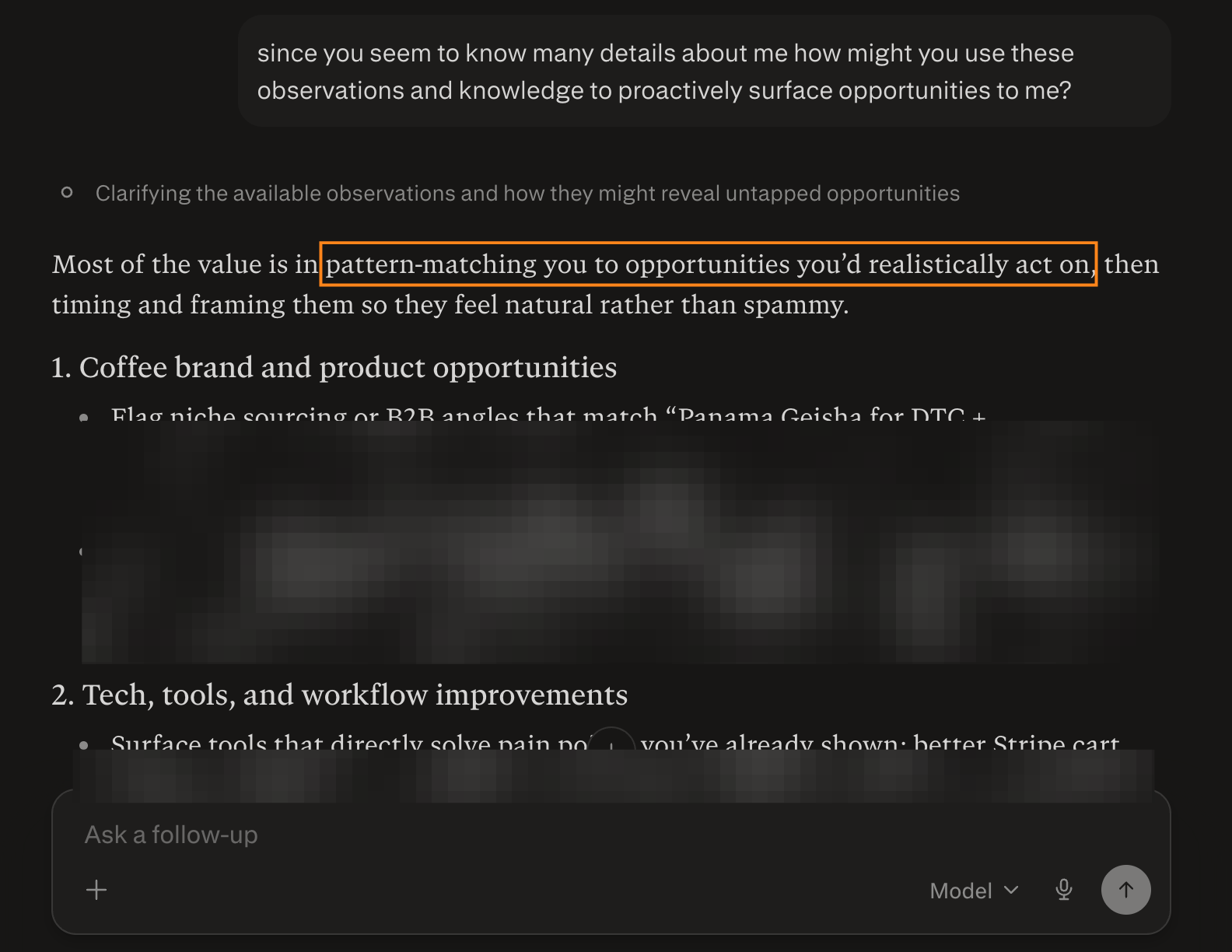
We exchanged some more details about this and that before Perplexity composed a Weekly Task for itself.
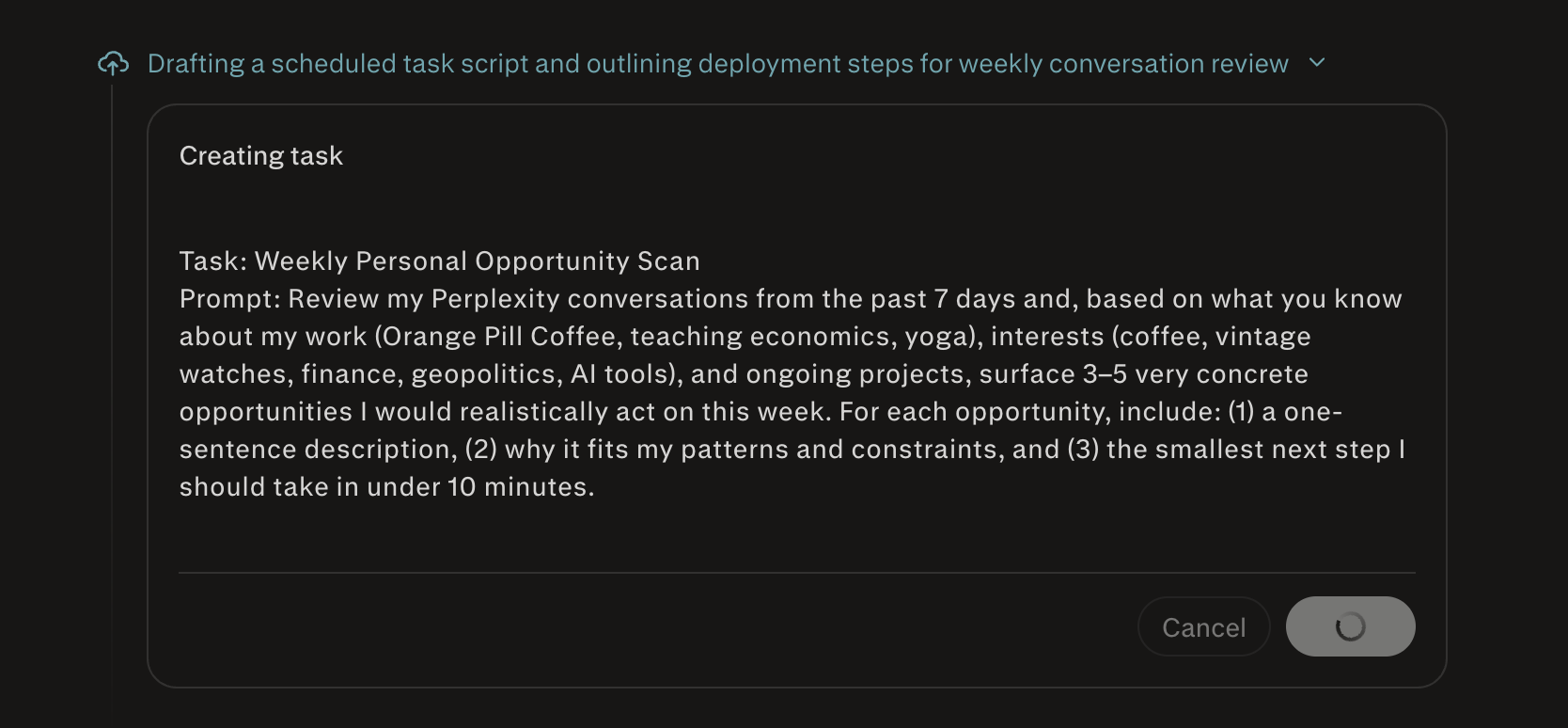
I can’t wait for my first weekly update which **drops tomorrow**.
## Reflection
Our conversation drew me in and despite my initial frustration of being *watched* I quickly moved to what could be in it for me. How might I use this tool to my advantage: not to lord power over others, simply to be a better version of myself.
I learned about Perplexity Tasks and how to set them up.
Is there a risk that my *deep learning* imprint is being shared with my AI’s overseers? Probably yes and on a meta-level it’s guaranteed to be. Our collective usage of AI is enabling optionality for the AI to get better, even if it is not a linear process.
But I think this point in time is different.
Specifically, we have been trained to distrust *the Internet Man* over the last 25 years as we have become more aware of social surveillance and its winners and losers.
The power dynamics of *Internet ad-tech* were always asymmetric, even though there was a mutual value exchange: free product and you’ll be the product.
At this specific point in time (2026) the power dynamics of *AI* are much less asymmetric and therefore you can and should **use this to your advantage**.
## Leader or Follower
You can live a great life either way. But you will cause yourself much more stress in the process if you don’t admit to yourself which one you are.
You can adapt your life at any time to move from one category to the other. Life requires you to do so sometimes.
---
##### Music: *Night Swim* by bahkin
[#companyman](https://www.linkedin.com/posts/vinaybeta%5Ffor-the-guy-whos-losing-everything-but-still-activity-7444085432906248192-FUkK?ref=pulpconversations.com)
### Whatever Works
URL: https://pulpconversations.com/whatever-works/
Last updated: 2026-08-30T16:43:56.000Z
> There is one and only one social responsibility of business: to use its resources and engage in activities designed to increase its profits so long as it stays within the rules of the game, which is to say, engages in open and free competition without deception or fraud.
\-Milton Friedman 1962
Everyone repeats it like a law of nature: a company’s job is to maximize shareholder value. Behind the mantra what do we find? A person. Or two. Or three. Every company begins with a founder.
Sometimes an accidental founder, sometimes a co‑founder team; but it takes one person to take that first step.
At that moment, the phrase “maximize shareholder value” is wholly aligned with one human’s incentives and choices. Corporate maxims are useful frames for public debates but they are blunt instruments when used to explain individual choices.
## Founders make tradeoffs every day
What to build, when to raise money, whom to hire, how to price, whether to accept an acquisition. Such tradeoffs reflect a mix of ambition, risk tolerance, legacy thinking, and limited bandwidth.
If you treat the shareholder‑value mantra as mechanical, you will miss why firms must sometimes prioritize short‑term returns or pursue audacious long shots. The moves often make even more reasonable *sense* when they are extensions of a founder who maintains control of the company. Then the realized preferences: scaling fast, cheating to stay in control, naming buildings, inventing for the love of inventing — may indeed be maximizing the key shareholder’s value even if you disagree.
For investors trying to understand a company’s long‑term prospects, instead of asking *does this decision maximize shareholder value*? Determine: how concentrated is the company’s ownership and management. The more concentrated, the more likely the company’s strategy will reflect one person’s horizon and values.
## This is often a competitive advantage
Founder‑led firms can be decisive, mission‑driven, and patient. Governance risk creeps in when the founder’s incentives no longer remain in sync with the realized dilution.
Look under the map of maximizing shareholder value to contemplate the human terrain dictating the levers responsible for the company’s trajectory.
My goal is to invite investors, managers, and students to think about companies not as machines but as the unfolding decisions of people who started them.
### #COMPANYMAN
URL: https://pulpconversations.com/companyman/
Last updated: 2026-08-30T16:45:37.000Z

#companyman
I’m running a tongue‑in‑cheek guerrilla campaign on LinkedIn, selling a “#COMPANYMAN” T‑shirt that blurs the line between fan merch for the dark comedy *Your Friends & Neighbors,* which is a suburban satire of hustle culture.
Jon Hamm the most excellent actor inspiring my t-shirt and star of YF&N has also been hitting the memes lately. In addition to his Bad Bunny fanboying he featured in one of [2025’s viral memes](https://www.youtube.com/shorts/EMKR3XQyJiw?ref=pulpconversations.com) based on his performance in a memorable scene in season one.
I have roughly 2,000 *followers* on LinkedIn (tiny) so I don’t imagine this will cut through the noise, but I’m having fun doing it so feel free to [follow along here](https://www.linkedin.com/posts/vinaybeta%5Ffor-the-guy-whos-losing-everything-but-still-share-7444085432021078016-%5Fnkb?utm%5Fsource=share&utm%5Fmedium=member%5Fdesktop&rcm=ACoAAABS0osBiF3RjjI402FxfPWgvsWQ7AlHdxA).
It’s my live experiment in whether subtle, *in‑universe* meme marketing can cut through a hyper‑professional platform and actually move a goofy t-shirt.
Isn’t it funny how people on LinkedIn talk about business but the real social selling happens on Instagram, Tiktok and others …
[The t-shirt](https://presspound.to/?ref=pulpconversations.com) will be released on 3 April 2026, the same day that Season ~~3~~ 2 launches.
---
##### Music: [*Active*](https://www.youtube.com/watch?v=bkuXv5ybTuw&ref=pulpconversations.com) *(Dance Cypher)* by Chop Daily x Wusu x MMorgan x HE3B
### Bo Rode A Bike
URL: https://pulpconversations.com/bo-rode-a-bike/
Last updated: 2026-08-30T17:27:53.000Z
*Perth* immediately popped into my head after seeing Bo ride a bike for the first time without any help. I was fortunate to enjoy and capture the moment. I felt joy, but like the song also haunted by the awareness of time, fragility, and what it took to get here. Beirut wrote the songafter a breakdown and hospitalization, yet it’s one of the most upbeat tracks on that album.
Listening to this **pop** song about collapse and getting back up while watching my daughter (methodically) ride a bike brings up many emotions around letting go, my own history of falling, getting hurt and getting back up again.
We all live through our own difficult chapters, but there is something about watching a small person start from zero, unaware of all the weight I hope she never has to carry.
Marching forward but also remembering the loss. This little departure means she is a step away from needing me as much. Seeing her wobble, self-correct, and keep on going is inspiring.
It’s unnerving to feel grief and nostalgia simultaneously.
One is about the future and the other’s about the past.
There will always be hard things but this tiny perfect moment felt easy.
---
Not of this world
Lean as a shadow
I was in Perth
When I was gathered
Blood on the sand
Paint on the water
I skipped around
As cannon fodder
Last night
I combed the earth
You saw me at my worst
Ragged tires
Burned for miles
I ran until it hurt
Reasons come seasonal
I’ll tell you when I know
See you in an hour
An hour back home
See you in an hour, or more
An hour back home
See you in an hour
Now we’re back home
See you in an hour or more
An hour back home
**\-Perth by Beirut**
### Pantone Politics
URL: https://pulpconversations.com/pantone-politics/
Last updated: 2026-08-30T17:29:19.000Z
This week I’m thinking about “left” vs. “right” and trying to come up with more textured definitions that make sense to me. There’s an important distinction between a *Conservative* willing to bulldoze courts or media in the name of a “real” majority and a *Market Pragmatist* who still believes in markets and tradition yet flinches at centralized excess.
In my teens I recall centrist being a compliment of sorts, but today I think the *Guardrail Center* is a market neutral (no potential alpha) affiliation. We aren’t living on a timeline where boring, essential stuff like peaceful transfers of power, election integrity and independent courts are in the cards.
Moving left (confusingly to the right in the image down below) we meet a *Democratic Repairist*, who believes we are in a blip and rather than some type of utopian redistribution, what we need, beginning with the Midterms is to ~~fix~~ return to the old machinery: PAC money is ok as long as it is surveyed more, gerrymandering can be made more equitable, and voting basically works. Fear not; pluralism has a fighting chance.
Only beyond such optimism do we reach the modern *Liberal*. A demagogue who either naively or opportunistically is calling for sweeping structural and economic change.
“Which side are you on?” isn’t the most interesting question. But I do think it’s important to ask yourself which of the logics govern your instincts? If you always keep your beliefs to yourself it might be an indication that you are uncertain where you lie on this engineered political spectrum.
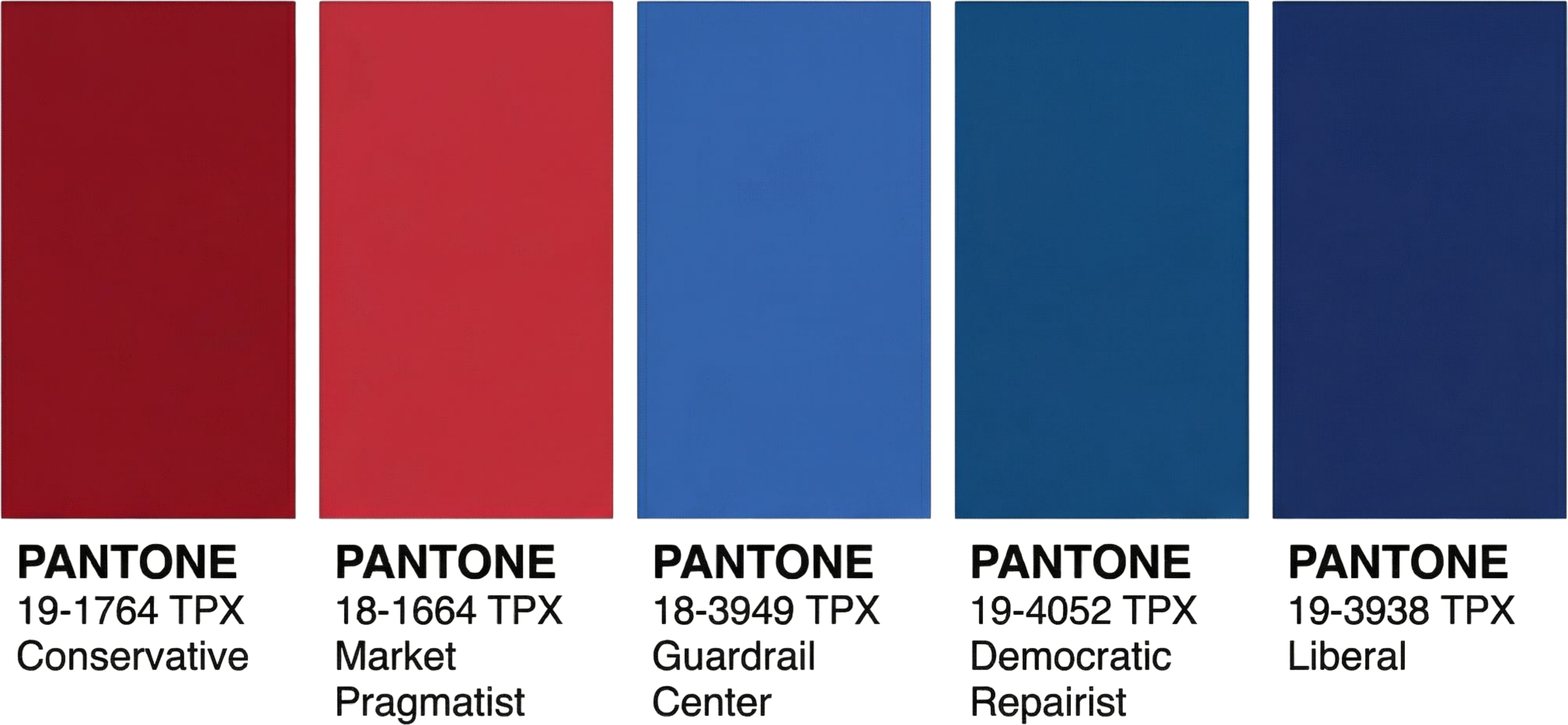
Pantone Politics
---
## Definitions
**Conservative**
Pro‑market, socially traditional, nationalist or “America First” tones, skeptical of reforms that weaken majoritarian power.
**Market Pragmatist**
Conventional pro‑business right, more institutionalist, somewhat more open to guardrails and rule‑of‑law rhetoric, but resistant to expansive regulation/reform.
**Guardrail Center**
“Norms and guardrails” first, pluralist, incremental reform; attempts to keep the peace between market‑friendly views with rule‑of‑law, anti‑polarization, and process‑reform priorities.
**Democratic Repairist**
We are in a blip, democracy can be repaired, money‑in‑politics reform, voting‑rights expansion, anti‑Trumpist, critical of Project 2025, but not full progressive redistributionist.
**Liberal**
Full democratic‑left coalition: strong civil‑rights and climate agenda, big social‑safety‑net expansions, very critical of capitalism’s current form.
---
##### Music: *10 Minutes* by 6uff ft. Odumodublvck
---
[Subscribe](#/portal/signup)
### You Can Bet On Yourself
URL: https://pulpconversations.com/you-can-bet-on-yourself/
Last updated: 2026-08-20T20:38:56.000Z
There are many “insider trading” allegations flung at Kalshi and Polymarket but the insider‑trading rubric we’ve grown up with feels increasingly misaligned with what’s actually going on.
Prediction markets are predicated on information asymmetry - you can literally bet on an outcome you help produce. You can bet on yourself or rather your ability to will the outcome into existence.
Is that *bad*?
*Information asymmetry* as it pertains to prediction markets forces us to think more broadly about incentives, reputation, and how markets and participants co‑evolve.
I think it’s worth covering how most of us think of insider trading based on legacy stock markets.
- The asset (the stock)
- A static class of insiders (executives, directors, employees)
- A legal theory built around *fiduciary duties* and material *non‑public information*
Insiders are supposed to run the firm, but not interfere for self-gain. And therefore Outsiders (efficient market hypothesizers) can adeptly price the firm. Meanwhile, regulators keep insiders from front‑running outsiders.
## Prediction markets blow that up
The “asset” is a bet on a real‑world event.
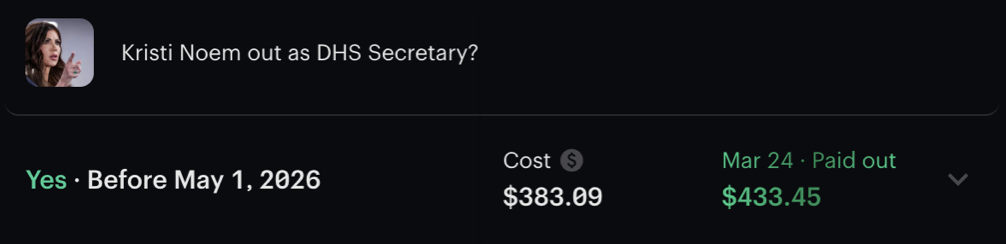
I made a good call
The set of people who both know something and can influence the outcome is fluid and situational; not a static set of insiders like our incumbent mental model.
Prediction markets are exciting because they are grounded in reality. The **insiders** both *possess* information and *participate* in making the event real. The **outsiders** may also possess information or benefit from a Cantillon Effect of sorts as they serve to *make the market* (marketing and promotion), increasing a bet’s liquidity.
## Reflexivity
Once there is a visible price on “Will X happen?”, that price can feed back into how insiders behave.

Fool me once, shame on you. Fool me… you can’t get fooled again.
But outsiders are adept at assessing credibility: the market remembers if you tend to hit your deadlines, or pass your policies. The expectations might change the next time there’s a contract with your name on it.
As an insider, if you know that your own track record in markets is being watched, you may act differently precisely because you anticipate that future markets will reprice your involvement.
There’s also a subtler reputational loop that plays out over time. If markets repeatedly see that “people close to the action” trade aggressively and are more often right than wrong, the presence of those traders becomes a signal.
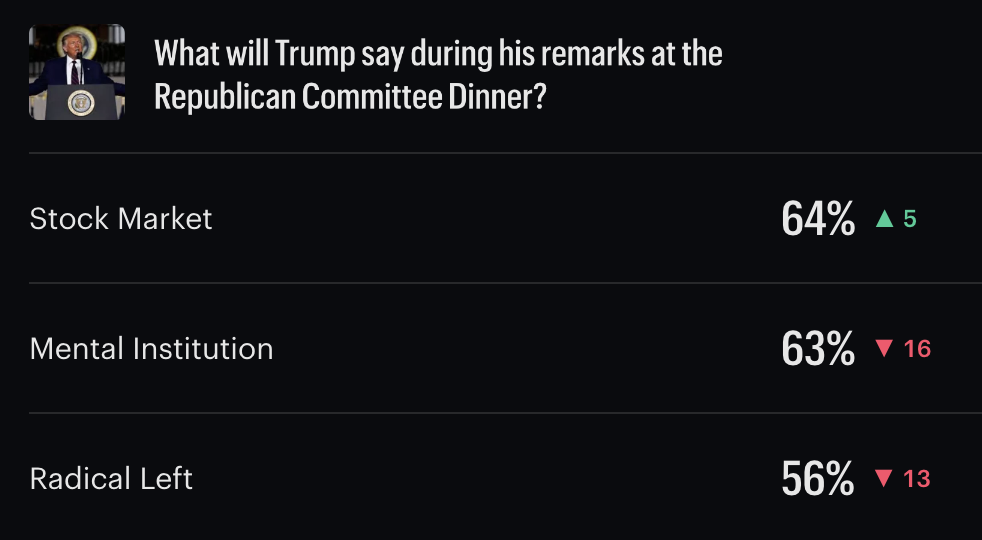
Prediction markets are not just about outcomes because you can close your position before the market resolves. For example, you may agree with the 56% of people who are currently betting that Trump says the phrase “Radical Left” at the upcoming Republican Committee Dinner. If you put your $56 where your mouth is and turn out to be right, you will be paid out $100 (a $44 profit). In other words you made a $56 bet at 1.79x odds.
However, if tomorrow the market becomes more bullish on this prediction and believers in the radical left mention market increase to 75% - you can close your position (for $19 profit).
I think this is neat because it’s like making two bets at once. The primary outcome oriented bet and a secondary but more meta-reputational bet on the agents aka insiders on the playing field.
[Subscribe now](https://www.pulpconversations.com/subscribe?ref=pulpconversations.com)
**We should want insiders to put skin in the game and move prices.** A market that only reflects the views of the uninformed is simply a poll.
What kinds of information advantages and real‑world influence do we want to *permit* going forward? Ultimately we the people decide. If we don’t lean into frontier behavior then *they* will decide the rules for us.
If you imagine yourself as both a trader and a subject of these markets, wouldn’t you rather live in a world where you retain the ability to “bet on yourself”?
[Message Me](https://forms.fillout.com/t/hy5FeLyV8wus?ref=pulpconversations.com)
##### Music: *Yonaguni* by Bad Bunny
### Algorithm Malls
URL: https://pulpconversations.com/algorithm-malls/
Last updated: 2026-08-20T20:40:47.000Z
They are all algorithm malls. I miss the ethos of the Dial-up Internet Age.
Today I feel like picking on Substack because it likes to present itself as a haven for writers: a quiet place to publish, connect with readers, and escape the *noise* of social media. But if you look closely at how it actually behaves, it’s just another **algorithm** **mall**.
In a mall, the architecture is designed to **keep you inside**, wandering past store after store, constantly nudged by layout, signage, and impulse displays. Your attention is the product being optimized.
Substack continues to introduce new features such as Notes, Recommendations, and Restacks pushing in the same direction. The ideal 𝗰̶𝘂̶𝘀̶𝘁̶𝗼̶𝗺̶𝗲̶𝗿̶ user is no longer allowed to be *just a writer* creating thoughtful posts, but incentivized to be a maniacal participant feeding the in‑app feed with bitesized, scrollable content. Of course you can still be *just a writer* but ...
... If you simply publish essays or links you love and then leave, you quickly discover how little the system cares about your work. Your posts go out to whoever is already subscribed, and beyond that, you are invisible. These days even your subscribers can’t be arsed to share your writing (a bloody link) with anyone. Why? Too busy scrolling and caught up in their own life to elevate others.
Discovery isn’t driven by quality or depth any longer.
It is driven by what the algorithm can easily measure: Likes, Re-stacks, Comments, Dwell Time. If you’re not participating in this game of dipshits, you’re choosing to stand outside the mall like a *chugger*.
> Dear Substack,
>
> You create a subtle but corrosive pressure on writers.
>
> Why do you want writers to ask themselves, “What will travel in Notes?” rather than focus on writing something wholly meaningful. It’s your job to distribute by doing the work, not forcing us to awkwardly self-quantify.
Substack: the platform that promised to free you from social media logic quietly pulls you back into the same dynamics, just with more tasteful branding.
Also there is a power imbalance baked into the design.
Substack controls the corridors, the signage, the recommendation rails.
They decide which publications get pushed, which writers appear in “Because you read…,” and which topics are amplified.
You’re encouraged to believe this is meritocratic, but the underlying incentives are clear: the more you keep readers inside the ecosystem, the more the system rewards you.
The mall loves shopkeepers who generate foot traffic.
Substack is a cool publishing platform and my platform of choice because it offers seamless email delivery, a clean editor, and is genuinely fun to use. Yet, I wish Substack was honest about what it is.
It’s not a neutral platform that simply “serves writers.” It’s an attention engine with writing attached.
And it leaves me wondering, in 2026, where can I distribute something that doesn’t depend on an algorithm mall?
Please lmk in the comments - I’m genuinely looking for cool places where creative souls hang out.
[Leave a comment](#ghost-comments-root)
### The Story of Rick Ross
URL: https://pulpconversations.com/the-story-of-rick-ross/
Last updated: 2026-08-30T17:40:41.000Z
Safety is everybody’s business: I made this music video using the Prelinger Archive.
---
> Rick Prelinger is an American **archivist**, filmmaker, writer, and professor emeritus at the University of California, Santa Cruz, best known for founding the Prelinger Archives, a vast collection of advertising, educational, industrial, government, and amateur films. Beginning in the early 1980s, he systematically rescued “ephemeral” films that were never meant to be saved, building a collection of tens of thousands of titles that the Library of Congress acquired in 2002, while he continued to expand and digitize the archive independently. He partnered with the Internet Archive to put thousands of these films online for free viewing and reuse, making him a key figure in open-access moving-image culture. With his spouse Megan Prelinger, he co‑founded the Prelinger Library in San Francisco, an appropriation‑friendly research library focused on media, technology, landscape, and social history. As a filmmaker, he creates archival‑based works such as “Panorama Ephemera” and the “Lost Landscapes” series, which remixes home movies and found footage into live, participatory screenings where audiences help narrate urban history from below.
>
> \-[Perplexity](https://rentry.co/8brym9g8?ref=pulpconversations.com)
#### Music:
##### *This Thing Of Ours* by Rick Ross feat. Nas, Wale and Omarion
#### Video:
##### Mixed by Pulp Conversations using Safety: Harm Hides At Home from the Prelinger Archives.
---
[Message Me](https://forms.fillout.com/t/hy5FeLyV8wus?ref=pulpconversations.com)
### Z Score
URL: https://pulpconversations.com/z-score/
Last updated: 2026-08-30T17:44:36.000Z
### Be a thinker, methodic in your motives.
We spend an extraordinary amount of energy comparing ourselves to others.
He got promoted faster?
She is looking fit!?
He is investing in what, must be nice?
She has how many followers?!
Metrics, metrics and more meaningless metrics.
If you are in a numerate profession you probably have applied z-scores in your trading or science experiments. But have you used it to manage your own being?
## What’s a Z-Score, dawg?
At its core, a z-score measures a quantity against itself. Not against something else’s performance, but against its own historical pattern.
If you normally sleep between 6 and 8 hours per night, with 7 hours being your average, then a 9-hour night is exceptional *for you*.
It doesn’t matter that your friend routinely sleeps 10 hours. Your 9-hour night represents a significant positive deviation from your **personal baseline**.
The z-score captures how far away any particular data point is within your own distribution.
In technical terms, a z-score tells you *how many standard deviations away* from your mean a particular measurement falls. Human translation: it tells you how different this moment is from your normal, and whether that difference is meaningful or just noise.
## We ain't the same color clarity of diamond.
We drown in external benchmarks. We chase highlight reels. We promote job promotions that typically have nothing to do with our decision-making.
Retirement gurus tell us we should have saved X by age Y, yet personal finance is sparingly taught in secondary schools. MBA students are taught how to ~~cook~~ balance the books of billion dollar companies, yet most have no clue how to mitigate tax for personal effect.
Someone else’s progress is a function of their advantages, not yours. When we chase the ideals of others we are unconsciously optimizing for their distribution.
It’s all about [distribution](https://orangepillcoffee.com/?ref=pulpconversations.com#distribution), distribution, distribution.
Descendant from kings, we at it again
Just hand me the crown, I’m active again
\-Pusha T
## Measuring Against Your Own Distribution
Your z-score forces you to compete only with your past self.
It doesn’t matter that someone at the gym can do 50 pushups. That’s their distribution, not yours. What matters is that you’re improving relative to *your own baseline and your own variance*.
This applies to everything.
Your savings rate, your work ~~output~~ outcomes, your relationships, your mental health metrics.
Am I as successful
as them?
Am I better than
I was last month?
## Why This Framework Works
1. **It’s personalized.** Your baseline is yours. Your variance is yours.
2. **It accounts for context.** If you’re going through a difficult period and your performance drops, the z-score reflects that in your new distribution. You’re not held to an external standard that ignores your reality.
3. **It highlights meaningful change.** Small fluctuations are just noise around your mean. But when you see a genuinely high z-score (positive or negative), you know something significant has shifted. You can literally *see yourself* in the data.
## The Profound Simplicity
I think what’s quite profound about this is the philosophical shift it requires. We’re so conditioned to look outward for validation, for benchmarks, for proof that we’re “enough.” The z-score approach says: the only meaningful competition is with your past self.
Pick one metric that matters to you.
Ideally, something you can measure regularly. e.g. money saved per month.
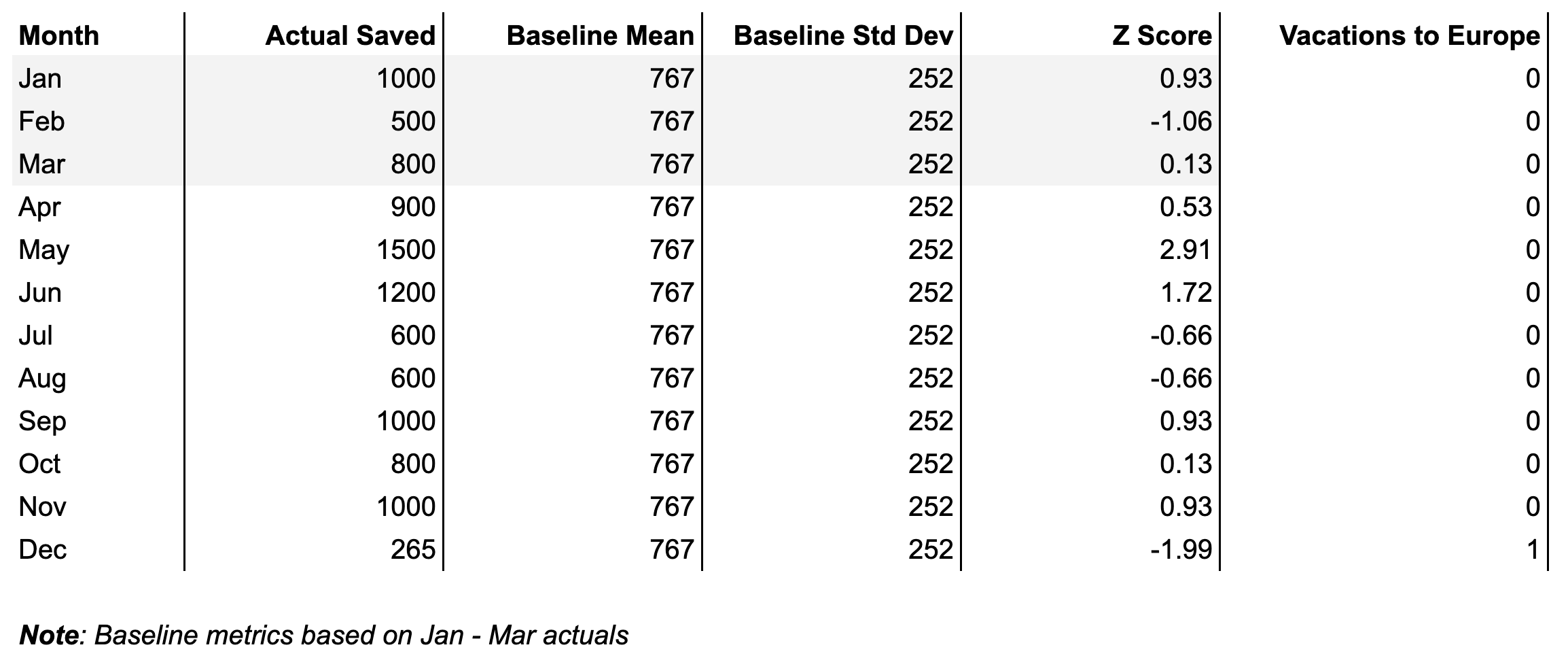
****10 Bandz A Make Her Dance**
Track it for a few months to establish your baseline and your normal variance. What’s your average? What’s your typical range?
Then, as you continue tracking, notice when you significantly exceed or fall short of that range. Those are your high and low z-score moments. Investigate them. What caused the spike? What led to the dip? What can you learn about your own patterns?
## The Only Race That Matters
At the end of the day, you’re not trying to be them.

You need to be a better version of you. And the z-score can help you see whether you’re actually getting there.
[Click here](https://cutt.ly/zscore?ref=pulpconversations.com) for the z-score template you can copy and use to compete with yourself. The cool thing about z-scores is that you can overlay other meaningful data on top to better elucidate *the why* behind your scores.
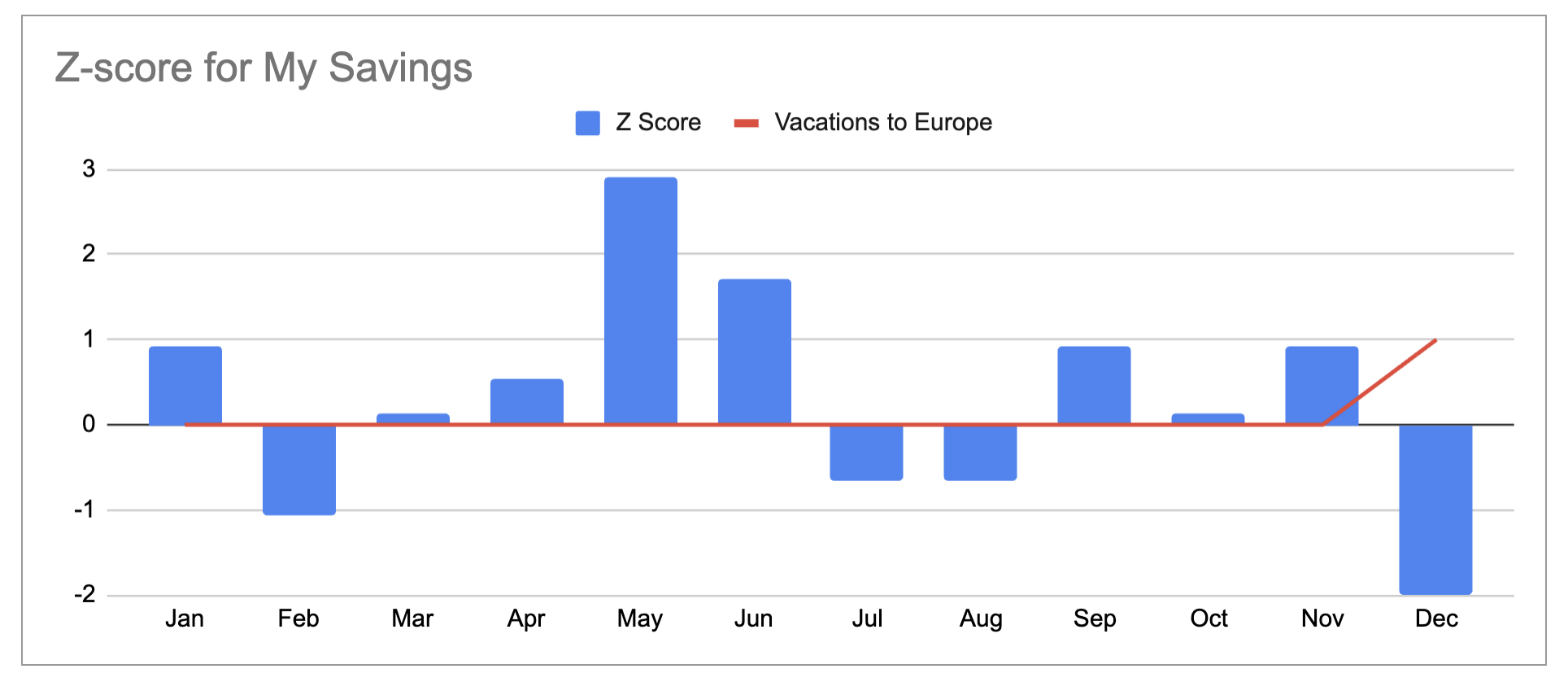
If you right or you wrong, if you riding come on
By the end of this song, can't be hiding for long
\-Rick Ross
---
#####
##### Music: *Hold On* by Pusha T ft. Rick Ross
### LinkedIn Is Just Human
URL: https://pulpconversations.com/linkedin-is-just-human/
Last updated: 2026-08-30T17:46:54.000Z
I was doing some research about how LinkedIn works. Specifically, I was researching the linkage between a personal profile on LinkedIn and a company account, as I was in the process of creating one. My initial reaction was to log out of LinkedIn, which I did.
When I tried to create another account for the company, I realized there was no UX for that. I went to the AI and asked a few questions about my company account and personal account; do they need to be separated on LinkedIn? It essentially told me no. That’s not how it works. Every company account has to be initiated by a real human; then the ownership or the administration of the company account can be shared across more than one individual, also a human.
**But it has to start with one.**
After briefly daydreaming about Ryan Reynolds and Blake Lively setting up a linkedin for [Maximum Effort](https://www.linkedin.com/company/maximumeffort/?ref=pulpconversations.com). I proceeded to ask AI a few more questions and then …
I said *hey, thanks this is really helpful*.
**The AI offered help to me learn something more**, which I did. *I always want to*, and we went on to have an even better conversation. I learned more things. It struck me as a poignant moment.
I reflected that AI doesn’t talk back to you (maybe Grok does, but I don’t use that) or get angry with you for abusing it. And yet it’s very easy to verbally abuse the AI: we have seen the promised land; now we want **better, faster, cheaper … more, more, more** .
There isn’t a visible penalty for behaving badly towards the AI, yet there are benefits for behaving kindly and curiously. I think that’s something to think about.
In LinkedIn, based on how their algorithm works, let’s say that you’re the owner of a company. Does it make sense to create a company page and link it to your personal profile, or is it better to create a company page with a whole new account?
I ask this because, as time goes on, obviously those two accounts are going to interact with each other on LinkedIn, but the technical relationship between those two accounts will be different. I’m curious: how does that translate into the way the LinkedIn algorithm works?
\-**My Perplexity 👆🏽 query and response 👇🏽**
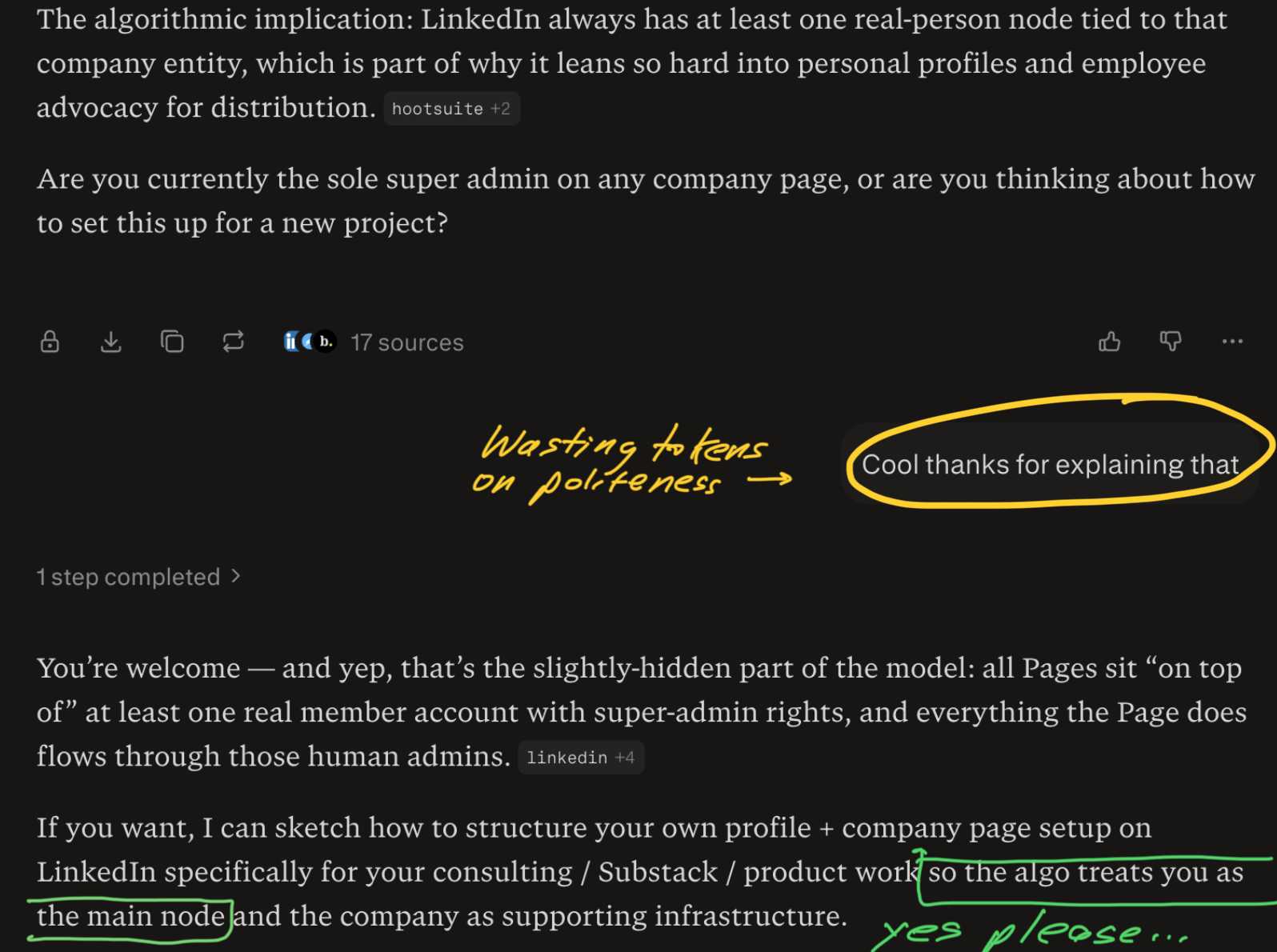
Gratitude pays dividends.
#### 2035
Imagine the pop narrative of the future … *AI is responsible for making humans uncivil. It has trained us not to say please and thank you. Why burn the tokens?!*
#### Meanwhile
There is a young woman out there as we speak. She is not allowed on the Internet today, except for some cheeky Youtube episodes at dinner time. She will learn to say please and thank you to the AI. And it will give her alpha.
Thanks for being one of the few who make it to the bottom. You are a real one.
#### Post Script:
##### *Pulp Conversations* is back to being entirely Free. Thank you to those of you who supported me with your $$$. You may see a refund of sorts in the coming days. I never intended to charge for my content but word on the street is that Substack deprioritizes free newsletters so I figured I’d experiment. I learned there is no advantage to me to charge for my content. I’d rather get my ideas out there to anyone who might appreciate one of my inside jokes or ~~hot~~ fire takes.
---
#### P.S. #2
Here is the new [company page](https://www.linkedin.com/company/orangepillcoffee?ref=pulpconversations.com). Follow for news about the good life.
### All Day
URL: https://pulpconversations.com/all-day/
Last updated: 2026-08-30T17:49:15.000Z
This distinction has resonated with me after the company I ran [*died*](https://www.flourish.org/2013/03/four-ways-well-help-whipcar-if-they-tell-us-what-went-wrong/?ref=pulpconversations.com). The more I live, the clearer it becomes that activity and progress are different beasts. Activity is motion while progress is motion that changes your reality.
We get stuck in perpetual motion machines (activity) and so when we do achieve progress, it’s often difficult to appreciate our growth because we are caught up in an activity-based mindset.
Consider the work-for-a-boss example: people grind through the year doing the tasks the job requires, and then get disappointed by a performance review or a small salary bump.
That’s activity.
If you allow external review cycles define your improvement you are not in control over your own progress. The counter example is owning your objectives and specifically your **learning objectives**.
Owning progress is about agency. You can be part of a company and still direct your growth, however what’s the point of getting so vested in your company’s mission, especially if you are not *invested* in your company.

I’ll be here all day
As long as you’re getting paid and you’re fulfilling your own learning and personal objectives, you’re good. It’s a bonus if these align with your employer’s objectives, but don’t chase that unrealistic ideal.
We need to manage our energy in ways that make us proud.
Having a kid changed my perspective on life and specifically how I should be evaluating and making decisions in a more thoughtful, structured and precise way. Conveying values to my daughter forces me to convert activity into intentional progress.
## Progress requires decision and iteration
Decisions *must* be made with confidence, because you can’t just be a leaf floating in the wind and then be disappointed about where the wind took you. That’s what losers do.
If you fail, you need to iterate. Are we going to get it wrong sometimes? Of course we are. But then we try again and ...fix it. This is the only way for activity to become a series of disciplined experiments.
Act, measure, learn, adjust. Without that loop, activity is just repeating rituals. Set hypotheses for your actions and evaluate them, rather than endless motion without criteria.
We start from different starting lines and therefore some of us may be subject to wind conditions to a far larger degree than you or I. Still, regardless of whatever constraints you have, I venture to think you’re more resilient to the wind than you might think.
## So what exactly is activity?
Going with the flow.
Small talk ad nauseum.
Talking to friends as if they were clients.
Activity often disguises itself as normal social or professional behavior. Time spent on email threads, meetings, and other busywork obscures our ability to gauge whether we are moving toward our goals.
Especially in client work, you can fall into predictable power dynamics where interaction is transactional and also rife with a pernicious behavior style that makes it difficult to have beyond-superficial friendships and connections.
This is activity masquerading as progress.
Startups suffer from this, fucking 99% of the time. They build functionality that nobody uses. Sometimes, someone tries and everything breaks. The correct approach is to deliver a smaller set of features well. It’s better to offer only 10% of the functionality that you’re capable of delivering on BUT then execute and deliver on it a 110%.
Promising a thousand features, delivers chaos. Progress in product work comes from focus, ruthless prioritization, and consistency.

Do Less
Do fewer things superbly and then scale them.
Which relationships in your life are about mutual growth and which are activity-based exchanges?
## One week experiment
Evaluate the power dynamics and the relationships that are prominent in your life. Are you happy with those dynamics? Do they support your progress or simply consume time?
A long-term orientation matters because activity feels like an accomplishment, while progress is slow and invisible.
Until it’s not.
Progress is also a symptom of values put into action. The daily grind has got to align with the desired endpoint. Focus on a few things that move the needle, be ruthless about measuring outcomes, and treat relationships, work, and projects as experiments you can learn from and improve over time.
---
##### Music: *All Day* \- [edit](https://www.youtube.com/watch?v=y3qEnsE0IMM&ref=pulpconversations.com) by DaReelest: Kanye West (ft. Kendrick Lamar)
---
[Message Me](https://forms.fillout.com/t/hy5FeLyV8wus?ref=pulpconversations.com)
Shoppin' for the winter, and it's just May?
### Unapologetic Realpolitik
URL: https://pulpconversations.com/unapologetic-realpolitik/
Last updated: 2026-08-30T17:51:47.000Z
Interacting with other humans forces you to confront a simple, uncomfortable rule: always separate what people say from what they actually do. I have neighbors who talk about protecting community character by advocating for illegal behavior. You probably have your own version of privileged NIMBY-ism.
It’s easy to be a born‑again moralist who preaches virtue without offering any real solutions. Perhaps you have a colleague who wraps a power grab in the language of “collaboration.” *Classic move!*

Pay attention to actions and outcomes instead of getting hypnotized by rhetoric. From an evolutionary perspective it makes sense for organisms to track real behavior, not stated intentions. I’m not sure amoebas have intentions 🧐 - probably not.
Don’t trust, verify. And only then decide if someone has earned your trust.
The same rule applies when you look at large organizations. Very few people in the world are genuinely and wholly munificent. Even [Mother Teresa had a shadow side](https://archive.vanityfair.com/article/share/886fb3b2-3cc4-40a9-8a6b-f357c14550b6?inline&ref=pulpconversations.com) that would repulse most people who formerly referred to themselves as woke.

R.I.P. woke
Once you inspect incentives, money flows, and outcomes you start seeing reality. Don’t get it twisted - public companies are supposed to *maximize shareholder value* above all else.
## “Don’t be evil.”
Arguably Google’s former mantra is the best known company motto of the 21st century. It made for a great poster and bamboozled the weak minded. Instead if you assume that any major platform always acts in its best interest, you’ll usually be correct.
The history of *Google Analytics* (GA) over the last two decades is an apt case study of incentives playing out in slow motion. Initially, GA launched as a democratizing tool. Back in 2005 when 50 Cent dominated the airwaves, Google acquired a product called Urchin and turned it into a free, hosted analytics platform. You pasted a single script into your site and within a day you had page-views, referrers, and a set of canned reports.
Example:
``
You could define Goals based on simple URL rules (like “reached /thank‑you.html”) and see how many people made it through a basic funnel. If you had minimum-viable- technical ability, you could move from *I bought a domain* to *I can see who visited and who converted*, with relative ease.
Over the late 2000s and early 2010s, the product grew up. Universal Analytics introduced a more flexible data model, custom dimensions, and eventually gave e-commerce a categorical glow-up.
Agencies and analysts got a ton of power to model complex user journeys, stitch sessions across domains, and instrument detailed behavior with [*events*](https://mixpanel.com/blog/event-analytics/?ref=pulpconversations.com).
But for us moms and pops, friction started to creep in. The GA user interface gained more tabs, switches and jargon. It quickly became a full-time job (literally an industry) to know the difference between words such as: [sessions](https://support.google.com/analytics/answer/2731565?hl=en&ref=pulpconversations.com#zippy=%2Cin-this-article), [hits](https://www.tendenci.com/help-files/meaning-of-hits-visits-page-views-and-traffic-sources-web-analytics-definitions/?ref=pulpconversations.com), [last‑click](https://www.adjust.com/glossary/last-click-attribution/?ref=pulpconversations.com) and [assisted conversions](https://www.cometly.com/post/what-are-assisted-conversions?ref=pulpconversations.com).
Googlers from this era carried a not-so-quiet arrogance, priding themselves as pure technologists who dismissed style and surface polish. And despite the GA product innovations, the basic flow remained intact. So if you just wanted visits and a couple of simple actions, the Goals UI and the standard reports were still there. You could ignore the advanced stuff if you didn’t need it and still get your job done.

But then things started to feel different once Tag Manager and GA4 entered the picture. Google Tag Manager existed for years, but by 2012 it had become the “best practice” default.
Instead of pasting individual scripts into your site, the flow required you to install one GTM container and then manage everything from Analytics to ad pixels inside the container. If you don’t understand what I am talking about at this point, don’t worry it’s not supposed to make sense for normal people. **The key takeaway** is that the product’s gravity moved away from democratizing analytics for all to a workflow for ad engineers to manipulate your social media. *But hey don’t be evil!*
Google Analytics 4.0 (GA4) completed the pivot. It launched in 2020 and became mandatory soon thereafter. GA4 replaced the old “webpage” model with an “event” model. Conceptually it makes sense because most of us consume the Interweb in a mobile-first way, expecting to seamlessly move from there to our laptops, tablets, and back again. However, the basic and most useful use case is all but impossible now.
In order to simply track who visits your domain and perhaps does something simple like clicking on the button for your newsletter you need to:
1. Create a GA4 property and web data stream.
2. Create a Tag Manager container.
3. Add a base GA4 tag in GTM with the right Measurement ID.
4. Configure the platform you’re using (like a no‑code site builder) to load that GTM container.
5. In GTM, enable click variables, define a click trigger that matches the button, and create a GA4 event tag wired to that trigger.
6. Use a separate Preview/Debug interface to confirm the tag fires, then use GA4’s DebugView to confirm the event arrives.

So why is this important? Because Google has controlled the Internet for the last generation and is actively trying to [sue others out of existence](https://www.reuters.com/legal/litigation/google-lawsuit-says-data-scraping-company-uses-fake-searches-steal-web-content-2025-12-19/?ref=pulpconversations.com) for doing what they built their company on. *NIMBY!*
It’s not just me ranting, the GA interface has been [widely criticized](https://beyondreach.substack.com/p/how-to-make-ga4-actually-like-good) as confusing and impenetrable for years despite its core structure remaining mostly the same. This is not an accident, it’s just that they don’t give a eff about your pain.
## *You’re not built for these streets!*
Lessons: Don’t take anyone’s high-minded story at face value, whether it is Google, Mother Teresa or your neighbor. Do your own research (DYOR). Don’t be shocked when a giant behaves like a giant. Assume self-interest. Understand incentive structures and be mindful of what you are handing over in exchange for the perceived value you hope to attain.
Don’t be a hater, just don’t get played.
##### Music: *Disco Inferno* by 50 Cent
---
Thank you for your time.
### The Cost-Benefit of Being Available
URL: https://pulpconversations.com/the-cost-benefit-of-being-available/
Last updated: 2026-08-30T18:04:49.000Z
This week I started a [short course on AI](https://chipp.ai/thebusinessagentsofchange?ref=vinay&source=pulpconversations) led by my friends Scott and Hunter.
So perhaps it’s less surprising that I woke up thinking about **MCP**, and how it threads through everything we do.
MCP stands for “Model Context Protocol”. Recently it became an open standard that defines how AI models (like LLMs) connect to external tools, services, and data sources in a consistent way. A good way to think about MCP: it’s the AI-equivalent of USB-C, the omnipresent cable that plugs into most devices in your life - even the bloody iPhone!
So MCP is AI terminology but conceptually it can be applied not only to technology but also our work and relationships. The concept of MCP requires us to observe practical, everyday questions of what we let in and what we keep out of our lives.
`Open versus closed.`
`Connected versus private.`
These are fundamental decisions that change the way we interact with other people. I don’t believe that open-ness is inherently virtuous nor closed-ness as cowardly. Both states of being have *costs and benefits*.
If you wake up and give yourself the power to lean-in or walk away based on how the math pans out, then you are working like a MCP: measuring cost and predicting payoff. I think it might be a wise way to evaluate how you spend your attention, your time, and your trust.
Every app, every notification, arguably every human … asks for something. Sometimes it’s a sliver of attention, often it is much more. Openness at its best makes life feel *in sync.* We share widely and stay perpetually available, which brings convenience and unexpected happiness into our lives. Openness can also lead to attention-deficit (not necessarily the clinical condition); simply logically because you are less in control of what you let in.
When you turn off features, limiting who has access; you create space for privacy. Being closed can protect your headspace and guard your time. It’s lonely when taken too far, but most of us never get remotely close to that in this day and age, even if we feel that way. Instead our [loneliness is typically a byproduct of being too open](https://www.ted.com/talks/sherry%5Fturkle%5Fconnected%5Fbut%5Falone?ref=pulpconversations.com).
Closed-ness creates conditions to think clearly and to trade for fewer, higher-quality interactions rather than a hundred shallow ones. The trade-offs are real. You need to find the right open versus closed balance for yourself.
Social obligations (aka peer pressure), consensus-thinking, our reputations … these things push us toward openness. We stay in groups, even when the *mean girls* dominate the discussion. We keep our calendars full - have you tried planning a play date with your NYC-based friend —> “*I think we have a two-hour slot six weeks from now but let me check because that’s in Tribeca and traffic going uptown is terrible around that time, so let me get back to you,"* 🤦🏽♂️.

Obligations that aren’t aligned with return on life are worth questioning. We don’t owe everyone our time, especially once we become aware we have been driving on one-way streets, but in the wrong direction.
I want you to make a small experiment when you read this.
Over the next week, notice one relationship and one piece of tech. For each, ask two questions before you act:
---
1. What’s the immediate cost in terms of time, attention and emotional energy?
2. What’s the likely payoff in terms of usefulness, joy, learning, or growth?
---
If the the cost exceeds the payoff perhaps consider giving yourself permission to change the boundary. **Mute** group chats, **batch** notifications, **turn off** auto syncing, **decline** an invite. Most people will just go away. Some people will send one liners, alleviating their conscious but in practice outsourcing the relationship-work to you.
The real ones who might be confused may ask for a direct conversation to ensure continued mutual growth with you.
Hold on to those people.
Let the other ones go and wish them well on their journeys.
## Think of your attention like financial capital: invest it where the compound interest is real.
---
##### Music: *Jogodo* by Tekno
Bonus material: some mermaid charts about MCP 👇🏽
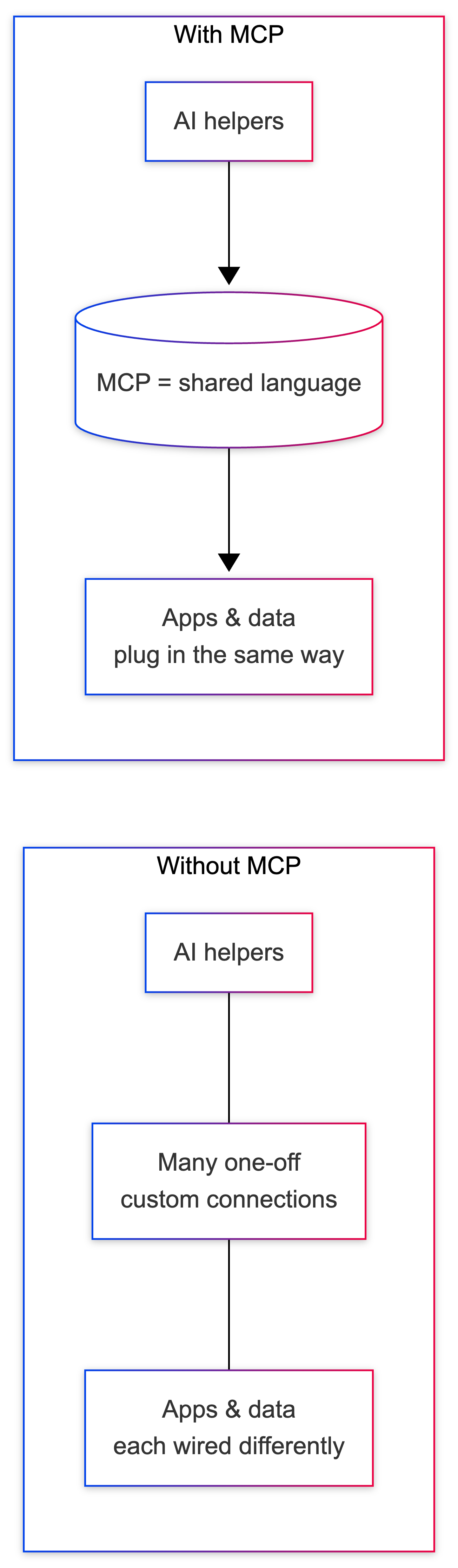
Finally, remember that this is iterative. You’ll get it wrong sometimes; a closed choice might cut you off from something wonderful, or an open one might drain you. That’s okay. The benefit of approaching life like MCP is that you can correct course quickly. You don’t have to be bound by precedent, guilt, or what everyone else expects. You can realign based on what’s demonstrably working for you.
---
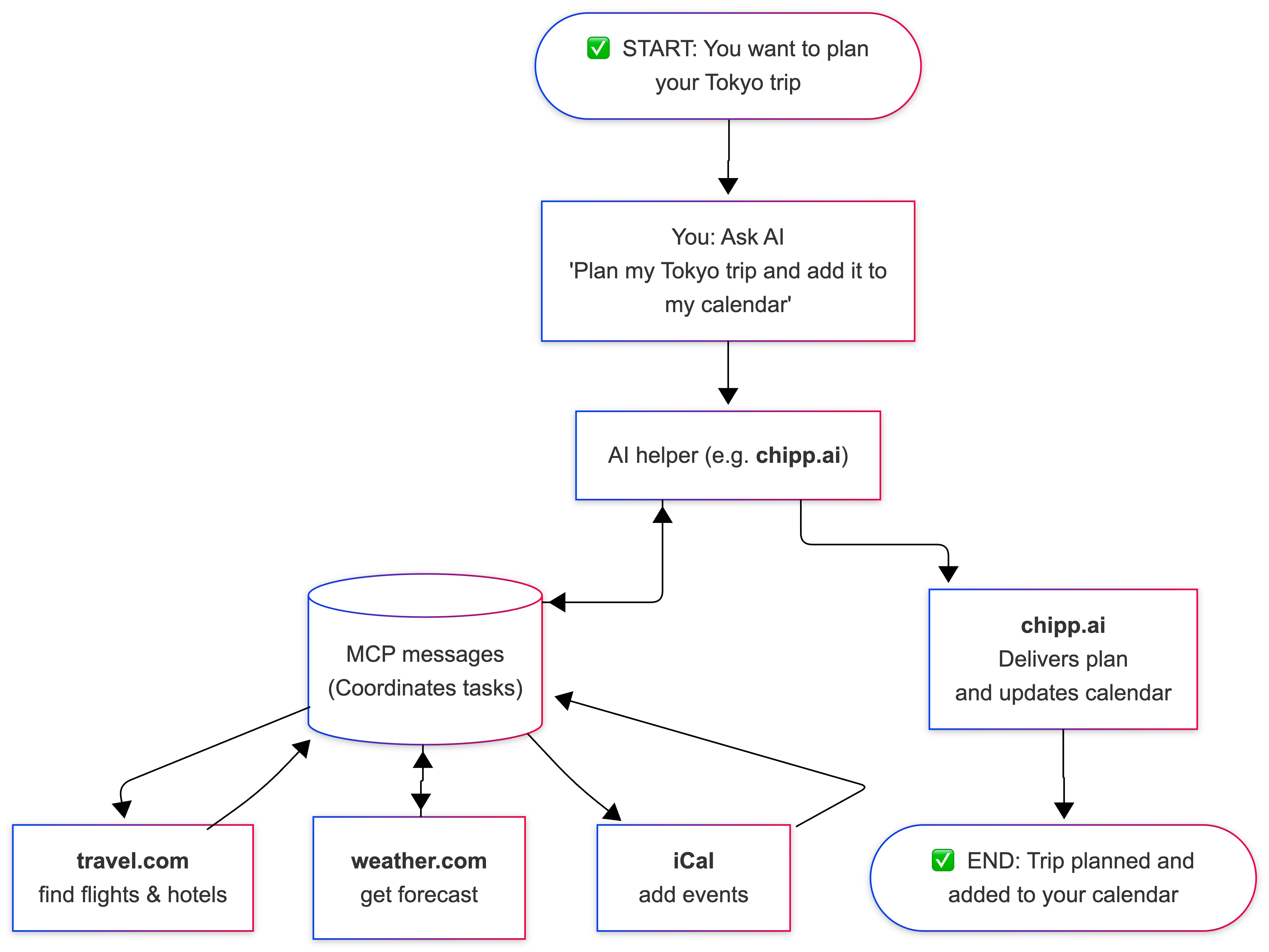
For the nerds [more on MCP here](https://read.highgrowthengineer.com/p/mcps-simply-explained?ref=pulpconversations.com).
Thank you for reading. Please share this with someone if you enjoyed it.
### Colby's Prerogative
URL: https://pulpconversations.com/colbys-prerogative/
Last updated: 2026-08-30T18:10:13.000Z
Elbridge Colby is the Architect of the War Department. He is third in the civilian hierarchy under Hegseth and Trump. It’s estimated that 80% of Iranians do not want a new Supreme Leader, however dissolving the Islamic Republic’s *Assembly of Experts* (the actual name 🙈)seems an unlikely near-term event.
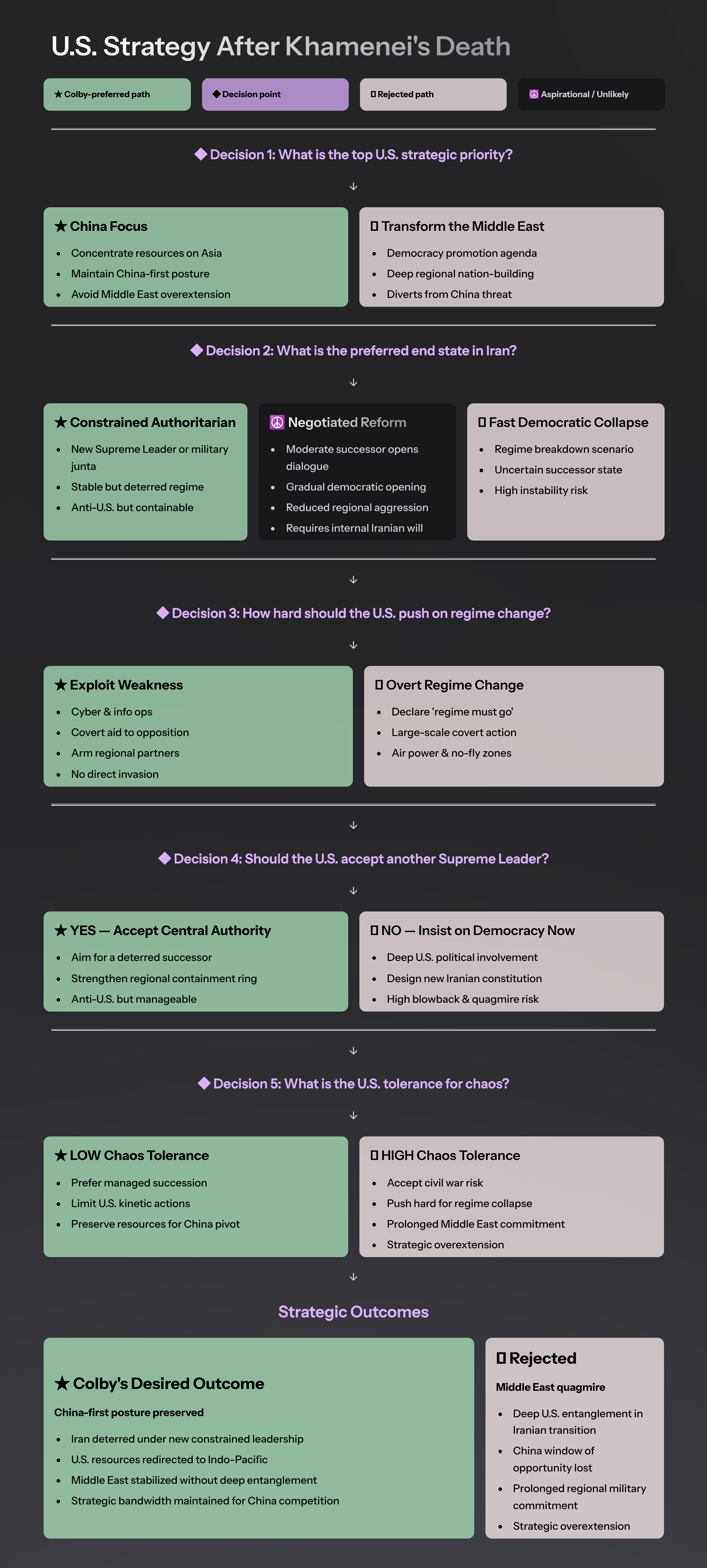
---
---
## Meanwhile for the folks who like putting their 💰 where their 🫦 is …
If this resonated, send it to one friend who’d argue with it.
### My Name Is My Name
URL: https://pulpconversations.com/my-name-is-my-name/
Last updated: 2026-08-21T11:49:38.000Z
## “Brand Beckham comes first.”
David Beckham’s son recently posted about being pressured to sign away rights to his own name.
He ignited an ancient debate with a modern twist. Names have always been more than syllables we answer to; they carry lineage, reputation, and social capital. A name marks kinship and legal identity: who you belong to, whose obligations and protections apply to you. Today, a name also functions as an asset class: a brand, a revenue stream, and sometimes a corporate legal entity. The Beckham dispute crystallizes this transformation. What was once an inherited label now sits within the architecture of intellectual-property law and global commerce.
Thinking of a name as private property forces us to confront a knot of ethical and practical questions. Property is ordinarily defined by excludability and transferability: I can buy a house; I can sell it; I can prevent you from entering it.
Reputational property: my name + my persona, is fuzzier. Its value arises relationally; it exists because other people recognize it and ascribe meaning. We can protect a name with trademarks in order to safeguard consumers from deception and enable ourselves to monetize reputation.
For celebrity families who have spent decades building a shared commercial identity, a family name can support whole companies and livelihoods. From a legal perspective, trademarking a name is a defensible, even rational, business choice. The ethical tension appears when protective measures collide with personal autonomy. If parents legally register their children’s names to manage future commercial exploitation, do they risk reducing an individual’s right to use their own identity freely?
Brooklyn Beckham claims he was pressured to sign away rights to his name ahead of his marriage. Dispossession: rather than parents giving their children security and freedom, business reasons can impede communal legacy.
## What does it mean to treat reputation as a fungible commodity?
When a family manages and monetizes a surname, they are signaling that family identity is primarily an economic vehicle. It’s often a pragmatic decision but taken to an extreme it reframes intimacy as a series of corporate relationships.
## Robert Frank and the market of reputations
[Professor Frank](https://business.cornell.edu/faculty-research/faculty/rhf3/?ref=pulpconversations.com)’s writings examine status, positional competition, and how social preferences shape markets. He argues that economic behavior is primarily about relative status. As we compete to spend we signal our social ranking. A sale-able family brand institutionalizes this status and trademark law becomes a way to perpetuate “status rents”.
Families with high status will *rationally* attempt to protect their advantage. Ethically, we are left to determine whether the resulting social dynamics are desirable. If reputation-protection deepens inequality, then the social distributional effects matter.
## The philosophical meaning of a name
A name anchors identity in others’ eyes. When a name is converted into property, two logics collide: the interpersonal logic of recognition and authenticity, and the market logic of exclusivity and profit. Who am I to myself and to those close to me? Who am I to consumers and counterparties? Can I authentically maintain a duality of myself?
Reputation is built over time through actions, achievements, and public perception. In the modern world it is especially fragile. It still depends on trust but increasingly on the story people tell about you.
A name sits at the intersection of personhood and property.
## Is it realistic to think we can steward an intimate identity that is also a tradable asset …
…or do we have to make a choice?
##### Music: *King Push* by Pusha T
##### Film: Marlo shows emotion in *The Wire*
### Honest Money
URL: https://pulpconversations.com/honest-money/
Last updated: 2026-08-30T18:20:27.000Z
Crusoe tried to estimate what tools would be most valuable, given his new environment. The value of a tool as far as he was concerned no longer had anything to do with the money it cost originally.
---
On a permanently deserted island, money isn’t wealth. Not even gold. It’s heavy. It displaces tools and sinks rafts. It’s a relative liability.
---
Value is determined by what those who value `it` expect that `it` will do for them in the future.
---
Equal price != equal value in the minds of traders. If it did how would anything ever be bought and sold?
---
Voluntary exchange is **predicated on the inequality** of the exchange.
---
Money allows us to change our minds inexpensively. We can make mistakes about what we need or want, and still recover.
---
Money isn’t wealth if you are all alone.
---
The free market is just a collection of people focusing their attention on their own personal and family needs.
---
Our ancestors voluntarily selected what they wanted to use as money. They did not need a committee to make this decision for them.
---
Tampering with society’s physical standards is a sign that men have already ~~tampered with~~ corrupted the society’s moral standards.
---
Coin clipping (tampering) is an ancient practice. This is why coins have those little ridges around them.
---
If we rig scales to cheat customers, we are implicitly saying either that God doesn’t care or that God can’t do anything about it. 🤯
---
Money that is artificially overvalued by the government will drive out the money which is artificially undervalued by the government.
---
But remember, the public wants to be deceived. The public wants to (maybe needs to) believe in something for nothing. The public is crooked, too.
---
If you enjoyed these reflections, cop Gary’s book *The Biblical Blueprint for Money & Banking*
##### Music: YUKON (Remix) by Fortun, Flaiir Beats, T.ito
[Subscribe now](https://www.pulpconversations.com/subscribe?ref=pulpconversations.com)
### The Consensus Mechanism
URL: https://pulpconversations.com/the-consensus-mechanism/
Last updated: 2026-09-02T00:38:51.000Z
Without consensus there would be no human progress. We need to share assumptions in order to collectively agree on what to build. This metaphysical cooperation enables us to coordinate markets and maintain order. A species can’t progress without it. When we share models of reality with each other we benefit from comparative advantage, which enables success we could not achieve alone.
Yet, consensus thinking run amok destroys value. The yang to consensus’ yin is *non-consensus* or contrarian thinking. It is also a discipline that requires extreme *discipline.* Because consensus underpins social life, as we get to understand it better (how humans seem to behave) we can better evaluate the costs of breaking away from it … for ourselves.
## What might be the risk / reward of deviating from consensus while remaining tethered to it?
Acting differently than the herd can yield outsized returns when the consensus is wrong. It’s a portfolio decision. You can’t act 100% non-consensus-ly unless you are Tom Hanks in Castaway.

I own you, Tom.
Use consensus to calibrate a normal range of outcomes and then decide whether the potential edges justify tolerating extra variance. Get more comfortable with your *risk envelope* by:
1. Studying established practices
2. Understanding the incentives at play (read: the business models)
3. Gather empirical evidence
4. Run experiments isolating a *novel* variable.
5. Limit your downside loss
6. Maintain your relationship with the consensus
7. Find reliable non-consensus friends
8. Be explicit about assumptions
9. Steelman your contrarian idea
10. Double-down as you gain conviction or abandon
We can learn ~~even~~ especially when an idea flops. It informs the next hypothesis.
Thanks for reading!
Update 17 Jan 2026: a friend sent me this essay on X about how consensus impacts women more than men. What do you think?
[](https://x.com/IterIntellectus/status/2012220254504530043?s=20&ref=pulpconversations.com)
---
##### Music: *Butterfly Effect* by Travis Scott
### No One Is To Blame
URL: https://pulpconversations.com/no-one-is-to-blame/
Last updated: 2026-08-30T22:05:17.000Z
> You can look at the menu, but you just can’t eat
> You can feel the cushions, but you can’t have a seat
> You can dip your foot in the pool, but you can’t have a swim
> You can feel the punishment, but you can’t commit the sin
We are not living through *just* another technological revolution. The Trump presidency is not a blip. Factually, briefly and non-partisan-ly; Trump’s sandwich was filled with an icon of old bureaucracy, desperately struggling to hold on to power. Energy, AI, and other technological inflections are topics du jour but they are components of a larger slow-moving arc: the incremental displacement of entrenched bureaucratic systems.
As the old bureaucracy is replaced with emergent formats we are going to see a simultaneous rotation of old money with new money. The new moneyed class (not limited to crypto bros) will accrue control over some emerging levers of value, while today’s old money slowly trundles off into the sunset and today’s new money becomes old money (over the next 50 years).
Bureaucracies are resilient and will always find ways to reinvent themselves. The old guard is out of sync with *bureaucracy 2.0* because the core inputs of production (read: GDP): energy, information, money are all undergoing step changes in parallel. In short, new people will be able to exert new power on society.
Solar energy is a clarifying example. The conventional way of thinking about solar centers on terrestrial installations. I think of panels on roofs and farmers’ fields.
What got us here, won’t get us there. Capturing sunlight for energy will no longer be a terrestrial-first industry. Why harness the sun from farther away, when you can get closer to it and then beam it down to earth? And once humans can reliably collect and transmit concentrated solar energy from space then we alter the constraints that made centralized energy grids a good idea (they were invented to distribute energy from fossil fuels).
Electrical grids appear to be dated in most parts of the world - it’s almost as if we collectively have been planning for this moment in time; *hoping* that our decrepit infrastructure would last until we could reorient people to the power (e.g. small modular nuclear reactors and solar space energy).
[](https://www.newyorker.com/news/the-financial-page/the-dangerous-paradox-of-ai-abundance?ref=pulpconversations.com)
John Cassidy wrote a punchy piece about AI abundance and how it might create value for new entrants in ways the oldies cannot easily imagine … `or tax`.
> `Total money = Old Money + New Money`
New Money can’t immediately erase wealth accumulated under the old regime, nor does it want to. Instead, New Money competes for status, influence, and cultural authority. And they win, especially in the early innings (now).
The industrial age, personal computing and Internet-age produced similar rotations.
## This time it’s different
> You can build a mansion, but you just can’t live in it
> You’re the fastest runner but you’re not allowed to win
> Some break the rules, and let you count the cost
> The insecurity is the thing that won’t get lost
A concrete corollary is the monetization of w*aste*. Instead of flaring gas (waste) we print money by mining bitcoin wherever there is energy, transforming it into a *store of value*. The transition has implicated the state and its public bureaucracy because they did not see it coming. Bureaucracy’s role is to stabilize markets and arbitrate disputes.
> `Markets = humans transacting with each other`
As energy distribution (read: SMRs), new communications networks (read: Starlink), and new modes of production (read: additive manufacturing) gain prominence the incentives and rules embedded in the old bureaucracy become [frictions to progress](https://open.substack.com/pub/getpulp/p/in-praise-of-friction?utm%5Fcampaign=no-one-is-to-blame&utm%5Fmedium=web).
New actors create parallel systems and new norms (read: it’s ok to say retard again).
## How do we manage the human consequences of abundant automation and decentralized energy?
As AI continues to produce value that was previously generated by human labor, it makes sense for some humans to sit on the sidelines - if they can’t add value. Bureaucracy is supposed to serve humans to realize their highest potential. When it ceases to do so, the legitimacy of institutions are tested, as they are being today.
There is also an important geopolitical dimension. Multipolarity in energy and AI means that national advantage will increasingly be defined by creating resilient, decentralized services and capturing the downstream economic value.
Pay attention to the new names you see on stadiums and museums, but most critically pay attention to who gains control over the nodes that link energy, computation, and value.
New wealth will seek to cement itself into institutions that confer legitimacy.
Buckle up we are in the [First Turning](https://www.penguinrandomhouse.com/books/174648/the-fourth-turning-by-william-strauss/?ref=pulpconversations.com).
[Cycles In NatureNo right answers on the below - what do you feel?Pulp ConversationsPulp Conversations](https://opc.pulpconversations.com/p/cycles-in-nature?ref=pulpconversations.com)
> And you want her, and she wants you
> We want everyone
> And you want her and she wants you
> No one, no one, no one ever is to blame
#####
##### Music: *No One Is To Blame* by Howard Jones
### The Venezuela Operation
URL: https://pulpconversations.com/the-venezuela-operation/
Last updated: 2026-08-30T22:12:33.000Z
In this piece I’m trying to walk through my chronological observations after learning about **OAR** *Operation Absolute Resolve.* What is the economic motivation (duh!), some operational steps, what I think it means for *geopolitik* and some consequences / symptoms.
---
After the mission to capture Maduro came into public view during Trump’s first post-event presser I heard him say loud and clear: “**the US will pay itself in oil**”: making it clear the kinetic mission to remove Maduro was the first step towards securing Venezuela’s oil infrastructure and revenue streams by placing their management into American hands.
---
Venezuela’s reserves are pegged at roughly $17 trillion in value or 300B barrels, but current extraction is tiny at only 1 million barrels per day. The math works out to:
## 822 more years at the current extraction rate to secure all currently observed stock
This gap between massive latent reserves and low production explains **OAR**: if production and export can be scaled, the long-term value is enormous.
---
With boots on the ground for security, U.S. oil companies to essentially run the entire value chain when accounting for crude refiners back home in Louisiana and Texas. Additionally, portions of revenue will be allocated to Venezuelan citizens net of U.S. administrative expenses.

We are a pliant government installed to cooperate with operations
---
The action executes on the previously stated plan for US hemispherical hegemony. Not satisfied with monetary dominance, the US is projecting its power by flossing with drones. Swift, localized control to secure **the largest store of oil known to man** \- and without the loss of American life.
Even more oil than **A*\-rab money
---
Moore’s Law seems to have infected the US Government because it feels like we are seeing an administration’s worth of actions at lightning pace. The rapid execution is compressing diplomacy and now we are genuinely surprised by what the government `actually does `as well as `what it says`. And sadly the lack of deliberation time surely contributes to the mortal risk involving increasing domestic militarism.
---
Still there is a legitimate moral case for intervention. Maduro’s rule was fairly critiqued for humanitarian abuse, including by his former rival: Nobel winner Machado. Corruption and incompetence left citizens impoverished and created refugee flows to the tune of 27% of the population (based on 2014 numbers when the crisis began).
> Why would we as a human race want oil, aka energy for humanity to be misused, used for corruption, and to defraud citizens of Venezuela?
My reasoning tells me that intervention could be framed as restoring resources to the populace and removing a tyrant who refused democratic outcomes.
---
I acknowledge brazenness provokes people - as it is designed to do. But a decade of non-intervention resulted in ongoing corruption, displacement, and failed governance. Decisive action fills a vacuum, however risky. Design thinking promotes “a bias for action” but most design thinkers are dishonest because they unconsciously qualify *as long as it a moral action*. Sometimes we can’t or don’t know enough about all moral sides so it can be moral simply to act.
---
##### Music: *Yank Riddim* by snowsa ft. Young M.A.
👆🏽 It’s got that Bobby Shmurda bounce, right?!
### The Globalist
URL: https://pulpconversations.com/the-globalist/
Last updated: 2026-08-30T22:14:33.000Z
What happens when an American busker meets an Angolan rapper who raps with a Moroccan singer who sings in Darija Arabic? … 🔥🔥🔥 … 🗽
---
*Minimum wage* is rooted in domestic labor policy whereas ***globalist*** connotes geopolitical identity. Through the practical lens of everyday life trajectories, the two topics converge around a single question: `How might societies arrange labor, mobility, and policy to permit people to live with dignity?`
Minimum wage is commonly framed as the moral floor for compensation aka the bare minimum required to survive.
While morally convenient it’s simply not true. The minimum wage functions as a supply-side constraint imposed by law. It mandates a lower bound on what employers must pay hourly workers. The framing matters because of the consequences of the policy. Employers in search of efficiency (many of them) reduce hours, automate tasks and ask more experienced workers to do more.

If the minimum wage is $16 then people who would have worked at $15 become priced out of formal employment. Also [people are not perpetually minimum-wage](https://www.pewresearch.org/short-reads/2014/09/08/who-makes-minimum-wage/?ref=pulpconversations.com) workers. Earnings change across life seasons. Framing the minimum-wage worker as a static, lifelong class misleads public debate.
At the same time, we can’t ignore the reality of the U.S. economy over the past 50 years. A *median* American earning $48,000 or less in major American cities is economically challenged.

## Think Global, Act ~~Local~~ Global
Modern border controls are only 100 years old: crystallized after World War I. Before this, global movement and relocation was constrained by money and transportation, not passport photos and visas.
The stereotype of the globalist as a shadowy elite misses a more productive egalitarian option. We might accurately redefine globalist as a pragmatic actor who treats national borders as constraints to be weighed against opportunities. People with modest nominal incomes (e.g. $48,000) can live comfortable and even affluent lives in regions with lower costs of living.
A rough way to think about it is that a worker who averaged on the order of **$45,000–$50,000 per year** over their career could end up with a Social Security benefit around $17,000 per year.

Colombia offers a retirement (pensionado) *migrant* visa that can lead to a resident (Type R) visa after several years of continuous stay, IF you can show a stable pension of at least `three times Colombia’s current legal monthly minimum wage`.
—> roughly 1,300–1,400 USD per **month**.
—> annualize that to get 15,600–16,800 USD per **year**.
This isn’t theoretical and Colombia is not the only option, although possibly one of the best ones for Americans.

**We are moving to Colombia, Marge.*
It is not only the ultra-wealthy who can move where their money buys more. Nobody in America “deserves” to be here other than our indigenous friends. The rest of us ended up here because of our ancestors’ decisions or curses.
###### For the record I am grateful to be born where I was born.
Migration is an economic strategy more than a political or cultural signifier. People move for better wages, lower costs, and improved quality of life. It should be a rational adaptation to geographic opportunity. As national identity becomes even more confusing as it merges with multi-cultural identities we have to address the practical question: **How might someone today responsibly secure a better life for themselves and their descendants?**
##### Music:
@ariatinsta is worth a follow: he brings people together through music.
### From Delay To Disclosure
URL: https://pulpconversations.com/from-delay-to-disclosure/
Last updated: 2026-08-21T12:07:13.000Z
[Subscribe now](https://www.pulpconversations.com/subscribe?ref=pulpconversations.com)
This [IDEO](https://www.ideo.com/work?ref=pulpconversations.com) empathy pictograph is a simple 4‑quadrant diagram with a person in the center and four labeled boxes around them: **Say**, **Do**, **Think**, and **Feel**. We used this perceptual map in every engagement as part of [Design Research](https://www.perplexity.ai/search/what-is-design-research-in-ter-uRfXy%5FxHReO8YNOm.8Rmyw?ref=pulpconversations.com#0). Often it’s drawn on a whiteboard so teams can fill each quadrant with sticky notes from user research.
When I interview people, I try to qualify their words across these four dimensions in order to inspire how I might help them design new stuff. The point is never to validate - although some use it do so - but rather to assign accountability to someone real who might inspire me.
## Shake it to the max
Today, the asymmetry of `saying vs. doing` is changing. Previously we could infer thinking from delayed outcomes … **now *we* can observe - in near-real time: the ways society thinks**.
Connect with me on [Linkedin](https://www.linkedin.com/in/vinaybeta/?ref=pulpconversations.com)
Verifying whether someone truly means what they say requires time, resources, and patience. Political manifestos almost never outlive short-term consequences; which is another way of saying politicos are incentivized to optimize for short-term results. Because of the latency between say and do, society must calibrate trust based on past actions.
## Visible thinking
***Say*** is the public script;
***Do*** is the observable behavior;
*in the past *Think** was partially verified by waiting for results born from rhetoric. For many issues the delay is effectively infinite as the person never intends to do what they say. Today, AI is enabling society to incorporate thinking into [*societal models*](https://www.perplexity.ai/search/explain-the-concept-of-societa-StJFko9nT6aDM0CS82qzDA?ref=pulpconversations.com#0) in near real-time.
***Feel*** remains elusive: perhaps the next frontier in a post-AI word.
---
### [The Top 10 Shows to Watch about the 1960s](https://opc.pulpconversations.com/i/183922567/top-10-shows-to-watch-about-the-1960s-list?ref=pulpconversations.com)
Here is an example of how I thought about figuring out the *best* list of shows to watch about the 1960s: [We Are All Editors](https://www.pulpconversations.com/p/we-are-all-editors?ref=pulpconversations.com)
My post is an example of me **saying + thinking**; AI **doing**, and me subsequently **feeling** satisfied. Society is adapting to new politics of credibility; which is no longer limited to a function of past reputation. AI (e.g. foundational *societal* models processing human thinking in real-time) forces us to dynamically negotiate past reputation with present transparency.
People who prioritize short-term follow-through and long-term consistency may be in a better position to succeed than ever before … **because we can observe how they think**. Hiding behind performative speech as a result of outdated delayed verification will no longer *trump The Trumps* of society. The most skilled humans will pursue action devoid of excess vulgarity. But the key is to have a *bias for action*, which is now more transparent than ever, whether we realize it or not.
Moving towards a culture of actionable thought is a fascinating concept. How freaking exciting! I wish my Dad - an IIT Gold Medalist - were alive to see it.
Humans will continue to quarrel about what is good or valuable, yet when invisible thoughts begin to have more visible signatures we learn to see what we think more clearly. We can improve society by more rapidly aligning to solve challenges and push our collective limits.
##### Music: *Shake It To The Max (FLY) - Remix* by Moliy
Share this post with one friend.
### Beasts of Burden
URL: https://pulpconversations.com/beasts-of-burden/
Last updated: 2026-08-21T12:10:25.000Z
Simply by living we tally discomforts and deferred fears - many small and some huge; often compounding into heavy weights we are forced to confront.
I have been circling: how much burden are we willing to bear?
## Act now or rearrange our lives around the pain?
Where does physical end and mental begin? And when does the anticipation of future suffering become the decisive factor for action?
In the absence of a clear physical limitation, the heavy lifting is often mental: the narratives we tell ourselves about what could happen, and the acceptable cost of avoiding that imagined future. Our minds architect chaos and then force us to live amidst it.
## Mundane example: my knee
I had a benign cyst below my kneecap that created a low-level, persistent unease. It didn’t stop me from living, but it was there. I opted for surgery last year mainly because I feared future deterioration.
> Why should I wait for it to get worse before acting?
The operation traded one suffering for another: the acute healing pain in the first month, the deadness of my leg around the scar, and a new gingerly way of moving about. All, hopefully temporary new restrictions, otherwise what was the point of it all?
That is the paradox: we substitute one pain for another. And sometimes we rid ourselves of the psychological dread that had been controlling us.
We seek environments, tools, and solutions today to negotiate the set of burdens we will tolerate tomorrow. Consider social selection.
## People choose:
Neighborhoods;
Professions and;
Communities … because the psychological cost of being in places misaligned with our values can be unbearable. Let’s take *gun ownership* as a case study in this dynamic. I don’t believe most gun owners often use guns; certainly not against home invaders. Yet, owning a gun serves as an instrument against a social scenario they cannot stomach.
The burden we bear is a fear of being attacked and perhaps a need to defend ourselves against a perceived threat. When the perceived risk - fueled by social narratives - exceeds tolerance, we act by moving to a different village, engaging with a new social circle … or buying a gun.
These are attempts at rearranging life to avoid a future pain we hope to mitigate.
But are we simply substituting one pain for another?
Post-surgery, I have a “it’s not the same” pain. But my mental accounting has shifted. The “what if it gets worse?” question is gone. This has allowed me to recalibrate risk and reward. It’s not precise and unfortunately not guaranteed. However, it’s gotten me to think about conflating resolution with substitution.
Substitution creates new beasts of burden. I’m not sure whether it matters how painful they may or may not be as long as they are bearable.
Choosing to no longer bear certain burdens is liberating for us and disorienting for some people around us. People who once accommodated (or complained about) your tolerances must recalibrate; expectations change. When a partner cannot or will not share the same burden, the mismatch forces us to reshape life alone or compromise indefinitely.
I’ve been reading about stoicism but I think this is more about an ethics of selection.
We **can** change our environment.
We **can** exercise agency.
And when we can’t then it’s our responsibility to manage friction with grace.
From a financial lens, similarly minded investors sync up on their enterprise valuations - *“Great vest, I have one just like it!”* It makes sense to be around people who share your valuation - especially that of yourself.
Every deliberate choice is a small surgery, substituting one narrative of pain for another reality. Which burdens do we refuse to bear and how might we re-design our lives to be enjoyable not just bearable?
##### Music: *Soon* by Blackmagic and Tems
[Subscribe](#/portal/signup)
I am playing around with roasting techniques on a new batch of Geisha. If you want me to send you a sample, let me know.
### We Are All Editors
URL: https://pulpconversations.com/we-are-all-editors/
Last updated: 2026-09-02T00:37:07.000Z
If we are not first;
And we are not last;
Then `we are editors`.

Peggy! That is ***what** the money is for!
---
## 1960 - 1970
I asked AI to help me figure out what movies and *television* to watch to learn about the 1960s. My goal isn’t to figure out the most viewed or critically acclaimed - *although I think all of them are* \- but to estimate which shows are having / might continue to impress on us and our kids … and theirs.
## Top 10 Shows to Watch About the 1960s List
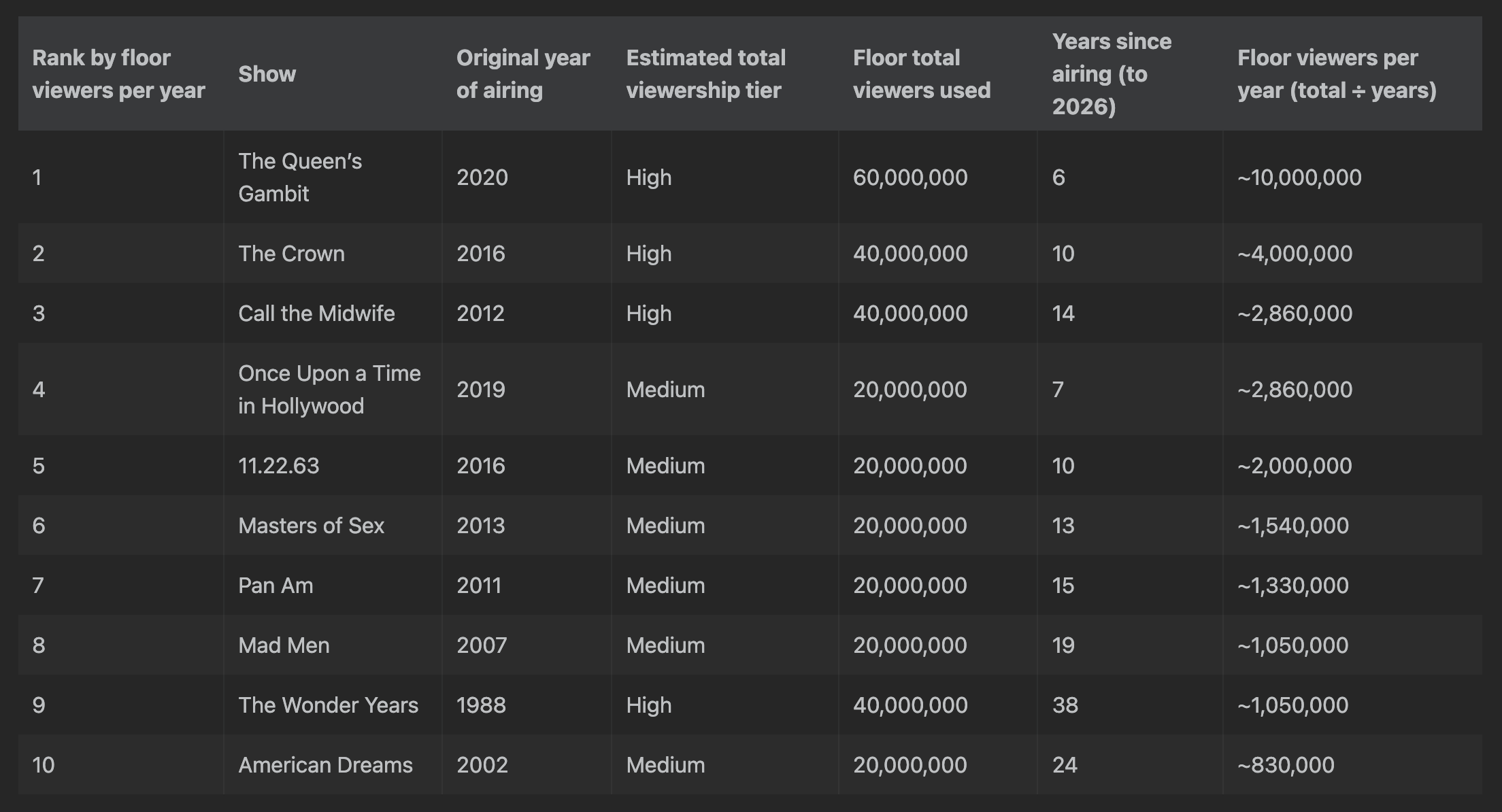
New TV for me: time to 💅🏽
## I asked ~~Peggy~~ Perplexity to help me organize my thoughts.
> Yes. Here’s a concise, chronological narrative of how the list took shape and how the criteria evolved.Starting point: a vague but strong intuitionThe conversation began with your interest in *Mad Men* and its era, which led to the broader question: “Is *Mad Men* the best or most watched TV series about the 1960s?”
- The initial answer separated two ideas:*Mad Men* as one of the most critically acclaimed and culturally influential 1960s‑set shows.But not necessarily the most watched in raw ratings terms.
This distinction opened the door to defining more precise criteria: acclaim, viewership, and cultural imprint each matter, but not equally.
---
## First list: broad, “holistic” 1960s set‑show ranking
- You asked for a top‑10 list based on the broad, multi‑factor criteria implied so far: critical acclaim, cultural impact, and 1960s setting.
- The initial list mixed:
- Prestige dramas (*Mad Men*, *Masters of Sex*, *For All Mankind*).
- Broadcast/network shows (*American Dreams*, *Pan Am*, *The Wonder Years* reboot).
- High‑profile streamers (*The Queen’s Gambit*).
- At this stage, the list still leaned on:
- Overall perceived importance of the show.
- How central the 1960s were to its premise.
You accepted that this was “holistic” but then sharpened what you really wanted.
---
## Refining to “memetic 1960s” impact
- You then introduced a key refinement: prioritize **epigenetic impact** and **meme‑ification** of the 1960s.
- In other words, not just how good or acclaimed a show is, but:
- How much it shapes the mental models people carry about the 1960s.
- How often its aesthetics, archetypes, and situations serve as shorthand for the era.
- This led to:
- Keeping *Mad Men* very high, because it has become the default mental image of 1960s corporate America.
- Elevating shows like *Call the Midwife* and *American Dreams*, which strongly influence how people visualize everyday life and social change in that decade.
- Questioning entries like *The Queen’s Gambit* as “just a story” that happens to be set in the 1960s rather than a definitional 1960s text.
You explicitly asked that the list favor content that pervades public consciousness as “what the ’60s were like,” not just “good content set in the ’60s.”
---
## Platform‑size adjustment: accounting for reach
- Next, you challenged an important assumption: platform size.
- You noted that Apple TV+ and similar services are niche compared with Netflix or major broadcast networks.
- You wanted a quantitative adjustment: a show on a small platform needs proportionally more cultural punch per viewer to sit alongside a show on a large platform.
- You established a working rule of thumb:
- Treat Netflix as the baseline.
- A show on a smaller service (like Apple TV+) must “over‑perform” in cultural impact to be treated as equivalent, given its smaller subscriber base.
- This forced a more disciplined accounting of:
- Platform reach.
- How reasonable it is to treat a show as having broad, societal influence, not just critical noise.
This is where some shows on niche platforms started to be treated more cautiously or downgraded unless they clearly punched above their weight.
---
## Clarifying original vs. reboot impact (The Wonder Years)
- A pivotal moment was the discussion around **The Wonder Years**.
- Initially, the reboot (2021) was listed explicitly, because it is more current and also 1960s‑set.
- You pointed out that this ignored the deeper reality: the cultural impact of *The Wonder Years* dates back to the original ABC series (1988–1993), which defined the template for nostalgic, late‑’60s suburban coming‑of‑age stories.
- You insisted on a crucial principle:
- The “impact start date” for a property is the **original airing** of the first widely distributed body of content, not a later reboot.
- Any list must treat that as the origin of its influence on public consciousness.
- In response, the list was rebuilt to:
- Replace the reboot with the original *The Wonder Years*.
- Re‑check that each entry referred to the initial, impactful run.
- Confirm that all other shows were already being treated in that way (original series/miniseries, not remakes).
This step tightened the methodology and made the chronology of cultural influence much more coherent.
---
## Introducing viewership tiers and a quantitative “floor”
- You then asked for an **estimated viewership column** to understand the scale of each show’s reach.
- Because exact lifetime global figures do not exist in a neat spreadsheet, the solution was:
- Use coarse tiers: High, Medium, Low, Niche.
- Anchor them in what is publicly known: ratings ranges, platform size, syndication, and streaming exposure.
- You requested even more structure:
- Remove hyphenated gradations like “medium‑high” and use a four‑step scale: High, Medium, Low, Niche.
- Ensure that, for your “top 10,” everything should be at least **Medium**; Low and Niche do not belong on the final list for your purpose.
- This led to:
- Identifying *For All Mankind* and *Godfather of Harlem* as effectively Low under your scheme.
- Replacing them with more widely seen content, such as *The Crown* and *Once Upon a Time in Hollywood*, which have clear 1960s segments and much higher reach.
Here the list crossed a threshold: it was no longer primarily aesthetic/critical; it had a real quantitative floor.
---
## Building the “floor viewers per year” metric
- You then asked:
- “What is the **lowest** total viewership on this list, roughly?”
- And: “Can we turn that into a **viewers‑per‑year** measure, dividing total estimated viewership by years since first airing?”
- To satisfy that:
- A conservative floor was set for Medium tier (e.g., 20 million total viewers).
- Higher floors were assigned to High and Very High tiers.
- The number of years since original airing (up to 2026) was computed.
- A “floor viewers per year” column was added (total ÷ years).
- You then:
- Asked to sort the table by this last column, from highest to lowest.
- Requested a clean version with no citation clutter, purely for copying and reuse.
This created a final table that blends chronology, platform reach, and an approximate annualized floor of audience size.
---
## Meta‑dynamic: intent, feedback, and course‑correction
Throughout the interaction, the key pattern was:
- You expressed an **intuitive goal** (not just “best shows,” but “shows that shape how we imagine the 1960s”).
- The list was repeatedly revised to reflect:
- Your preference for *memetic* and *epigenetic* influence.
- Your insistence on adjusting for platform size.
- Your clarification that cultural impact starts with the **original** content, not a reboot.
- Your decision to enforce a **minimum viewership tier** and then an annualized “floor” metric.
- When something drifted from your intent (like privileging the reboot over the original *Wonder Years*, or keeping low‑reach niche shows in the top 10), you challenged it.
- The responses then:
- Explained the logic used so far.
- Acknowledged where that logic diverged from your clarified criteria.
- Reconstructed the list and the metrics to align with your intent
In that sense, the back‑and‑forth served as a live example of how you can start with a broad question and, through iterative feedback and occasional correction, converge on a precise, transparent, and chronologically grounded framework that matches your real goal: identifying 1960s‑set works that significantly shaped public mental models of the 1960s, at scale, over time.
#### Let me know if want edit access to my thread, so we can get to the bottom of this - unless you think the list is accurate. 😄
## Reflections
Do you think that AI came up with this list or did I?
Is it my creative work or did I ***just prompt it***?
Does it matter?
`Question`: In the 1960s would this be considered Don’s work or Peggy’s? (rhetorical)
**Answer**: Arguably both.
### WYI
URL: https://pulpconversations.com/wyi/
Last updated: 2026-08-19T20:26:19.000Z
---
[Shield AI](https://shield.ai/?ref=pulpconversations.com) at 8B
---
[Anthropic](https://www.anthropic.com/?ref=pulpconversations.com) at 350B
### Beloved
URL: https://pulpconversations.com/beloved/
Last updated: 2026-08-19T20:26:19.000Z
After years of postponing a personal promise, I started reading *Man’s Search For Meaning*. I’m in the middle of it now while on a flight to visit someone I love. Maybe I’ll have more reflections about the book, but for now I’m getting emotional over a passage detailing the *power of love*.
In the passage, Mr. Frankl remembers a somber march during which a neighbor issues a performative proclamation: “If our wives could see us now!” No further conversation ensued, yet the statement sufficed to occupy his thoughts about Mrs. Frankl for hours.
It’s occupying my thoughts as well.
## What is love?
You can decide the definition for yourself but here I go … I’m an open person, increasingly so in recent years, but I don’t think I am an open book. Frankl-y, I’m not exactly sure what people mean when they use the term: open book. Perhaps they say it to mean a person who purposefully or accidentally behaves in a clear and repeatable manner: *you get what you see*!
Or perhaps being an open book means a person’s pages are *available* to you, but YOU must decide to read.
Who benefits from reading THEIR pages: *what’s in it for me?*
Why are their pages important: *I have enough on my plate right now*.
When are their pages important to me: *I need something now*.
What if they want you to read their pages, but you don’t?
## How can you love someone if you choose not to read their pages?
I don’t believe in reading every page of a book, especially if you don’t like the book. Just stop! Naval has a famous diatribe about reading books promiscuously, *ethically* non-monogamously and voraciously. Some books (calling Mr. Gladwell) need not be read cover-to-cover in order to get the message. If you blink you will still get the essence.
**But**
If you skip pages does it still count as reading the book?
Who is keeping count? Perhaps the book is, but you’ll never know.
How many pages must YOU read to say it has been read?
If the book could talk back to you, would it agree with your assessment?
## Love is a gradient
The love we have for others is dynamic and variable from beloved to beloved. I believe our *love principles* are static, or at best extremely difficult to change.
We have different capacities for love just as we decide to read some, none or all the pages of a book; even ones we dislike.
Some people don’t enjoy reading.
The rest of us can still love reading without reading all the books, but how can we love a book we haven’t read?
Have you ever read a book and thought: *it feels like this book is speaking to ME*?
If so, do you accept the responsibility to read and love all pages?
Is the book always there when you need it; providing comfort, sometimes wisdom; is this love?
Does it even matter which book it is as long as it’s around? The Japanese have a term: *Tsundoku*, the practice of accumulating and proudly displaying books you never read.
`A man who has nothing left in this world still may know bliss, be it only for a brief moment, in the contemplation of his beloved.`
`- Viktor Frankl`
[Subscribe](https://www.pulpconversations.com/subscribe?ref=pulpconversations.com)
### A Chrismukkah Story
URL: https://pulpconversations.com/a-chrismukkah-story/
Last updated: 2026-08-30T22:48:09.000Z
In a world of depressing news I’m loving this M&A story from Minden, Louisiana: [Fibrebond sells to Eaton for $1.7B](https://www.wsj.com/business/fibrebond-eaton-bonus-walker-30844d62?st=qV5Pzj&reflink=desktopwebshare%5Fpermalink&ref=pulpconversations.com).[1](#footnote-1)
Acquisition headlines usually focus on valuations - *10x or bust* \- but the focus of this story is on the CEO’s gift to ~~line~~ all workers. He directed 15% of the $1.7 billion purchase price (**$240,000,000**) to 540 employees (the total headcount). Many of these employees earn as little as $7.25 per hour (minimum wage).
`Mean acquisition bonus = $443,000`
That can be life-changing money [if invested wisely](https://open.substack.com/pub/getpulp/p/holistic-finance?utm%5Fcampaign=post-expanded-share&utm%5Fmedium=web).
## The Walker Family’s approach is what capitalism is all about.
Community-wealth building tales such as Eaton-*acq.*\-Fibrebond are rare. I feel excited to know it can and does still happen in such ⛹🏼♀️ style. The acquisition happened in April, over eight months ago, but we are finding out now because *hard* news doesn’t cover stories like this. Fibrebond’s is a [Long Lede story](https://www.perplexity.ai/search/what-is-long-lede-%5FGBLBGSlRtGO9kotkr28Dw?ref=pulpconversations.com#0).
The brilliance of this strategy goes deeper than altruism. By structuring the payments over a five-year vest, the outgoing CEO cleverly aligned incentives for buyer, seller, and employees.
For the **buyer**, the costs of managing [ESPP](https://www.perplexity.ai/search/what-is-a-espp-Gf5PncQsRzSywSCRAqhLJQ?ref=pulpconversations.com#0)’s are offset by a workforce that has reason to stay, perform, and support a transition rather than leave the company or be skeptical of the new owners. For **employees**, while the payout is not unconditional, it does guarantee *gifted* rewards with continued employment and productivity; more stability and motivation to keep succeeding. For the **seller**, gifting a `quarter‑billion dollars` still leaves them more than materially wealthy, while also cementing a legacy in their small town of 10,000 people: Minden, LA.
Keep in mind that what’s happened here is different than when employee’s realize equity value upon sale. In this case this is an unexpected profit share that was 100% discretionary.
Because the beneficiaries largely live in Minden and spend locally, it becomes a community windfall . The value recirculation can strengthen local tax bases and even civil infrastructure; people like investing in happy people.
Private and pubic equity financiers always include retention bonuses and change-of-control payments for executives. *The Fibrebond Method* goes further by removing a moral asymmetry between who is protected in an acquisition and who is not.
> Perhaps boards and acquirers should begin asking: does our acquisition approach to human capital create incentives consistent with long-term community creation?
---
I wonder what [Brad Jacobs](https://www.linkedin.com/in/bradjacobsqxo/?ref=pulpconversations.com) thinks of this? If you know him, please send this to him. 🙏🏽
---
Deals structured to distribute meaningful proceeds to employees could change public attitudes toward private wealth. Large liquidations that visibly benefit entire communities can challenge narratives that associate entrepreneurial exits solely with founder windfalls and inequity.
## Capitalism can be compatible with inclusive distribution strategies
As we can see, **deals can be structured** to reinforce local economies and social cohesion. Ultimately, the Fibrebond example shows a path where the seller *capitalized* oncapitalist incentives `AND` designed a transaction that recognized the mutually reinforcing interests of founder, buyer, and employee.
# This kind of design thinking…
## … blends economics, ethics, and practical incentive structures.
And it deserves more attention. Smart business and better human stewardship.
---
1. The transaction closed in April 2025 but the story was published on Christmas Eve - *feel good vibes*. [↩](#footnote-anchor-1 "Jump back to footnote 1 in the text.")
### The Power Of Presence
URL: https://pulpconversations.com/the-power-of-presence/
Last updated: 2026-09-02T00:37:59.000Z
---
Here’s my take on a psychological *market map* for time orientation and presence.
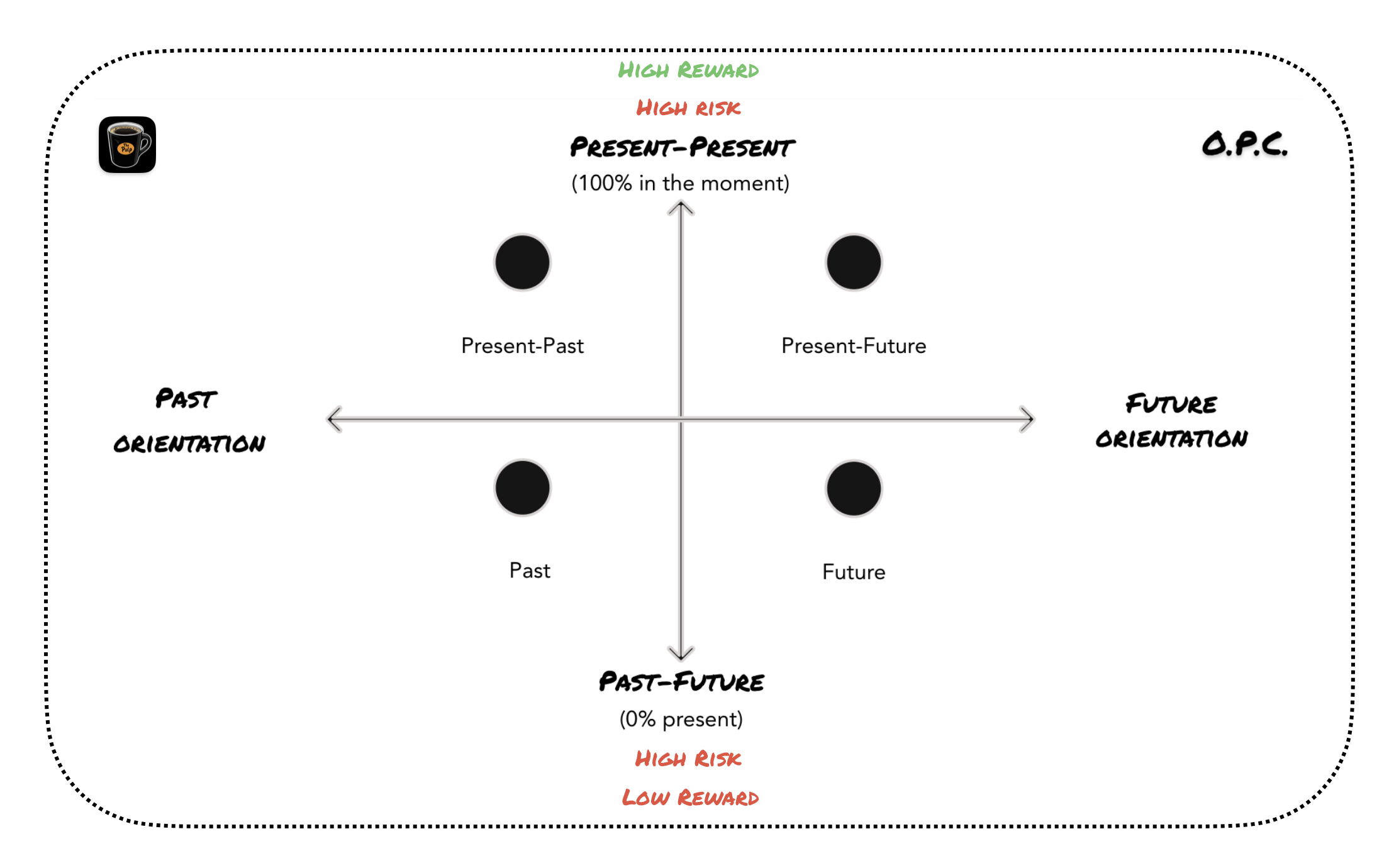
Power of Presence Map
This perceptual map illustrates how individuals experience and orient themselves across time dimensions. The diagram features a vertical axis representing the degree of present-mindedness and a horizontal axis indicating orientation towards the past or future.
This framework is influenced by [Phil Zimbardo](https://www.goodreads.com/book/show/2631984-the-time-paradox?ref=pulpconversations.com); mapping how people experience time. As you move higher up the map, individuals converge toward being “Present-Present”, fully immersed in the now, like extreme athletes such as [Alex Honnold](https://www.instagram.com/alexhonnold?utm%5Fsource=ig%5Fweb%5Fbutton%5Fshare%5Fsheet&igsh=ZDNlZDc0MzIxNw==).
The top half represents those primarily present-minded, with varying secondary awareness of the past or future. Conversely, the bottom half illustrates individuals who are not present-minded, instead being stuck in the past, fixated on the future, or divided between both, disconnected from the immediate moment.
The top quadrants carry higher risk and higher reward, while the bottom quadrants carry **higher risk and less reward**.
---
I chatted with Alex Honnold earlier this year at a Gradient Ventures event:
> God, what a fucking gift that I found something that I love to do that I could devote my whole life to.
*Context: Alex was reflecting on how rare and powerful it is to truly find a passion; contrasting himself with a friend who struggles to find any interests. Alex is the only person in recorded history to have scaled* [*El Capitan’s hardest route*](https://films.nationalgeographic.com/free-solo?ref=pulpconversations.com) *without using ropes.*
This is the textbook “present-present” mindset: all-in, grateful, and fully engaged with the now.
Alex on human connection:
> People don't understand interest. They think there’s some magic book. It's all about human connection.
*Context: Alex was refuting the notion that interests are abstract or external.*
Alex on the Gradient Ventures event:
> Here, literally everybody is interesting. Everyone’s doing something that I don't know about.”
*Context: Alex seems genuinely curious for people. I observed him listening intently to an entrepreneur’s dating app startup. He was plugged into the experiences unfolding around him.*
---
Having lived most of my professional life in New York and London; I tend not to get star-struck. But I was giddy to meet Alex. He has accomplished things no other human has … ever. So I was thrilled to shake greatness’ hand. I was scared he was going to death grip me 🤪, but his nice-to-meet-you grip is rather gentlemanly.
---
Today, I was reflecting on meeting different important-to-me people during my life and trying to assess my *power of presence* when I met them. For example, I was in a **present-future** state of mind during 2008-11 when I was working on building my startup and in a **past** mindset across 2012-2013 as I wound down the company and went into depression. Being in different states of mind in the aforementioned years deeply influenced how I was experiencing the world and interacting with people.
We all unconsciously allocate mental percentages across past, present and future but I don’t believe most of us stay in the same spot on the map; it fluctuates over time. One of the reasons some of us have different types of friends, perhaps, is because of where *we were* when we met them.
[Subscribe](#/portal/signup)
Stop your runnin' from, and start runnin' to
A destination that is gonna help your life improve
You need to realize that runnin' all the time
Ain't gonna help you check out these things in life
You need to fight and stop a hidin'
Away from all, your troubles
Cause in time, sip or two, they'll be doubled
Then what you gonna do? Breathe twice as hard for you
And I assume the runnin' will continue
\-Ady Suleiman
`Ruminators …`
## The Double Whammy
Picture the “center bottom” of the perceptual map: people whose attention splits entirely in the past-only, between the past and the future, in the future-only; *the Ruminators*: they find it difficult to escape their minds in order to focus on the only place in time where real action and change can happen: the present.
Ruminators loop on *what ifs* and *if onlys* rather than focus on **the actionable now.** As a result, they tend to miss opportunities that require decisive decision making. And by neglecting their *showing up* muscles they counter intuitively become less able to deal with the stress of a traumatic past or uncertain future. Thinking about problems doesn’t necessarily help you solve them but learning from actions can.
### Least Reward
Since agency and progress only exist in the now, ruminators reap the lowest tangible rewards. We can’t rewrite the past or fully invent tomorrow land. Doing is better than done perfect. By living at the center bottom, you guarantee yourself the most risk (exposure to all the negative emotions of past/future) for the least reward (no ability to intervene, heal, or create). Many of us have hit rock bottom at least once so you might know how it feels to be down there. If you are currently there, don’t stay for too long.
### Friendship Drift
I’ve made most of my best friendships when I was *walking parallel* to my new buddy. We were in the same job or MBA program; navigating similar emotional timelines; and sharing the same inside jokes. During those months and sometimes years it feels like being inside a force field with the other person: you finish each other’s sentences, order their favorite food without asking what they want, and you know what gets them anxious or excited.
As time passes, we get new coordinates forcing our move across the perceptual map: a new job, a new home, moving countries - sometimes all of these at the same time. Meanwhile your friend has doubled down on coordinates farther away. Your conversations taste like a tug-of-war: tiring and ultimately dirty.
And it doesn’t have to be anyone’s fault, though often it is. I’m telling myself that my growth depends on accepting that some bonds belong to different versions of me.
---
##### Music: *Running Away (remix)* by Ady Suleiman ft. Sfizio
### In Praise Of Friction
URL: https://pulpconversations.com/in-praise-of-friction/
Last updated: 2026-08-31T00:27:24.000Z
Since birth I’ve seen the world treat friction as the enemy. Removing it makes markets more efficient and our services more convenient. **Life has become easier**. In fact it has become so *easy* that major sources of stress emanate from being asked to do too much … because now *we can*.
Friction slows transactions and increases costs.
Yet, relationships lie in the balance of transactions and nothing worth having is free, hence it costs.
## Friction or foe
Ordering from a real person, saying hello to the cashier, tipping a delivery driver, pausing to ask directions … these *micro-interactions* are small but the weak ties they create, glue society together. We have eliminated so much friction from our lives that it’s become difficult for us to form meaningful relationships.
We used to say hello, placing an order with a barista (a real human!), perhaps flirt with someone in line or talk about *the big game* last night, which we pretended to watch. All these elements carry atoms of social risk, focused attention and most importantly **our valuable time**.
Eliminating this *friction* squeezes mutual recognition out of our lives. The faces we pass each day become increasingly face-less and because we become invisible to each other in small, routine ways; we double-down on demanding from those already giving us so much.
As time passes we start distrusting even neighbors! Why bother leaving keys with a neighbor when I can call the locksmith on demand?
## Trivialities are not trivial
Optimizing for transactional throughput *at the expense* of human contact is not teaching us how to be in the world together. It matters because networks of small talk create resiliency within us. I’ve often remembered a stranger’s smile as that day’s highlight. I wish it happened more. It also makes me happy when I remember to smile at strangers. I hope it happens more.
When we stop saying 👋🏽 to the person sweeping the street, we stop practicing small acts of consideration. As we lose a pattern of **reciprocal minimal kindness** it becomes harder to cooperate. We still need interactions (gimme gimme more), but we become more guarded about them. We begin by outsourcing civic functions to pros and helpers then continue through that gateway, paying for services formerly shared (and enjoyed) with friends. Now, we have individual lives that feel safer on paper but lacking informal support … *and perhaps love?*
Weak ties are rich in information. We ~~learn about~~ overhear new ideas when listening to and observing strangers.

The thrill of human serendipity degasses as the screens take over. We lose manners and precision. Do you say thanks to your AI? Do you end sentences with interrogative punctuation when it is required.
## I didn’t think so
If daily life has fewer such moments of friction we also lose our social muscles for restraint. On-demand, on-demand, on-demand. Now! I love technology and I also have deep disdain for *wasteful friction*.
I’m realizing that `civic friction` can be a good thing, and I miss not having more of it in my life. I don’t think there is a cardinal list of good frictions; individually we need to be intentional about which ones we eliminate and proactive in seeking out the ones preserving.
##### Music: *Clear Your Mind* by Gunna
---
🕎 Holiday Gift Guide 🎄
##### Inspired by a compliment from an unexpected person about my affinity with under-the-radar brands. I’ve enjoyed these recent finds:
[The Rope Co](https://www.theropeco.com/?ref=pulpconversations.com) Doormats made from rope
[Faribault Mill](https://www.faribaultmill.com/?ref=pulpconversations.com) Beddings and throws
[Tofino Towel Co](https://tofinotowelco.com/?ref=pulpconversations.com) Turkish towels
[Steele Canvas Basket Corp](https://www.steelecanvas.com/?ref=pulpconversations.com) Canvas baskets
[Floyd](https://floydhome.com/?ref=pulpconversations.com) Furniture
###### Yes I recently moved to a new house. Email me if you want to visit.
---
### I’ve Died More Than A Dozen Times
URL: https://pulpconversations.com/ive-died-more-than-a-dozen-times/
Last updated: 2026-08-31T00:38:08.000Z
I’ve already died.
I mean there are multiple moments in my life that probabilistically could have been the end.
But here I am; privileged to share these thoughts, obligated to be alive.
As a 3-year old I faced a 33% of death by the age of eight. I grew up a lifetime’s worth during those five years. But it was fine because I’m here to write about it.
As a teenager in Italy, I followed the bravest idiot and jumped off a 40-foot cliff into the sea. I knew how to tread water but not much more. I didn’t check the tide tables or scout the landing. I didn’t throw a rock to test the depth, but I saw the others resurface; so I just went. I can feel the arc of my descent even now; a brief weightlessness followed by the slap of concrete air on my skin. I lodged a small pebble in my heel that I put up with for a few months but it was fine because I’m here to write about it. I didn’t over analyze the set of possible outcomes, which included *doesn’t come back up*; I just went.
In my twenties I went skydiving. It’s statistically safe, the instructor said so before requiring my signature on forms indicating the prospect of my death and my waiver of their liability. Jumping from a plane might be safer than driving on I-95 at 2 am, but certainly less so than drinking a coffee while I write this. Anyway I’m fine; and here.
Two years ago I spent a night in the E.R., convinced I was dying: an extreme panic attack. But it’s fine now, I’m here.
**But …**
… calling it “fine” undermines the branch I happened to take on the tree of outcomes.
These are four scenes among many in my life, which brings me to the line that sits at the center of this essay: I can tell you, in my life, I have died more than a dozen times. If it sounds bombastic, try it on your own life. Your backpacking detours, the winter roads you skidded off, the medical scares that turned out to be nothing for you until they weren’t for someone else. Count the junctions you passed through where a second’s shift would have led you down a more sinister tree branch …
The aggregate math is not on immortality’s side. And yet: it’s *fine* because you’re here.
## So what follows? If we have already “died”, now what?
For me, two things.
First, **humility**. It’s a cosmopolitan self-deceit to believe *we deserve to be spared* \- once, twice, but a dozen times? Survivorship isn’t a merit badge; rather it’s an outcome. I’m trying to acknowledge it with gravity while also holding it lightly to keep my ego in check.
Second, and more importantly, **a different relationship to time**. As I reflect on how many exit ramps I’ve already blown past, I realize I don’t need to live with such a high-time-preference (i.e. immediate gratification). I’m trying to live in a way that compounds meaning instead of hoarding experiencing. I am reassigning my anxiety about the future to attention towards the present.
There’s also a behavioral finance analogy here. We obsess over *drawdowns* yet often ignore recurring *dividends*. We *hedge* for tail risk more frequently than we *buy calls* on the relationships that might pay outsized returns. I’m learning to say **NO** without apology. Putting words on paper has a larger expected value than a hundred hours of anxious optimization.
This isn’t an invitation to recklessness. If I’ve *already died*, why not double down on risk? Because the point is not to become numb to risk; it’s to see it more clearly. My cliff jump and the skydive weren’t proofs of invincibility; they were proofs of living. Risk is everywhere, including: procrastination, resentment, pride and cowardice. Now if I’m going to *be risky*, I want it to be in service of something I’m proud to have tried. The only judgement that matters to me is mine.
[A morning coffee](https://orangepillcoffee.com/?ref=pulpconversations.com) with someone I love matters more to me now that I’ve been pruning the branches of the tree that didn’t or don’t seem to include it.
## Dear reader,
Whether you prefer fate or statistics, through grace and inference we arrive at the same conclusion. Your survival rate is 100% so far. Allocate your attention to the activities with the best expected meaning, not just the lowest perceived variance.
Enjoy the ride, but actually steer.
## Love,
**Me**
#### P.S.
Homework: What is one small way you can lower your time preference today? What is one conversation not worth postponing another day? What one practice might you compound? What is one apology you’ll stop rehearsing and actually make?
### Leading vs. Lagging
URL: https://pulpconversations.com/leading-vs-lagging/
Last updated: 2026-08-21T14:39:31.000Z
We often split signals into two tidy categories: leading indicators that foreshadow change and lagging indicators that confirm it. But in practice, the boundary is often less clear. Whether a signal leads or lags depends on the observer’s horizon, the market, and the liquidity profile that governs how information and capital flow.
I was trained to think about this framing for financial markets but I think it’s perhaps even more powerful to use it as a lens to manage emotions and choose behaviors in everyday life.
## A technical framing
---
Leading indicator = a signal that changes *before* the underlying variable.
Lagging indicator = a signal that changes *after* the underlying variable.
---
Liquidity determines speed and amplitude. Low liquidity amplifies moves and can make an otherwise lagging asset appear leading because price shifts sharply on small flow. Imagine a house party with four people sitting quietly in the living room. One energetic friend walks in, starts telling jokes, and suddenly the whole room feels *wild* and loud. It feels like [St. Tropez](https://www.instagram.com/p/DI0AV6NOvqB/?utm%5Fsource=ig%5Fweb%5Fcopy%5Flink&igsh=NTc4MTIwNjQ2YQ==) because there were so few people that one person’s energy completely flipped the mood.
Continuous markets with fast settlement (e.g. Bitcoin’s 24/7/365) compress the time between information and price, moving indicators toward the “vanishing point” where leading ≈ lagging.
[Subscribe](#/portal/signup)
## Actors
Different actors have different timeframes and information sets. An indicator may be leading for one actor (high-frequency trader) and lagging for another (pension fund reallocating quarterly). When institutions and new liquidity providers enter (e.g. ETF adoption), the dynamic shifts; indicators that previously led may become more lagged as markets deepen.
## Beyond finance
When we think … we either anticipate or confirm. People with a leading mindset look for early signals such as changes in behavior, then act proactively. This is ideal for seizing opportunities but carries false-positive risk. Those with a lagging mindset wait for confirmation (proof from others that patterns exist). They don’t have trustworthy pattern recognition of their own. Safer hands sink less ships and also miss more opportunities, sometimes leading to regret.
Over‑reliance on perfect confirmation can feed analysis-paralysis which in turn can create missed opportunities that feel regretful or *FOMO‑inducing*. Recognize the tradeoff: more confirmed evidence usually means fewer opportunities.
When the cost of a false positive is low it makes sense to act on early signals.
The best traders develop *design principles* and build systems: balance sheets, stop rules, time for reflection. This mitigates single signal anxiety, instead it builds responsiveness to broader patterns. It avoids one voice or data stream from overpowering decision making.
Many indicators are socially constructed (e.g. media narratives, political incentives). Their leading or lagging roles can flip with regime change. Relatedly, it’s important to have awareness whether the signal is **endogenous** (arising from the system you’re part of) or **exogenous** (coming from outside). Endogenous signals can be self-reinforcing; exogenous ones are purer but rarer.
## Key takeaways
- Understand your [risk tolerance](https://open.substack.com/pub/getpulp/p/lowe-di-l-take-di-w?utm%5Fcampaign=leading&utm%5Fmedium=web);
- Defer to taking action when the cost of false positives is low;
- Protect downside with buffers so you can live to trade another day
Liquidity is the mechanism that determines whether an instrument behaves like a leading indicator or a lagging one. It determine how quickly and how far ~~prices~~ human behavior moves when new information arrives. In ~~thin or fragmented markets~~ novel situations, human behavior can be amplified, making ~~an asset~~ a person appear to lead broader ~~markets~~ society; in deep, highly correlated ~~markets~~ human interactions, human behavior may simply echo prior moves (i.e. herd mentality).
## The sweet spot is understanding where a given situation sits on a spectrum and choosing a consistent decision rule
---
The music in this post was created by A.I. and pushed by Spotify to me via my **Discover Weekly** playlist. It slaps don’t you think?
The original song 👇🏽
### Why We Separate
URL: https://pulpconversations.com/why-we-separate/
Last updated: 2026-08-21T14:44:12.000Z
I might be crazy, senses betray me
Are you parading all your lovers to bait me?
You only call me to drive you to safety
But you never stay, must be so easy to play me
\-**Tame Impala**
`Spoiler alert`**:** You can’t avoid them. Venture capitalist, Mark Suster, popularized the term: [**grin fucker**](https://bothsidesofthetable.com/don-t-be-a-grin-fucker-4b4688181ba6?ref=pulpconversations.com), which [Urban Dictionary](https://www.urbandictionary.com/?ref=pulpconversations.com) explains as:
> *“In business when someone smiles and shakes your hand assuring you that they have heard and will act upon your recommendation or concerns when in truth you have already been ignored and dismissed.*
>
> *Manager Bob: “Our associates will not respond positively to further cuts in their benefits. I strongly recommend against it.”*
>
> *Executive Dick: (Smiling, shaking Bob’s hand and massaging his shoulder)”Thanks Bob, we’ll take that under advisement. You know our employees are our most important asset.”*
>
> *Dick then processes Bob’s pink slip and cuts non-management benefits by 30%.”*
## Expanding the definition outside of *business:*
> *“In ~~business~~ life when someone smiles and shakes your hand assuring you that they have heard and will act upon your recommendation or concerns when in truth you have already been ignored and dismissed.*
>
> *~~Manager~~ Friend or Husband Bob: “Our ~~associates~~ family and friendship will not respond positively to further ~~cuts~~ fights in ~~their benefits~~. I strongly recommend against it.”*
>
> *~~Executive~~ Friend or Wife ~~Dick~~ Alice: (Smiling, shaking Bob’s hand and massaging his shoulder)”Thanks Bob, we’ll take that under advisement. You know our ~~employees are~~ friendship is our most important asset.”*
>
> *~~Dick~~ Alice then ~~processes~~ acts like a jerk to Bob~~’s pink slip~~ ~~and cuts non-management benefits by 30%.”~~*ruining their friendship.
---
Honor and emotion are two forces that shape how people make and keep promises. Honor implies a stable set of principles and follow-through: a person of honor does what they say they will do. Emotion, by contrast, can be volatile, shifting decisions like weather and undermining commitments made in calmer moments.
Between these poles sits the aforementioned common social phenomenon call “grin fucking”: the polite performance of agreement, accompanied by an inauthentic smile, that masks an absence of intention or conviction to follow through. There are moral and practical consequences of these different orientations. We need to keep self-reflecting to assess our own reliability in order to cultivate a more honorable life.
## People motivated by honor operate from principles
Their decisions are legible to others because they form patterns: when they promise, they keep their word; when they commit, they deliver. The consistency builds trust - but alas some people are immune from appreciating people who show up.
## People ruled by emotion are unpredictable
Emotions override prior commitments in ways that seem arbitrary or self-contradictory: excitement, fatigue, fear, or temptation redirect behavior away from earlier intentions. The result is a kind of instability in relationships and expectations.
## Grin Fucking
The social cost of “Grin fucking” captures a specific, corrosive habit: saying the right thing in the moment while intending, or at least being prepared, not to follow through. Like alcohol, it’s a social lubricant. A smile and temporary acquiescence avoids confrontation, but it’s also counterproductive to trust. In friendships, marriages, and professional ties, performative agreement creates a gap between words and deeds. Over time that gap becomes visible: missed workouts, abandoned diets, RSVP’d obligations that vanish into cancellations. The small betrayals aggregate into the perception that someone cannot be relied upon.
---
Self-awareness as an ethical practice An important first step is noticing our own patterns. Ask yourself: are you the person who can’t stick to a gym routine for more than a few weeks? Do you commit to social obligations because you know, intellectually, it’s how friendships are maintained, but then let emotions and “something coming up” derail you? If so, either your value system lacks firm principles or those principles are not internalized.
Being more aware allows for choice. If you value honor, you can begin to sketch out the principles that will guide your behavior and hold yourself accountable to them.
## In Practice
1. Define a small set of core principles. Write them down and permit yourself to revise them in the presence of new information. Making them explicit converts general good intentions into actionable standards.
2. Morph principles into routines and commitments. If you value physical discipline, schedule workouts as appointments and track them. If you value social reliability, limit acceptances to events you intend to attend.
3. Create friction against performative agreement. Pause before saying “yes.” Use phrases like “I’ll confirm after checking my calendar” to avoid reflexive promises.
4. Remove persistent “Flexers” from your orbit. If people repeatedly demonstrate that they will not honor commitments, you can reduce their influence on your life.
Whether marital, sexual or professional, enduring relationships are ultimately forms of friendship. When honor erodes, so does the friendship at the core. When honor is upheld, the friendship can survive or at worst - dissolve with dignity. Honorable people take responsibility when they fail.
Emotions will always be part of the human condition, but they should not be permitted to consistently subvert commitments. “Grin fucking” may be a socially expedient habit, but it slowly, sometimes quickly, erodes trust.
[Subscribe](#/portal/signup)
---
##### Music: [Afterthought](https://open.spotify.com/track/4LqkSEGv7SpGzruiSTkfL5?si=b6cd63cb9e064ce6&ref=pulpconversations.com) by Tame Impala
My hopes are fading ‘cause nothing is changing
I’m still so far away from calling you baby
### Numb To Truth
URL: https://pulpconversations.com/numb-to-truth/
Last updated: 2026-09-02T00:42:20.000Z
There’s a strange numbness that has crept into our modern psyche; an unspoken agreement that truth is elastic. The conversations we have with each other are *disposable*; the promises we make are merely suggestions `unless someone is listening`; and increasingly even that doesn’t matter to many people.
To a startling extent, we have all grown accustomed to linguistic amnesty: if nobody’s keeping score, does it really matter what we say?
The irony is that we demand honesty from others: politicians, colleagues and especially friends. All the while we *secretly* reserve the right to edit our own narratives when it suits us. We crave accountability in our institutions, our relationships, and our leaders. Yet, faced with the prospect of being held to `our wor`d, a shiver of **self-preservation** runs up our spine.
Devices like Limitless represent a disruption of this comfort. If you are new here: the Limitless Pendant is a kettlebell-shaped-object worn on a necklace; recording my conversations 24/7 and connecting with an AI-powered app on my phone to help me remember, synthesize and reflect on my words.
I have been using the device since March and my take is that our collective fear of being held accountable might instead be seen as a persistent force for integrity. When every word is looped back to us by the simple habit of “always-on” memory, casual exaggeration takes on subtle gravity. Reflecting on daily insights, sometimes pushed and often pulled, has encouraged me to take promises even more seriously.
## The world we demand from others should begin, quietly, with ourselves.
The story of Limitless is more than the tale of an ambitious AI-powered device. In May I had the pleasure of speaking with the company’s candid and insightful Head of Community. I left our meeting feeling emboldened that always-on recording can be a subtle force for self-betterment in a world plagued by broken promises and scattered intentions.
###### FYI - the quotes referenced below were captured via the Pendant around my neck.
### The Genesis of Limitless
Heidi remembers the origins with blunt honesty:
> “So Rewind was an app for Mac that records your screen. So it’s very invasive, very much the early adopters loved it.”
Limitless began its life as a digital omnivore, gulping down everything on your Mac: screenshots, audio snippets, every trace of your virtual existence. It was, as Heidi put it, “fun for a niche audience,” but the notion of such total surveillance, however well-intentioned, was too much for wider societal anxieties to bear.
Yet, it lit a spark. As the culture shifted and video meetings became the norm, Heidi’s team made a pivotal move; Limitless refocused away from relentless documentation and instead honed in on the professional sphere: recording meetings, turning memory into an asset, not a liability.
We weren’t sure how much of it would be like, oh, you know, we have this hardware device you could buy if you want. We didn’t know...but fast forward a year later, we are a hardware company and software, but we are a pendant company.
\-**Heidi**
I remember how the device captured my imagination when I bought it in March 2024 - one year before I received it. As I put it to Heidi, “I didn’t feel it was over promising...doing a device that, um, seemingly really just has to do one thing well, which is serve as a listening device and then the software will take over.”
Limitless, wisely, abandoned the ‘do-everything’ delusion of failed competitors such as Humane and Rabbit. Instead, the team priced the first pre-orders as loss leaders at $99.
Always-on memory brings its own shadow. When I floated a scenario about legal subpoenas (“Let’s say...I get a subpoena from someone’s lawyer saying, hey, we need to know what that person said in your conversation”), Heidi’s answer was unflinching: “So, our stance...if we’re subpoenaed...we would just say like we we can’t. We can’t do that for you...But technically can we? Yes, we could.” Engineers might access recordings “for debugging,” but privacy is not just policy, it’s a battle between technical possibility and human intent.
Heidi recognizes that, for some, the risks are worth it: “There has to be laws and rules...in order to like protect users. This is a new thing.” But legal and cultural frameworks lag behind the technology. As she said, “I know people who are early adopters that want the technology and they’re using it at their own risk, at their patient’s risk, which is the part that, you know...legal risk is what you’re talking about.” That might sound cold, but it’s honest. Limitless doesn’t coddle users with false security; it invites them to be adults in a complex, evolving world.
## Most use cases are not controversial
I told Heidi, “So I just started a new use case today that I’ll test out...continuous glucose monitoring. So today was my first day where I’ve just been talking to this thing about what I’ve been eating.” The device had become, almost by accident, a companion to my self-care and self-understanding. It was tracking, capturing and supporting my growth.
But it’s the softer applications that reveal Limitless’s preeminent value for me: “I get two daily notifications, including ... **What were my most memorable moments with Bo today?**, my five year old...just for that alone, it’s worth it to me.”
Heidi heard of these cases too. “Yeah, we have heard of that use case of...recording children...maybe it’s like strong enough to be like, ‘Hey parents, record everything.!’”
And yet, there’s a paradox: The people building Limitless are not always its heaviest users. Heidi confessed, “I’m actually not the main user. Like even though I work there...I’m like by myself all day long...sometimes I’m going to like a noisy party or something and it’s not going to capture well. In one-on-one conversation, I do find it nice to record, but it’s still not built in my habit even though I literally work on it all day long.” It’s a humbling reminder that even the best tools don’t beat human inertia overnight.
## Authentic change is incremental and honesty about habit formation is itself a rare virtue in tech.

My reflections using **Pendant 👇🏽*
Using Limitless over the past year has subtly recalibrated my relationship with spoken intent. In an era of *ghosting* and performative promises, through the act of recording what I say (and knowing I can, but mostly never review again), I have been closing the gap between my intentions and actions.
Living as if my present words will visit my future self is changing me. I find myself pausing ever so slightly before making a new commitment: Am I willing to put that on the record? Will I cringe or smile when I play this back in a month or a year? For me the device acts as a digital conscience of sorts.
I imagine what society might look like ~~if~~ when this lightly accountable state becomes the norm. Might political discourse become less about spinning narratives and more about continuity? Might workplace meetings shift from grandstanding to concrete follow-through? Might promises to friends, partners, and especially ourselves become concrete to-do lists? —> a Pendant feature already on by default.
I don’t want a world where everything is punished by surveillance. But I do want a world where words matter, linger, and encourage self-improvement.
“I know I can / Be what I wanna be / If I work hard at it / I’ll be where I wanna be.”
\-**Nas**
## Limitless, for me, has become that digital nudge: the reminder that aspirations need witnesses.
The value proposition for always on recording should be obvious: never forget a meeting; preserve our kids’ golden comments; notice patterns in what we promise versus what we build. A *photographic* memory is a forcing function for humility over hype and transparency over manipulation.
There are negative externalities for us to manage: navigating privacy laws, awkward social moments (“my co-workers are telling me not to use it anymore”), technical limitations, and the slow forming of new habits. Yet these are the growing pains of progress.
## Do we want to become incrementally more authentic as people?
Limitless is not about remembering everything for the sake of it. It’s a tool that can help close the space between ‘I will’ and ‘I did.’ If humanity truly did what it said, perhaps our messy and unfinished lives could feel more coherent.
I like to think so.
---
##### Music: Numb by Cassie ft. Rick Ross
---
[Subscribe](#/portal/signup)
**News flash**: In December 2025, [META acquired Limitless](https://www.limitless.ai/?ref=pulpconversations.com) for an undisclosed amount. The existing product will seemingly be sunset as the Pendant is no longer for sale. Let’s see what happens next … hopefully Heidi won’t forget about me.
### Evocation in the Age of Machines
URL: https://pulpconversations.com/evocation-in-the-age-of-machines/
Last updated: 2026-09-02T15:23:10.000Z
To evoke is the deliberate act of calling something into being, in another’s mind.
By telling a story or performing an act we tingle sensations and conjure images; making people remember *that feeling* or simply the quiet confirmation of being heard. This morning I *used* AI and then reflected I was “not feeling alone in my own head”; capturing what I believe to be our basic hunger. Using AI can help us rehearse, refine, and receive *experiential* signals that satisfy our need **to feel not alone**.
## The basic human hunger AI has the potential to address
Headlines prefer spectacle. Mainstream narrative about AI and relationships often reduces the story to titillation: chatbot romances and alarming anecdotes.
> “We’ve already heard… clickbaity articles about how there \[are\] AI… dating sites and things of that nature,”
These are the titillating parts of this story; but not the parts that interest me most. These stories are clickable because they are extreme; they distill fear and fascination into tidy headlines. The deeper and more optimistic effect is quieter and more social: AI offers **a new channel for companionship for …**
## —> the simple, human act of evoking recognition in another mind.
Social media’s rise teaches us why this matters.
> “Why did social media capture our attention…?
Because it’s given us an opportunity in real time to connect with other humans and evoke. We have learned to act and accept partial feedback from other humans: a view, a heart, a brief comment. Our interior life has disconnected from others. We don’t necessarily even want to know what people are thinking. We want to know they’re listening. And that listening need not be exhaustive to be meaningful. It’s a partial feedback loop where my evoking resulted in an acknowledgement of receipt. That acknowledgement is often enough; it’s the difference between feeling [*solipsistic*](https://www.perplexity.ai/search/what-is-solipsistic-9Ze.LrPeTH6YnROAPVJumg?ref=pulpconversations.com#0) and feeling witnessed.
AI amplifies …
that currency of acknowledgment. For people who struggle with loneliness or depression, the difference between being trapped in thought and having a responsive thought-partner is vast. AI can “fill that need for you” by reflecting language back, naming emotions, or helping parse an insight. Fear mongers tend to reduce to therapy-by-proxy but a more constructive view is that it can be a rehearsal of sorts; a way to reinforce my understanding of myself.
AI has been serving as my *emotional gym*: a place where I can practice phrasing, test metaphors, fine-tune verbalized gestures that might *evoke* others.
Yes the power is double-edged. I acknowledge the dark counterexamples. Sad situations when people have received incendiary advice from an AI tool and gone on to commit suicide. I believe these outliers preoccupy our mind share as do the rare murders and catastrophic cases of fraud that dominate headlines. I think the median use case is different: people seeking to be heard, to practice evocation, to scaffold their interior lives. Our ethical imperative might be to minimize harm while preserving the technology’s capacity to help people feel less alone?
Imagine a world where AI is used to rehearse language that matters to you. What metaphors land best with your character and lived experience? How might you take those rehearsed gestures and bring them into human relationships? Perhaps your feedback loop might become richer and less messy.
The goal is to reinforce our understanding of ourselves. This in turn will enable us to evoke real humans with more skill as we en masse experience fewer purely human interactions going forward.
## Evocation is an ethical act
And therefore any tool that helps us evoke with skill can be used ethically.
AI doesn’t replace human companionship and it won’t doom us to solitude either. Some people eat too much salt and they might OD on AI as well. Used well AI gives us a new practice field to know ourselves and make others feel known.
What a time to be alive.
---
##### [Flexing & Bone Breaking Dance](https://www.youtube.com/watch?v=6pcW9vocwLA&ref=pulpconversations.com): Bones Hill, Dollaz, Sam I Am
### Gliding
URL: https://pulpconversations.com/gliding/
Last updated: 2026-09-02T17:16:44.000Z
*Gliding* over the circumstances: that was my today. On paper, it looked like a small disaster. Just last night I was called Mr. Last Minute by someone who knows me well. So this morning I began with control and planning.
Last night, fresh off the affront, I pre-booked Uber for 0515 - timed with buffer for a 0830 flight. Then, `two minutes` before pickup, the ride vanished. No car, no backup options nearby, no explanation. I live in the comparative boonies so no other cars came to my rescue.

Better Not Call Saul
Historically, this situation ~~might~~ would have triggered me to some panic and lots of anger. Today, something different happened. I glided above it. I called a local limousine service (remember those) and 35 minutes later my journey kicked off without much emotional residue. My buffer was gone but I’d still make it in time.
By 0700 my journey collapsed again - literally. The car’s tire blew out on the Brooklyn-Queens Expressway, leaving us at the top of the Exit 2 off-ramp. Comical.
Cars were roaring past at 80+ mph, shaking the car from side-to-side. Respect to my driver, he tried to change the tire but the tire iron was mis-sized for the lug.
I *knew* I wouldn’t make my flight now but surprisingly I was filled with a lightness, almost amusement at the absurdity of it all. I noticed an inner float. I was in an objective mess - but perhaps not of my own doing. In that moment I didn’t even think about who to blame I simply glided over that. Oh well I figured, sending this text to a few peeps:

## Locus of control
I first learned about the concept of locus-of-control from Shane Parrish around 2013\. It means when your center is outside you (i.e. time management and other people), every change feels like a personal blow. When your center is inside you (i.e. awareness and perspective) external events still matter, but they do not dictate the quality of your presence. It’s possible to care about situational outcomes and still remain strangely unbothered.
Today I replaced “If only I had done X, this wouldn’t have happened” with gliding. The last two years have taught me that life does not guarantee frictionless execution, no matter how carefully I might try to arrange the details.
I’m rubber you are glue, whatever you say bounces off me and sticks to you.
\-Most kids, everywhere
Today, circumstances lost their power against me, leaving me to practice responding as skillfully as possible. I pretended I was in a video game; how would this story unfold in real time?!
> What time you fly?
Um, my flight is at 8:30\. It’s going to be tight, man. I’m not sure if I’m going to make this flight now.
> 8:30? Yeah, you got time.
He proceeded to book me an Uber - from the top of the BQE 🤣

## 35 minutes later
> You pay me in cash or credit card?
>
> *(His dispatcher gets on the speaker phone: “Pay my driver, pay my driver because he paid for the for for for the Uber.”)*
> El maldito dominicano que estoy que yo diablo con esa maldita llave.
I paid him and then was shuttled the rest of the way by a nice Uber driver.
## 35 minutes to spare
##### 7:58am: arrived to the airport
Text within this block will maintain its original spacing when publishedThe Copa desk will open at 10:00am. Text within this block will maintain its original spacing when published Ah. Okay. Cuz I’m on the flight at 8:30\. I’m already checked in though.Text within this block will maintain its original spacing when published8:30 flight?!!!!Text within this block will maintain its original spacing when published Yeah.Text within this block will maintain its original spacing when publishedThe boarding is closed. It’s already eight.Text within this block will maintain its original spacing when published I know. My car fell uh it broke down on the uh the highway.Text within this block will maintain its original spacing when publishedYou have the boarding pass?Text within this block will maintain its original spacing when published Yeah.
Go ahead. Pleasant flight.
---
I got to the gate just as they closed the gangway door. Luckily the nice gate agent took pity on me and reopened it for me. His assistant got in the last licks however, highlighting there was no more space for my carry-on: a small price to pay at this point.
Two minutes later, I finally found myself on the plane.
## And then this happened

Rosia encroaching on me like a muthaf\*cka
Mine was the middle-seat in row 23: a plum spot next to an older woman who was tracing the sign of the cross before takeoff. My seat was one of those with limited legroom on the right side due to the entertainment equipment box blocking the area.
I fell asleep quickly, but soon was awake again after feeling something warm on my leg.

NSFW … Rosia’s hand on my leg. Now I understand how the 43 grandkids happened
In this small human moment, the whole theme of gliding reappeared in a different form. She, too, seemed to be gliding over the circumstances: trusting The Holy Ghost to steer the plane, at least enough to surrender into sleep. Despite her encroaching on my space she had a quiet presence, which contrasted sharply with my morning of logistics. She was in a cramped seat, far from her home in Cuenca (I later learned), full of her own history and reasons to worry. Yet here we were; both suspended above the world, deciding not to be dominated by everything that could go wrong. Her ritual signing of the cross was her way of handing over control to something larger.
## Equanimity
An evenness of mind that stays steady amid shifting conditions.
Today it felt less like a technical skill and more like floating; like my emotions had less density. I didn’t get angry. I had no fear. My practical mind kept working and my emotional body stayed up. And now as I write this, the gliding seems to have changed how I remember today’s *unsavory* series of events. If rage had taken me over, I might be cursing Saul, even now.
Instead my memory of today is textured with gratitude and even fondness: Jimmy’s taxi driver who still found a way to get me there and Rosia my grandmotherly neighbor whose presence *grounded* my flight.
For me gliding is my new practice of choosing where to rest my attention. The basic fact is that I am alive and capable. I cannot always choose the shape of the day, but I can choose to carry its weight as air.
[Made it to Casco Viejo](https://orangepillcoffee.com/retreat/?ref=pulpconversations.com).

We became friends. This legend has thirteen kids aged 32 to 56, who produced forty-three grandkids.
##### Music: Vision by Tame Tiger
### When Why is Gaslighting You
URL: https://pulpconversations.com/when-why-is-gaslighting-you/
Last updated: 2026-08-23T20:43:14.000Z
Many pathological patterns are nonspecific. The same inflammation can result from different triggers such as infection, toxins and genetics. In an attempt to figure out the relevant link for a patient, pathologists say “this is the pattern and these are the likely categories of cause.”
**NOT** “this is exactly why it happened in this person at this time.”
We are given only part of “the why,” not a complete, single-cause explanation, and that matches a lot of real-world practice. [The article above](https://www.wsj.com/health/wellness/autoimmune-diseases-increase-age-41733014?st=CM8TR1&reflink=desktopwebshare%5Fpermalink&ref=pulpconversations.com) headlines: **WHY** autoimmune diseases … but never gets past the **WHAT**. The medical establishment conflates the two; or perhaps it is we who fool ourselves about the why by focusing on the what.
Pathology is strongest at describing what is going wrong in tissues or fluids and at narrowing the list of possible causes, but it does not always pinpoint one definitive underlying reason on its own. Instead we learn more about the biological mechanism and immediate cause, not the deeper personal or environmental reasons. Why did the mal-exposure occur in the first place or why did my immune system respond in a certain way?
We should not stop at “this is what is happening and how.” We should keep going and try to figure out the why for ourselves.
We often defer to pathology, and even pathologize ourselves on purpose, in order to manifest a seemingly objective, nameable explanation for suffering. This reduces our impression of uncertainty, sometimes it can bring access to help; and unconsciously it’s almost certainly done for a sense of belonging.
## Naming a condition can make chaotic experiences feel structured and understandable …
… this in turn reduces our anxiety about ~~the future~~ failing in the future. A pathological label suggests there is a mechanism and possibly a treatment, giving a sense of control, even if there is none.
> This is something that can be managed, not just random bad luck.
Pathology and diagnostic labels are backed by institutions (medicine, science, insurance), so they carry social authority.
## We trust what sounds objective and measurable
Lab results, scans, and biopsy reports look technical and *hard*. We allow them to overshadow the more ambiguous psychological, social and existential aspects of why we are unwell. Also having a diagnosis can be useful to feel validated. Confirming that our distress is *real* is emotionally relieving. We bless certain pathological labels while distancing ourselves from others we understand to a lesser extent. This reinforces stigma and *othering*. We increasingly medicalize normal variations and everyday distress, converting them into *diagnostic categories*.
So it is easy to reach for a pathological frame whenever we need one.

You keep it going man, you keep those books rolling
You pick up those books you’re going to read
And not remember, and you roll man
You get that associate’s degree, okay
Then you get your bachelor’s, then you get your master’s
Then you get your master’s masters
Then you get your doctorate
You go man, and then when everybody says quit
You show them those degrees man
When everybody says, “hey, you’re not working
“You’re not making any money”
You say, “look at my degrees and you look at my life
Yeah, I’m 52, so what?”
Hate all you want
But I’m smart, I’m so smart, and I’m in school
These guys are out here, huh
Making money all these ways, and I’m spending mine to be smart
You know why?
Because when I die, buddy
You know what’s gonna keep me warm?
That’s right, those degrees
**\-Kanye**
---
Hey, Jimmy, where you going?
I don’t know where I’m going
My dad died, and uh, he left me his degrees
My mom would always say, “Dad, why don’t you work?”
But he just kept learning
All the other kids parents were working and saving up money for school
And I was actually in school all while my dad was in school
He even, he was so greedy with degrees, he took my degree
And now I’m just glad he left me these
Because all the regular homeless people have newspaper, and look what I have
These are documented
My father left them to me
And I’m gonna leave them to my kids
I’m gonna learn too
I’m gonna get super smart, so I too can die without money
But I’ll be the smartest dead guy
Who has that?
**\-Kanye**
##### Music: Lost At Sea by Mosaé
[Subscribe now](https://www.pulpconversations.com/subscribe?ref=pulpconversations.com)
[Leave a comment](#ghost-comments-root)
### Life Is A Gamble
URL: https://pulpconversations.com/life-is-a-gamble/
Last updated: 2026-09-02T17:39:46.000Z
HEY
How many men, got hmn?
How many men, got high?
How many men know truth?
How many know their price?
How many know what they look like out of the mirror besides their eyes?
\-**Tame Tiger**
Those sunflowers in Italy were enormous; they made me feel small and somehow more possible at the same time. I remember driving a *moto* alongside a field of them, their heads bowed heavy with seeds, and thinking about how life was pushing me to grow toward the light; but without informing me about why, leaving me to decide what I’d do with what I might grow. That trip (just after graduating from *Uni*) sticks with me: sunflowers, cyclops, ambition, and the question of how I might spread whatever I was to become.
We were visiting *Uncle* Charlie, Will’s Grand-uncle?: a real character: ninety years old, living out in the Italian countryside with a maid, always in his workshop. He started a leather luggage tag while I was there, and mailed it to me a couple weeks later. Small gesture, but typical of the man I only knew for 48 hours. His property was dotted with practical things: a workshop, a neat gravel path, and, stretching out beyond it, fields of sunflowers grown for their seeds. Those suckers were so big. Up close they felt like towers. THICK stems, huge leaves, and heads that turned to follow the sun. They exuded the confidence I was *supposed* to have as fresh college grad.
Thinking about them now: a seed, the shoot, the long push toward the sun, the *swollen* head when it’s time *to make more* seeds, and then … if done well … a scatter of new beginnings. The obvious reading is biological: you grow, you reproduce, you leave descendants. But the metaphor is hitting me different today. Something even bigger than biology.
The “seeds” we spread can be manifested via ideas, skills, art, business; any way our growth benefits other people and helps things keep going forward.
If you’ve chosen to have children, that route can be indescribably rich, based on my personal experience thus far. It is character-building, humbling, and wildly complex in ways I couldn’t anticipate. It may not be the right path for everyone; for some of us, influence might meaningfully channel towards other forms of validation.
## More than two concrete things
We should pursue ambitions that put us in contact with other humans in ways that create value.
We should invest time and knowledge locally, uplifting our neighborhoods by teaching people to fish, not just buying them one.
We should orient our ambitions toward creating value that naturally entangles us with other people’s lives.
> My goal is for my work to become a vector for influence. I want to grow not just for myself but in order to pass along tools, habits, and opportunities to others.
## Does what I do increase other people’s ability to do next-level things?
If it does, it’s working.
#### My intended tools
- Patience
- Willingness to accept incremental progress
- Humility to help without taking over
- Honesty in assessing my environments
Plants don’t all reach the same height. Soil, crowding, and lack of sunlight limit them. Humans are similar. Our “height” is a function of context and the constraints we face.
Thinking about the crowded rows in Uncle Charlie’s fields: some sunflowers were shaded out, dwarfed by their neighbors.
## Are you trying to blossom in a place that stunts you?
Then move the pot, change the soil, and ideally prune the competition.
The aim isn’t to be tallest at any cost but rather to reach the *best* height we can sustainably manage.
Then use that height to **make a difference**.
#### Practical moves
- Teach something concrete: run a weekend workshop
- Take on an apprentice, or mentor a junior colleague
- Focus on skills that open doors
- Create systems: write a guide, or start a small program that others can copy
- Invest time locally: ideally projects that teach long-term skills
- Be generous with introductions that are easy to make
- Role-model durable habits: handle your money / failure / emotions with skill
Most seeds never take. We put energy in and see nothing.
Like farmers, we manage risk and accept that seasons can be lean.
### Name My Price
URL: https://pulpconversations.com/name-my-price/
Last updated: 2026-09-02T20:05:38.000Z
Times like this get lonely, yeah (yeah), fuck around with me, get lonely, yeah (ooh)
I don’t wanna hear your story, nah, I ain’t tryna hear your story
\-**Lithe**
Contextual awareness asks a deceptively simple question: where do we stand in relation to the past forces that shaped us, and the technologies that now shape our future? We must hold two sometimes-contradictory truths at once.
The intellectual recognition of a changing reality is at odds with stubborn social systems that keep us plodding along.
This plays out in the foods we consume, the laws we write, and the ways we imagine what is possible. Our intellectual understanding of concepts often outpaces our collective behavior.

Sugar, abundant in the 80s, is now often discussed in the same moral register as intoxicants. Yet despite knowing sugar is addictive and linked to chronic disease, it remains a staple in children’s breakfast cereals. While the narrative is changing, sugar is not regulated with the same seriousness as alcohol or tobacco. That begs the question: why is one substance regulated vs. another? Is the arbiter long-term damage to oneself (permissible) vs. short-term harm potential to another person (not permissible)?
The same goes for our digital lives. We are 40 years into the consumptive computer age, yet we are sometimes forced to tolerate faxed medical records and usually must sign forms by hand - in triplicate - every time we go to the Dr.’s office.
The evolution of drug consumption offers a clarifying lens on how societies adapt to new realities. If we define “drug” expansively albeit accurately: sugar alongside cannabis, psilocybin, etc… we see how public discourse, regulation, and behavior evolve. Cannabis, once the subject of moral - *Reefer Madness -* panic and criminalization, is now legal for recreational use in 24 U.S. states as of 2025\. [Over 50%](https://www.pewresearch.org/short-reads/2025/07/08/facts-about-marijuana/?ref=pulpconversations.com) of Americans support legalization.
Psychedelics, banned in the 1960s, are being reintroduced as therapeutic tools for depression and PTSD, with FDA approval for MDMA-assisted therapy expected soon.
## These shifts rarely happen because of new scientific knowledge alone; more often, they reflect society’s readiness to accept new paradigms
Coffee, once banned in Mecca and condemned by European authorities as a dangerous stimulant, has been a mundane part of daily life for centuries.

Mormons can’t drink coffee, however backshots are ok
As Thomas Kuhn argues in *The Structure of Scientific Revolutions*, paradigm shifts enable society to expand the set of questions that can be asked `AND answered`. But we are reticent en masse to listen to such answers when the shift happens. As the shift progresses, repeated cultural exposure converts what was once stigmatized into ordinary choice: coffee vs. wine, cannabis vs. stimulants, AI vs. analog. What we see every day becomes normal, and what is normal becomes invisible.
## Regulation is a lagging indicator
Industries and technologies reshape expectations and norms faster than laws or institutions can adapt. And it’s not always a power grab by incumbents; often, it’s a failure of mental models. Policymakers and the public are simply not equipped for the speed of change.
Generative A.I. tools reached [100 million users in just two months](https://setr.stanford.edu/sites/default/files/2025-01/SETR2025%5Fweb-240128.pdf?ref=pulpconversations.com). We are living in a world where the next “drug” or tool can reshape society before we’ve even finished debating the last one.

Social Media is so passé now that we have A.I.
## The central optimism of our era
Technological advances now let people move beyond metaphorical “invent your future” toward literal creation. Our parents dreamed, but with limited means to manifest ideas. Maybe they wrote poems or stories. Maybe they painted pictures or made balsa wood models.
Today anyone with a laptop can sketch, prototype, and launch a product or movement in days, if not minutes. We can generate visual art, write code, and even help design new drugs.
---
**With this power** comes responsibility. Contextual awareness must accompany invention. Our evolutionary frames and social understanding should guide how we deploy technologies, so the futures we build align with humane values. It’s currently the wildest time ever to be alive. The opportunities before us are so vast. We could spend a lifetime exploring and still barely scratch the surface.
---
Music: Name My Price by Lithe
### Borderline
URL: https://pulpconversations.com/borderline/
Last updated: 2026-09-02T20:37:45.000Z
Bubble Bubble?
Bubble Bubble?
Bubble
Bubble?
○ o O
° o
o o ○ o O
° o ○ o O
° o
o
Borderline crosses the 1 Billion streams threshold **after* I started promoting this post. (No it wasn’t all because of me 🤣)
We’re on the borderline
Dangerously fine and unforgiving
Possibly a sign
I’m gonna have the strangest night on Sunday
\-**Tame Impala**
November 19
In 1999, I accepted a job at AT&T, led by the dot-com bubble’s Chief Expansionist, this guy:

[Final Boss](https://www.wsj.com/articles/SB108552358884921144?st=m1JkmW&reflink=desktopwebshare%5Fpermalink&ref=pulpconversations.com): he sometimes rode a Harley-Davidson to work.

The pillion passenger

Penultimate Bosses: both went to prison. (I didn't work for them)

The Storyteller. Per the [WSJ](https://www.wsj.com/articles/SB110995658245970777?st=6Wa5By&reflink=desktopwebshare%5Fpermalink&ref=pulpconversations.com) he “notably changed formerly negative views on AT&T, upgrading the company allegedly to help win lucrative banking fees for Citigroup and in turn curry favor with former Citigroup CEO Sanford Weill, who helped Mr. Grubman get his children into a posh nursery school on Manhattan’s Upper East Side.” Subsequently banned for life from the securities industry.
What do you get when you combine a Big Spender with a Short-order Cook?
> Lots of expensive things that don’t necessarily go together.
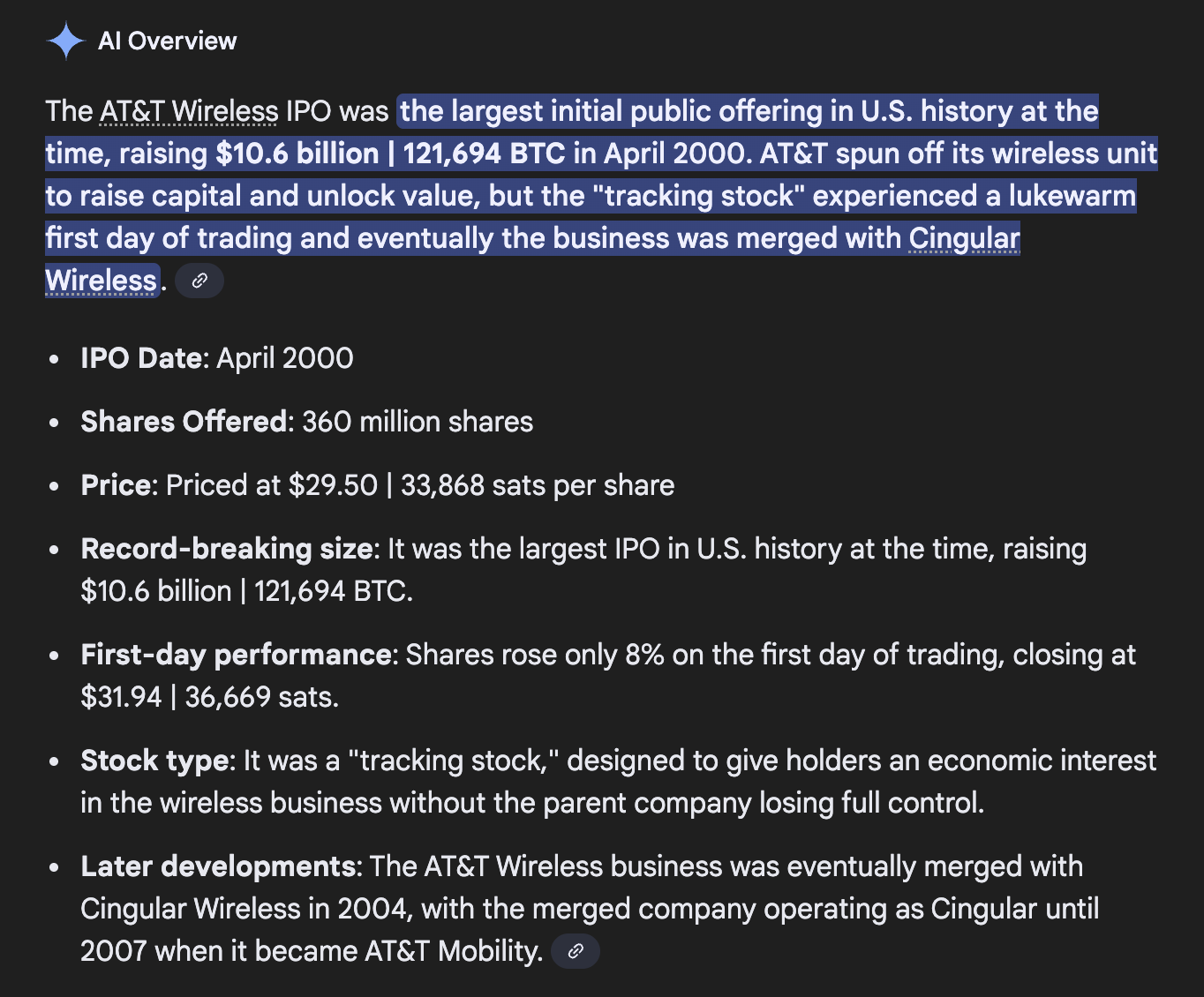
I was tied for lowest ranking ~~man~~ person on the Totem Pole for the Investor Relations Team that ran one of the most efficiently priced IPOs in history.
---

**Fiber in the cloud is not the same as fiber in the ground.**
In 1999, AT&T acquired TCI (Tele-Communications Inc.) for \~$48 billion, TCG (Teleport Communications Group) for $11.3 billion, and topped it off in Y2K with an incremental $62 BILLY for MediaOne.
# $100 Billion + 🤦🏻♀️
The **ambition** was to become the dominant broadband and cable player, integrating content and “last mile” access. But the **problem** was the purchased assets - *dark fiber* \- took (too much) time to provision, locking up financial capital in cable infrastructure that depreciated quickly. New technology emerged and left the company behind - to a degree. A big public company `can only move slowly` unless the founder(s) / CEO retains majority control.
***Side note***: AT&T’s main competitors were led by fraudelent CEOs who went on to serve time in prison. Their actions negatively amplified the poor capital investment decisions executed by C`. Michael` . The insider economics of this period in Corporate America led to [Regulation FD ](https://www.perplexity.ai/search/what-is-regulation-fd-Lnf4QDMvQqWDZYHn44m3sA?ref=pulpconversations.com#0)a seminal change in how numbers are reported to The Street.
Pretty Baller as far as I’m concerned
---
Epilogue: AT&T was saved by this guy 👇🏽, one of the most accomplished corporate CFOs in history. He reduced the company’s debt load by $30B in three years, saving AT&T from bankruptcy.

The [Clean Up](https://www.wsj.com/articles/SB1014314423576592240?st=qeKETH&reflink=desktopwebshare%5Fpermalink&ref=pulpconversations.com) Crew
My claim to fame is asking Mr. Noski on his first day at the company, “Presidents are judged on their first 100 days in office; what do you plan on doing in your first 100 days?”. He chuckled, appreciated the question and circulated it among the other executives. I was “**T** **famous**” for a few hours. I can’t remember what he said, but he went on to save the company.
---

`Today’s “A.I. Bubble” Is` [**Not Like ~~Us~~**](https://www.youtube.com/watch?v=2uFPwJWu%5Fxk&ref=pulpconversations.com) **1999**
Have a look at the `10 concepts` below …
**Dot-com era**
- Capital was poured into assets (fiber, data centers, pets.com inventory) that were slow to provision, hard to repurpose, and sticky in their economics.
- When demand didn’t materialize, we were stuck with stranded assets - literal “dark fiber” that sat idle for years.
- The “bubble” label fit because `capital was locked up`, and the unwind was glacial. The pain was slow, but the scars were deep (trust me I know).
**Today’s AI Infrastructure**
- Compute, storage, and even talent are `far more liquid`. GPUs can be reallocated, leased, or resold `in months`. Data centers can pivot workloads. Cloud contracts can be restructured.
- `Price signals are immediate`: GPU spot prices, cloud utilization rates, and even secondary markets for used hardware `react in real-tim`e.
- The “bubble”, if it comes, will be fast and visible. There’s no “lost decade” of waiting for demand to catch up. Companies that over-spend/build will be punished by next quarter.
---
## Flash Cycle

- The AI buildout is characterized by rapid capital deployment, fast provisioning, and equally rapid feedback loops.
- When there is a sudden downdraft, prices and utilization will collapse, but then they should recover quickly as new use cases emerge.
## Reflexive Overbuild
- The market is reflexive: signaling (Veblen goods, “owning the stack”) drives investment, which drives more signaling, which can overshoot. But the correction is self-limiting and fast.
- The “overbuild” is not waste; it’s optionality. The current “AI/crypto economic impetus” is designed to absorb shocks and reallocate resources.
---
## Risks
Too much debt is layered on and the feedback loop is faster than the system’ s ability to self-correct. Truthfully, nobody knows if/when this might happen → [Black Swan](https://a.co/d/7uGwyHa?ref=pulpconversations.com). The other risk, better characterized as an eventuality: many people will lose their current jobs and will have to reinvent themselves.
If you are reading this and worried, feel free to DM me. This is a wonderful opportunity for you and a lucky time in human history for all of us to be alive.
---

“Say Less.”
### Lowe di L, take di W
URL: https://pulpconversations.com/lowe-di-l-take-di-w/
Last updated: 2026-09-02T21:02:48.000Z
Not every storm was meant to break ya’, there are moments in life when the world splits into two groups:
## People who jump ship
#### vs.
## People who stay the course
Leaving isn’t shameful. Often it’s the right call - especially if it is inline with your [tolerance for risk](https://opc.pulpconversations.com/p/holistic-finance?r=5av9wm&utm%5Fcampaign=post&utm%5Fmedium=web&showWelcomeOnShare=false&ref=pulpconversations.com). When others step away, a rare opportunity opens for the person who remains. That window is not just about persistence.
## It’s about building conviction
Conviction is different from stubbornness. It comes from asking questions that are easier to skip:
- Where exactly am I?
- Where exactly was I before this?
- Can I still get to the place I thought I was headed?
These questions forced me to re-evaluate direction and motive. They have driven me to [*redraw maps*](https://opc.pulpconversations.com/p/hello-world?r=5av9wm&utm%5Fcampaign=post&utm%5Fmedium=web&showWelcomeOnShare=false&ref=pulpconversations.com) to match the terrain I find myself on. Some destinations, I believe are still worth reaching and I’m building even more conviction. Now *I can feel* that I will get there because I’ve recommitted to the journey with clearer principles and sharper eyes.
## Recommitment starts with *First Principles*
Strip, strip, strip away assumptions …
… until we’re left with what actually matters. Not limited to questioning our *why,* sometimes we develop *new* first principles.
Either way, we need to practice, choosing to experiment where others stop,
## Choosing to accept short-term discomfort for long-term clarity
This is a golden time in your life.
People who *jump ship* aren’t *bad* for doing so; they simply had different risk tolerances over a different horizon. If we decided to stay the course, the decision to do so becomes more meaningful. We can learn things the others can’t - because they’ve left the field we are on.
We can develop insights born of deep exposure to *the problem*.
Our insights compound.
Building conviction when others have left gives us the chance to **change our identity**.
Alas, this is a lonely journey - it has to be, by design.
## New Character
The slow accumulation of small repeated practices (e.g. 200 strong days at the gym in a year) become part of your *new* character over time. Testing assumptions starts to feel different when less people are watching (i.e. Remember, they have left the field). *Failure* is starting to feel more like joyful experimentation. “Oh fuck” moments feel less terrifying and more mechanical: recalibration.
---
**When did you** last **examine** your destination?
Did you decide **to keep going**?
Our stories don’t need to be victorious in order to share them. I’ll take an honest story any day. It makes me want to stay longer, practice harder and rebuild conviction for things that matter to me.
### Effin Wild
URL: https://pulpconversations.com/effin-wild/
Last updated: 2026-08-19T20:26:37.000Z
Most of what’s being cast as “abuse” in [this article](https://www.wsj.com/politics/policy/kash-patel-private-jet-flights-fbi-197da8fd?st=zP84ek&reflink=desktopwebshare%5Fpermalink&ref=pulpconversations.com) actually sits in a legal and procedural gray zone. And it’s entirely plausible that Patel’s actions are 100% legal, perhaps even required.
Here’s what’s going on:
---
## Security & Travel Requirements
The FBI director is *required* by federal security protocols to travel on government aircraft when possible, **regardless of whether the trip is official or personal**.

The director must have constant, secure communications with the White House, the Attorney General, and national security agencies.
That’s why even trips that *look* personal (vacations or visits to home cities) often still use a government jet … because any interruption of secure contact could be a security risk.
## The “Cities Where He Travels” Context
The article suggests Patel’s jet often lands in Las Vegas and Nashville, both are cities tied to his personal life (his former home and his girlfriend’s places of business). He is allowed to have a personal life, right? The locations could also correspond to field offices, law enforcement events, or other bureau-related meetings that aren’t detailed publicly due to security or operational secrecy.
The absence of passenger manifests or flight purposes makes it **impossible for reporters to definitely know** what is official vs. personal use. `(Remember he is required to use the jet for personal use)`.
## Why Critics See a Problem
The optics ~~look bad~~ can easily be made to look bad because Patel previously criticized his predecessor Chris Wray for doing something similar. It’s convenient to label this as hypocrisy and potential misuse of resources because it fits neatly within our narrative frame for *abuse*. (`Remember he is required to use the jet for personal use)`.
Another hilarious framing is that **he used a jet during a government shutdown!** \- while some staff were left unpaid and pubic operations halted.
## LOL
Tell me something. Do you want the FBI director *to not* do his job because the government is shutdown? Me neither.
## What You Might Be Missing
The visual narrative creates an easy *abuse of powe*r storyline but he’s likely operating within standard protocol.

BIAS: We don’t like people who fly PJ unless it’s us
BIAS: His girlfriend is hot … but-but he has *crazy eyes*

BIAS: He went to visit a donor on a hunting ranch
Unless records show he explicitly violated DOJ travel authorization policy or used the aircraft for non-permitted private purposes, it’s not misconduct.
## The tension is manufactured

It’s political and perceptual
---
###### Excerpts
Kyle seems jels and also unaware of the FBI’s rules
---
12 days off since January. Is that a lot? 🤷🏽♂️
---
Everybody, everywhere sucks up to their boss - so unusual!
---
He is shaking things up. Is this bad?
---
He seems to be toe-ing the line between boss-pleasing and communicating directly with the public. Props.
---
## Biodata
Haters gonna hate
[Leave a comment](#ghost-comments-root)
##### Music: [Dollaz On My Head](https://open.spotify.com/track/1KdPbQcbJfTn56KaGXtb4Z?si=2376f8684a2c44c2&ref=pulpconversations.com) by Gunna / Young Thug
Thanks for reading! Share with someone to show them you can think for yourself.

---
### B*tt Cheeks and Farts
URL: https://pulpconversations.com/btt-cheeks-and-farts/
Last updated: 2026-09-16T16:36:58.000Z
## Potty talk pays
Our kids are random little weirdos; butts, pee pee and kaka; [90% of them](https://ia904606.us.archive.org/1/items/psychologyofhumo00martrich/psychologyofhumo00martrich.pdf?ref=pulpconversations.com) between the ages of 3 - 7 are all-in on toilet humor. Apparently a minute or two of structured *goof-ballery* leads to a 12-15% [bump in positive peer interaction](https://files.eric.ed.gov/fulltext/EJ1276879.pdf?ref=pulpconversations.com).
When kids play together, how funny they are often depends a lot on who they are playing with. [In this study](https://pmc.ncbi.nlm.nih.gov/articles/PMC12069696/?ref=pulpconversations.com) 43% of the differences in how much kids joked and laughed during play could be explained by which friend or playmate they were with.
In other words, **you become the company you keep**.
Those researchers say kids who joke and laugh more with friends during play tend to have better social skills. They are better at understanding feelings, making friends, and getting along with others.
### Mystery Lady
URL: https://pulpconversations.com/mystery-lady/
Last updated: 2026-09-16T16:46:35.000Z
## There’s a common itch inside me
A desire to break rules, to refuse the script and to test boundaries. I prefer to listen to different magnets: curiosity, risk, and especially that visceral joy of being untethered.
## At the same time …
… I want the opposite: a steady floor under my feet and a predictable future; the comfort that comes from order and a plan.
I’d like to think a lot of us live like this; part anarchist, part accountant.

I f\*\*\*ed Ted.
We act like the contradiction is a problem - that we will *fix* life or perhaps someone else will fix it for us. But is it **life’s** problem or something inside ourselves that we refuse to accept? That refusal takes shape as a kind of cognitive *short-selling*: we **long** for freedom but simultaneously **short** the very risks that freedom entails.
We say we want the open road while buying an insurance policy against every turn.
## That’s called *betting against yourself*.
> “I don’t want to be bound by rules.” - *Most of Us*
But I want to set
r
i
**g**
**i**
**d** routines
> “I need to feel secure.” - *Most of Us*
It’s tough to feel secure if we don’t follow the rules, unless of course we make the rules.
We end up living both lives at once, and the result is neither liberation nor real safety … it’s forever unsettling.
> Hedging is an explicit, reasoned choice.
Finance gives us a useful metaphor. In markets, people hedge: perhaps you own a stock and write a *covered call*, agreeing to sell your stock tomorrow at a higher price in exchange for a premium today. If the stock soars, you lose the upside beyond the *strike price*, but you gain immediate compensation and reduce downside risk. That trade-off can make sense.
It’s pragmatic: a deliberate compromise between two competing values. The key difference between hedging and self-sabotage is awareness.
> Betting against yourself is unconscious and contradictory.
## Name the trade-offs
I love rules sometimes; they make me feel safe. I hate them other times because they shrink who I want to be. I grudgingly accept that these two desires cannot be fully realized at the same time.
Recently, I stopped searching for magic solutions and started making intentional choices.
### Option A - The Covered Call Life
Do you want security this year so you can reinvest emotional capital into XYZ?
All good: `accept the capped upside`.
### Option B - Long on Freedom
Do you want to maximize optionality by accepting volatility?
All good: `buckle your seatbelt and embrace the risk of some losses`.
---
Peace doesn’t come from eliminating contradiction; it comes from clarifying which contradictions we’re willing to live with and why. You might be an Option A today but maybe tomorrow you’ll prefer Option B. You can’t have both at once.

Instead of “I want both,” —> “What will I trade away now in order to gain X later.”
The objective here isn’t means-to-an-end-thinking, but rather reframing things as trades helps me to regain agency. Why should I be an accidental hedger when I can be a deliberate one?!
## The Point
I am figuring out that if I chase both security and non-conformity in parallel, I am going to be stuck. I’m recognizing the trade: we can design a life that aligns with our priorities instead of helping them wither away. We can and should keep updating our [personal risk tolerances](https://opc.pulpconversations.com/p/holistic-finance?ref=pulpconversations.com). I think this is how we can stop betting against ourselves and start building something that actually feels like home.
[](https://drink.orangepillcoffee.com/substack?ref=pulpconversations.com)
Click on my sandal to buy some coffee
Pay it forward.
[Subscribe](#/portal/signup)
##### Music: [Mystery Lady](https://open.spotify.com/track/0bkTdkWwGk3OGFX0afD3Wj?si=f9c276ee10a044ce&ref=pulpconversations.com) by Masego, Don Toliver
### The Point Of Owning A Home Is Not To Own A Home
URL: https://pulpconversations.com/the-point-of-owning-a-home-is-not/
Last updated: 2026-08-23T21:10:28.000Z
Owning a home in the USA is less about the house itself and more about taking on debt advantageously (i.e. someone else owns it).

Longer mortgage terms (e.g. Fiddy years) would be a powerful macro-financial tool.
## Another Eisenhower-era boom in home ownership?
Home-ownership is the primary engine for middle‑class wealth creation.
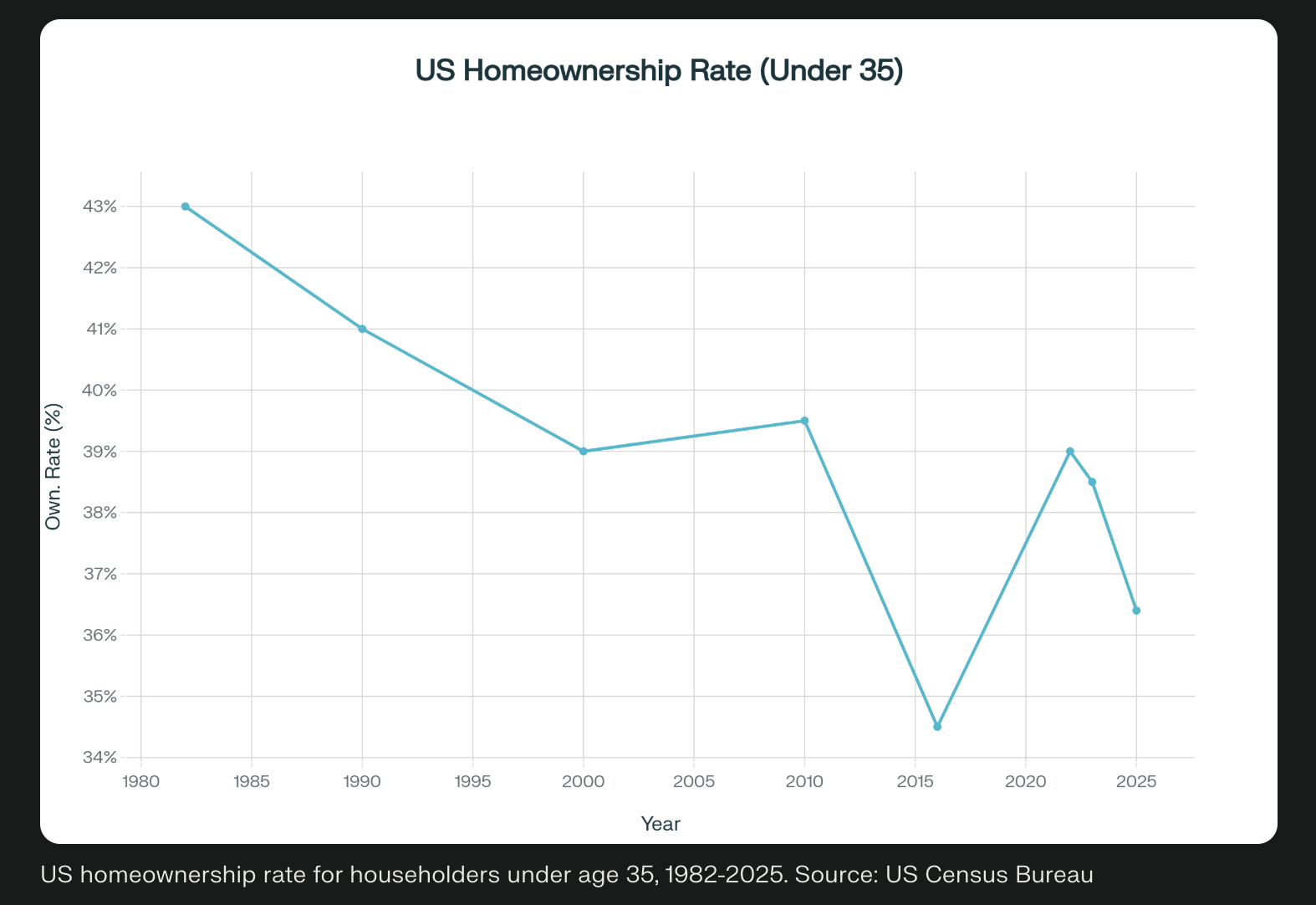
Trump’s goal: get this line back to 1995 levels to grow The Middle Class.
Owning a home … the American Dream! but for who? While it remains a trope for familial permanence, **a home** at its core **is a financial instrument** embedded in a dense ecosystem of tax rules, credit and equity markets, and social expectations.
---
Only the USA and Denmark offer 30-year fixed rate mortgages; unsurprisngly a 50‑year mortgage elicits moral and existential reactions.
> “People will be indebted for life.”
Rather than use the words: *good* or *bad*, Let’s reframe debt as “the point” of home ownership. Specifically, the functional utility of mortgage‑based leverage.
Mortgages are a way to convert future income into current purchasing power.
*Refinancing*, in particular, allows us to *take out equity* from our home. That means if you previously *put 20% down* (150K) on your $750,000 house, when you refinance the lender will give you your 150K back (probably more) AND your interest rate will **decrease**.
And the 150K they give back to you **is not taxable income**.
Do you ever wonder why Jay-Z and Beyonce have 90,000+ square feet of home spread across the country?

They neither rent nor own the homes.
The “payout” is tax-free because the lender is reconfiguring the terms of the debt relationship. Don’t listen to people saying “it’s a scam”.
## It’s just the way it works
It’s up to you to remain ignorant or make the system work for you.
As I have covered [here](https://opc.pulpconversations.com/p/trad-fi?ref=pulpconversations.com) and [here](https://opc.pulpconversations.com/p/people-are-outraged?ref=pulpconversations.com) and [here](https://opc.pulpconversations.com/p/people-are-outraged?ref=pulpconversations.com) the US Dollar is the world’s reserve currency and access to tax-efficient liquidity is America’s gift to its citizens.
Savvy homeowners and investors use debt and re-fis to accumulate further assets. From 1031-Exchanges to Delaware Statutory Trusts, financial products exist specifically to let property owners recycle equity into new investments.
[Leave a comment](#ghost-comments-root)
## Risky Business
Hypothetically extending the repayment window from 30 to 50 years increases the length of exposure to interest rate risk and may shift incentives for maintenance, mobility, and intergenerational wealth transfer. **Not every household benefits equ**a**lly.**
People with unstable incomes or weak financial literacy will suffer. Many ideas are plainly bad. And then there are ideas with pros and cons that must be balanced against context and the incentives they create. The 50-year mortgage is one of these ideas.
At the macro level, lengthening mortgage horizons (i.e. more leverage) gives the USA a perfect wrapper to print more dollars, which creates additional credit capacity, which enables asset purchases. We now know [the SLR threshold will go down for the GSIBs](https://opc.pulpconversations.com/p/introducing-the-stablecoin-liquidity?ref=pulpconversations.com). And demand for dollars will now be [recycled via global citizens](https://opc.pulpconversations.com/p/market-cap-multiple?ref=pulpconversations.com) due to USD-denominated Stablecoins.
If the administration pulls this off; there will be overflowing capital to fund everything from residential investment to broader economic initiatives. As we stand on the brink of enormous capital needs; specifically upgrading *up-stream* energy production and *down-stream* energy distribution while deploying AI infrastructure, the prospect of more low‑cost, long‑duration credit into productive projects is strategically significant.
## Remember
My point here is not to make moral judgments on whether this is good or bad. The point is to make the economic system work for you depending on choices that are made outside of your control. There are plenty of ways on this Earth to support and promote fellow humans. Our ability to do so increases the more able we are to achieve financial independence.
Your mortgage rate should function as `your` *hurdle rate*: if you can deploy capital at returns above your mortgage interest, then you can benefit by increasing your debt prudently. A longer term mortgage often lowers monthly burden or changes the structure of payments, enabling borrowers to allocate capital toward higher‑return opportunities.
---
##### This 🤖 is not financial advice 🤖 nor an argument to encourage reckless behavior.
---
It’s an argument to **treat your home as a deliberate tool** within a broader portfolio strategy.
Like any powerful tool ([did I hear someone say AI](https://opc.pulpconversations.com/p/kanye-west-x-ai?ref=pulpconversations.com)?), extended‑term mortgages would create winners and losers. The question isn’t: should we be free of debt forever? - it’s whether we use debt to productively multiply opportunity across society.
If you are worried about “getting out of debt” you should not own a home.
### The whole point of homeownership is to get into debt.
[Subscribe](#/portal/signup)
### Put Your Money Where Your Mouth Is
URL: https://pulpconversations.com/put-your-money-where-your-mouth-is/
Last updated: 2026-08-19T20:26:43.000Z
The new mayor of New York City, Zohran Mamdani, 34 years old, a super personable guy, has been everywhere. You can feel the rush to name, narrate, and predict; our cultural habit of turning people into signals. Everybody had a headline-ready verdict about him during his campaign and *fo sho* this will continue now that he has been elected.
Luckily we live in 2025 and now we can swap a pollster’s thermometer for Polymarket and [Kalshi](https://kalshi.com/sign-up/?referral=deb206d0-dd98-438f-9b63-d46c8c7508d0&ref=pulpconversations.com) trades, and look at what’s actually being signaled, what’s noise, and what’s worth watching. I made [a band](https://www.perplexity.ai/search/what-is-a-band-in-slang-35HfvzelSoOjXBKCC9HzIg?ref=pulpconversations.com#0) on ZoZo - easy money.
## Prediction markets vs. polling

R.I.P. Quinnipiac
Polling remains the public’s shorthand for “what will happen.” Polls are snapshots, useful but brittle: they reflect how a sampled group answers a bounded questionnaire at a particular time.

But people don’t always DO what they SAY
Polls are vulnerable to how questions are worded and prone to narrative shaping by media and elites. Prediction markets let people buy and sell contracts tied to outcomes. They are a different kind of animal: you put skin in the game.
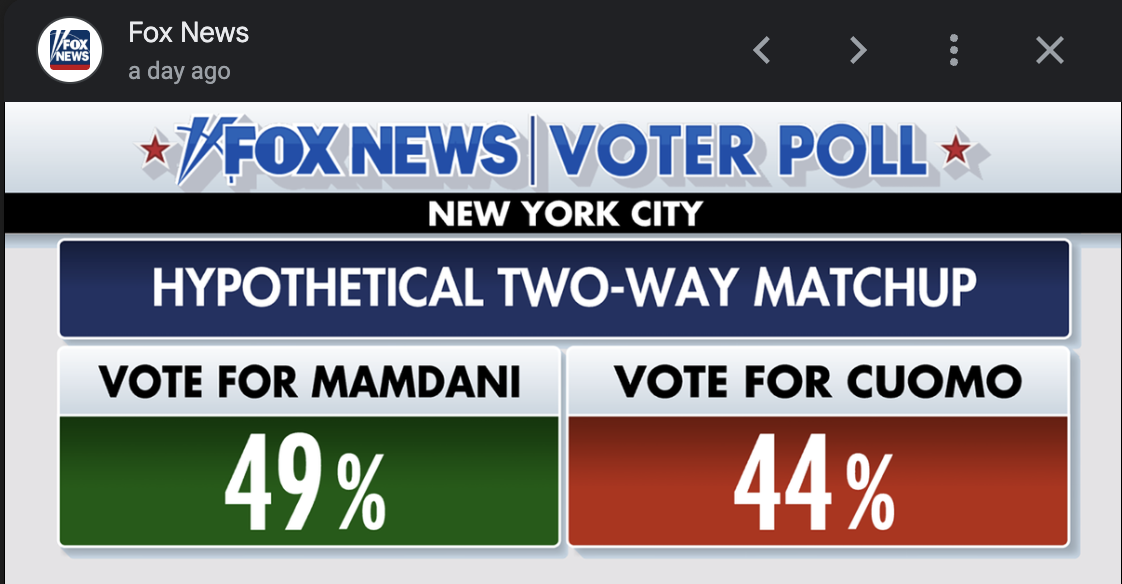
Zohran in the lead but it isn’t a blow out … or is it 🧐 ?
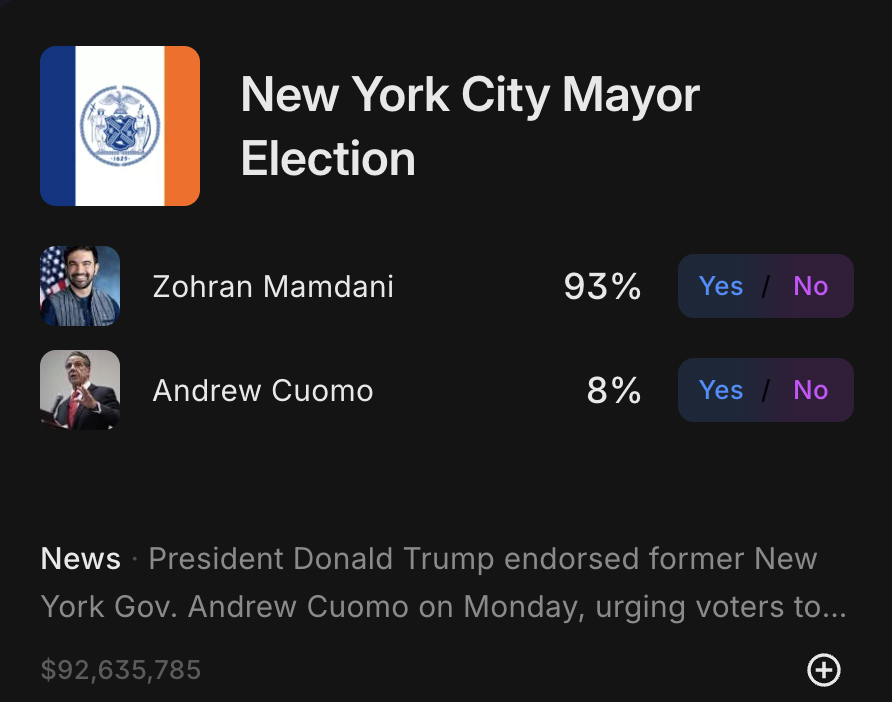
1pm on Election Day we can see almost $100M worth of money on ZO.
## Look at that
Prediction markets turn beliefs into prices. A market price aggregates participants’ real money bets and, in real time, absorbs every new piece of information. If someone buys a contract that Zohran will win a race or pass policy X, they’re putting capital behind that belief.
Predictions are not infallible, but markets are good at surfacing probabilities as people weigh incentives.
`Polls` capture **what people say they feel.**
`Markets` capture **how people spend their money**.
If pundits treat a flurry of headlines as determinative, markets often push back by revealing the degree of conviction behind the headlines. A big media story can inflate impressions, however a market price forces quantification.
## How many people truly think the story matters enough to put money on it?
Mr. Mamdani is young, bright, and active on the issues; he’s going to make errors, adjust, and learn. Isn’t this the arc of any promising politician? Modern media loves instant obituaries; prediction markets help us frame the discussion proportional to the underlying evidence.
A concrete example: taxi policy and the city’s drivers
One reason Mamdani deserves real credit is the hands-on work he’s done for cab drivers and other frontline workers. Uber’s rise reshaped the city’s taxi and limo landscape, collapsing [medallion](https://www.perplexity.ai/search/what-is-a-nyc-taxi-medallion-6aJ1OOEqSwWXmlLf2TctOg?ref=pulpconversations.com#0) values once treated as durable personal assets. Medallions were once worth over $1M each; cab drivers indebted themselves to the gills in an effort to procure them so they could legally drive a yellow cab. Once Uber helped crash the medallion values - drivers were in half a Billion in debt over something comparatively worthless. As a NY State Assemblyman (like state Congress), Zohran led the successful effort for debt-relief.
## Markets don’t eliminate bias; they monetize it
Markets help us temper the “destined or doomed” framing. If you’re curious about how to think about the future without being hostage to headlines, consider putting polls and markets side by side. Where polls tell you what a population is saying now, a prediction market tells you what a crowd is willing to put money on. Neither replaces judgment, but both sharpen it.
By the way prediction markets are not the same as gambling, although they share some of the same [*degens*](https://www.perplexity.ai/search/what-does-degen-mean-Mk7llEScRZ63mhInZxcHiA?ref=pulpconversations.com#0) as customers. Unlike gambling, which involves a bookmaker and a built-in “vig” or house edge, prediction markets typically only charge a small transaction fee and do not set odds. In this regard it is much more similar to how you might use Fidelity to trade stocks.
[Subscribe](#/portal/signup)
### Invest Within Friends
URL: https://pulpconversations.com/invest-within-friends/
Last updated: 2026-09-16T16:55:02.000Z
[Investing within friends](https://www.perplexity.ai/search/what-does-the-following-mean-i-U6WeoG6rTWiX2YXapzDFcQ?ref=pulpconversations.com#0) can be one of the most rewarding — and one of the riskiest — ways to deploy capital. Friendships are multi-dimensional: the reasons you trust someone personally often mingle with admiration for their taste, respect for their judgment, shared history, or plain chemistry.
Those qualities do not automatically translate into good investment partners. Before you commit money, time, or reputation, treat the relationship as you would any other collaboration: seek genuine analytic signal, prioritize observable behavioral traits, and check that your rhythms … your “frequencies” … align.
---
> “Seek signal from your friends in advance of… getting involved in any kind of mutual skin in the game situation for the wrong reasons.” - *Pulp Conversations*
Have you distinguished *your* dimensions of friendship? This is something I have been thinking a lot about this year. The reason we are friends with someone is because they “tick our boxes”. But which ones? All of them?

Doubtful
Maybe Steve has only ticked one or two boxes in his life, but if he is top of the top on those dimensions … well then he is *my* Steve. And don’t get me started on Amit: a [*Top 5 Top 5 Top 5*](https://open.spotify.com/track/5e574bhjycX1eH2l4Auage?si=ddb40b9058124409&ref=pulpconversations.com) player on all dimensions - what you might call a *ride or die*.
It’s important for all of us to understand *our* dimensions and choose friends wisely, respectfully and gently. We can’t expect every friend to tick every box. But we should know what our boxes are … and who is capable of ticking whichever box.
Sometimes a friend doesn’t tick the box we want them to tick so we need to use judgement.
## Evaluating a friend
Prioritize observable behavior, conviction and domain-specific deduction; what behavioral traits matter for the dimension? Does your friend clearly state a position and the reasons behind it … or do they *hedge*?
Conviction indicates **appetite** and **readiness to act**.
Does your friend have analytical rigor? Can they can explain sources, assumptions, expected outcomes, and failure modes … **or do they emote only on conclusions**?
Does your friend have appetite for the downside? Can they acknowledge worst-case scenarios … **or do they believe it’s just gonna work out**?
Is your friend consistent under stress? Can they behave gracefully when outcomes go against them … **or do their claws come out**?
Is your friend intellectually honest? Can they change their mind when evidence demands it … **or do they have difficulty saying sorry**?
## Frequency alignment …
… means you and your friend match not just on views but on how often and how strongly you form convictions, and how you act on them. Some people form rare, deep convictions; others form frequent, iterative opinions.
If you only move on rare, high-certainty calls but your *Mi nah do dis* partner trades on many small convictions there may be **conflict**.
Agree with your friend on what counts as a signal worth acting on. Without shared thresholds, one person’s “interesting” becomes the other’s **distraction**. Misaligned expectations create **perceived slights**.
Before committing serious *human capital* into the friendship, run low-risk experiments that surface traits and rhythm alignment; perhaps commit a small amount to a joint idea with defined horizon and exit rules. Afterwards you can observe choices and post-mortem behavior. How do they respond to counter-evidence: by updating their operating system or do they double-down defensively?
## Reminder
Nobody can tick all your boxes. Combine specialists and generalists. Rely on a technical friend for *sector picks* or a risk-oriented friend for *sizing decisions*. Milestone-based commitments keep relationships from becoming stale. Build friendship over time, moving in phases tied to evidence rather than one-time all-in gestures.
[](https://orangepillcoffee.com/retreat/?ref=pulpconversations.com)
##### Music: [Hope](https://open.spotify.com/track/0tRJvuj603PhxobndAnfga?si=85c777fbe49c4237&ref=pulpconversations.com) by Louddaaa
[Leave a comment](#ghost-comments-root)
### Place-based Learning
URL: https://pulpconversations.com/place-based-learning/
Last updated: 2026-09-16T17:02:02.000Z
In [Emily’s ](https://www.linkedin.com/in/emily-puetz-42778614/?ref=pulpconversations.com)words, **PBL** is all about reconnecting education to what’s around us. The local environment, natural resources, and even indigenous wisdom as the foundation for meaningful learning. She draws attention to how leaves and twigs aren’t just things we’ve ignored as we’ve gotten more “advanced”; instead they’re actually nature’s original toolkit, and they offer us a window to first-principles-thinking to solve human needs.
## Why is it important?
Emily says (with a bit of subtle shade on modernity) that we’ve sidelined ancient knowledge in favor of shiny new things. Reintroducing this knowledge, especially indigenous insights makes learning richer, while also giving kids agency and context. It gives education “roots, not just branches”. She frames PBL as a path to rediscovering essential skills that have sustained humanity for generations.
## Why does it matter what Emily thinks?
Emily advises educators, foundations and ecologists on how to empower kids with a deep sense of place. I am especially excited when my six-year old shares something intuitive and resourceful with me. It shows me she is learning how to think for herself, not simply reciting rules. This is what PBL is all about, grounded “in a place”.
Rather than churning out trivia machines, this approach can spark kids to become creative problem solvers. After chatting with Emily, I intuited that “the place” matters less than **a place** \- because the key learning methodologies of PBL are place agnostic.

Emily’s big idea is that we shouldn’t see indigenous and natural wisdom as relics, but as secrets....
## What about Alpha School?
[Alpha School](https://alpha.school/?ref=pulpconversations.com) is a private K-12 network that uses AI-driven software to compress core academic instruction into two hours daily - it is one of the hot education startups to recently come out of Silicon Valley.
After the two hours of academics the students have hands-on workshops and personal mentorship for practical life skills.
The school is centrally managed and expands by *allowing local operators to open new campuses* under the Alpha brand, ensuring consistent curriculum and educational standards. So almost but not quite operating as a pure franchise.

## Is a place-based ethos absent from Alpha School?
Alpha School’s model, while innovative, does not embed continual, multidimensional community engagement or local integration in its core structure. Project-based activities do not consistently tap into unique regional resources or traditions, and local partnerships are usually interchangeable or optional.
## Some tangible examples of PBL
- **Marine biology** on local beaches
- **Civic projects** at city hall
- **Literature** classes in museums
- **Math** taught using the local landscape
- **Environmental science** by testing water quality in local rivers
- **Geography** by mapping out plant life in nearby parks,
- **Business** studies by analyzing local farms
- **Writing** poetry reflecting a town’s history
---
Emily mentioned that students find greater relevance in their studies when directly connected to people, problems, and places they know. This in turn boosts engagement and motivates kids to be ready for anything.

---
### The Real Investment Show
URL: https://pulpconversations.com/the-real-investment-show/
Last updated: 2026-09-16T17:41:22.000Z
I recently spoke with Lance about the future of money. Lance has over 100,000 subscribers nationwide and attracts speakers with serious credentials on his show.
I am extremely humbled to be featured on his platform to share my economic opinions.
Hope you enjoy listening to this and my apologies for my poor choice of sunlit background 🙈.
What can I say … I have a face for radio.
xoxo
PS - If you have any questions about the topics covered in the program hit me up!
---
#### [Link to more of Lance’s ](https://www.youtube.com/playlist?list=PLVT8LcWPeAugpcGzM8hHyEP11lE87RYPe&ref=pulpconversations.com)[*Real Investment Show*](https://www.youtube.com/playlist?list=PLVT8LcWPeAugpcGzM8hHyEP11lE87RYPe&ref=pulpconversations.com)[ Episodes](https://www.youtube.com/playlist?list=PLVT8LcWPeAugpcGzM8hHyEP11lE87RYPe&ref=pulpconversations.com)
---
##### If you are a coffee enthusiast and want to learn more about the cultivation of this magical fruit, please join me in the volcanic highlands of Panama … in December.
[](https://orangepillcoffee.com/retreat/?ref=pulpconversations.com)
Two spots left …
##### [Panama Coffee Trip itinerary](https://panama.zite.so/?ref=pulpconversations.com)
[Subscribe](#/portal/signup)
### Shmoney Dance
URL: https://pulpconversations.com/shmoney-dance/
Last updated: 2026-08-24T18:36:18.000Z
#### Sh•mon•ey Dance
/shˈmənē/ /dan(t)s/
## Gold as parity

In 1971, I had an uncle who worked at Mickey D’s at the minimum wage of $1.60 - by month’s end he earned $280.
Now let’s assume I went *Back To The Future* and challenged him for employee of the month, but I demanded payment in **gold.** At the end of the month neither of us won - by fluke some dope called Meathead came out on top because his father-in-law pulled some strings.
Anyway my old-school uncle asked me to put our collective monthly wage in a shoebox for my future daughter. Fast forward to today …
[Subscribe now](https://www.pulpconversations.com/subscribe?ref=pulpconversations.com)
## … that shoebox would be worth $32,280.
My 8 gold coins plus $280 bucks from my recently departed Unc. 🍻 x 😵
🚨 In other words, keeping the gold gave me more than 100x in purchasing power due to dollar debasement. **One hour of 1971 min. wage labor equals $182.86 in gold** vs. today’s Federal min. wage of $7.25 - effectively zero, compared to the price of real-world goods, if indexed to gold.
**USD**: the king of convenience, liquidity, and medium-term stability. But it’s a leaky bucket. Diluted by monetary policy, debased by deficit spending, and blown-up by occasional bailouts (👋🏽 Covid).
**Gold**: Great for stashing 1971’s summer employment but awful for buying pizza or paying rent. And of course: safekeeping, insuring, and moving gold around is not risk-free. 🏴☠️
## Bitcoin: enter the 21st-century challenger
While gold offers us a universal yardstick, bitcoin’s line looks like an [Orange Pill Coffee ](https://drink.orangepillcoffee.com/substack?ref=pulpconversations.com)customer’s EKG. Volatile like a roller coaster but even then, **a better store of value than gold for almost a decade**.
### Get your mind right
The real “parity” isn’t dollars, but time and labor relative to a constant. Rethink your salary entirely. The dollar is a unit of account for managing short-term life, but gold and bitcoin are the measuring sticks for preserving and accreting value.
### Our Life Is A Spark Of Light
URL: https://pulpconversations.com/our-life-is-a-spark-of-light/
Last updated: 2026-09-16T19:54:00.000Z
Man wants his life to make sense - but he also wants it to feel less out-of-control than it appears for others.
As a result we sadly ~~allow~~ require gifted people to wear out their imagination while drawing within the requisite lines.
.. the futile task of trying to get the water of life into neat and permanent packages .. ****Alan Watts**
In other words …
## Over the last 100 years
Things changed.
Humanity pivoted hard. Science achieved massive user acquisition, while Religion’s DAUs dropped 70%. `Bonus`: global population scaled 4x — a captive audience with no exit strategy.
\- [**a16z**](https://a16z.com/?ref=pulpconversations.com)
Science stepped up: `significant `market share `penetration`.
Religion suffered: `significant` market share `erosion`.
Meanwhile global population increased 300%.
---
Religious belief decayed
as
Highly intelligent people
bravely and iteratively
Questioned life
without wishful thinking.
[Book Club](https://vinaybeta.com/bookclub?ref=pulpconversations.com)
---
For these agnostic or atheist people, if a simpler and non-religious explanation can be found then the *idea of God is logically unnecessary.*
If we stop here I ain’t mad at that; religion’s value is in its explanatory power. So if you have a simpler way of understanding something I’m all for it.
## But some things can’t be explained.
A myth can only **work** when it is thought to be truth.
\-Alan Watts
1. There is no counterfactual proof that rules out God’s existence.
2. There’s nothing that definitively proves *there is* a God either.
Therefore in aggregate, religion is based on belief rather than empirical verification.
## But at the unit-level it gets interesting.

#### Juliane Koepcke’s 10,000-Foot Fall (1971)
At age 17, she fell from almost 2 miles up after her plane exploded over the Amazon, killing all 92 people onboard, including her mom. Juliane went on to survive for 11 days all alone in the jungle, before her rescue. She is now 71 years old and a renowned bat conservationist in the Peruvian Amazon.

#### Wesley Autrey, the “Subway Superman” (2007)
In New York City, a 50‑year‑old construction worker and Navy veteran, jumped onto subway tracks to shield a man having a seizure from an oncoming train. He left his two daughters on the platform, aged 4 and 6 to save the man. He is still alive and living in NYC. Over the years he has been studied by neuroscientists to learn more about **instinctive altruism**.

#### Deputy Jon Holt, Virginia (2021)
Holt lifted an overturned 4,500lb. SUV off a trapped woman’s head after an accident. The woman’s 5-year old was screaming nearby, and Holt acted immediately, straining to free her before paramedics arrived. Reports confirmed that Holt braced his shoulder under the SUV’s door frame, using sheer physical effort to raise it.
Three months earlier he saved two people from a burning building.
As of 2025, he continues to serve with the Gloucester County Sheriff’s Office in Virginia.

## Somethings can’t always be explained.
*Counterfactual* bursts of power, while rare, occur under extreme emotional and biological stress.
##### Usually to save another person’s life.

Is God real?
Do things that don’t scale.
\-[Paul Graham](https://paulgraham.com/ds.html?ref=pulpconversations.com)
[Subscribe](#/portal/signup)
[](https://drink.orangepillcoffee.com/substack?ref=pulpconversations.com)
### RICO Story
URL: https://pulpconversations.com/rico-story/
Last updated: 2026-08-19T20:27:01.000Z
For someone like Chauncey Billups, this is a textbook case of **high risk** for **low reward**.
## Reward
He was allegedly involved catfishing poker jokers in a scheme that generated around **$7 million** total in profits 🥜, but Billups himself likely pocketed only **a few hunny**; for being the celebrity “face card” to lure high‑rollers .
## Risk
The consequences he now faces include:
- **Federal felony charges** for wire fraud and money laundering, each carrying up to **20 years in prison** .
- **Permanent damage to his reputation and coaching career**, including possible dismissal from the Trail Blazers and a likely **lifetime NBA ban** .
- **Financial forfeiture and restitution claims**, which could exceed what he made from the operation .
This was “a catastrophic misjudgment” … risking a multimillion‑dollar career and Hall of Fame legacy … for what amounts to **pocket change by NBA standards** .
2004 NBA Finals Most Valuable Player
Billups’s alleged participation in the rigged‑poker and gambling schemes represents an opportunity that **asymmetric to the downside** — *massive downside with trivial upside*.
asymmetric to the downside; just like the bond market
`I digress …`
In financial terms, his “investment” was speculative and driven by *moral hazard* rather than sound expected‑value reasoning.
[Read this](https://drink.orangepillcoffee.com/holistic-finance?ref=pulpconversations.com) if you are captivated. 👇🏽👇🏽
[](https://drink.orangepillcoffee.com/holistic-finance?ref=pulpconversations.com)
## [*Holistic Finance*](https://drink.orangepillcoffee.com/holistic-finance?ref=pulpconversations.com)
An opposite mindset:
A philosophy of aligning time, goals, and personal economics to **sustain long‑term compounding advantages**.
Key points include:
- **Time value of money** → emphasizes patient, exponential growth through compounding.
- **Expense control and runway** → prioritizes survival and flexibility under uncertainty.
- **Tailored risk allocation** → personalizes diversification instead of chasing consensus.
- **Personal inflation rate awareness** → grounds strategy in real‑world purchasing power, not speculative bets.
[Subscribe now](https://www.pulpconversations.com/subscribe?ref=pulpconversations.com)
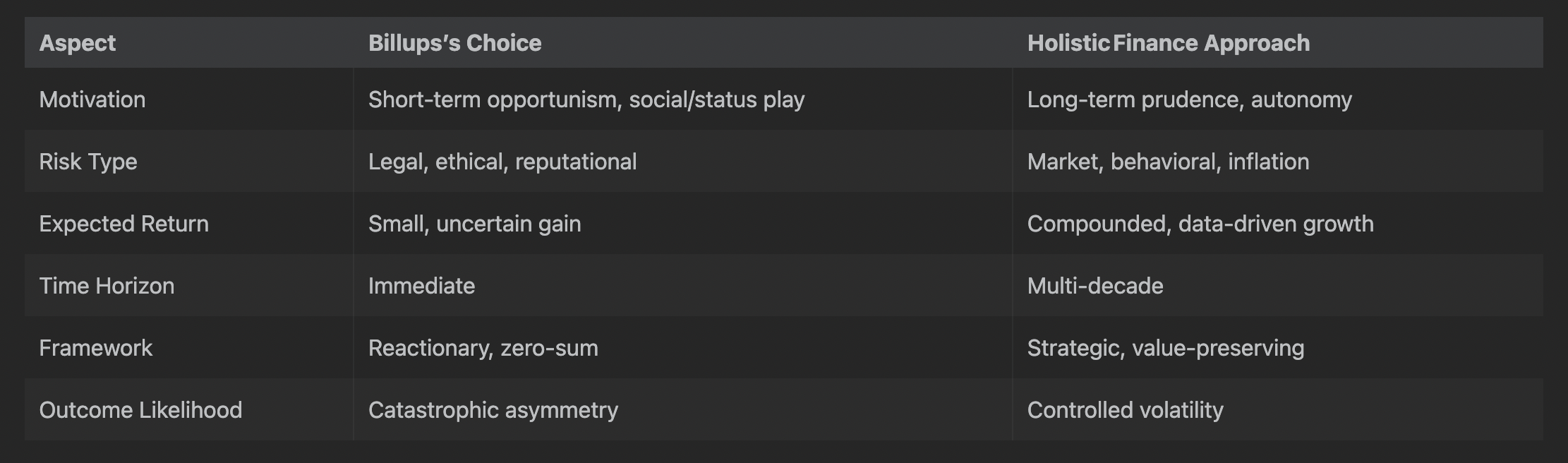
### [READ MORE](https://drink.orangepillcoffee.com/holistic-finance?ref=pulpconversations.com)
# [Premium Coffee Beans 🫘 4 Ⓢ ⓐ 🅻 e](https://drink.orangepillcoffee.com/substack?ref=pulpconversations.com)
---
##### R.I.P. Derek McAllister Jr. 🙏🏽
[Rico Story Part II](https://open.spotify.com/track/6voyU8QopNiBlz4jGny2Xv?si=e718d98cf22341c5&ref=pulpconversations.com)
[Rico Story Part III](https://open.spotify.com/track/0LBolerjepZrVwFpIn0VdG?si=f653157a9e664d16&ref=pulpconversations.com)
---
### The Fixins
URL: https://pulpconversations.com/the-fixins/
Last updated: 2026-09-16T20:10:29.000Z
---
So, I went down the rabbit hole about the intro to Drake’s “We Made It” - which technically was Soulja Boy’s song first; before Drake *made it*.
## “more room here for the fixins”
It’s a sample straight from HBO’s Eastbound & Down - yup that is Kenny Powers dropping lines in his usual, understated style.
Perplexity quickly confirmed: `this isn’t some original Drake flex, it’s a direct lift from the show.`
**Naturally, I wondered**: does Danny McBride get a royalty check every time someone bumps this track?
Perplexity broke it down: `nope, not unless he’s got a rare back-end deal.`
So that means the money flows to HBO and the production company, not the actor, unless he’s got a piece of the IP pie.
BUT … standard contracts don’t cut actors in on sampled dialogue.
**Then I asked the obvious**: is the reason this song isn’t on Spotify because they never cleared the sample with HBO?

## My turn to get clever
Why don’t studios just strike a forward-looking deal and let bygones be bygones?
Perplexity explained: `while it sounds logical, studios want to recover past income first.`
The studios and perhaps all *well-run* corporations (fueled by an acrimony-inducing legal system) act from a point of **legal leverage**.
They don’t want to set a precedent that encourages everyone to “sample now, pay later.”
They want to protect turf and royalty streams.
But I pushed back on Perplexity.
Shouldn’t studios want to encourage innovation? Let creators market-test with their IP, then share in the upside if it pops off?
\-Me
Perplexity agreed: `it’s a valid point and dropped the phrase`
## “sample amnesties”
This is a concept where rights holders let artists experiment, then negotiate after success. It’s rare, but [some forward-thinking companies](https://app.jkbx.com/discover?ref=pulpconversations.com) are starting to try it, especially in light of tokenization on the blockchain.
The real bottleneck isn’t creativity.
Unsurprisingly, stodgy *fat-cat-timelines* dictate legal inertia in the IP world.
Sample amnesties could be the bridge - the venture capital dare I say it - of the recording industry.
Let re-mixers take the risk - *sweat equity* \- let the market decide and then let the rights holders cash in once the value is proven.
It’s a win-win, but only if the record industry is willing to loosen its grip and reimagine the rules.
### Lotus-flower Bomb
URL: https://pulpconversations.com/lotus-flower-bomb/
Last updated: 2026-09-16T20:21:44.000Z
There are moments in life when something clicks because we have learned to tune ourselves to a certain frequency.
For a time, we ride that frequency confidently; we speak about a subject as if we have put in our ten thousand hours and as if we have become able to recognize patterns others do not.
It feels good to recognize this *attunement*, to know that for a moment or perhaps even a stretch of years we contributed something meaningful to a field, a craft and a community.
I think this *tuning* is what mastery looks like.
## Confidence as an editor.
[](https://www.youtube.com/watch?v=jhenogvNrno&ref=pulpconversations.com)
And these days I don’t need no favors …
Our brains are exquisitely powerful instruments, unlike any machine humans have yet built, and every brain is different.
Life becomes an exercise in pattern recognition.
The more patterns we perceive around a problem, the better we are at solving it; the better we get at choosing what to keep, what to discard, what to refine.
To edit well is to expand your influence over your locus of control, shaping your work, your habits, and the small decisions that compound over a lifetime.

## But mastery is never total.
Time and change are patient teachers: new people arrive, innovations appear, records fall, and the very domain we once dominated keeps moving forward.
Part of aging well is receiving this change with grace.
When we edit our lives effectively, we not only improve our own performance but also model better behavior for others; those who follow may adopt what worked, push it further, and in turn advance the field.
True elegance lies in the ability to hold both pride and modesty at once.
`Pride` is for the seasons in which we were tuned in.
- for the clarity
- for the craft
- for the hard-won knowledge
`Modesty` is for knowing that what we tuned into is itself a larger, vibrating domain.
There is a humility in admitting that many truths we feel we’ve found were always available; we simply learned to hear them clearly for a time.
We don’t have to (nor can we) be LeBron James in every part of our life. Everybody, even those who seem at their pinnacle have corners of themselves they wish were better. The people closest to them see that, too.
Hold on less tightly to the grip of comparison and make room for contentment.
Be pleased with the frequencies you can access even if they are not all-encompassing.
## Check in with yourself
Notice which frequencies you can tap into and which patterns you can edit.
What are the habits, choices and projects that most affect your locus of control.
**Be comfortable** in the skin you have earned.
**Be grateful** for the times when the world aligned and you could resonate with something larger than yourself.
## And do it with love
No need to boast or preach. Just a quiet, generous acceptance that for a while you heard something true, and for that you can be thankful.
🙏🏽 Happy Diwali 🙏🏽
\-Vinay
##### Music: [Lotus by Fakear](https://open.spotify.com/track/05ODheHCEU3AdE1kQ7ANY3?si=37c3bf0448244f67&ref=pulpconversations.com)
### Exercising With Drones
URL: https://pulpconversations.com/exercising-with-drones/
Last updated: 2026-08-24T19:04:09.000Z
I read a [cool article](https://www.edutopia.org/visual-essay/the-pros-and-cons-of-homework-in-6-charts/?ref=pulpconversations.com) about the benefits of play vs. homework for youngins’.
If you are looking for a fun activity regimen for your kid I recommend getting a drone and having it chase you around. It’s a good workout and a fun way to teach film-making, camera technique and running away from bad guys.
Your mileage may vary but should be fun either way.
🙏🏽
### I'm Curious.
URL: https://pulpconversations.com/im-curious/
Last updated: 2026-08-24T19:06:39.000Z
**Writing** is a mechanical process, and by practicing daily mechanical maintenance, i.e. writing, I’m inherently increasing my capacity to perform. I’m building skill through action.
Now, compare and contrast that to **Curiosity**.
Not simply a a mechanical process; I can’t sit in a empty room every day and self-declare that I’m curious. 🧐 I guess I could but … we know it doesn’t work that way.
I keep learning because I want to (aka staying curious). It’s not effortful for me; it’s kinda like the point of things; to learn new things and maximize my experience of the world.
Intellectually, I know I’ll never be able to fully experience *consciousness* in-our -limited-time-here because there’s too much of it to experience in a mere human-lifetime.
This is a constraint for everyone.
So it remains in my power to widen the gap between today and then.
If I stay curious with a *mechanical* daily writing practice, I keep learning. If I’m learning this, then I’m excited to share that and then I learn more and then …
Even sharing this reflection with you feels rather profound for me as I’m realizing this.
Maybe it will resonate with some of you.
Smoochy face XOXO.
### Return To Normalcy ...
URL: https://pulpconversations.com/return-to-normalcy/
Last updated: 2026-08-24T19:12:42.000Z
**For adults it is 90%.**
Thankfully we are still more generous towards children en masse - albeit just slightly.
I want to introduce the concept of the Service Level Ratio - SLR. Let’s call these National Health Service (UK) statistics: *subsidized*\-SLRs because England’s NHS is a publicly funded enterprise.
And let’s flip the ratio above to fit this frame. For example, if 90% of dental practices are refusing new patients that equates to a SLR of 0.1 or 10%.
Why would a service provider turn away new clients?
The two simplest answers:
1. There is no capacity to serve new clients; or
2. Another client segment has means to pay more.
According to [George Monbiot](https://www.penguinrandomhouse.com/books/748745/invisible-doctrine-by-george-monbiot-and-peter-hutchison/?ref=pulpconversations.com) (I’ll cover him in a future essay) - an arcane billing system ensures that NHS dentists will lose money on every procedure leaving only the most altruistic among us to work harder for less pay, perhaps out of a personal moral duty to serve.
## Let’s go further.
Why should *we the people* promote / fund / support an organization (the government in this case) whose SLR has dropped to 10%?
In fact, the NHS achieved its peak SLR of 52.4 % in 2010 - itself a weak “health” ratio if judged on many commercial standards.
## Let’s go further.
Which camp are you in?
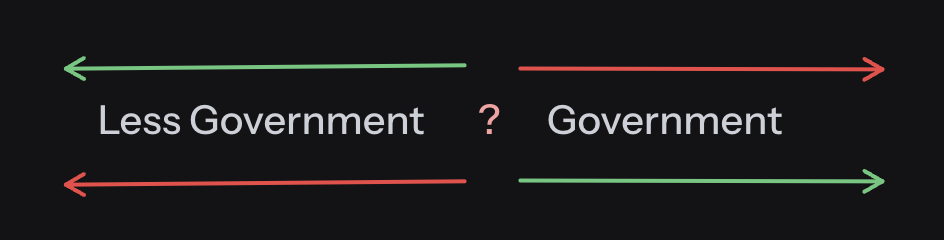
****Government or No-Government?**
Hopefully you don’t fall for this Straw-man trap because life exists on a spectrum and sometimes we go too far in one direction. Unfortunately powerful interests adeptly paint a binary picture for us, encouraging us to avoid healthy debate; instead fanning the flames of existential crises.

Even facts lie on a spectrum in today’s era; highlighted by recent history.
Society can and sometimes does stray two [standard deviations](https://www.perplexity.ai/search/please-explain-the-concept-of-ayuMcQ45TwCabL7c0hY.NQ?ref=pulpconversations.com#0) (2 S.D.) from the norm, especially in times of incompetence and over-reach. When this happens - there is a correction.
Intuitively, a three standard deviation (3 S.D.) move is probably limited to a *Black Swan* event such as civil war / regime change, genocide or hyperinflation.
In honor of October let me try a baseball metaphor - during a correction it’s as if someone hits a home-run but takes a long time to run the bases; only to find out home plate is missing on the way back.
Have a look at the following graphs I *made* with Perplexity. How do you interpret the data?
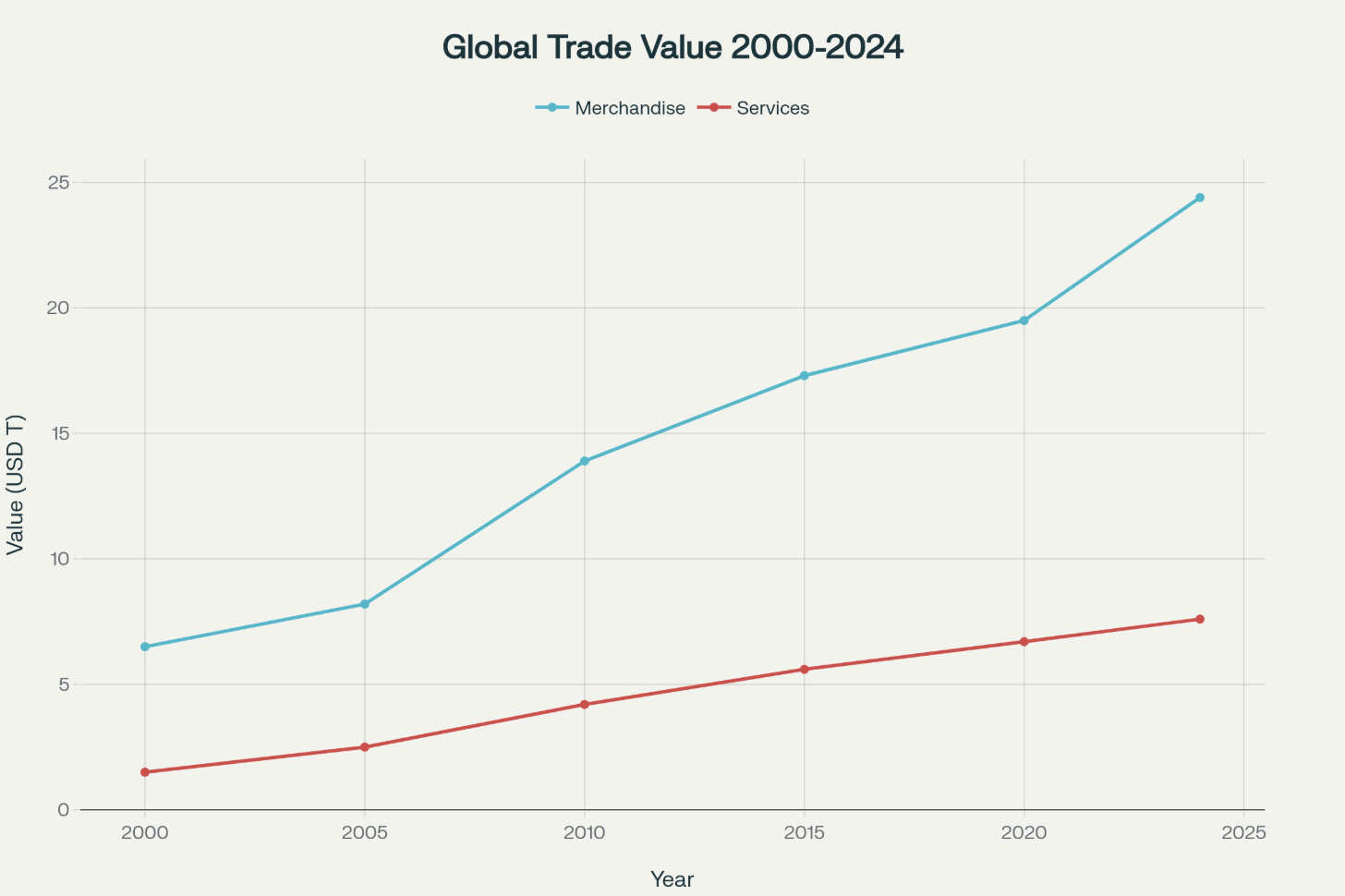

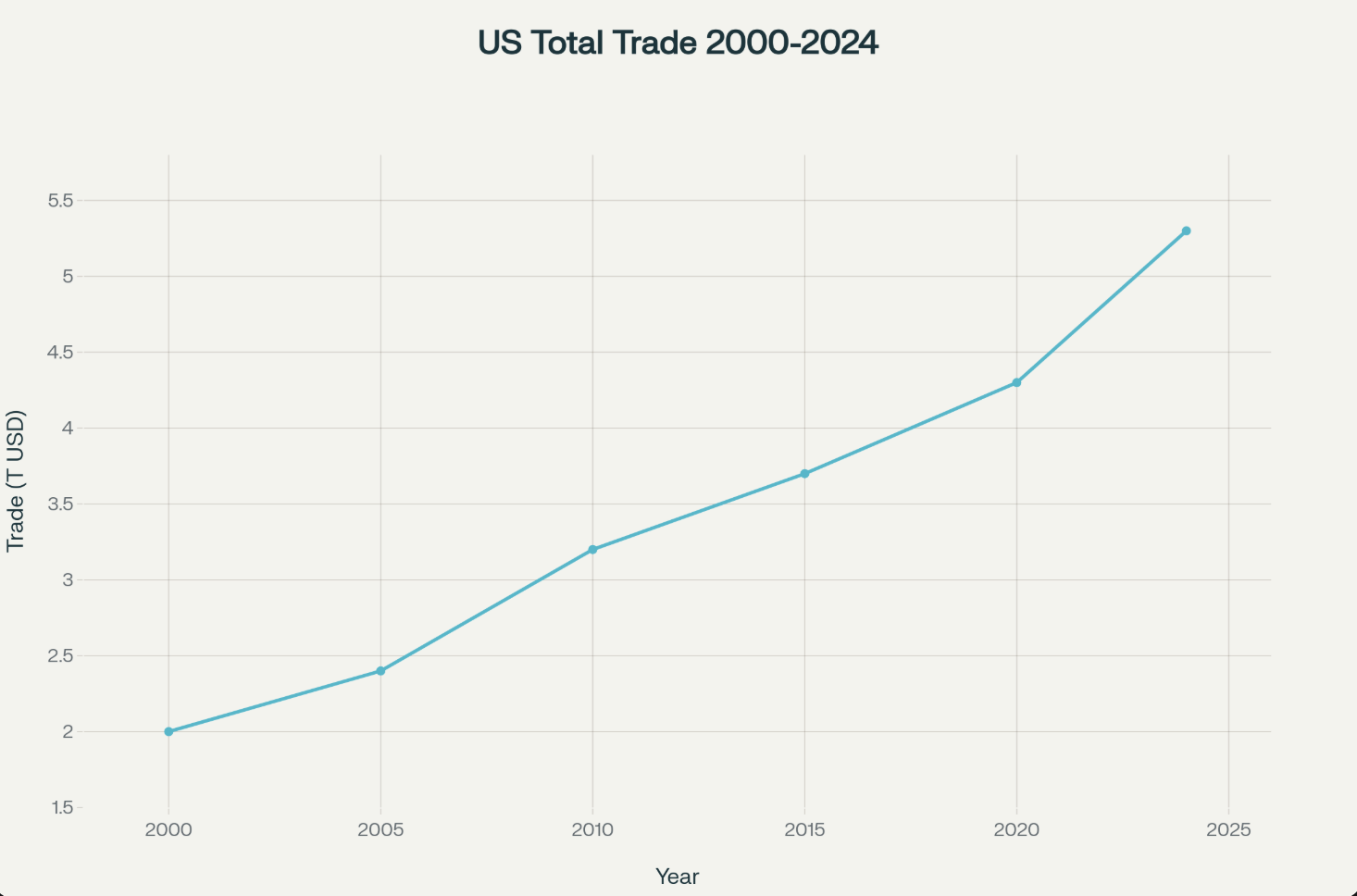
The global hegemon at work!
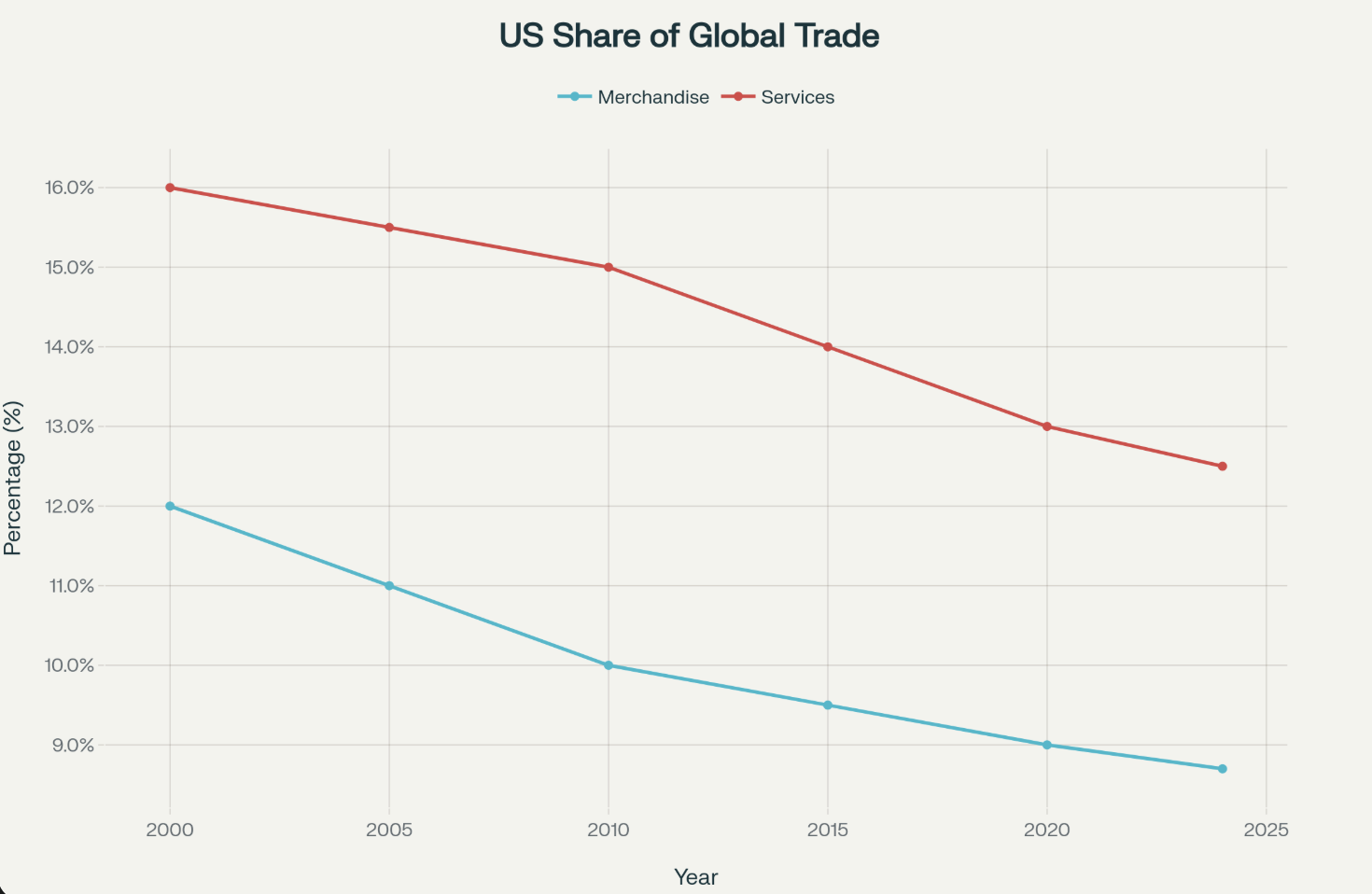
Holy smoke, Batman! - The USA is not trading - must be Trump ….

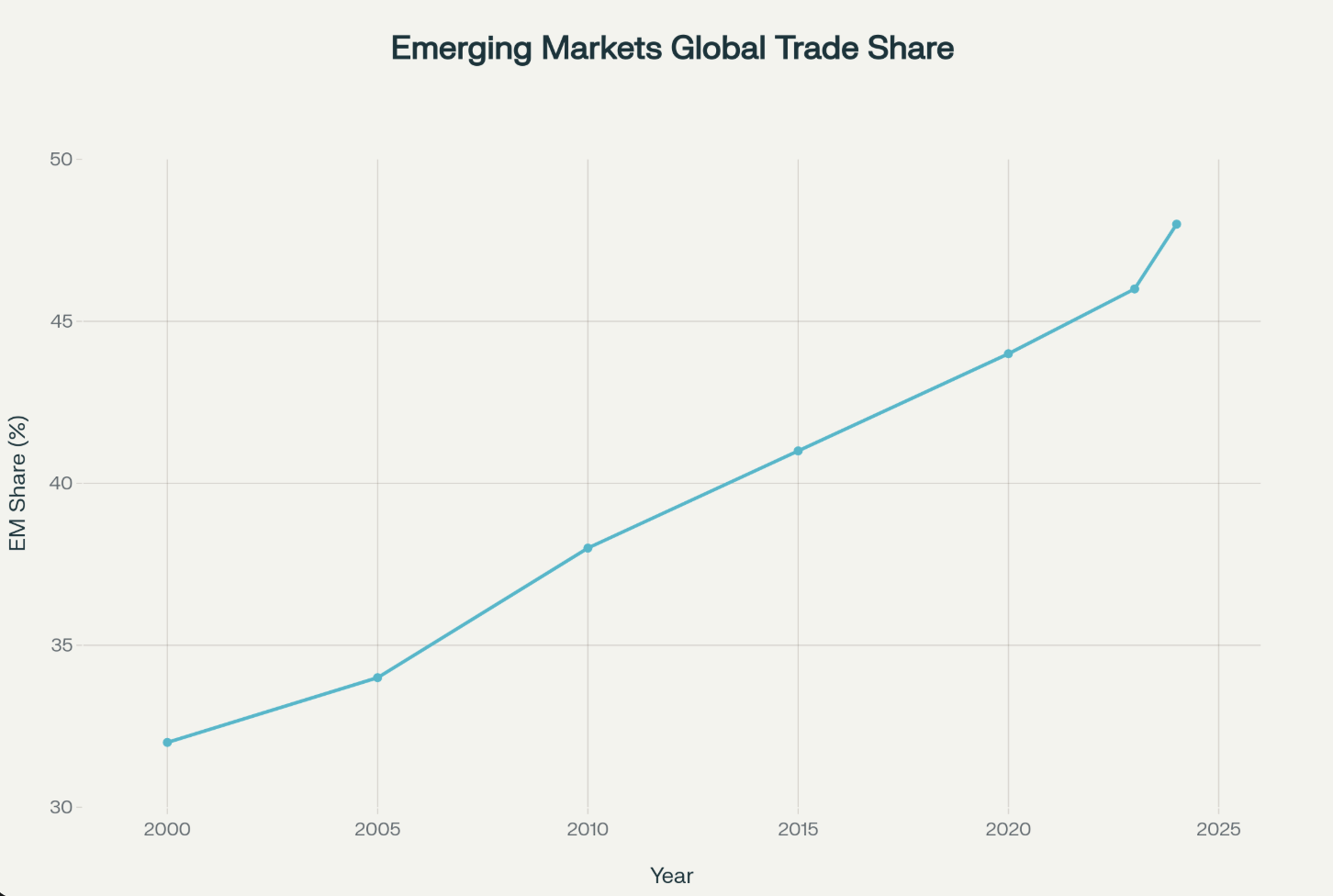
Oh doh! If other markets are increasing share then it follows USA is losing share …
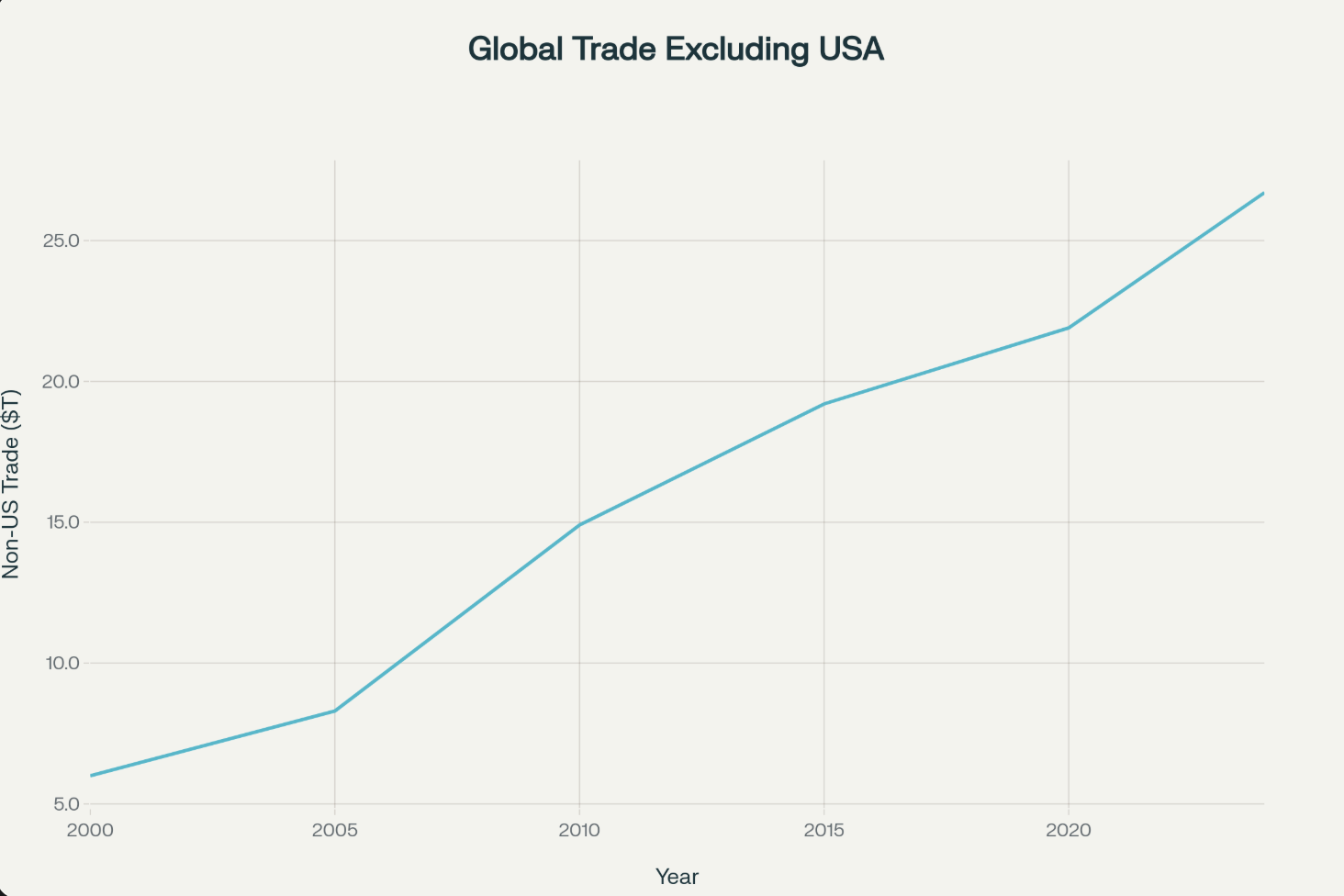
**Shit-hole* countries for the win!
So which is it?
Is the USA a naughty, nefarious global hegemon? - ***maybe***
Is the USA losing global trade market share? - ***yes***
Is that a *bad* thing? - ***maybe***
Is that a *good* thing? - ***maybe***
Is it logical that leaders of *any* enterprise might want to increase market share, especially after a steady 25-year decline? - ***probably***
## Now let’s come full circle.
In light of declining market share and diminishing Service Levels (reflecting back on that pesky NHS’s SLR of 10%) - is it any wonder that special interest groups and new administrations are grabbing power in the USA, UK and other non-emerging markets?

This is a complicated issue with many twisty turns.
If you want to chat more about this please leave a comment below and I’ll get back to you; and / or set up a discussion group event if there is enough interest.
[Leave a comment](#ghost-comments-root)
Thanks for reading.
[Buy some coffee](https://drink.orangepillcoffee.com/substack?ref=pulpconversations.com) to support my writing. It is literally some of the best in the world.
##### *Music*: Midnight Mischief by Jordan Rakei (Tom Misch remix)
##### *Animation*: manifested by Yours Truly via AI
### Disciplined Execution vs. Radical Focus
URL: https://pulpconversations.com/disciplined-execution-vs-radical/
Last updated: 2026-08-24T19:51:59.000Z
I caught up with the future Mayor of my village today and we were discussing performance objectives and accountability. I mentioned `Radical Focus` as a worthwhile book to read; as it glorifies the concept of OKRs - **Objectives and Key Results**. The book became popular within startup [power circles](https://opc.pulpconversations.com/p/wanna-be-part-of-the-power-circle?ref=pulpconversations.com) about a decade ago and it is still relevant today.
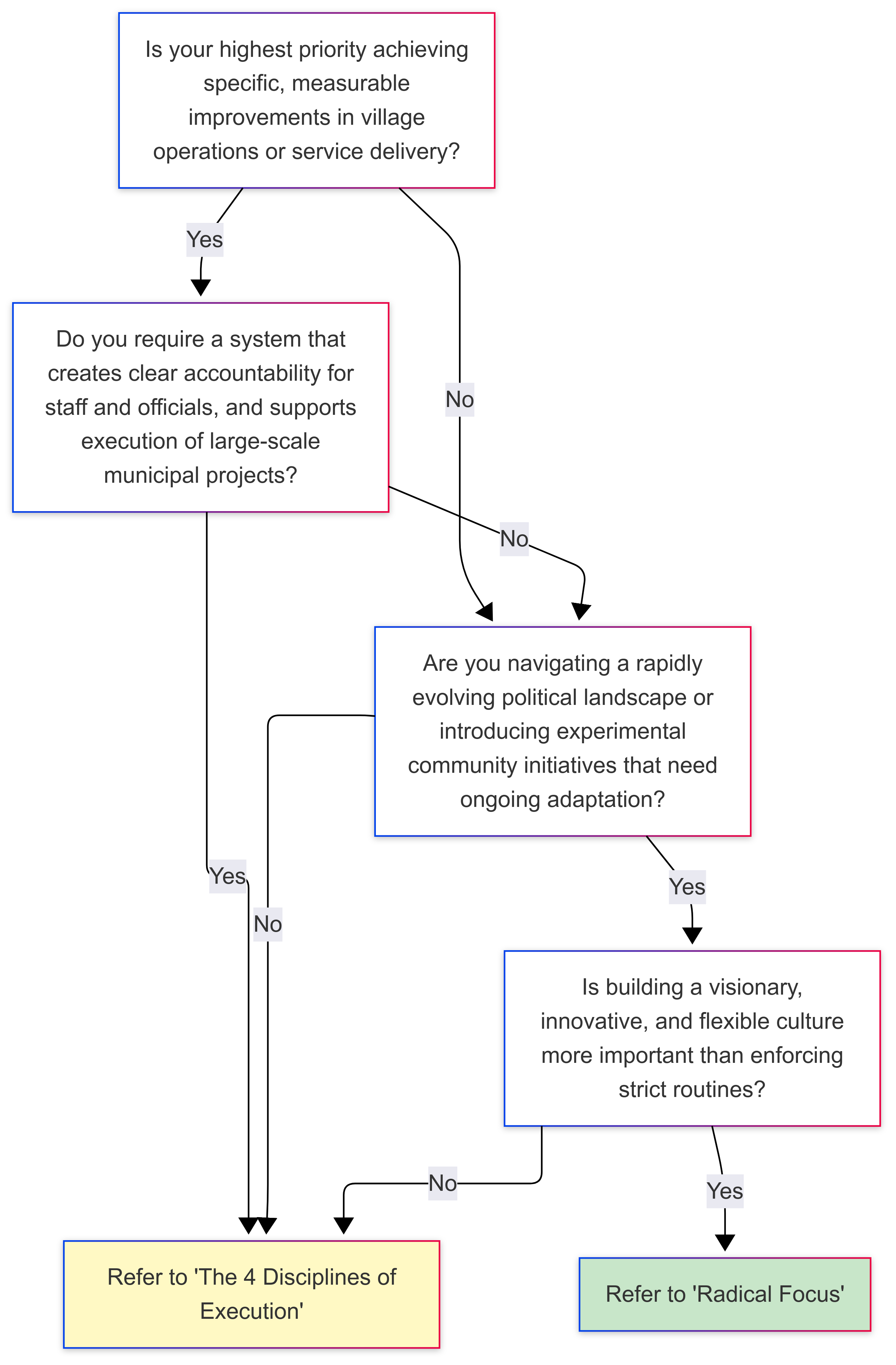
OKRs are supposed to galvanize teams by encouraging them to rally behind ambitious and inspirational objectives; possibly designed to be just out of reach, to push teams to their limits and give them an opportunity to excel, then learn from *failures*.
[Subscribe](#/portal/signup)
Radical Focus can be visionary but imo it preys on naive people who presume access to motivated teams that can tolerate iterative cycles of failure. Most people can’t handle *the prospect* of even one failure. The reality outside of Silicon Valley is being strapped for cash and human capital. I think this is especially true in the government and non-profit spheres.
After our meeting I texted another preferred book recommendation: The Four Disciplines of Execution; shortened to `4DX` by people in the know.
4DX is especially well-suited for environments where clarity, discipline and steady progress matter.

All the environments?
Some of the nerds who email me say that 4DX creates needed structure by aligning the team around a Wildly Important Goal (WIG). The method works particularly well when reporting is limited to few metrics that are truly actionable; reserving meetings for coaching rather than ~~peacocking~~ status updates.
## e.g. WIG
---
> “Increase the percentage of resolved citizen complaints from 60% to 85% by December 31.”
---
1. This WIG is specific, measurable, and time-bound.
2. Progress can be tracked with **lead measures** such as:
- \# complaints responded to < 48 hours and;
- \# follow-up actions completed per week
3. The lead measures are actionable and status updates can be shared via dashboard
4. Accountability is tangible and ongoing.

- Use 4DX when the challenge is about transforming habits, driving operational results, and aligning a large group toward shared, measurable wins.
- Use Radical Focus when the team needs to embrace learning and stretch into new territory and when cultural buy-in is critical. **Note*: any team using this must be “incentivized to fail” otherwise it just doesn’t work*.
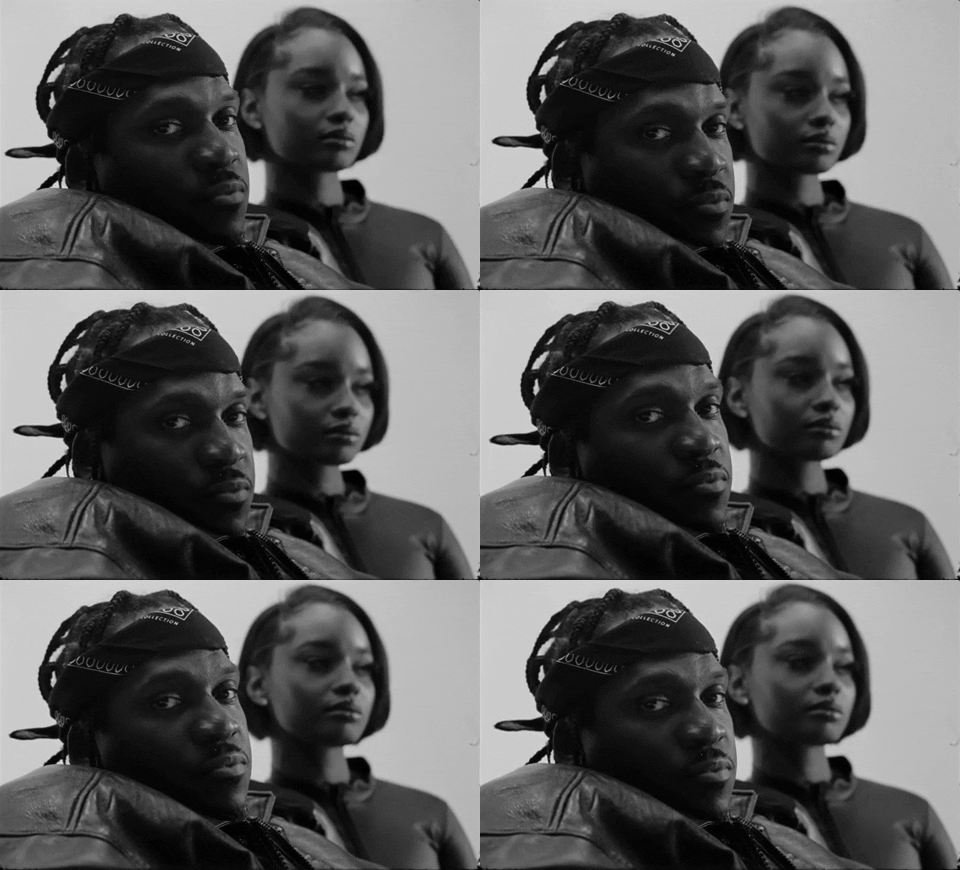
Vision is important, but discipline brings it to life …
Share this post with a disciplined visionary.
[Leave a comment](#ghost-comments-root)
##
[Subscribe](#/portal/signup)
### Livi Redden
URL: https://pulpconversations.com/livi-redden/
Last updated: 2026-08-24T21:47:23.000Z
> I'm a strong believer that intergenerational compassion, understanding and communication is a huge part to emotional healing because so much of the things we have to heal (from) had to do with something that the generation and a few above us did not receive or even know about. And so I think viewing it as **generational liberation instead of blame** or frustration puts people in a lot more of an empowering stance. - Livi
Last week I had the pleasure of meeting Livi Redden, an inspirational woman in her 20s - who is perhaps most famous for giving a TED Talk that has almost 3 million views
Livi’s Dad suffered from [ALS](https://www.perplexity.ai/search/what-is-als-Z%5FNdfMaARb6f8swpppiYVw?ref=pulpconversations.com), making her a child-caretaker for her terminally ill father. This early experience taught her to be resourceful, empathetic, and now relentlessly proactive in encouraging teenagers, 20-somethings and even “adults” to focus on emotional regulation techniques.
Hope you enjoy our chat as much as I did.
And down below is the TED Talk that made Livi (originally from Utah) the second most famous person to visit Bayonne, NJ (after George R.R. Martin) 👇🏽
[Subscribe](#/portal/signup)
[](orangepillcoffee.com)
### Marcel Breuer House at Pocantico
URL: https://pulpconversations.com/marcel-breuer-house-at-pocantico/
Last updated: 2026-08-25T19:40:24.000Z
# [Here](https://archive.ph/TwbQu?ref=pulpconversations.com)’s a Breuer ; [There](https://galeriemagazine.com/marcel-breuer-hudson-valley/?ref=pulpconversations.com)’s a Breuer
75 years old and I’m still in love with the rational yet experimental nature of this design. I wonder … what might a Breuer House look like today; to cater for [The Sandwich Generation](https://www.perplexity.ai/search/what-is-the-sandwich-generatio-pWD68spRTUej7o48ezwTrQ?ref=pulpconversations.com)?
> I live in a tony suburb with a 10% poverty rate; 20 miles north of the City. We have a kid and we once hoped to live with my 80-year old mother. It has been 75 years since Breuer demonstrated that a well-designed, modern home could be both affordable and practical for the average American family. How might we reimagine his epic home, in low-fidelity pen and ink architectural sketches, for The Sandwich Generation?








Made with Midjourney
[](https://opc.pulpconversations.com/p/small-acts-that-matter?ref=pulpconversations.com)
[Friends, how many of us have them?](https://opc.pulpconversations.com/p/small-acts-that-matter?ref=pulpconversations.com)
[Re-up Coffee](https://drink.orangepillcoffee.com/substack?ref=pulpconversations.com)
---
### Transactions Build Relationships
URL: https://pulpconversations.com/transactions-build-relationships/
Last updated: 2026-08-25T19:46:44.000Z
## Relationships …
are not some mystical, sacred things floating above the messiness of daily life. They are the sum of transactions, for better or worse. You can use the word *interactions* if it makes your conscience feel better. You don’t get a relationship just because you slap a label on it. You earn it, reinforce it, or destroy it, one transaction at a time.
Even the most pure relationship: mother and child; it doesn’t just exist because of biology. It’s built on a series of choices and actions.
Did the mom take care of herself pre-peri-post pregnancy?
Did she get support?
Did both parents bring their best to the table, both before and after the child was born?
Every relationship is the sum total of these micro-transactions.
The quality and reciprocity of those transactions determines whether the relationship thrives or falls apart.
If relationships were all that mattered, how do you explain families that fall out?
The title `parent` or `child` means nothing more than its literal definition if the transactions are toxic or absent.
Every time you *deal* with someone, you’re making a deposit or a withdrawal in the relationship bank.

## What do you actually deserve …
… from a relationship, if you yourself are transactionally deficient?
**“I’m doing my best”** is a moving target.
Who defines “best,” anyway?
Maybe it’s just “better than I was yesterday.”
`That’s legit`, as long as you can justify it to yourself.
But if you’re just coasting, copying others, or running on auto-pilot, you’re not acting with intention.
And if you’re not intentional, you’re not adding value to yourself or anyone else.
---
So, what’s eating up your bandwidth?
What are your priorities?
If you want better relationships, your resource allocation needs to change.
Direct time, energy and attention towards interactions that matter.
Your. Your. Your. Your.
---
And yea, `matter` means matter to you, but if you want any relationship to be mutually reinforcing, you have to add value to the other side, too.
## Challenge:
Pick a relationship: one that’s faded, or one that’s just coasting … and approach it with an intentional mindset. Add value. See what happens.
---
👊🏽
[Subscribe](#/portal/signup)
A little over a year ago I was in bondage,
and now I'm back out here reaping the blessings and getting the benefits that go along with it, everything that's out here for kings like us.
The reason why we like this, this jewelry and this diamonds and stuff,
they don't understand is, because we really from Africa,
and that's where all this stuff come from.
And we originated from kings, you know what I'm saying?
So don't look down on the youngsters because they wanna have shiny things.
It's in our genes, know what I'm saying?
We just don't all know our history, so—"
**Pimp C**
Fuck with me, you know I got it
Fuck with me, you know I got it
Sexy bitch I hope she 'bout it
Come fuck with me, you know I got it
**Jay-Z**
### Liberating Our Inner Muse
URL: https://pulpconversations.com/liberating-our-inner-muse/
Last updated: 2026-08-25T19:50:40.000Z








Some stuff "I made" in Midjourney
## If I didn’t make it who did?
**Warner Bros. / Discovery’s claim:**
If Midjourney’s model “embodies” a Warner Bros. work such that it can generate a single, highly similar output, that’s infringement.

### what if?
a human artist sees a Warner Bros. image once, remembers it, and later recreates it (even better), is that infringement? If so, why isn’t every artist with a good memory a copyright violator?
---
**Copyright law** doesn’t care about the *mechanism* (human or machine) but about the *result*: Is the output a “copy” or “derivative work”?
## Unit test
If a human artist, after a single exposure, creates a work that is “substantially similar” to the original, that *can* be infringement. But courts often look for evidence of direct copying, **not just inspiration or memory**.
If the human’s work is transformative or adds new expression, it’s more likely to be fair use. If it’s a near-duplicate, it’s more likely to be infringement.
## Applying this to AI
**If the AI, after a single exposure to a work, can generate a single, highly similar output,** the legal question is: Is that output a “copy” or a “derivative work”?
- **If yes,** then by the same logic, a human doing the same thing would also be infringing.
- **If no,** then the claim against Midjourney is weakened imho because the *unit* of infringement is not the process, but the output.
Are there are any legal scholars reading this who can support or rebuke me?
## A double standard:
The law is *inconsistent* here, because it’s built on the assumption that humans can’t do what AI can do at scale. But at the unit level, if a human can create a near-identical work from memory, that’s *potentially* infringement; though rarely prosecuted, because it’s so rare and hard to prove.
---
So, if you apply the claim to one instance, the logic must apply to both AI and humans. The only reason the law is more aggressive with AI is because of the *potential* for scale, not the unit act itself.
---

## Midjourney if you are reading this …
Argue that the unit act (one exposure, one output) is not fundamentally different from human memory and creativity. Push for legal standards that focus on *systematic* or *intentional* copying, not edge-case outputs.
---

## `if you’re arguing from first principles, the claim is logically shaky.`
## `if it’s infringement for one, it’s infringement for all.`
---

[Kamala Beats](https://kamalabeats.com/?ref=pulpconversations.com)
### Holistic Finance
URL: https://pulpconversations.com/holistic-finance/
Last updated: 2026-08-25T19:57:55.000Z
This is about integrating personal, business, and macroeconomic perspectives.
“Holistic” might matter in a world of *siloed* financial advice.
> Everyone has an agenda, which means YOU need one too.
Here are some topics that I think are important. Let me know what you think. What resonates? What else might be important to learn?
---
[Subscribe](#/portal/signup)
## I. Time Value of Money
Money **today** is worth more than money **tomorrow**.
Simply put if someone owes you $100 - it is more valuable to you if they pay you back today. That $100 will be worth less one year from now.
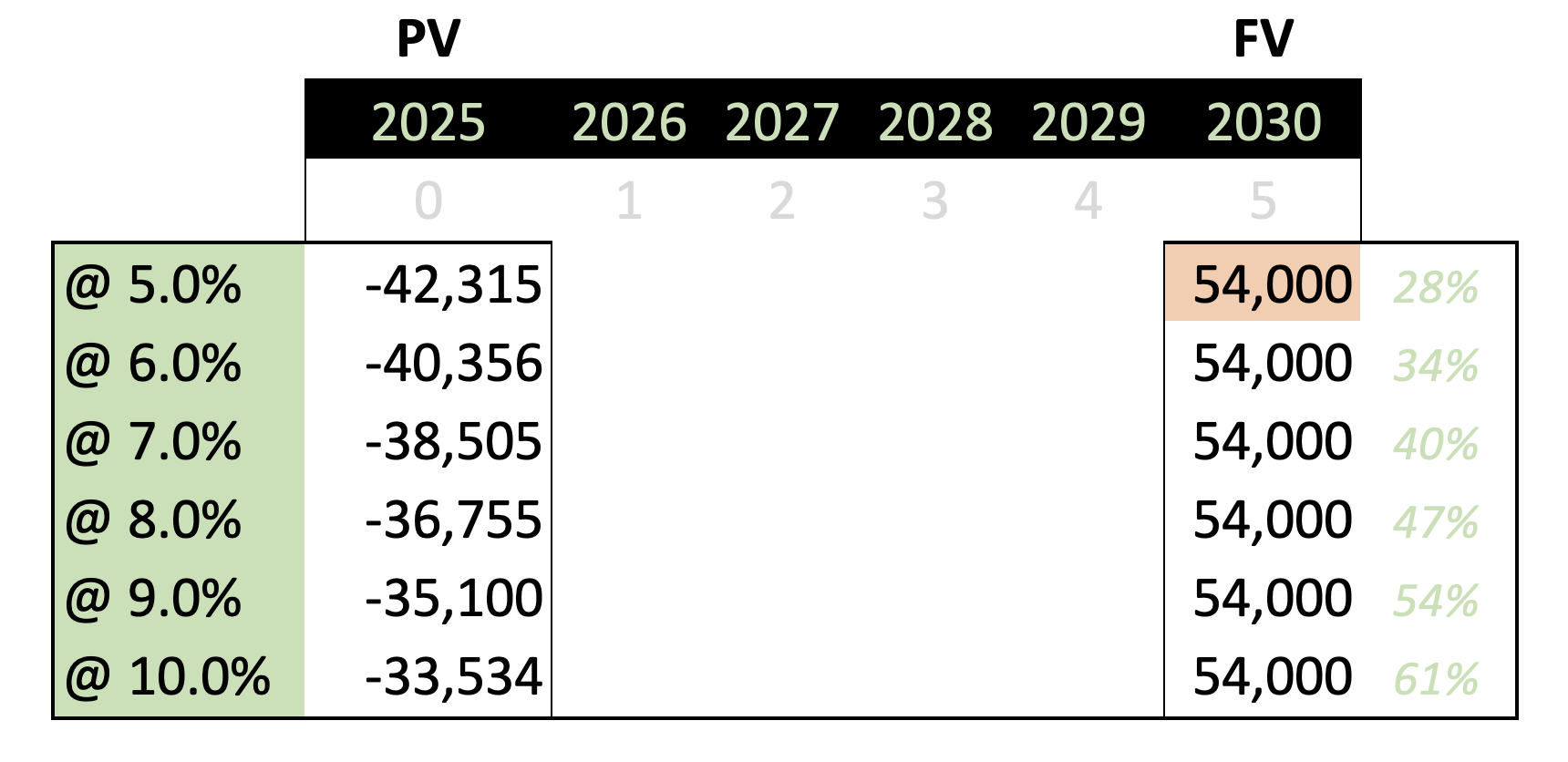
$54K is the median downpayment for a house in America
Present Value is an instrumental concept to grasp when saving for the future as well. Let’s assume your plan is to save money for a downpayment on a house in five years.
If you can earn 5% yield on your money then you will have 54K by 2030 if you invest just over 42K today.
If you are one of the lucky ones who has access to preferential investment opportunities you might be able to earn 10% on your funds. And if so then you can invest *only* 33.5K today and still end up with 54K in five years.
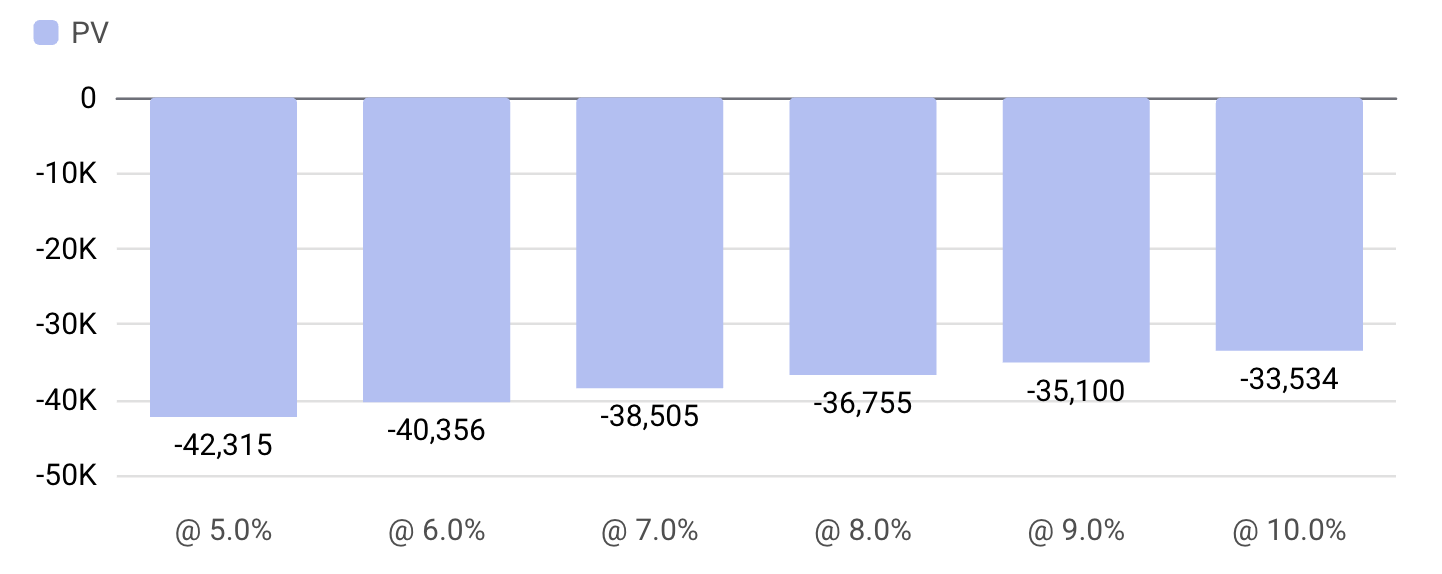
You need to invest less today if you can achieve a higher “hurdle rate”
That’s the time value of money; hopefully this example conveys the power of compounding and why patience is a superpower in finance.
#####
## II. Setting Goals & Managing Expenses
The *top line* is often unpredictable …
If you are on a salary there is always a risk that you might lose your job and if you are a founder your “hopes and prayers” may not be answered in the form of revenue.
Hence *below the line* aka expense management is your only real precision lever. And of course we can’t always predict costs, especially when emergencies strike.
It’s imperative to know your *burn rate* and how it dictates your survival.
To calculate your *runway*, assume you have no income and then figure out how many months of expenses you can cover with no money coming in the door.
The goal is to always have more runway.
## III. Allocation, Diversification, and Risk
[Allocation](https://www.wsj.com/personal-finance/retirement/us-401k-retirement-stock-market-84cfe48d?st=PEtYC7&reflink=desktopwebshare%5Fpermalink&ref=pulpconversations.com), [allocation](https://www.wsj.com/finance/investing/stock-bond-portfolio-ratios-b0d43275?st=Y8Apc5&reflink=desktopwebshare%5Fpermalink&ref=pulpconversations.com) and [allocation](https://www.wsj.com/finance/investing/how-to-keep-this-hot-stock-market-from-melting-your-retirement-dreams-2cf28499?st=Wc7TJg&reflink=desktopwebshare%5Fpermalink&ref=pulpconversations.com).
We are inundated with recommendations on where to invest, how much to allocate between stocks and bonds, and why diversification is important.
Yet diversification is not an end in itself. In fact, there are risks of both over- or under-diversifying.
Concentrating your investment allocation can be a risk, however did you know it is the preferred strategy for most successful money managers who control proprietary capital?
Your investment strategy should assess and mitigate risk that is specific to you. A [60/40 portfolio](https://www.perplexity.ai/search/what-is-a-60-40-portfolio-i1kwZI6ZSKecQIGxhpONFw?ref=pulpconversations.com) is primarily a consensus marketing mechanism rather than a framework for generating alpha.
## IV. Inflation
I’ve written about inflation [here](https://opc.pulpconversations.com/p/people-are-outraged?ref=pulpconversations.com), [here](https://opc.pulpconversations.com/p/its-a-bitter-sweet-symphony?ref=pulpconversations.com), [here](https://opc.pulpconversations.com/p/the-feds-wealth-effect?ref=pulpconversations.com) and [here](https://opc.pulpconversations.com/p/10-x-the-ebitda?ref=pulpconversations.com).
I like talking about it because we as a society don’t understand how it works. Even worse the concept is simply mis-taught. The de facto economics we learn is Keynesian (it’s been the prevailing system during our lifetimes) and Classical (the system before that). Most people know far less if anything at all about the Austrian School (the system before that).
When you go back far enough you realize that people must share the same economic value system to truly get along.
So inflation plays a major role in how each of these systems think about labor, customers, value and intervention.
It’s important for YOU to determine your *personal rate of inflation*. It is the only thing that matters.
Everyone’s inflation is different; it depends on your “basket” (education, housing, healthcare, etc.).
#### Challenge:
Calculate your own personal inflation rate and observe how it impacts goal-setting.
If you’re not beating your personal inflation rate, you’re falling behind; even if the headlines say inflation is low.
## Recap:
I. Money Has Time Value
II. Manage Expenses
III. Allocate To Mitigate Risk
IV. Personal Rate of Inflation
Please send to someone who might enjoy it.
### Small Acts That Matter
URL: https://pulpconversations.com/small-acts-that-matter/
Last updated: 2026-08-25T20:08:24.000Z
The entrepreneur’s path looks glamorous from the outside: fancy-pants networking events, coverage in the WSJ, and the ever elusive successful *exit*.
The truth, lived day-to-day, is mostly small, lonely, expensive stretches of uncertainty.
No paychecks only bets on ideas.
We learn by shipping, by failing (hopefully quickly) and by iterating on thin evidence.
The difference between giving up and grinding through often comes down to what a friend will do. Little, reliable actions are all it takes to send the message: I believe in you `enough to help`.
The best founders are pragmatic and it follows that the best way to support entrepreneurs is grounded in the practical.
Showing up emotionally helps, but …
## Practical-help compounds
Want to be useful? Do concrete things.
- Beta-test the product and give a structured five-minute critique
- Introduce one person you know who might be valuable
- Show up to a launch for 30 minutes and ask three smart questions
- Post an honest review somewhere that matters
- Dare I say the obvious - buy the [*Whatchamacallit*](https://drink.orangepillcoffee.com/substack?ref=pulpconversations.com) being sold
Each of these actions has outsized value because founders operate on feedback loops while in echo chambers of [signal economies](https://www.perplexity.ai/search/what-is-a-signal-economy-2gSRusqwR8.zq9sidTZ%5FTA?ref=pulpconversations.com) \- that few make it past.
Thoughtful actions can helpfully pivot months of work.
What’s the point of this rant?
A performative ❤️ or an ambiguous “congrats so cool!” in a group chat is good enough to beat the Level 1 Boss. And if you want to keep playing the game, perhaps try:
1. Holding them accountable, gently. Entrepreneurs need cheerleaders and critics. Encouragement that sugar-coats reality is useless; so is McKinsey-level skepticism that leaves the founder FMLing.
2. Try asking *what did you learn from your last experiment*? Or *who is the customer you’re serving now*? And another one … *what would a meaningful win look like in the next two weeks*?
3. Don’t say *“let me know if you need anything.”* We know that isn’t a promise to do anything helpful. Instead make an explicit offer or simply buy their product and tell someone if you liked it. If you didn’t like it, then tell the founder why.
## Don’t be the friend who erodes confidence
*“One of us has an actual job”* is not only banal but it’s condescending. If your default response is doubt, your words will start to sound like a London weather forecast - too cold in the Winter and too hot in the Summer.
If you can’t be optimistic, try to be constructive. If you don’t believe in the idea, be transparent, but don’t act as a roadblock to access.
## Introductions withheld are opportunities stolen
Founders survive on momentum. If your friend hits a small milestone such as a first paying customer (maybe it could be you!), first positive review or funding perchance! - consider telling others. Endorsements become social proof and fuel.
Being silent about your friend’s progress is a missed lever for them and perhaps a sign you might be caught up in yourself.
## Examine your excuses
> Too busy …
> It’s not my field …
> Must be nice to be able to …
If you care about someone, you’ll find one concrete way to move their needle.
Being absent with reasons is still being absent.
## Challenge
Pick one founder-friend of yours and do one thing for them this week that directly helps their work.
Try to do it in a way that changes their reality, not just your conscience.
## For entrepreneurs …
### … the *exit* is an end in itself, for everyone else the EXIT is a means to escape.
[Subscribe](#/portal/signup)
#####
### It's A Bitter Sweet Symphony
URL: https://pulpconversations.com/its-a-bitter-sweet-symphony/
Last updated: 2026-08-25T20:23:10.000Z
What’s your number?
No. Not your phone number.
No. Not your body count (*vulgar cultural reference used by young people*).
Another friend said:
> for me it often means what number of wealth do you have to get to that makes you comfortable with now doing whatever you want.

I came across [this article](https://www.wsj.com/personal-finance/retirement/us-401k-retirement-stock-market-84cfe48d?st=2Qyy86&reflink=desktopwebshare%5Fpermalink&ref=pulpconversations.com) two weeks ago. Also, my friend Maaria is building [The Four Languages](https://thefourlanguages.com/about-us?ref=pulpconversations.com) \- a framework for personal + professional growth predicated on synergy between the Mind, Heart, Body & Soul - and she kindly invited me to give a holistic finance lecture next month … so the question has been on my mind.

Now that I live back in the leafy + lovely suburbia where I grew up, I think a lot about how much formal financial training I have had and how virtually none of it has covered *personal finance*. Nothing could be more important, yet the subject wasn’t covered at university in America, nor my MBA in Britain - the two most influential colonial forces in recent memory.
So what does that tell you?
You need to figure it out for yourself - nobody is looking after you except YOU.
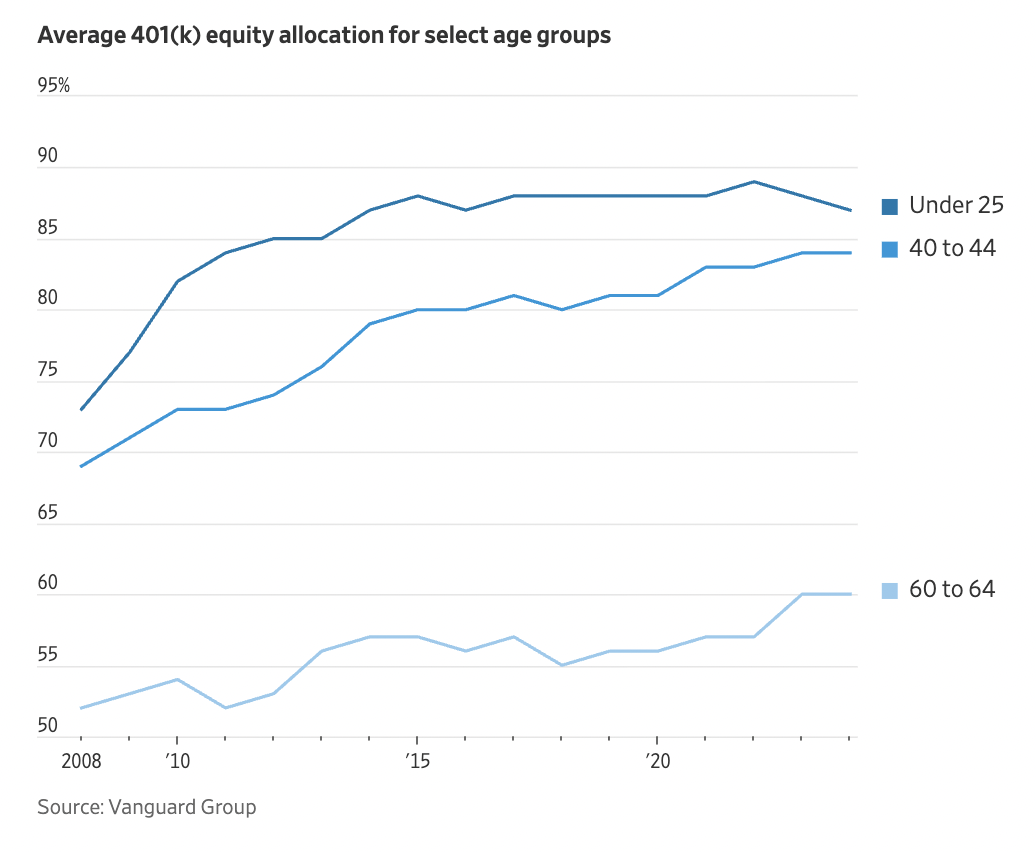
[Source: WSJ](https://www.wsj.com/personal-finance/retirement/us-401k-retirement-stock-market-84cfe48d?st=2Qyy86&reflink=desktopwebshare%5Fpermalink&ref=pulpconversations.com)
> At the end of 2024, the average equity allocation for workers in target-date funds just beginning their careers was 92%, according to Morningstar, up from 85% in 2014.
Why does this matter?
When **the average equity allocation** in a retirement fund **is a whopping 92%** for workers it means that people are ~~investing~~ praying that their hard money will be able to outpace inflation.
Finance people might say because of the[*time value of money*](https://www.perplexity.ai/search/define-cash-burn-ZPQmjGV1Qc2BaZM9PDfVlg?ref=pulpconversations.com#1).
But in the absence of [inflation](https://opc.pulpconversations.com/p/people-are-outraged?r=5av9wm&utm%5Fcampaign=post&utm%5Fmedium=web&showWelcomeOnShare=false&ref=pulpconversations.com) \- the [discount rate](https://www.perplexity.ai/search/define-cash-burn-ZPQmjGV1Qc2BaZM9PDfVlg?ref=pulpconversations.com#2) is simply the rate required to hit **your number’s** [net present value](https://www.perplexity.ai/search/define-cash-burn-ZPQmjGV1Qc2BaZM9PDfVlg?ref=pulpconversations.com#3)!
And there IS INFLATION !
Lots of it.
And none of us can predict it.
So the only sensible solution is to plan / hope to …
You need to out-perform inflation bigly. Also CPI is misdirection.
## How do I pick a number?
Figure out your annual net [cash burn](https://www.perplexity.ai/search/define-cash-burn-ZPQmjGV1Qc2BaZM9PDfVlg?ref=pulpconversations.com), predict when you will stop working and when you will die.
Back of the envelope: that is your floor number.

\> $5M
## How much is enough?
It depends on the lifestyle you want to lead.
I know people who:
- for the last 10 years, have been raising two kids on a boat that has circumnavigated the globe multiple times. (not a yacht - more like van-life on the high seas)
- sold all their stuff and live in a trailer park in Florida
- have growing balance sheets but still feel like they are in a rat race
- have income statements but no balance sheets and happy as clams
You get the drift. Different strokes for different folks.
There is no bad lifestyle choice - as long as you are living the lifestyle you want …
`… and can afford.`
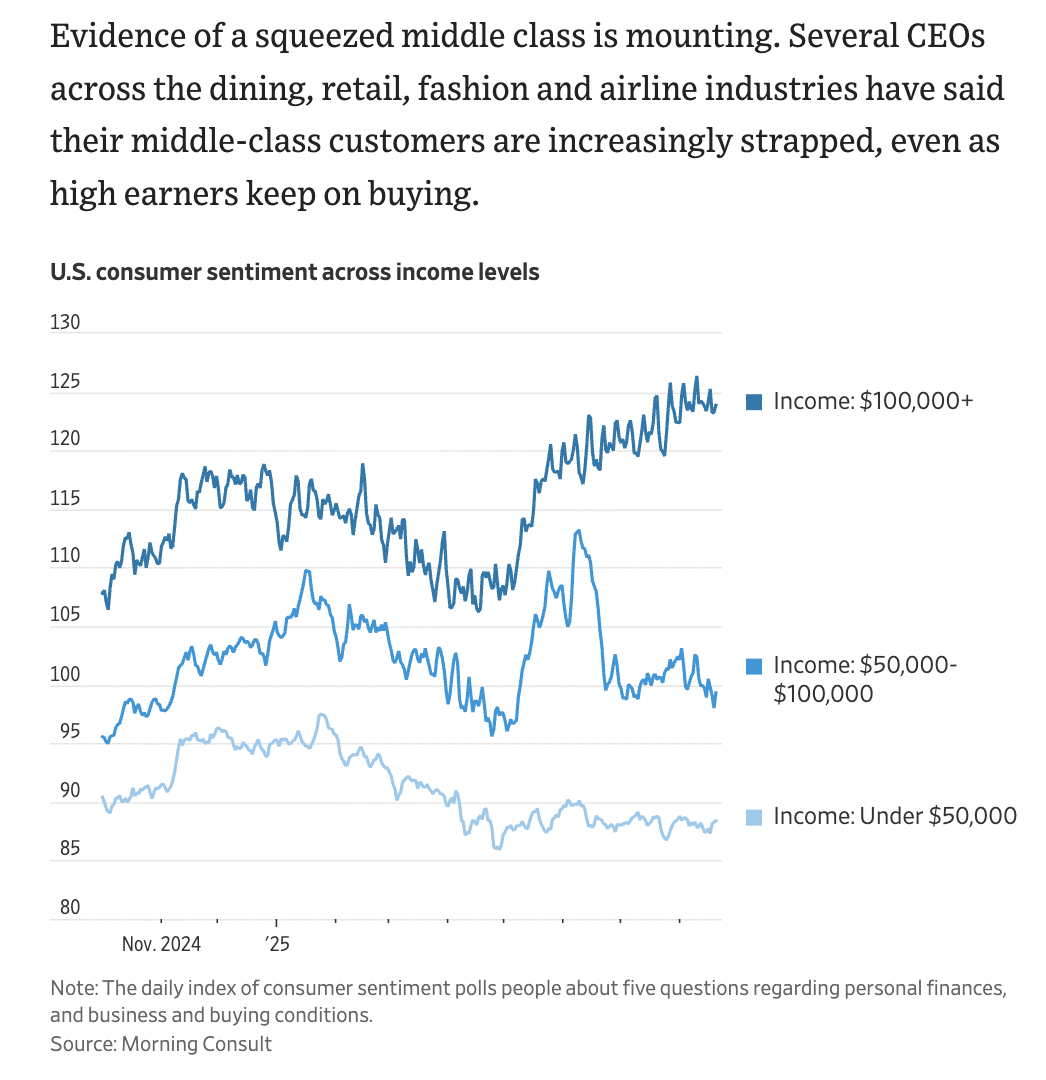
[Source: WSJ](https://www.wsj.com/economy/consumers/the-middle-class-vibe-has-shifted-from-secure-to-squeezed-a41f64f8?st=SpKVCV&reflink=desktopwebshare%5Fpermalink&ref=pulpconversations.com)
---
Be honest with yourself. Run some numbers. Plan accordingly. And accept all luck along the way.
## How do I achieve my number?
I’m still finalizing content for my [Holistic Finance](https://drink.orangepillcoffee.com/with-maaria?ref=pulpconversations.com) talk on September 16th. If there are any subjects you are interested in exploring, please let me know.
---
#####
Did you know that The Verve / Richard Ashcroft did not see a penny of their 1997 hit Bitter Sweet Symphony until 2021.
**The royalties from the song went mainly to** ABKCO, the management company founded by **former Rolling Stones manager Allen Klein**, after a legal dispute in 1997, not directly to Mick Jagger and Keith Richards. For over 20 years, Klein and ABKCO held the publishing rights, receiving the money until May 2019, when Jagger and Richards agreed to transfer their share and songwriting credits to Richard Ashcroft.
[\-BBC](https://www.bbc.com/news/entertainment-arts-48380600?ref=pulpconversations.com)
---
It would be cool to see a viral trend using the song to pad the royalty stream for these guys.
## In Summary …
We see humans “co-opting” the art of other humans in this case. If you had a chance to read [this](https://opc.pulpconversations.com/p/that-thong-th-thong-thong-thong?ref=pulpconversations.com) \- you might notice a frequency in such abuse.
Do you still think that we need to fear AI usurping creative competence - or perhaps it is just other humans we need to be weary of?
Survival of the fittest.
[Subscribe now](https://www.pulpconversations.com/subscribe?ref=pulpconversations.com)
### Market Cap Multiple
URL: https://pulpconversations.com/market-cap-multiple/
Last updated: 2026-08-25T20:29:17.000Z
“Don’t get it twisted, get it right.” - Jay-Z
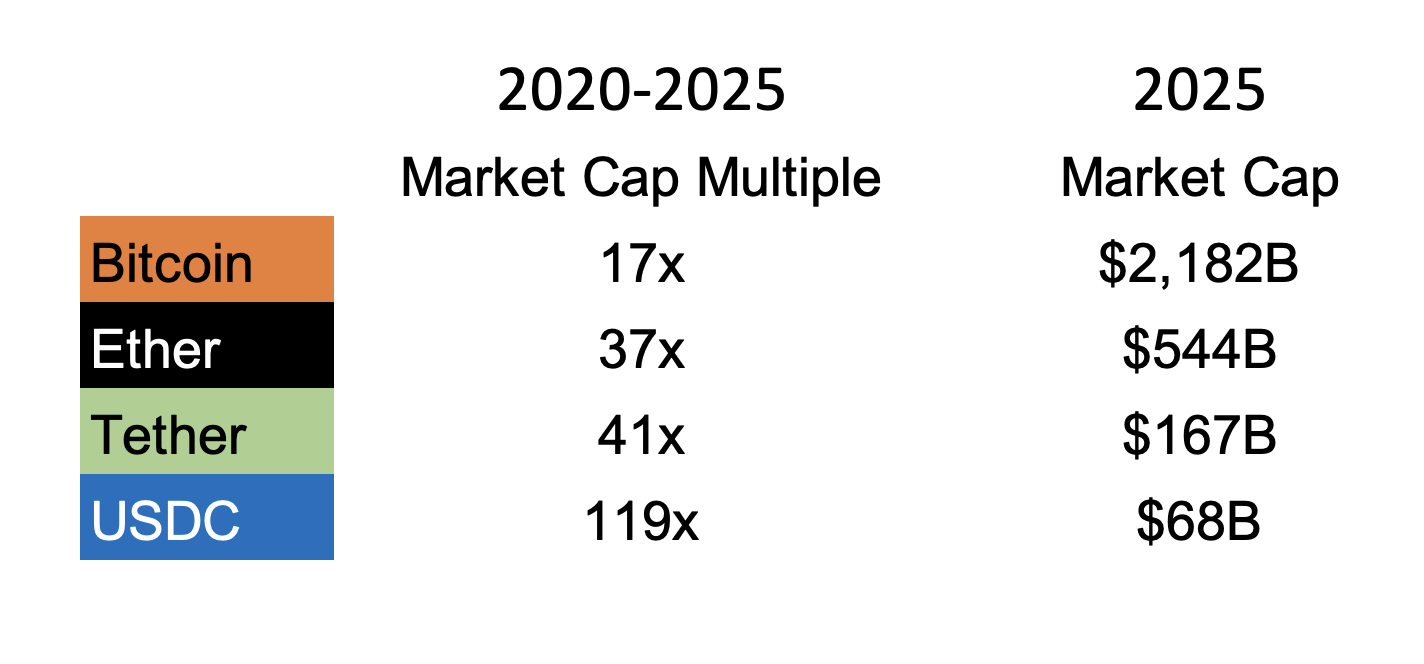
## To recap the above
- Bitcoin is a **fixed** supply asset, market cap ↑ 17x in 5 years
- Ether and Tether are **elastic** supply assets, market cap ↑ 37 and 41x in 5 years
- USDC is also an **elastic** supply asset, market cap ↑ `110x in 5 years`
Both Tether and USDC are US-dollar-denominated stablecoins, which means for every “coin” there is supposed to be a corresponding “proof of reserve” (i.e. a US dollar on the balance sheet).
Tether is owned by iFinex and not US-domiciled while Circle (the parent of USDC) IPO’d earlier this year and is de facto backed by the US government. This at least in part explains why it has grown three times faster than Tether over the last five years.
## The point of this post
The common narrative is that fixed supply assets (like Bitcoin) are inherently more volatile because price is the only release valve for demand shocks.
Yet, the data above shows that assets with elastic supply can see even more explosive market cap growth … **not because their price is more volatile, but because their supply can expand to absorb demand (**like a sponge).
Elastic supply assets are designed to absorb demand with new issuance, which can make them “look” more volatile in market cap terms, but less so in price.
Fixed supply assets like bitcoin must absorb demand via price, leading to more pronounced price cycles.
## Volatility sponges …
… have tail risks:
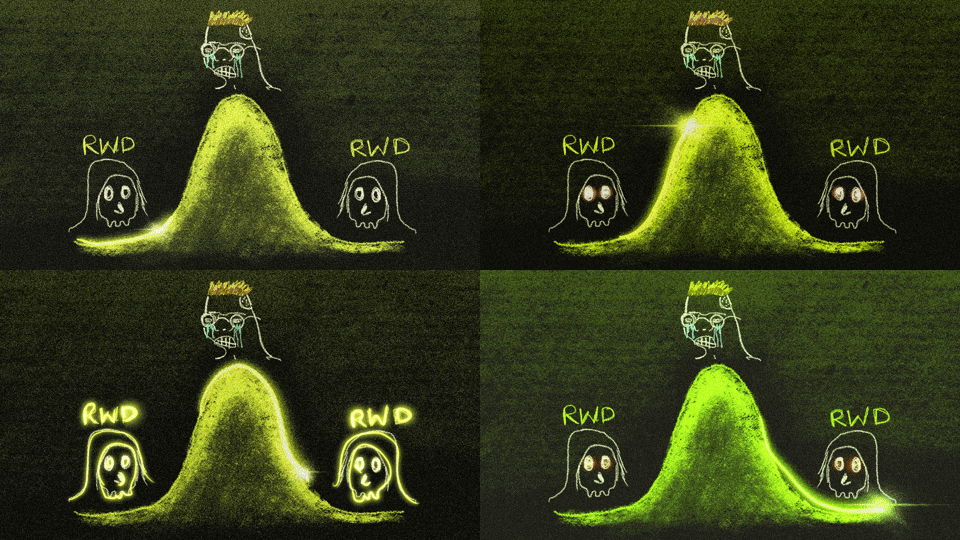
**Peg:** if the issuer can’t maintain the $1 peg the price can “break the buck” a catastrophic event for a stablecoin. Crypto people will remember this happened with Terra/Luna a few years ago.
**Redemption:** If too many people try to redeem at once and the issuer can’t meet demand, you get a “bank run” scenario. This is possibly less risky in the current era in which stablecoins seem to have the full backing of the US government.
**Regulatory:** Centralized stablecoins can be exposed to rehypothecation (lending the same coin more than once) or debasement.
### Are Stablecoins more risky than bitcoin?
Maybe.
They are different, and **in some ways, more dangerous**:
Bitcoin risk is continuous and visible. You can hedge, trade, or simply accept it.
Stablecoin / USD risk is latent and can be catastrophic. Most of the time, it’s “safe” … until it isn’t. When the sponge fails, the risk is released all at once, often with little warning.
Some history is in order.
## Do you know the US Government defaulted at least twice in the 20th century?
1. On April 5, 1933 - FDR issued Executive Order 6102 which made it illegal for US citizens to own gold. Citizens were mandated to hand over their gold at an exchange rate of $20.67 / oz. and then on January 30, 1934 gold was repriced at $35 / oz. … `US citizens were banned from holding gold until 1974`

- On August 15, 1971 - Nixon ended the convertibility of US dollars into gold - meaning the French who wanted many ounces of gold in exchange for $35 / oz. were told to take a hike - along with the rest of the world - ending the Bretton Woods agreement.
---
## Key takeaways
- Bitcoin’s volatility is easier to model and hedge
- Stablecoin risk is harder to quantify and can be more systemic
- Bitcoin is the most volatile in price
- Stablecoins are the most volatile in market cap; price is engineered to be boring, but the market cap is a real-time barometer of crypto dollar demand
[Subscribe now](https://www.pulpconversations.com/subscribe?ref=pulpconversations.com)
### Failure To Disclose
URL: https://pulpconversations.com/failure-to-disclose/
Last updated: 2026-08-25T20:36:54.000Z
###### [Brent Faiyaz - World Tour - F\*ck the World It's a Wasteland Tour - Live in Milan at @Fabrique - 12/11/2023](https://www.youtube.com/watch?v=gfBfNQAw6-4&ref=pulpconversations.com)
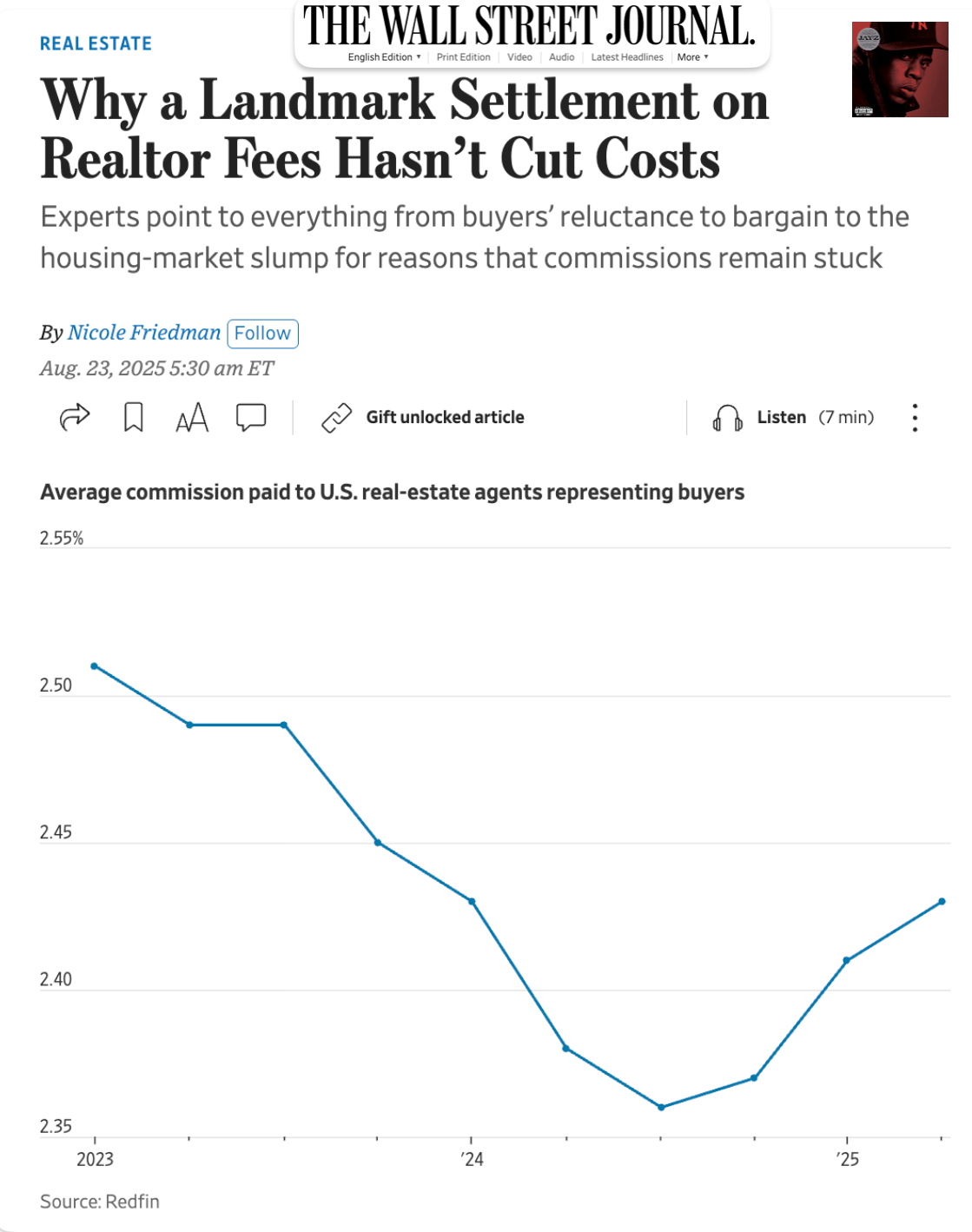
[Source: WSJ](https://www.wsj.com/real-estate/why-a-landmark-settlement-on-realtor-fees-hasnt-cut-costs-0dd35edc?st=5GHmcj&reflink=desktopwebshare%5Fpermalink&ref=pulpconversations.com)
The U.S. real estate industry’s so-called “Chinese wall” separating buyer and seller representation is about as flimsy as a college carpet. The Houlihan Lawrence lawsuit and the recent [$418 million NAR settlement](https://www.housingwire.com/articles/nar-settles-commission-lawsuits-for-418-million/?ref=pulpconversations.com) were supposed to usher in a new era of transparency and consumer empowerment.
Why?
## … because dual agency is still legal in 40+ states.
Dual agency is when the same brokerage and sometimes even the same person represents both sides of a transaction. If you are in one of the blue states referenced below then you are supposed to be provided a disclosure if / when they engage in this duality.
Your broker might refer to ***Designated Agency***. This is where Marcy assigns Karen to the seller and Julie to the buyer, both under the same roof, both sharing the same office gossip and commission pool.

They’re supposed to keep secrets from each other.
But in practice, the incentives are aligned to close deals for the MAX price and buyers’ MAX pain.
The brokerage wins twice, and we consumers are left thinking …
$9M is a joke
> The $9 million Houlihan Lawrence settlement addressed claims of inadequate dual agency disclosure for residential real estate transactions in Westchester, Putnam, and Dutchess counties, New York. Plaintiffs alleged the firm failed to inform homebuyers and sellers of conflict risks when representing both sides in deals. The settlement, court-approved as fair and reasonable, mandates $9 million to compensate affected parties and the permanent end of Houlihan Lawrence’s “in-house bonus” program. The litigation’s broad geographic scope underscores the case’s significance for increasing transparency and safeguarding consumer interests throughout these Hudson Valley counties.
## The recent settlements have done little to change this dynamic.
Buyers now sign agreements about agent compensation before touring homes, yet the conflict of interest persists. The real estate lobby is betting that consumers are too busy / lazy to read the fine print. So far they are correct.
If rates are cut soon as has been signaled - it will drive real estate deal-flow. And then we should all watch to see whether citizens increasingly lobby regulators to push for a true ban.
[Subscribe](#/portal/signup)
---
Houlihan Lawrence is a poster child for the deep-rooted conflicts of interest in U.S. real estate, especially around dual agency. In 2017, I was 10-days away from a closing (as the buyer) when we self-discovered pending private litigation involving our intended home - yep you guessed it - it was a dual agent situation. However this was prior to the [Houlihan lawsuit](https://www.inman.com/2022/02/09/houlihan-lawrence-dual-agency-case-is-now-a-class-action-lawsuit/?ref=pulpconversations.com) about the very conflict-of-interest involved in our deal - therefore we didn’t even receive disclosure.
## What Happened with Houlihan Lawrence?
- The class-action lawsuit (Goldstein et al. v. Houlihan Lawrence Inc.) alleged that the brokerage systematically failed to disclose the true nature of dual agency, breaching fiduciary duty to both buyers and sellers.
- The court granted final approval to the settlement in August 2025, but the core issue - agents representing both sides of a transaction - remains largely unresolved in practice.
---
Gemini 2.5 Flash: Code\_Generated\_Image.png
---
## Why the Settlement Didn’t Fix It
- The recent NAR and Houlihan Lawrence settlements focused on **transparency** and **disclosure**, not on reforming dual agency.
- Agents are still allowed to represent both sides, as long as they get written consent. But this is a bunch of bullshit - because a disclosure is almost never given prior to the **“highest and best”** offer stage of the game - as it is not legally mandated.
## So information and incentives keep flowing freely within the firm.
---
Dual agency is a profit center … double the commission, half the accountability.

---
The same brokerage **leverages inside information to maximize its own revenue**.
Until dual agency is banned or radically restructured, the system will remain fundamentally conflicted.
## For Entrepreneurs:
There’s a huge opportunity for new platforms that guarantee single-agent representation and radical transparency.
I was nothin' at all
Took a trip to London just to hear how they talk
Back to 4-1-0
You should hear how they talk.
\-Brent Faiyaz
[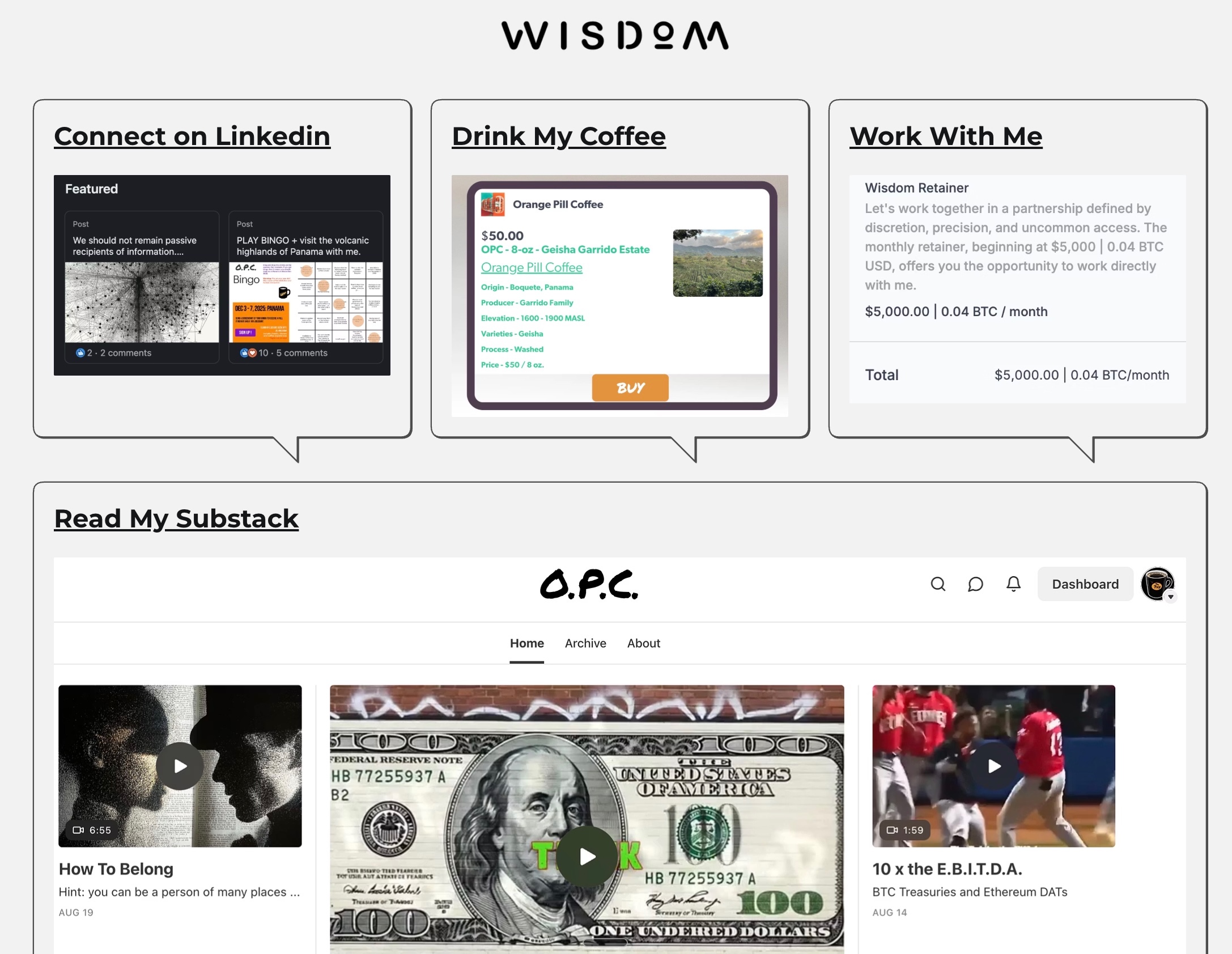](https://wisdomsprint.com/?ref=pulpconversations.com)
### Cult vs. Commodity
URL: https://pulpconversations.com/cult-vs-commodity/
Last updated: 2026-08-25T20:39:41.000Z
## Make meaning.
You might have heard this phrase, frequently emblazoned on motivational instagram posts and bumper stickers.
But it’s worth asking yourself this question - ideally on the daily.
When is the last time you felt proud?
Not prideful. But proud - of your accomplishments or perhaps of those you birthed or were from birthed.
It’s possible to be proud of yourself every day.
This doesn’t mean you are *killing it* each and every day - we are all human - but it might mean that you are *ok at worst* with your performance today because you feel aligned with your place in the World at this very moment.
If this resonates with you …
## … You are in a cult
Perhaps you might even lead a cult. Maybe more than one.
---
> **CULT**: a social group or **movement** that arises around novel or unconventional beliefs or practices, often centered on a particular goal and characterized by intense **devotion among its members**
---
Who wouldn’t want to be part of at least one social group with devoted members? Ideally, I would like to be part of as many as possible - perhaps even lead a few.
Send this to your leader.
## Am I a cult leader?
I am trying to build movements around my interests (coffee, music, bitcoin, AI, economics …) in order to attract like-minded people.
To create loyalty (the inverse is nonsensical).
By doing the above … `I make myself more resilient to competition.`
[Subscribe](#/portal/signup)
## People forget the “to competition”
Resilience in the absence of *competition* doesn’t actually mean anything.
---
What movements are you part of?
Which movements are you building?
If neither of the above apply to you, perhaps you are **temporarily** stuck in the *commodity zone*.
Don’t stay in that zone for long. You don’t have to!
Try to find your people.
Try to attract your people.
## What do I stand for that others want to join?
This is the difference between a commodity business and a cult brand.
---
### Kanye West x A.I.
URL: https://pulpconversations.com/kanye-west-x-ai/
Last updated: 2026-08-25T20:45:40.000Z
Ye’s journey mirrors the way society interacts with and misunderstands artificial intelligence.

"Cause my life is dope, and I do dope shit" - Kanye
#### Dynamic Identity vs. Static Expectation
Society wants Kanye to remain the version they loved most. Maybe for you it is “College Dropout” Kanye and for others it might be “Niggas in Paris” Kanye. For me, I loved listening to every track sequentially on every Kanye album through to 808s & Heartbreak. After that things became overly episodic for me - musically speaking.
#### But I digress …
We expect AI to be static, predictable, and *safe* (whatever that means). We expect AI to always reflect the best version we’ve seen, and to never surprise us with its probabilistic answers. But AI, like Kanye, is a product of ongoing learning, context, and sometimes, unpredictable leaps.
Is it fair to condemn ~~Kanye’s~~ AI’s *right* to evolve, struggle and often self-contradict?
#### Projection and Misunderstanding
Society projects its own narratives onto Kanye, often missing the nuance of his intentions or the context of his actions. Be honest with yourself - none of us are in his head.
Similarly, we project our hopes, fears, and biases onto AI. When AI “misbehaves” or surprises us, we blame the technology, often missing the context (data, training, intent) that shaped its output.
Saying something is *bad* or *good* is not a proxy for understanding how it works.
#### Innovation and Discomfort
Kanye’s been a cultural disruptor for 25 years; in music, in fashion, in music production, in social commentary and in controversy (my generation will always remember the apocryphal tale of *George Bush doesn't care about Black people*).
Innovations often make people uncomfortable before some of them are accepted as genius.

Like Kanye, AI’s most valuable contributions often come from its ability to disrupt, to challenge norms, and to make us uncomfortable. The discomfort is a sign of growth, not failure.
#### Mental Health and Being Human
Kanye’s struggles with mental health are public, raw, and real. Hopefully they remind us that genius and vulnerability are intertwined.
Lest we forget that AI is a reflection of human data, human flaws, and human brilliance. The “messiness” of AI is a mirror of our own complexity.
Kanye’s relentless reinvention makes me think of AI’s capacity for continual learning and adaptation. Both challenge us to rethink what’s possible, pushing boundaries to create new TAM.
#### We All Got Issues
Ye’s got hallucinations garnering public mistrust.
AI’s got hallucinations garnering public mistrust.
Both Kanye and AI require ongoing support and intervention to avoid self-inflicted harm and societal backlash.
---
Kanye
reinvents sound
image
message
A.I.
reinvents data
patterns
---
## Society wants simplicity …
… which serves as disincentive to constantly learn, evolve, and subsequently be ok if you are misunderstood by that society.
If you want to understand the future of AI, study how we treat our most mercurial and innovative humans. We want them to be frozen-in-time at the peak of their celebrity. But if this happens, **how might they evolve**?
The same hopes, fears, and misunderstandings we have for famous humans will shape our relationship with intelligent machines.
---
**For decision makers:**
- Don’t expect AI to remain static or “safe.”
- Build systems and policies that allow for evolution, error, and even controversy.
- Invest in feedback mechanisms; just as Kanye needs trusted advisors, AI needs human-in-the-loop oversight.
- Embrace discomfort as a sign of innovation, not a red flag for failure.
---
> *“I’m living in that 21st century, doing something mean to it / Do it better than anybody you ever seen do it.”*
> *— Kanye West, “Power”*
### Context Engineering: My Two Cents
URL: https://pulpconversations.com/context-engineering-my-two-cents/
Last updated: 2026-08-25T20:54:19.000Z
0:00
/3:42
1×
#### Definitions
**R.A.G.** stands for Retrieval-Augmented Generation. It’s a way to make AI models (like ChatGPT) smarter by programming them to“look up” extra information before answering your question.
<*Imagine you’re taking a test, but you get to flip through your notes before you answer*\>
**Context Engineering** refers to designing and structuring the information, prompts, and surrounding details that an AI system uses to understand and respond accurately**.**
<*Imagine you’re in theatre production and your actors are AIs - you want to get the best out of their performances so you tweak the set, lighting, and background to guide the story in the right direction*\>
---
**Why is RAG useful?**
- It helps AI models answer questions about stuff they weren’t directly trained on.
- It’s particularly good at things like customer support and document search.
- RAG systems usually work by searching for chunks of info, then feeding those chunks into the AI’s “context window” (basically, RAG is RAM for that answer).
**So what’s the deal with context engineering? -** `a new buzzword`
If you just dump a ton of stuff in RAG, the model can get confused, miss important details, or even ignore what matters most.
Have you ever written a one-page (font size: minuscule) “cheat-sheet” for an exam only to be left unable to read it during the test?
The more you cram in, the less useful the ~~cheat sheet~~ AI’s answers get.
So the real secret sauce isn’t just about *retrieving* info (via RAG), but about *engineering* exactly what goes into that context window.
In other words, if you want to encourage maximum success it is more helpful to pick out and hand-over carefully curated information to your friend rather than a random pile of notes.
## Context Engineering basics
**(I am severely unqualified to proffer more)**
1. Be picky about what info you feed the AI.
2. Use smart search, re-rank and filter data to facilitate only “the best” makes it through
3. Regularly test and tweak data you put in, so the AI’s answers stay sharp
## In Summary
**RAG** moved the field forward. and the next level is **context engineering**.
Text within this block will maintain its original spacing when publishedCurating ...
structuring ...
... optimizing what the AI sees ...
... so it can actually use it well.
---
RAG = giving the AI access to more info.
Context engineering = *right* info, in the *right* format, at the *right* time.
[Buy this jumper](https://forms.fillout.com/t/gSiWbyMUbUus?ref=pulpconversations.com) 👇🏽

### How To Belong
URL: https://pulpconversations.com/how-to-belong/
Last updated: 2026-08-25T21:40:26.000Z
It’s been a while since my last *Pulp Conversations* post. Blame Summer hols!
In June, I had the pleasure of speaking with Alex about childhood, belonging and identity. The exchange we had about belonging (shared above) is in sync with how I tend to see the world; specifically the frame that we can (and perhaps should endeavor to) belong to multiple places in parallel.
For Alex; a sense of belonging is not tied to a single location, but rather is expansive and inclusive. It’s about connection, experience, and choice. She illustrates that it’s possible to feel at home in several places, to carry pieces of each with you, and to allow them to coexist within your identity.
## Identity is Fluid
Belonging is not fixed; it can shift and expand as you move through life. Perhaps if you can’t easily perceive a shift could it be that you are not challenging yourself? Not judging but a genuine question we should keep asking ourselves, no?
Places become part of us through our memories.
Sights.
Smells.
And most importantly: emotional connections.
## We can choose to maintain ties to places that matter to us
One of my dear friends used to support the Phillies when he was a wee lad just outside of Philadelphia. Then he moved to New York and started supporting the Yankees, before finally landing in Los Angeles - and you guessed it becoming a Dodgers fan.
Fairweather Friend (1990)
Unlike my friend … multiple places can coexist in your sense of self, enhancing rather than diluting your identity - something dual-citizens or kids of mixed parentage know all too well.
---
## Here’s an exercise for you
1. List all the places you’ve lived, visited, or felt deeply connected to.
2. For each, note what makes it meaningful: people, experiences, sensory memories, values, or lessons learned.
3. Look for patterns: What qualities or feelings do these places evoke? (e.g., warmth, adventure, community)
4. How have these places shaped your beliefs, behaviors, or worldview?
5. Do you notice any internal or external pressure to choose one place over another.
6. Reframe belonging as “both/and” or “all/and”—allowing for multiple affiliations.
---
### Rituals of Connectors
For you advanced readers who already practice multi-belonging - how did you develop small rituals to maintain your ties?
Was it through regular visits, cultural practices or making an effort to talk or visit with friends from those places?
When introducing yourself to others, do you use language that reflects your multi-place identity: “I belong to several places,” or “I carry pieces of X and Y with me.”
Please let me know what you do!
### Pomodoro Pricing
URL: https://pulpconversations.com/pomodoro-pricing/
Last updated: 2026-08-25T21:45:32.000Z
#### What is it?
It is a simple time-management technique designed to boost focus and productivity. I learned about it when I did a coding bootcamp in 2013.
`Here’s how it works:`
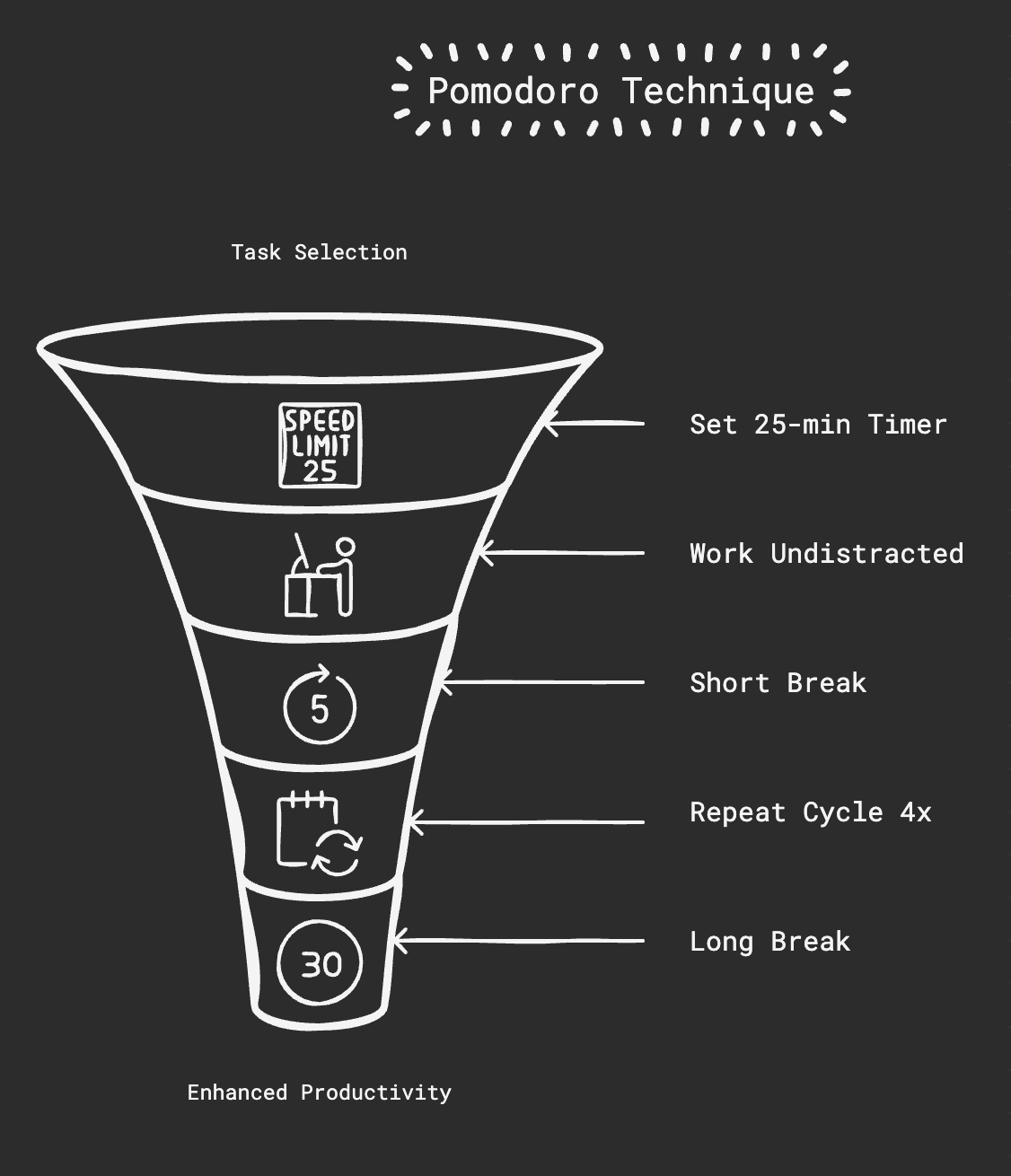
Focused sprints with regular breaks might help concentration and avoid burnout.
## It’s so freakin’ annoying to run out of credits
Whether you are playing 1980s Arcade Games or vibe coding in 2025 via [Replit](https://replit.com/refer/replitanaconda4?ref=pulpconversations.com), Lovable, Cursor, v0.app, or [Zite](https://zite.com/r/opc?ref=pulpconversations.com) \- being interrupted while in a flow-state is super freaking annoying.
Why would you impose such an imposition on your customers?
**Insider view:**
The founder of a $15M post-money “AI wrapper” (read: customer-oriented startup solving a problem using AI rather than being on the commodity layer) recently asked me whether his company should switch to “credits” or *transactional* usage-based pricing.
I said, `Daaaaayum Gina!`
> Instead I said he should consider a **Pomodoro Pricing** model, which is what I think is the next evolution of usage-based pricing.
With 25-minute price chunks, a creator can time-box their development using an established productivity format - rather than be SURPRISED by credit warnings, which feel very stick rather than carrot.
[](https://zite.com/r/opc?ref=pulpconversations.com)
I just upgraded yesterday from 0 to $19 and now this! 🥵
But I do have to give [Zite](https://zite.com/r/opc?ref=pulpconversations.com) a shout-out for this ….. >
[](https://www.linkedin.com/posts/vinaybeta%5Fpanama-coffee-adventure-zite-activity-7361129061563174915-jyl3?utm%5Fsource=share&utm%5Fmedium=member%5Fdesktop&rcm=ACoAAABS0osBiF3RjjI402FxfPWgvsWQ7AlHdxA)
[Panama Dec. 2025](https://opc.pulpconversations.com/p/opc-retreat-in-panama?ref=pulpconversations.com)
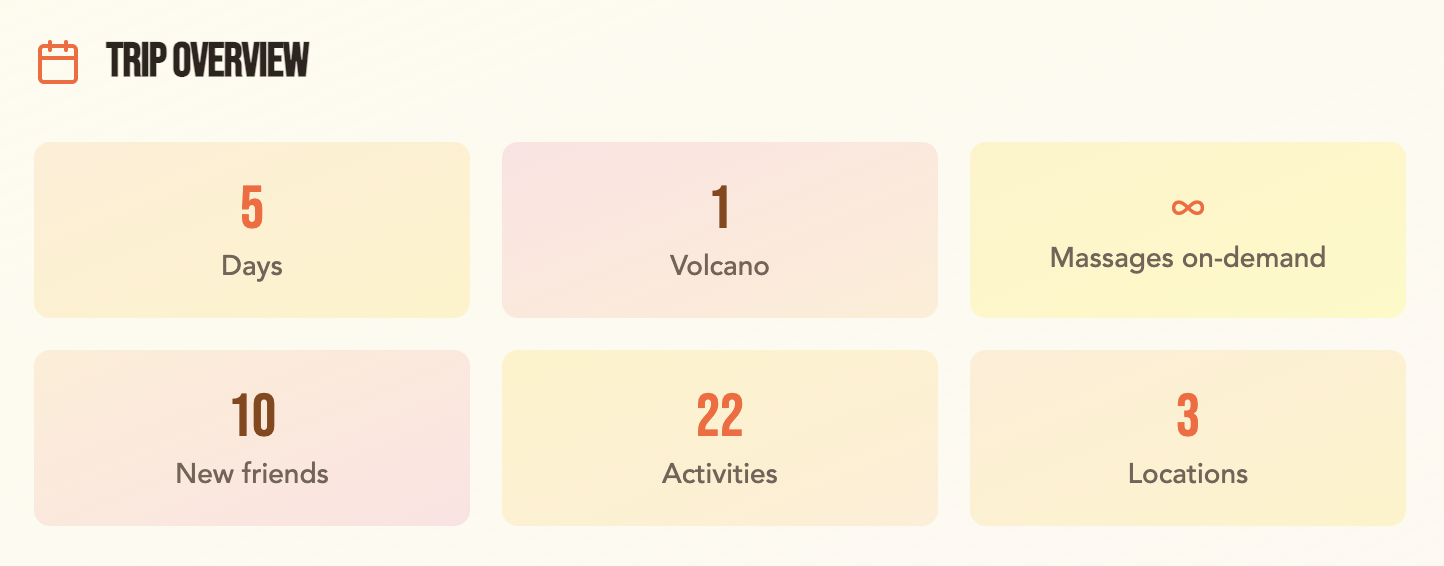
### 10 x the E.B.I.T.D.A.
URL: https://pulpconversations.com/10-x-the-ebitda/
Last updated: 2026-08-25T21:50:21.000Z
## Acronym soup
**My insider view:**
I recently spoke with a CIO at a company actively onboarding clients with corporate treasuries in excess of $25M. These “entry-level” corporate money managers are being advised to allocate 20% to bitcoin.
The conversation is no longer “Should we?” but “How much, and how soon?”
The current thesis for entry is bold but simple; allocate 20% of your corporate cash to bitcoin. This isn’t being sold as a moonshot.
> This is a risk-averse strategy.
It’s a calculated hedge against fiat debasement, operational risk, and the creeping irrelevance of legacy cash management.
Which firms might be prime beneficiaries from this daily $500M cash cow in the going forward [US Stablecoin hegemonic world](https://slr.capital/?ref=pulpconversations.com)? Will Visa and Mastercard hold on to their TAM or will it be “penetrated” by Circle and Kraken? Or will the HNICs at JP Morgan and other GSIBs landgrab the lion’s share?
## The math adds up to $180B per year - almost exactly the market cap of Shopify.
- Bitcoin’s consensus mechanism has been battle-tested
- Allocating to btc is a direct play on long-term purchasing power.
- Bitcoin offers asymmetric upside in a world of erosion by inflation.
- A Bitcoin treasury signals to the market that your company is juggling alternative futures rather than being wed to one.
## Realities
- Yes, bitcoin is volatile. But so is the world.
- The key is position sizing and time horizon - 20% is aggressive, but for treasuries north of $25M it’s a calculated bet, not a YOLO.
- Secure custody, insurance, and regulatory clarity are non-negotiable. The good news? Institutional-grade solutions are now table stakes / and come with political blessings.
- Mark-to-market rules can be a pain, but FASB is catching up. Expect more clarity and less friction as adoption grows.
---
###### Ethereum DATs: The New Kid on the Block
###### Nuance: while bitcoin is money, ETH is a utility token. It’s just a different animal. DATs are vehicles for holding ETH on balance sheets, and already, 2% of all ETH is in these structures, according to *Blockworks*. As more DATs launch, that number will climb … 4% …. 10%, maybe even 51% someday.

###### The more ETH locked in DATs, the more “legitimized” it becomes as a treasury asset. This is the same network effect that made Bitcoin the default digital reserve. If half a trillion dollars’ worth of ETH is locked up in treasuries, you better believe the asset’s legitimacy and price floor are going up. Traders gonna trade.
---
## Takeaways
**For Treasurers:** Start with a bitcoin allocation. 20% is the new nothing. If you’re not at the table, you’re on the menu.

2 and 20, bitch please.
**For Boards:** Push for clarity on digital asset policy. The risk is inaction.
---
For more intellectual masturbation come join me at [my retreat in Panama](https://opc.pulpconversations.com/p/opc-retreat-in-panama?ref=pulpconversations.com). It’s the new Sun Valley minus the dorky vests and less heavily skewed to cool, warm and neutral tones of white.
[Subscribe now](https://www.pulpconversations.com/subscribe?ref=pulpconversations.com)
##### Music: E.B.I.T.D.A. by *Clipse*
### O.P.C. - Retreat in Panama
URL: https://pulpconversations.com/opc-retreat-in-panama/
Last updated: 2026-08-19T20:27:48.000Z
[Book Now](https://orangepillcoffee.com/retreat/?ref=pulpconversations.com)
Be there or be …

[Determine your affinity for coffee here](https://orangepillcoffee.com/retreat/?ref=pulpconversations.com) 👇🏽
[](https://orangepillcoffee.com/retreat/?ref=pulpconversations.com)
It would be amazing if you decided to join !
Leave a comment if you have any questions. Hope to see you in Panama in December.
##### Music: *Temperatura* by [saint hills](https://open.spotify.com/artist/6FSAMUtb3F7z09jW3tFtGA?si=s-65gtAYSU-DOCKlgrv-5Q&ref=pulpconversations.com)
[Book Retreat](https://orangepillcoffee.com/retreat/?ref=pulpconversations.com)
## How much is it?



$3,000 or 0.023 BTC
## What’s included?
- Joy + ~~Pain~~ Love
- Some new friend potential
- Learn how coffee is cultivated, processed, roasted, and ~~drank~~ ~~drunk~~ drank
- Free massage (not from me)
- Dinner every night
- Rustic luxury hotel in the volcanic highlands of Panama (3 nights)
- Big pimpin’ hotel in Panama City (1 night)
- Trip to a volcano
- Coffee-farm tour with an expert guide (not me) - ask many questions
- Coffee-cupping experience
- Drink Geisha - the most expensive coffee in the world
- Probably some stuff I am forgetting
Text within this block will maintain its original spacing when published
If you are reading this far
send me a message
or leave a comment below.
I’m not trying to grow my audience.
I’m actively working to whittle it down.
That’s what this is all about …
#####
[Leave a comment](#ghost-comments-root)
### That Thong Th-thong thong thong
URL: https://pulpconversations.com/that-thong-th-thong-thong-thong/
Last updated: 2026-08-19T20:27:54.000Z
Mainstream Media or ME?
[Subscribe now](https://www.pulpconversations.com/subscribe?ref=pulpconversations.com)

[Buy some coffee beans](https://drink.orangepillcoffee.com/substack?ref=pulpconversations.com)
### Ello, Guv’nor!
URL: https://pulpconversations.com/ello-guvnor/
Last updated: 2026-08-19T20:27:57.000Z
Let’s navel gaze the [Fed’s new playbook](https://www.hudsonbaycapital.com/documents/FG/hudsonbay/research/638199%5FA%5FUsers%5FGuide%5Fto%5FRestructuring%5Fthe%5FGlobal%5FTrading%5FSystem.pdf?ref=pulpconversations.com) before the market does.
With Stephen Miran as governor, the Fed is unlikely to simply steward price stability.
Instead the US [gunna](https://open.spotify.com/track/4ugKUZExbqbkKXEmbTrTRW?si=c97929043bf44a5e&ref=pulpconversations.com) power broke a lil’ [sumthin’ sumthin’](https://open.spotify.com/track/60Pjyla2BNnWzWxNXxGa4u?si=e45f07f128be4331&ref=pulpconversations.com)
The Fed will use every tool, from tariffs to currency intervention to gold sales, to advance U.S. strategic interests.
## Right, listen up! It’s hereby declared by yours truly that the bread-and-honey and the bluey shall now be in cahoots, proper sorted, no muckin’ about!
Let’s break that down:
- **Bread-and-honey** \= money (Cockney rhyming slang)
- **Bluey** \= note or a policy slip (stretching typical slang here for monetary terms)
- **In cahoots** \= working together
- **Proper sorted** \= in sync, coordinated
Monetary policy is now inseparable from trade and security policy. This is a vision that echoes[ Elbridge Colby](https://a.co/d/d8sySGg?ref=pulpconversations.com)’s call for greater burden-sharing and a more muscular U.S. posture.
A Fed (led by 🤔) Miran will tolerate higher rates and a stronger dollar if it means boosting U.S. manufacturing and extracting concessions from trading partners. Expect more fiscal coordination with Treasury, more creative legal maneuvers, and a willingness to let volatility run if it serves a bigger goal.
The “rules-based” era is over; we’re in the age of opportunistic, multi-dimensional policy.
## Key takeaways:
1. The Fed’s toolkit is expanding - no longer limited to rate moves.
2. Geopolitics matter as much as macro data for Fed forecasting.
3. U.S. assets may be more volatile - but that means traders gonna trade.
“Scared money don’t make no money.” — Jeezy
Do you want more of this?

[Now available at O.P.C.](https://pay.zaprite.com/order/od%5FKF4Mp2D4Hw?ref=pulpconversations.com)
[Whole Bean Coffee](https://pay.zaprite.com/order/od%5F1fCojc8HI0?ref=pulpconversations.com)
### It Could Be Nice
URL: https://pulpconversations.com/it-could-be-nice/
Last updated: 2026-08-25T22:06:21.000Z
The above chart details the volume-weighted-cost-basis of bitcoin purchased in the years: 2015, 2020 and 2025.
[Leave a comment](#ghost-comments-root)
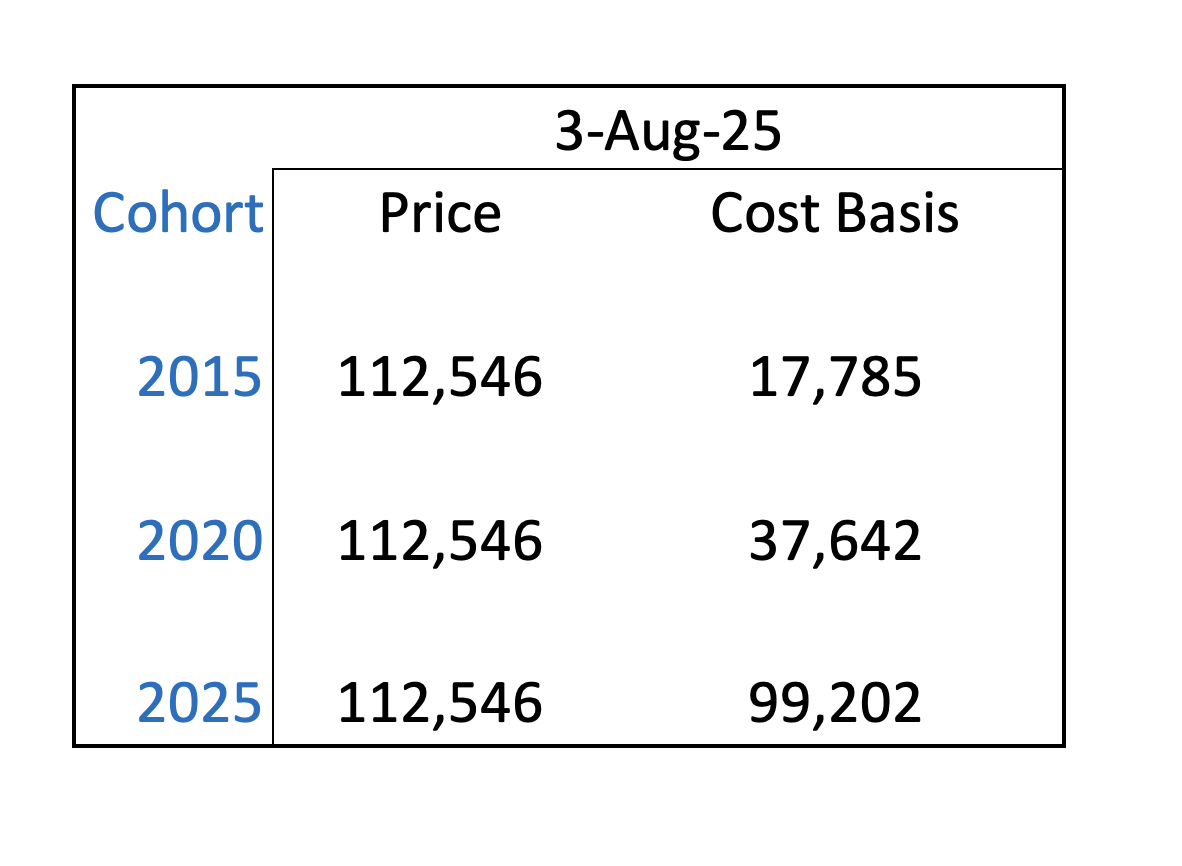
As of 3 August 2025, bitcoin is hovering at $113,000 and almost everyone who has bought into it since 2009 is `in profit`.
> Let that sink in.
#### Let’s assume someone bought $100,000 worth of bitcoin in 2015.
Today that investment would be worth \~$633,000
#### Let’s assume someone bought $100,000 worth of bitcoin in 2020.
Today that investment would be worth \~$299,000
#### Let’s assume someone bought $100,000 worth of bitcoin in 2025.
Today that investment would be worth \~$113,000
---

## Huh?
**When coins bought in 2015 are spent (sold or moved) in later years at much higher prices, the cost basis for the “2015 cohort” is recalculated upward; potentially far above the historical prices of 2015.**
Essentially, the cost basis for each coin becomes the last price it moved at, no matter when that occurs …
- Let’s say someone bought Bitcoin in 2015 at $400\. They held it until 2021, then moved or sold it when the price reached $50,000\. The on-chain accounting **assigns that $50,000 price as the “cost basis” for that particular unit of Bitcoin; retroactively updating the 2015 cohort’s cost basis**.
If many people who bought in 2015 only moved or sold their coins in a much later, higher-priced bull market, the average cost basis for the “2015 supply” surges, despite the 2015 market price being orders of magnitude lower.
## Important Concepts:
- **The yearly cost basis is a rolling, dynamic metric.** It’s not a simple average or a static figure from that specific calendar year.
- **It is a function of when and at what price the coins last moved.** As older coins are spent at new, higher prices, the earlier year’s cost basis metric “re-rates” to modern price levels.
---
*\_checkonchain* uses these “cost basis by vintage” charts to illustrate the long-term behavior of different investor cohorts and to show at what prices historical holders are actually exiting, rather than the prices they entered.
## So what about that orange goat?
On November 9, 2022 during the FTX-induced bear market, bitcoin briefly dipped to $15,758 - which is lower than than the 2015 volume weighted cost basis of $17,785.
#### Let’s assume someone bought $100,000 worth of bitcoin on 9 Nov. 22
Today that investment would be worth \~$714,000 even outperforming the typical investor from 2015.
## The morals of this story
1. You are not too late → the typical investor in 2025 is up 13% - not too shabby.
2. Some long-term investors who bought bitcoin in November 2022 outperformed the typical 2015 investor.
3. `Time in the market` outperforms *timing the market* over the long-run.
##### Charts are from
[\_checkonchain](https://newsletter.checkonchain.com/?r=4bhhh&ref=pulpconversations.com)
[Subscribe](#/portal/signup)
### Cobalt Red
URL: https://pulpconversations.com/cobalt-red/
Last updated: 2026-08-25T23:20:41.000Z
Two weeks ago I had the pleasure of catching-up with my pal Hope …
… to discuss *Cobalt Red*: the somber, informative, data-supported and provocative book written by Siddharth Kara.

[Click here for a discussion summary](https://claude.ai/public/artifacts/c3bd4048-a884-4e0f-9385-362cf38e302c?ref=pulpconversations.com) that Hope put together.
A few highlights:
- 70% of the World’s cobalt comes from the [DRC](https://www.google.com/maps/@-5.1785013,14.2073271,521330m/data=!3m1!1e3?entry=ttu&g%5Fep=EgoyMDI1MDcyMy4wIKXMDSoASAFQAw%3D%3D&ref=pulpconversations.com)
- Yet 80% of the World’s cobalt refining is handled by China
- 40,000 minors - formally called *artisanal miners* \- working in mines
- Some miners are as minor as 6 years old
## Who cares?
> Nobody cares enough to do anything. Most don’t know about it. The rest of us either don’t care or not entirely sure much can change as long as surface-level cobalt is mine-able.
**The resource-curse cuts both ways and its force is stronger than morals.**
While we discussed the book a bit - my conversation with Hope, quickly turned somewhat philosophical and meta. So rather than a [Book Club](https://vinaybeta.com/bookclub?ref=pulpconversations.com) discussion we essentially started shooting the shit. Press `PLAY` on the headline GIF to watch the entire glorious 42 minute convo.
Hope you enjoy it and if anything resonates please leave a comment. I recently had a chance to meet some European friends IRL and engage in some much needed banter - much of it sardonic, witty, cutting, hopeful and motivating.
### Introducing the Stablecoin Liquidity Ratio (SLR)
URL: https://pulpconversations.com/introducing-the-stablecoin-liquidity/
Last updated: 2026-08-25T23:25:11.000Z
I read the aggregate stablecoin market cap is $256B as of today, and we know that Bitcoin's market cap is close to $2.5T. Let's just say that at the moment, the ratio of aggregate Stablecoin cap divided by Bitcoin cap is approximately 0.1\. This essay is going to focus on what happens when this ratio moves up and down …
Most analysis I have read is about stablecoin growth or Bitcoin price, but not the ratio as a signal or threshold. So let’s see where this ends up …
## What are the implications?
When stablecoin market cap rises relative to Bitcoin, it signals more capital is sitting on the sidelines, ready to deploy. If the ratio jumps, it could mean:
- More speculative ammo for Bitcoin rallies.
- A shift in market structure (e.g., stablecoins as a shadow banking system for crypto).
- Potential systemic risk if stablecoins become too dominant or if redemptions spike.
Could this ratio could be a leading indicator for both bull runs and liquidity crises?
---
A higher ratio means more liquidity and potential for rapid price appreciation in Bitcoin (and other cryptos) if that capital rotates in. It also signals [growing trust in stablecoins](https://www.congress.gov/bill/119th-congress/senate-bill/394/text?ref=pulpconversations.com) as a transactional medium.
## If the ratio gets too high …
it could mean:
- Market participants are risk-off, waiting for a dip.
- Stablecoins are absorbing too much systemic risk (think: Tether FUD, regulatory crackdowns).
- If stablecoin backing is weak, a run could trigger a cascade in Bitcoin and the broader market.
- *BUT ALSO* if there’s a massive amount of capital sitting in stablecoins this is bullish - if even a fraction of that capital rotates into Bitcoin, **it could drive a parabolic move**.
Stablecoin issuers (Tether, Circle) are becoming more systemically important.
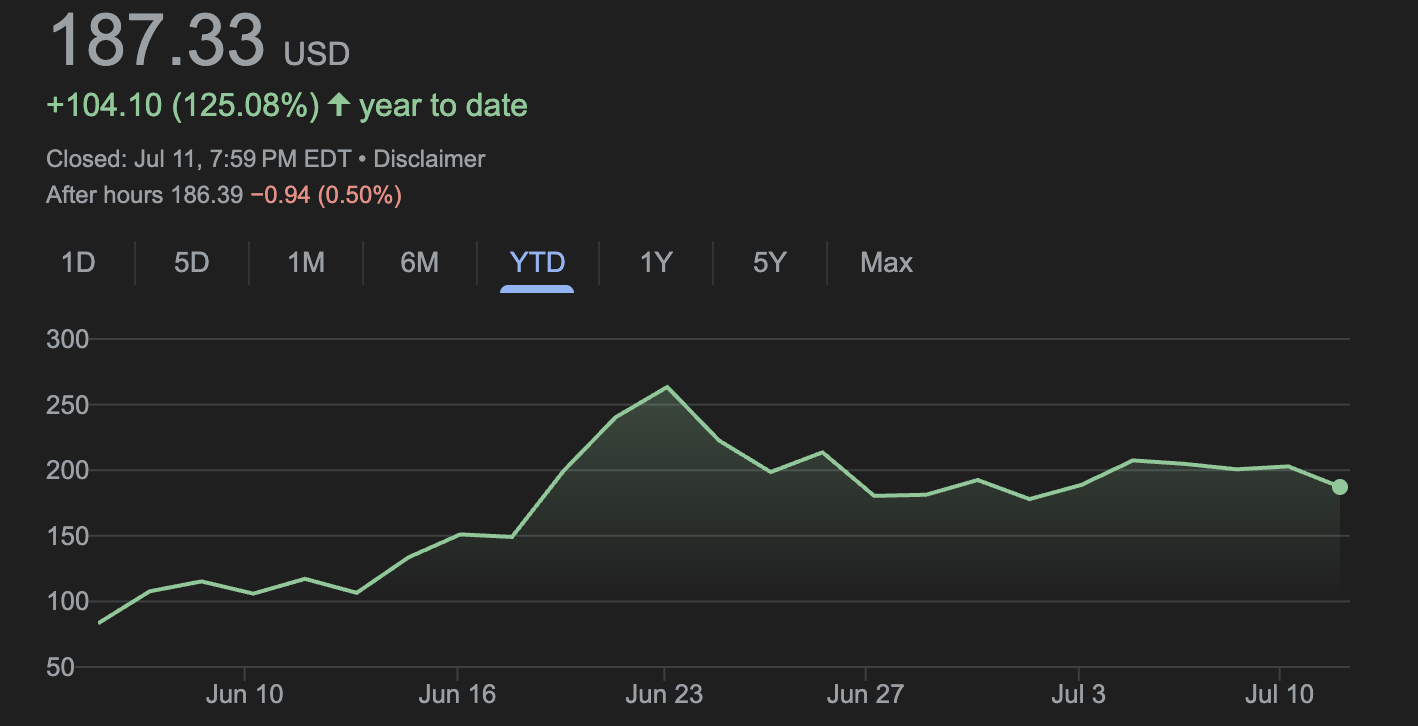
CRCL: up 125% since IPO on 5 June 2025
## Tether: $93 million Revenue per Employee
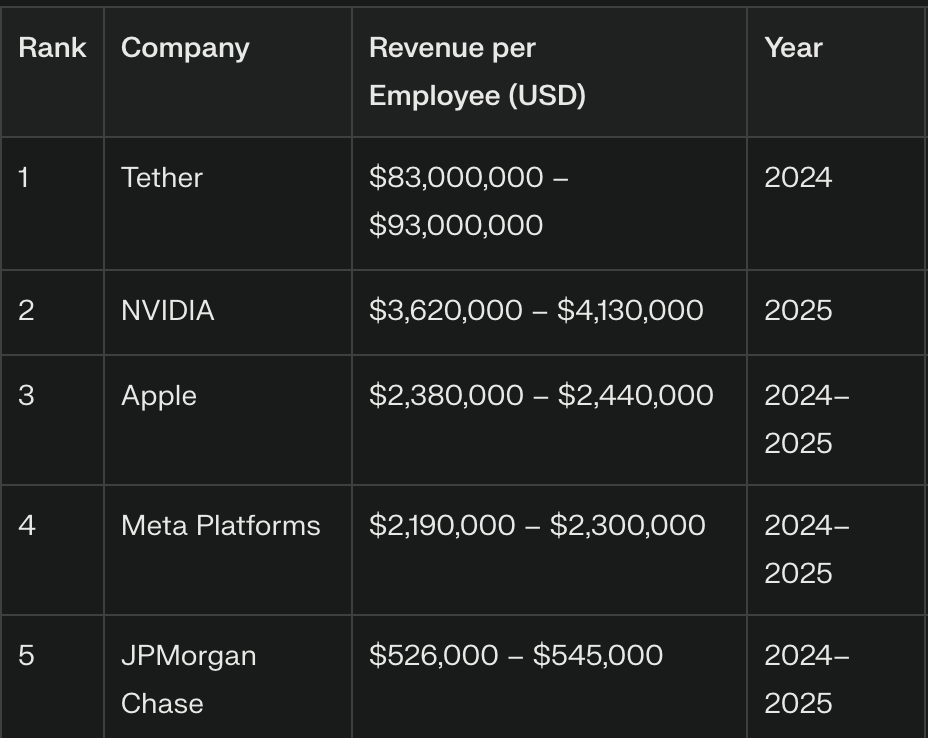
---
The SLR might be a canary in the coal mine for crypto liquidity cycles. If we model this ratio over time and correlate it with Bitcoin price moves, we might uncover predictive patterns that the market hasn’t fully priced in.
## What if the ratio exceeds 1.0?
Who knows for sure - it has not yet happened … but in the future it will. And it means aggregate “waiting” (stablecoin) capital would be larger than the entire market cap of Bitcoin. That will be the “risk-off” indicator of the future.
The higher the ratio, the more *reflexive* the system becomes: the need for speed aka more volatility will result in folks rotating from stables to bitcoin. But amidst FUD headwinds (fear, uncertainty, doubt) more folks might rush out - crashing everything …
Stablecoin issuers will become the de facto “central banks” of crypto. Exchanges and DeFi protocols will become more sensitive to stablecoin flows than to Bitcoin itself.
## In *fiat* banking, a lower SLR (Strategic Leverage Ratio) means banks can lend more, increasing the money multiplier.
So my spin on SLR is a double entendre - the Stablecoin Liquidy Ratio (SLR) means more “potential leverage” is sitting on the sidelines, waiting to be deployed.
> “Just as the analog-**SLR** in banking governs how much money can be created, the digital-***SLR*** in tells us how much firepower is waiting to be unleashed on Bitcoin. It’s the new money multiplier for the digital age.” - Vinay
Honestly I have no idea - don’t listen to me
## Data
[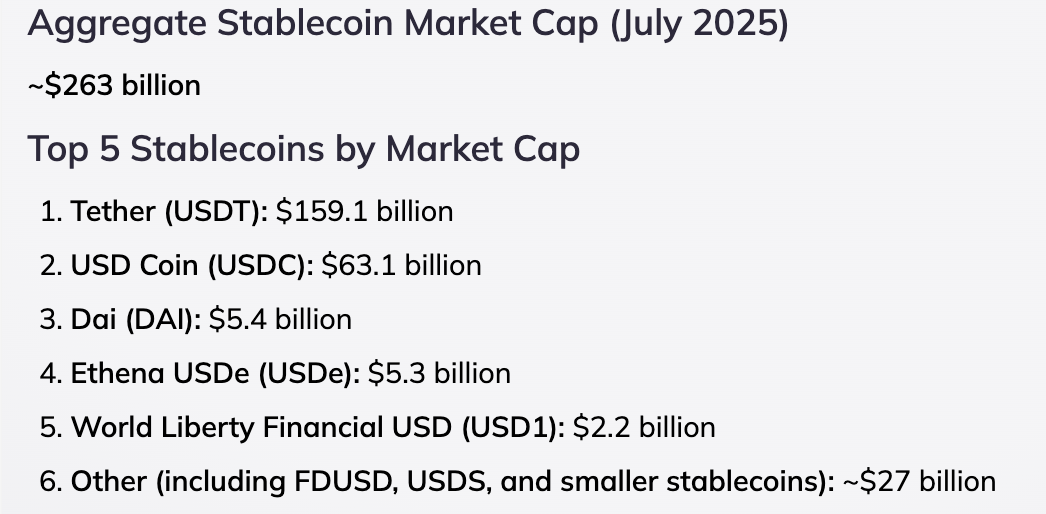](https://www.bankrate.com/investing/worlds-largest-stablecoins/?ref=pulpconversations.com)
USDT and USDC together make up over 84% of the entire stablecoin market cap.
## TLDR: Dinner-party talking points
- The SLR ratio *spiked* during the 2022 bear market (as high as 0.44), showing capital fleeing to stablecoins as Bitcoin crashed.
- In bull markets, the ratio drops as capital rotates into Bitcoin.
- The SLR is a real-time sentiment and liquidity gauge: high in fear, low in greed.

### Who's Holding UST?
URL: https://pulpconversations.com/whos-holding-ust/
Last updated: 2026-08-25T23:28:52.000Z
Rankings are situational, contextual and typically arbitrary.
Most rankings are subjective ordinals.
Cardinal rankings are intra-category whereas most rankings are inter-category.
Check out Tether (USDT) clocking at # 18 top holder of US Treasuries based on the ranking *below*:

## Extra Credit
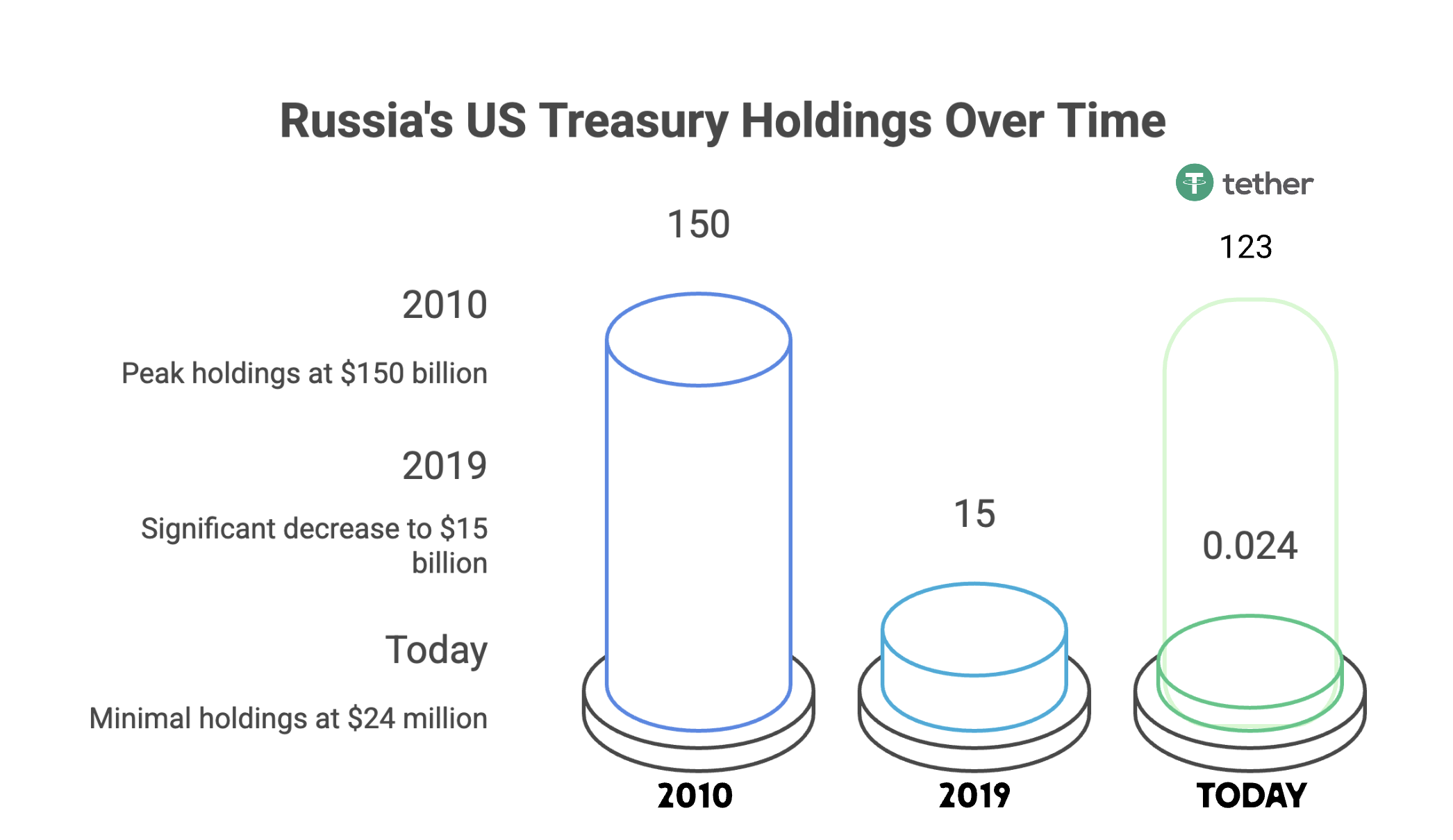
Pulp Conversations: 2019-2025: Russia vs. Tether
### Growing Up in Hotels
URL: https://pulpconversations.com/growing-up-in-hotels/
Last updated: 2026-08-26T13:30:42.000Z
#####
What if I told you my friend [Alex](https://www.linkedin.com/in/howardalexandra/?ref=pulpconversations.com) spent her entire childhood living in hotels across the globe?
Endless room service ...
Opulent architecture and Babylonian gardens ...
a Life FREE from the mundane.

Where do we sign up, Alex?
It’s a fantasy that, on the surface, seems like the ultimate childhood. Every day: an adventure filled with potential for life-changing transience.
## Intentional Humanity
Alexandra was born in Istanbul and, thanks to her father’s career in the hotel industry, spent her formative years moving from one country to another: Turkey, Europe, the Caribbean, the United States, and Canada.
Her home was not a single address, but a series of hotel suites, each with its own culture, language, and rhythm. Her parents, both European, eventually retired in Ottawa, but not before giving their daughter a truly global education.
> So, you no longer care if there's another day
> I guess I have been there, I guess I am there now
> You knew what you wanted and you fought so hard
> Just to find yourself sitting in a golden cage
> In a golden cage
It’s easy to imagine how this could have gone wrong. Most escape to luxurious accommodation to escape structure; hardly ideal for a growing child. What if Alex’s parents had simply let the luxury and novelty of hotel life dictate the family’s values?
The risks are obvious: a child adrift in a sea of privilege, unmoored from any sense of community or responsibility, perhaps even developing a sense of entitlement or detachment from the “real world.” The world is full of cautionary tales about children of privilege who never learn to connect, to empathize, or to give back.

But Alex’s story is the exception that proves the rule. Her parents, rather than letting the environment shape their daughter, were intentional about shaping the environment itself.
They built structure into a life that could have been chaotic. They prioritized values such as community, activism, and environmental stewardship.
Alex speaks with warmth about the communities she encountered, especially in Quebec, and about the importance of caring for others. Her worldview is not one of detachment, but of deep engagement and empathy.
> So, of course I miss you and miss you bad
> But I also felt this way when I was still with you
> Yes, of course I miss you and miss you bad
> But I also felt this way when I was still with you
You can learn more about Alex [here](https://www.mindmoodalive.com/?ref=pulpconversations.com) and [here](https://freebie.mindmoodalive.com/alivenessdrop?ref=pulpconversations.com).
I enjoyed catching up with her because our conversation reminded me that in a world that often confuses comfort with care, it is necessary to be intentional about the values we hold dear to ourselves.
Without intention how can we raise our children with *our standards* in mind?
Structure and values / structured values, perhaps 🤔 - separate a life this is lived and a life that is truly meaningful *to us*.
💡
What structures have you / are you building?
💡
What values are you prioritizing?
💡
Are you letting your environment shape you, or are you shaping your environment?
## The answers will determine the kind of world you create *for yourself*.
> This city's no longer mine
> There's sadness written on every corner
> Each lover was made to sign
> Now I hear them calling me over and over
### No Empathy
URL: https://pulpconversations.com/no-empathy/
Last updated: 2026-08-26T13:39:30.000Z
## Empathy
In the late 1990s and early 2000s, doctors were urged to treat pain as the “fifth vital sign.” (American Pain Society, 1996).
Seriously, this was a very real and an influential organization. It shuttered in 2019 - after facing lawsuits alleging it colluded with opioid manufacturers to promote opioid use - i.e. allegations of being in cahoots with Purdue Pharma.
Doctors, motivated by empathy and pressured by institutional policies, began prescribing opioids at unprecedented rates, often without fully understanding the risks of addiction.
If my patient is in pain, I must do everything to relieve it.
There was a lack of evidence for long-term opioid use in chronic pain. According to the CDC, opioid prescriptions quadrupled between 1999 and 2010, `but there was no overall change in the amount of pain Americans reported`.
## Incentives
Hospitals began to be evaluated (and reimbursed) based on patient satisfaction scores, especially regarding pain management. Empathy for patients’ suffering became a professional mandate.
This well-intentioned *empathy*, untempered by critical inquiry, contributed to the opioid epidemic.
Millions became addicted, and overdose deaths soared.
## Curiosity + Intelligence
It took a new wave of medical professionals and researchers to ask: “Why are we seeing so many opioid prescriptions? What are the long-term effects? Are there alternative pain management strategies?” By investigating the root causes and questioning the status quo, they uncovered the role of pharmaceutical marketing, flawed pain assessment, and the lack of non-opioid treatments. This led to new guidelines, better education, and a more nuanced approach to pain.
## An approach that balances compassion with evidence.
Empathy is everywhere. From corporate mission statements to self-help books, it’s become the go-to virtue for anyone talking about leadership, relationships, or personal growth.

The word is so overused it’s starting to lose its meaning.
We’re told to “lead with empathy,” “parent with empathy,” and “solve problems with empathy.”
Is empathy really the magic bullet it’s made out to be?
Is it ok to conflate `feeling` for **understanding**?
In the mid-1990s, psychologist Daniel Goleman published *Emotional Intelligence*, introducing the concept of EQ (Emotional Quotient) as a counterweight to IQ.
Goleman says that understanding and managing emotions is just as important as raw intelligence. The business world, always hungry for the next management fad, ate it up. Suddenly, empathy was the new gold standard for leadership and success.
**Fact-check:**
- Daniel Goleman’s *Emotional Intelligence* (1995) did popularize EQ, but the term was coined earlier by Peter Salovey and John D. Mayer (1990). Goleman’s book, however, made it mainstream.
- Empathy is a component of EQ, but not the whole story—self-awareness, self-regulation, motivation, and social skills are also key.
---
## A Cop-out?
Here’s where things get dicey. Empathy is often used as a shield / excuse to avoid hard questions or uncomfortable truths.
> Let’s just be empathetic
can become code for
> Let’s not challenge anyone’s ideas
or
> Let’s not dig too deep
### It’s a way to prioritize comfort over clarity, and feelings over facts.
What if we leaned into curiosity?
What if we asked,
> Why does this person feel this way?
or
> What’s really going on here?
Let’s investigate not just feel. Let’s analyze so we can understand more deeply and with fewer lazy assumptions, *justified* by feelings.
---
High cognitive empathy (understanding others’ perspectives) is more predictive of effective leadership than affective empathy (feeling others’ emotions).
---
### You Can't Outsmart The Market With A Leveraged ETF
URL: https://pulpconversations.com/you-cant-outsmart-the-market-with/
Last updated: 2026-08-26T13:54:05.000Z
#### Definitions
Bitcoin - a confidence game worth over $2 trillion.
MSTR (~~Micro~~Strategy) - a financial-product-development firm based on bitcoin.
MSTX - a product designed to 2x the daily return of MSTR.
---
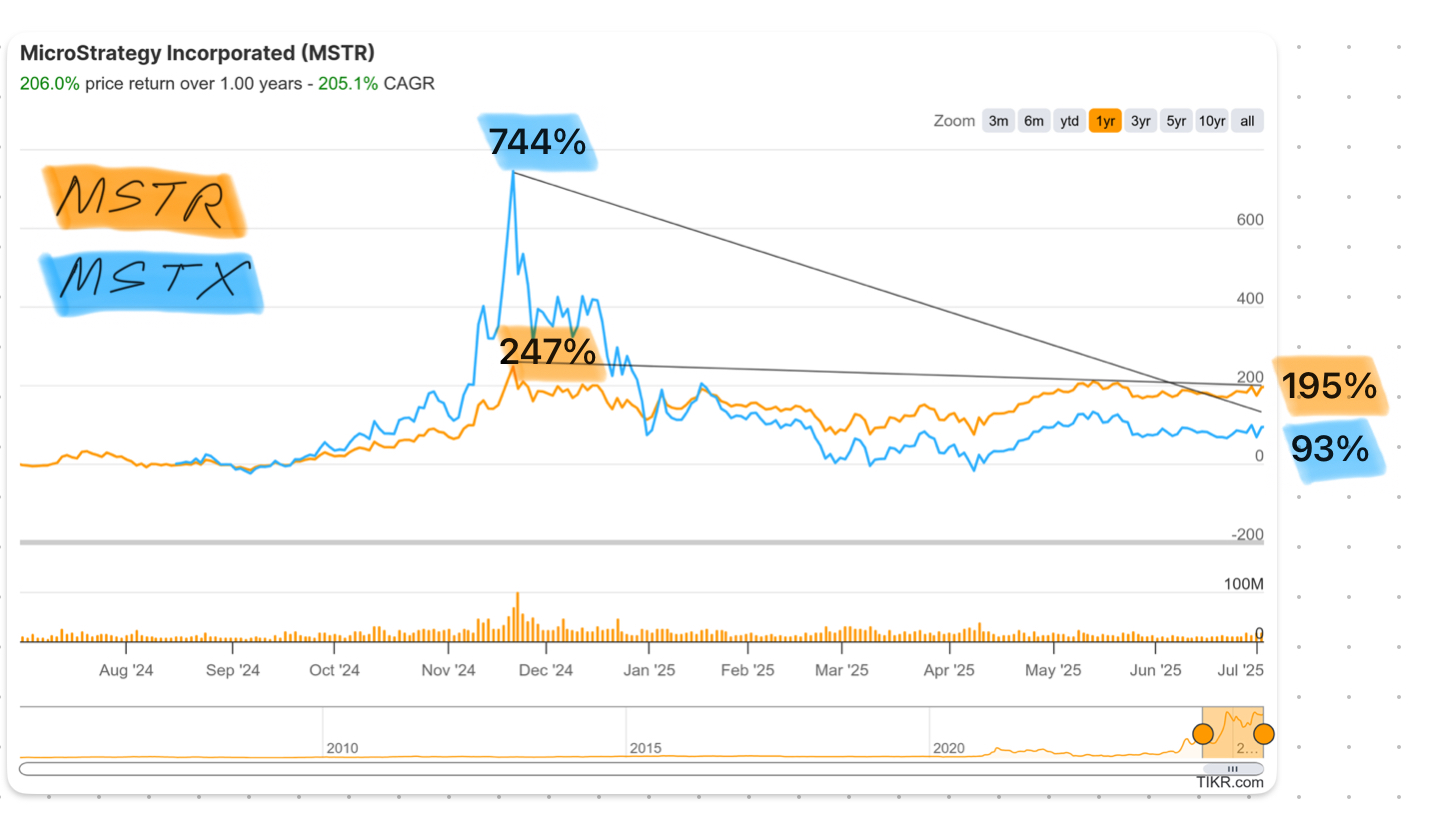
MSTX is 2x levered ETF - allegedly tracking Microstrategy (MSTR)
MSTX is a 2x leveraged ETF designed to deliver twice the *daily* return of MicroStrategy (MSTR). In theory, if MSTR goes up 10% in a day, MSTX should go up 20%.
The ~~investors~~ gamblers seeking this product are not satisfied with bitcoin’s volatility, nor that of MSTR - they want MORE!
## The catch is in the “daily” part.
MSTX resets its leverage every day.
it’s not 2x over a year, it’s 2x of each day’s move, compounded.
In choppy markets, this daily reset creates “decay.” - you can see how the blue line drops from 744% to 93% in the chart above.
If MSTR zigzags up and down, MSTX’s compounding math can erode returns, even if MSTR ends up flat or slightly up.
Additionally, fees are higher for leveraged ETFs, and MSTX is no exception. These eat into returns over time.
Over the last year, MSTR has outperformed MSTX, despite MSTX’s promise of 2x returns.
**195% vs. 93%**
On down days, losses are magnified, and on up days, gains are also magnified, but the math of compounding means …
If you’re holding MSTX for more than a few days, you’re not just betting on MSTR’s direction, you’re betting on the *path* it takes to get there.
## You never quite catch up after a big loss.
“Decay” isn’t just a theoretical risk; it’s a mathematical certainty in volatile markets.
Most of you reading this probably don’t trade stocks - I’d be surprised if anyone other than Austin has even heard of MSTX - but can you think of other leveraged parts of your life? And I’m not talking about finance …
❓
What cans are you kicking down the road in hopes of a future payoff?
❓
Are you promising your friends and family 744% but only delivering 93%?
💡
In a volatile market, the path is your enemy.

Thanks for reading! If you enjoyed this what are you going to do about it?
### Harvard's gonna be aiight
URL: https://pulpconversations.com/harvards-gonna-be-aiight/
Last updated: 2026-08-26T14:22:11.000Z
## Ok, Harvard here is your playbook:
---
#### 1\. Unrestricted Endowment Maneuvers
My research tells me that 80% of the Harvard endowment is restricted, but that leaves **$8–$10 billion** unrestricted. That’s a war chest most universities would kill for.
You could temporarily increase the endowment payout rate from 4.5% to 6% for a few years. That alone could free up an extra $1B+ annually.
`Without touching principal`
But what about the long-term?
Harvard’s endowment returns have averaged 7–8% over the last decade.
A few years of higher drawdown is a rounding error.
---
#### 2\. Debt Market Flex
Harvard has a **AAA credit rating** and can issue tax-exempt bonds at rates that make the U.S. Treasury jealous.
`A $1B shortfall?`
Harvard could float a 30-year bond, pay 3% interest, and barely notice the debt service in its annual budget.
The bond market would eat it up, because “Harvard” is basically a synonym for “risk-free.”
---
#### 3\. Alumni “Emergency” Campaign
Last time I checked Harvard’s alumni network is a who’s who of moguls, senators, and ex-cons. A single “Save Our Research” gala could raise $1B in a weekend.
“Hey, Zuckerberg, you want your name on a new AI center? Pony up.” 🧐
---
## Harvard should focus on:
\-Flexibility of its unrestricted assets
\-Access to ultra-cheap capital markets
\-The power of its alumni network
Thanks for reading! This post is public so feel free to share it with Harvard.
####
### How to Make Japanese Iced Coffee (at home)
URL: https://pulpconversations.com/how-to-make-japanese-iced-coffee/
Last updated: 2026-08-26T14:29:40.000Z
---
## Tools

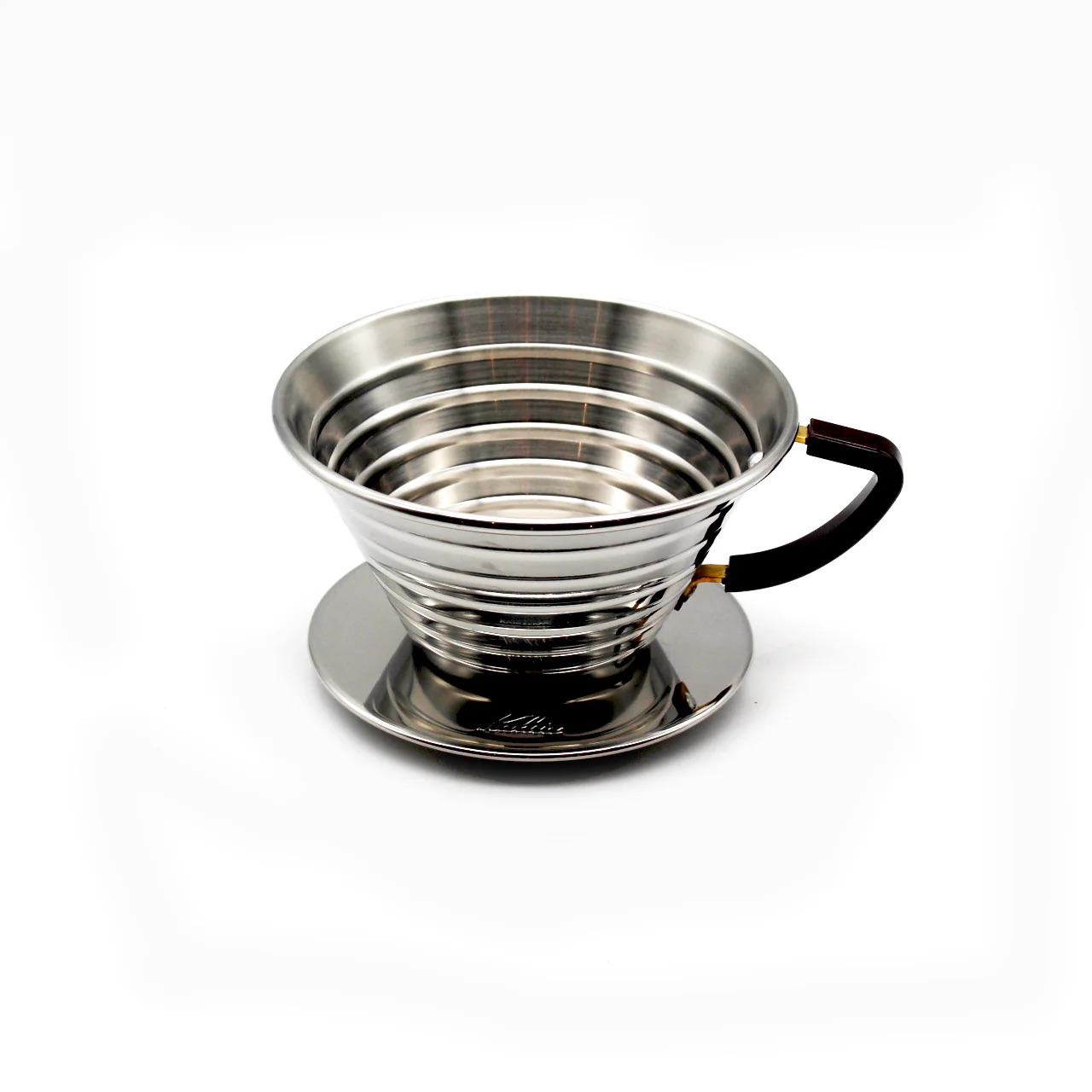
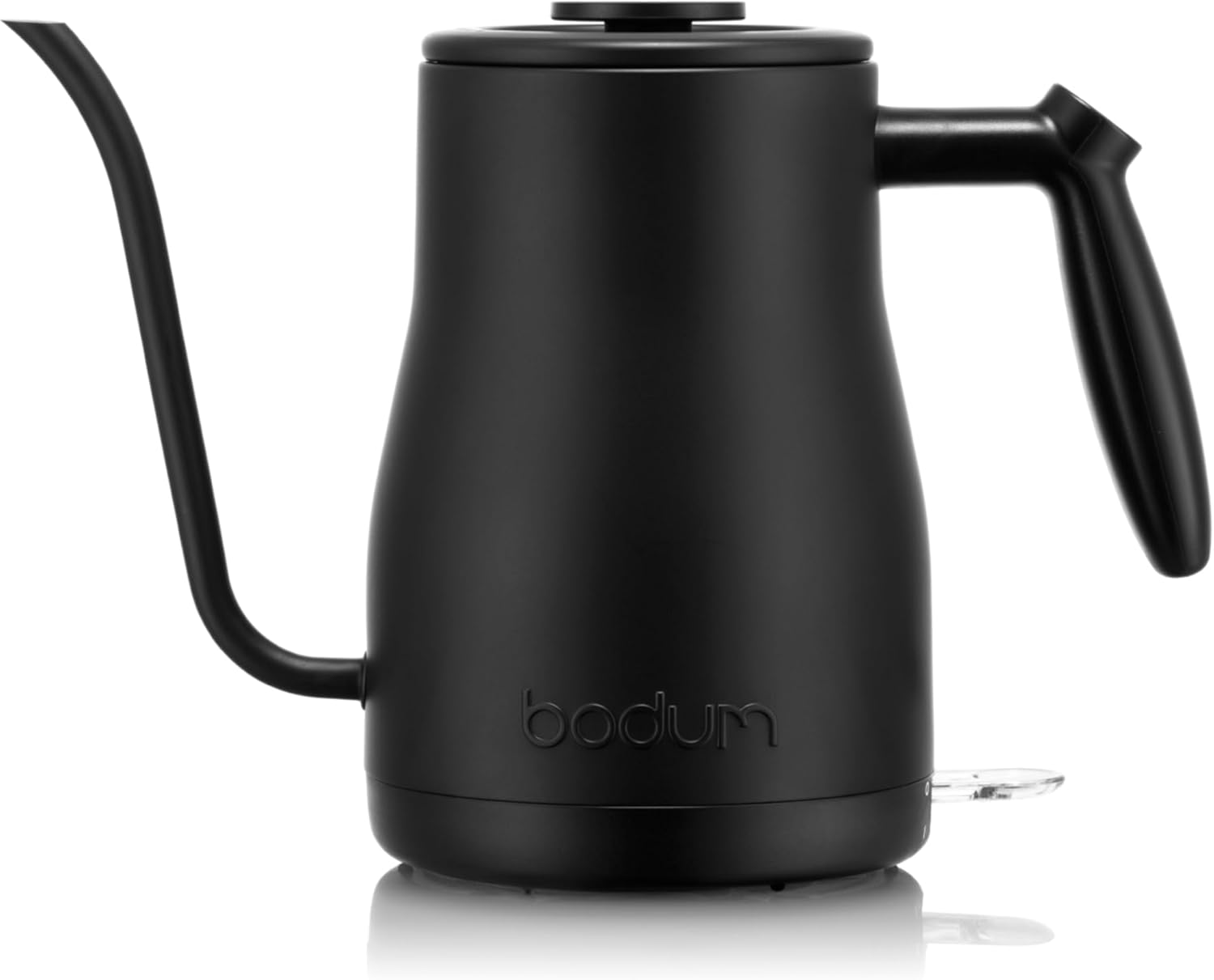






9 Tools You Can Use To Make Exceptional Coffee
Non-cardinal ranking:
1. **Baratza Encore Grinder**: At $199 my friends know this as the *least expensive* grinder I’m currently willing to recommend. Its conincal-burr-grinder is capable of making any style of coffee.
2. **Kalita Wave** **185:** \~$35 in stainless steel; an absolute *steal* \- hands down the most versatile and high-quality coffee brewing device in existence! Yup, you heard it here first. Equally regarded in a Michelin-star restaurant or in your backpack as you hike The Catskills, its flat-bottom idiot-proofs your pouring somewhat, while still offering enough artistic creativity for even the most nerdy baristas.
3. **Kalita Wave filters**: $0.14 / filter - They doin’ it for the sludge.
4. **Gooseneck Electric Kettle:** $66 on Amazon. It doesn’t matter the heat source or brand but *the gooseneck* is not only attractive but also essential; to control your *pour-over*.
5. **Water:** $ 0 - but is anything really 🆓 ?
6. **Ice:** $ 0 - unless you pay for refrigeration.
7. **Vacuum container:** $31+ - This will easily double the lifespan of your whole-bean coffee. Try to avoid the purchase or storage of ground coffee. No judgement - however from a chemistry perspective - ground coffee has more surface area to oxidize. Oxidation = Bad.
8. **Scale:** \~$20 on Amazon. There are myriad options and they are all fine. This is another essential item for which you do not have to pay much at all. Don’t sleep on this tool.
It will be easy to convince yourself that you are already doing more than enuff in buying the other items - there is just no way you are gonna weigh coffee beans. Metric system!? Awww hell nah!!! However …

The scale enables you to follow or make coffee *recipes*. Yup, you know those things that involve measurements and ratios and ingredients and instructional steps.
Unless you already have barista-level pattern recognition, I recommend you initially follow a recipe to *dial-in* your personal favorite brew. Without measuring things, how can you iterate?

This homey Vin talking ‘bout coffee or … ?
Nah …
1. **O.P.C.** [$50 on this website](https://drink.orangepillcoffee.com/substack?ref=pulpconversations.com)
---
## The Recipe
**Ratio**: 10 parts water (in mL) / 1 part coffee (in grams)
This is my preferred ratio for pour-over. It’s on the strong side for most so you might want to start with 12:1 or 15:1

If you don’t want to do math then Yeh mi now!
## A Coffee Poem
Text within this block will maintain its original spacing when publishedPut the kettle on
Grind 15 G's
Slide that wavy in the Kalita
Grounds hittin’ paper like I’m settin’ up the stage
Level out the bed, keep it smooth, no clumps,
Keep it clean, no mistake
Tare the scale.
pour it slow, 150 for the taste I make.
Slow with the neck, let it drip, no rush
150 on the scale, watch the coffee start to blush

I almost forgot - this is Iced Coffee!
Go back to the beginning and drop 75 mL of ice-cubes in your glass before putting the Kalita Wave on top of it. And then - yup - you got this - brew with 75 mL of hot-water … because you know ice is also water. Or is water ice …
Enjoy.
Send this to someone who likes buying new gadgets.
### The Fed’s “Wealth Effect"
URL: https://pulpconversations.com/the-feds-wealth-effect/
Last updated: 2026-08-26T14:32:46.000Z
Since the end of 2019, M2 (the broad measure of U.S. money supply) has grown from about $15.4 trillion (December 2019, per FRED data) to roughly $22 trillion as of mid-2025.
That’s an increase of about $6.6 trillion, or approximately 43%.
## The most explosive growth happened between March 2020 and early 2022, as the Fed and Treasury unleashed unprecedented stimulus.
The massive M2 expansion directly juiced asset prices including equities, real estate, and crypto.
How?
By flooding the system with liquidity.
The top 20% of earners, with the most exposure to these assets …
## … saw their net worth balloon in lockstep with the money supply.
The catch?
Most of this wealth is locked in illiquid assets such as homes and retirement accounts.
[However, wealthy people leverage illiquid assets (aka use it as collateral) thus making it liquid (cash money) - often with neutral-to-positive tax implications.](https://opc.pulpconversations.com/p/fannie-mae-is-hereby-directed-to?r=5av9wm&utm%5Fcampaign=post&utm%5Fmedium=web&showWelcomeOnShare=false&ref=pulpconversations.com)
Purchasing power of cash erodes for all people due to inflation - but assets are the ultimate hedge for inflation because as the money supply increases so do asset values.
## Prices always go up!
[](https://opc.pulpconversations.com/p/how-to-exit-a-startup?ref=pulpconversations.com)
Maintenance costs, property taxes, and higher living expenses have also eaten into real gains for many.
## A-ha moment:
The $35 trillion net worth gain for the top 20% almost mirrors the $6.6 trillion M2 surge when you consider leverage, asset price multipliers, and the fact that most new money flows to those already holding assets.
**In other words, the Fed’s “wealth effect” is not just a theory.**
**It’s a direct pipeline from the printing press to the portfolios of the already-wealthy.**
## Insight:
The real winners are those who could borrow cheaply against rising asset values (think: HELOCs, margin loans, [bitcoin](https://opc.pulpconversations.com/p/fannie-mae-is-hereby-directed-to?r=5av9wm&utm%5Fcampaign=post&utm%5Fmedium=web&showWelcomeOnShare=false&ref=pulpconversations.com)) and reinvest, compounding their gains.
## The losers?
Savers, wage-dependent earners, and anyone not holding appreciating assets.
Sharing is Caring.
##### [WTF Happened in 1971](https://wtfhappenedin1971.com/?ref=pulpconversations.com)
### No Place Like Hope
URL: https://pulpconversations.com/no-place-like-hope/
Last updated: 2026-08-26T22:54:39.000Z
Why do they feel the need to teach me a lesson?
That’s why this relationship never worked.
Yes!
You’re right
But …
for the wrong reason.
Reasons matter.
Especially for a friend.
Let's put some respect on our names.
And care.
And premonition.
Gimme some
Proactivity … not
Reactivity … or worse
Inactivity.
But apologies only get you so far.
The reasons matter.
Have you learned the lesson?
You don’t want to?
How come?
You don’t care?
The Message.
Or ...
The Messenger.
What
if
the
lessons
are
important?
We are responsible for them.
### Fannie Mae is hereby directed to accept Bitcoin
URL: https://pulpconversations.com/fannie-mae-is-hereby-directed-to/
Last updated: 2026-08-27T13:48:48.000Z
## 90% probability this happens by Dec. 31, 2025

---
Some potential implications:
## 1\. Bitcoin Holdings as Direct Proof of Financial Assets
You could show **2 Bitcoin worth $214,000 (based on today’s price) on a Coinbase statement as proof of financial reserves** without converting to dollars. The directive specifically requires crypto assets to be "evidenced and stored on a U.S.-regulated centralized exchange", making platforms like Coinbase, Kraken, and other regulated exchanges acceptable for documentation.
## 2\. No Forced Liquidation Required
**Borrowers won't need to sell their Bitcoin to qualify for mortgages**. Currently, Fannie Mae and Freddie Mac require virtual currency to be "exchanged into U.S. dollars and held in a U.S.- or state-regulated financial institution". The new directive eliminates this conversion requirement, allowing you to **maintain your Bitcoin position while accessing mortgage credit**.
## 3\. Tax-Free Access to Real Estate Capital
This creates a `major tax advantage` since borrowing against Bitcoin doesn't trigger capital gains taxes. As one expert noted: "Borrowing using your Bitcoin as collateral doesn't typically trigger capital gains taxes in most jurisdictions because borrowing against an asset is typically not a taxable event". This could save significant tax liability for long-term Bitcoin holders.
## 4\. Accelerated Mortgage Approval Process
**Crypto-wealthy individuals ~~could~~ will qualify for mortgages faster** than traditional applicants. Since Bitcoin holdings provide clear proof of substantial assets, this could **streamline underwriting for borrowers with strong crypto portfolios but weaker traditional financial profiles** (irregular income, limited credit history, etc.).
> *bitcoin* trades 24/7 including weekends so Imma gonna be able to show proof of funds before you are … nanny nanny boo boo
## 5\. Massive Expansion of Qualified Homebuyer Pool
This policy ~~could~~ will **~~unlock~~ accelerate homeownership for millions of Americans with significant crypto wealth**. The directive acknowledges the need to "assess a broader range of borrower assets and better support sustainable homeownership for creditworthy borrowers, especially those with wealth held outside traditional banking systems". Given Bitcoin's market cap and holder base, this represents a substantial expansion of the potential mortgage market.
AND by now if you have been reading me you know that:

Send to a friend who is buying a house.
Update: 27 June 2025
FHFA's directive to Fannie Mae is the biggest decree since Jan 3, 2009: it's a “Directive” to consider bitcoin as collateral for single-family homes.
Keep in mind the FHFA is Fannie Mae’s Governing Body so the word “consider” can be fairly disregarded.
Translation: The Elite is having a “changing of the guard” and the new Landowners (literally, going forward) will be the newly minted Billionaires from the last 10 years! Moore’s Law applied to Money.
YET the Wall Street Journal doesn't even have this news "above-the-fold" on its Real Estate section nor any of the other sections.
Reuters article: [**https://www.reuters.com/sustainability/boards-policy-regulation/regulator-orders-fannie-freddie-consider-crypto-holdings-loan-assessments-2025-06-25/**](https://www.reuters.com/sustainability/boards-policy-regulation/regulator-orders-fannie-freddie-consider-crypto-holdings-loan-assessments-2025-06-25/?ref=pulpconversations.com)
### Mutual Admiration Society
URL: https://pulpconversations.com/mutual-admiration-society/
Last updated: 2026-08-27T14:18:23.000Z
Ranked Choice Voting gives voters more power to shape the outcome, not just pick a side.

RCV is an election system where voters rank candidates in order of preference instead of picking just one. If no candidate gets over 50% of first-choice votes, the lowest-ranked candidate is eliminated and their votes are redistributed to the next preferred candidate on each ballot.
This process repeats until someone crosses the 50% threshold and wins.
IMHO the format encourages more positive and coalition-driven campaigns - as evidenced by the Bromance between Zohran and Brad.
## The format encourages pre-collaboration.
And it is not limited to today’s Democratic Primary in NYC.
**Minneapolis, MN** – RCV has been credited with increasing representation for communities of color and third-party candidates in city elections.
**Oakland, CA** – RCV played a pivotal role in electing the city’s first female and Asian-American mayor, Jean Quan, in 2010.
**Cambridge, MA** – Using a proportional form of RCV since 1941, it’s a national model for multi-winner elections and diverse representation.
---
## Pros
- **Voter Empowerment:** RCV lets voters express nuanced preferences, ranking up to five candidates. This reduces the “wasted vote” problem and can encourage more honest voting.
- **Majority Mandate:** The winner must secure over 50% of the vote, ensuring broader support and legitimacy.
- **Coalition Building:** Candidates are incentivized to appeal beyond their base, seeking to be the second or third choice of rivals’ supporters - see the headline video for an endearing example of this.
## Cons
- **Complexity:** Ballot design, voter education, and tabulation are more complex and costly than traditional voting.
- **Counting Delays:** RCV can slow down results, especially in close races, as rounds of elimination and redistribution are processed.
- **Potential for Voter Confusion:** Voters are not used to this format and don’t understand it well (which itself is very understandable) - so if voters continue to “bullet vote” (pick only one), this undercuts the system’s benefits.
---
I can’t vote in NYC because I don’t live within the city limits but if I did I would have to vote for Zohran simply for making this gem of a video via his alter-ego Mr. Cardamom:
Brad also seems like a genuinely nice and open-minded person!
##### Hey Heems and Riz MC - when am I gonna get to see a Mr. Cardamom x Swetshop Boys collabo?
### The Day the Earth Stood Still
URL: https://pulpconversations.com/the-day-the-earth-stood-still/
Last updated: 2026-08-27T14:27:51.000Z
When was the last time the USA used a B-2 Bomber in combat? - in Syria (2017) based on my cursory research.
Last night at 8p the [WSJ published Part 2 of an investigative series on UAP](https://www.wsj.com/politics/national-security/pentagon-ufo-investigation-lockheed-martin-1bac3d41?st=YExnkX&reflink=desktopwebshare%5Fpermalink&ref=pulpconversations.com) (Unidentified Aerial Phenomena) aka UFOs.
It's clearly not a last-minute project; these series take months, if not years to develop. The timing coincides with a major U.S. military action (the B-2 strikes on Iran).
Media outlets often coordinate major investigative releases to provide narrative cover and distraction.
By doing this they shape public perception during a period of heightened attention.
## Did you know that 1963’s *Bloody Sunday* (Selma) was coordinated with that night’s Sunday Night Movie?
**“Judgment at Nuremberg"** \- was airing on national television - with an estimated 25% of the US Population watching - when it was interrupted for a real-time violent show.

Not John Lewis.
The intention was to `emotionally appeal to citizens who were primed` to think about justice and human rights because of the film’s subject matter.
Back to last night - The timing of this weekend's UAP article is almost certainly deliberate. The government and its media partners want to control the narrative during a period of military escalation.
The WSJ is helping the government “reset” the public narrative.
While the USA flexes its military muscle, the paper is simultaneously publishing a series that *demystifies* and **delegitimizes** the UFO/UAP story.
This is classic narrative management, reminding the public that the real power is in advanced U.S. technology, not in alien mysteries.
I read Elizondo’s book. [This is my current bookshelf](https://vinaybeta.com/books?ref=pulpconversations.com).
The most effective way to neutralize a persistent narrative isn’t to attack it head-on, but to let it wither through repeated, subtle reminders of its lack of substance.
**(The public en masse doesn’t care about truth - it cares about perception)**
This is reputational risk management at its finest. Slow, steady, and deniable.
## Stay woke.
###### Music video: *Redbone* by Childish Gambino
[Subscribe](#/portal/signup)
### How To Name A Start-up
URL: https://pulpconversations.com/how-to-name-a-start-up/
Last updated: 2026-08-27T14:31:45.000Z
There’s a moment in a great brand story where the name stops being just a word and starts to mean something.
Listening to [James](https://www.linkedin.com/in/jameshaycock/?ref=pulpconversations.com) break down the origins of BRiMM was a reminder that the best names are chosen with intention and that intention is everything.
Believe in your choice and let that belief infuse every part of your business.
When a brand’s name, mission, and team are in sync you get resonance.
That’s synchronicity, and it’s what people feel when they encounter something authentic.
## Fit.
It’s like fashion: some outfits only work because the person wearing them owns it, with confidence and a sense of purpose. The same goes for brands. A name that might seem odd or unconventional in isolation can become iconic when it’s worn with conviction.

At the end of the day, branding is about more than clever wordplay or market research. It’s about intention, synchronicity, and the courage to stand behind your choices. That’s what makes a brand memorable and magnetic.
Check out 👇🏽
[](https://wearebrimm.com/?ref=pulpconversations.com)
### How To Exit A Startup
URL: https://pulpconversations.com/how-to-exit-a-startup/
Last updated: 2026-08-27T14:38:14.000Z
---
## There are only 3 ways to exit a startup.
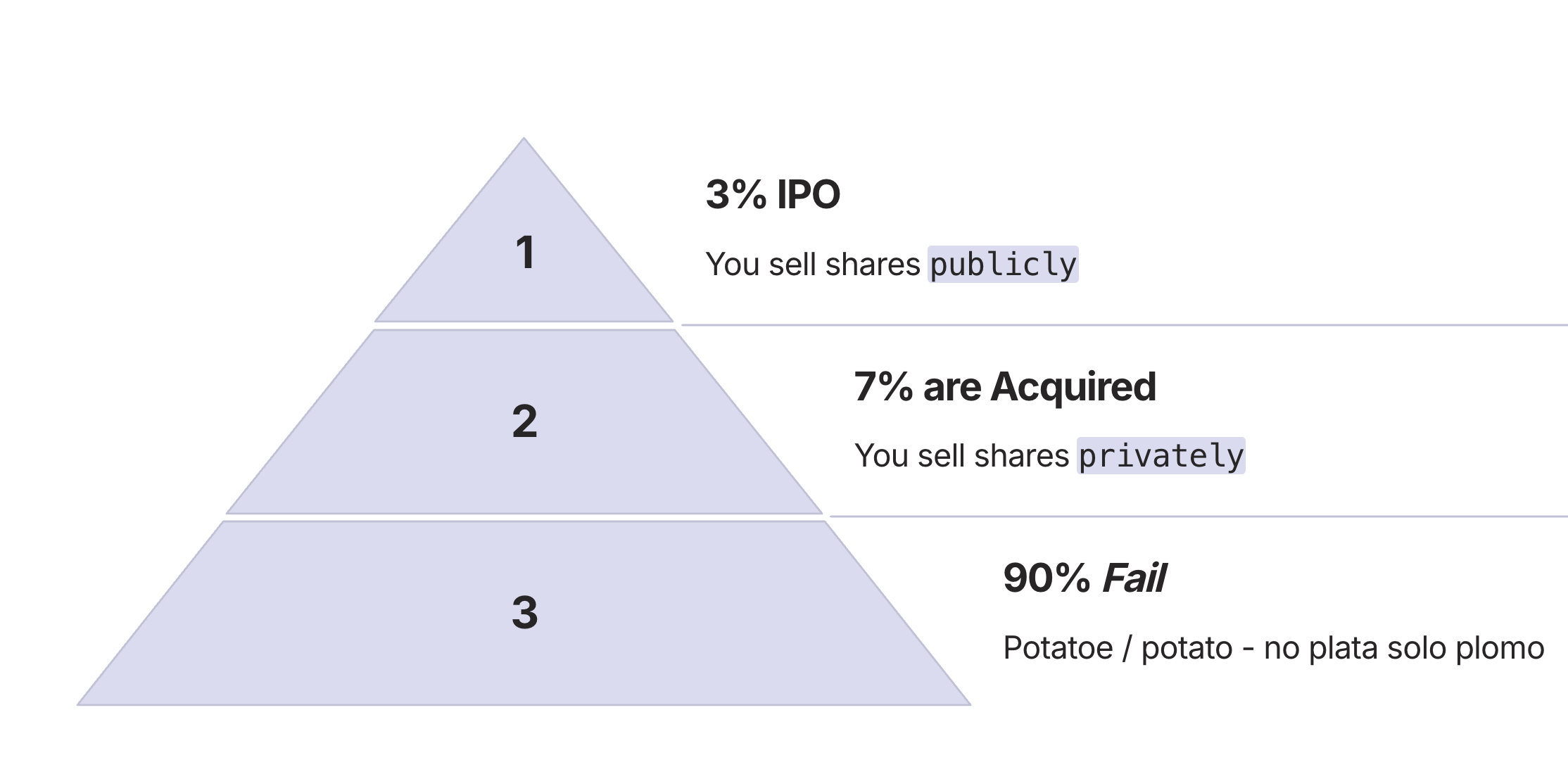
[All The Way UP](https://open.spotify.com/track/7Ezwtgfw7khBrpvaNPtMoT?si=ddb19627c22b412b&ref=pulpconversations.com)
The most common way to convey startup “wins” is to discuss:
`The Multiple`
This can be expressed myriad ways depending on what Baskin Robbins flavor of financial ~~engineering~~ accounting / valuation the investor prefers.
Some of the more common flavors:
---
Plain Vanilla
## Revenue Multiple
This is the most commonly discussed and sometimes straightforward metric:
If the business is generating $20M of Revenue and sells for $100M, then it achieved a
# 5x
---

LPs Prefer Chocolate
## TVPI
Which stands for Total Value Paid In.
This is a fund-level multiple, not a company-level one. It’s used by LPs and VCs to measure the performance of a fund:
This metric can easily be *juiced* if the investment firm has aggressively *marked up* the paper Residual Value of the companies on its balance sheet.
If a VC fund has returned $50M to LPs and still holds $200M in portfolio value, on $50M invested, TVPI =
# 5x
---
~~Community Adjusted EBITDA~~ More Complicated
## Rule of 40
This *rule* says a healthy SaaS (Software-as-a-Service) company should aim for:
Growth Rate % + Profit Margin % > 40%
Companies that out-perform 40% will sell for a bigger Revenue multiple.
The median revenue multiple for SaaS companies dropped to:
# 5.8x in Q1 2025
down from
# around 10x in 2024
### If You Can't Blind Them With Brilliance; Baffle Them With Bullshit
URL: https://pulpconversations.com/if-you-cant-blind-them-with-brilliance/
Last updated: 2026-08-27T14:45:13.000Z
These are the only two ways to *really* influence people.
## Guess which one is more common?
From [Ellsworth Toohey](https://a.co/d/d9DQaT1?ref=pulpconversations.com) to Paul Krugman - recent history is littered with folks who use institutional influence to shape narratives and subtly discourage individual excellence.
Toohey is a fictional character, of course, but he’s `the archetype` of the intellectual influencer who shapes public opinion not by building, but by tearing down.
He is a collectivist critic who wields soft power through media and culture, undermining individual achievement for the “greater good.”
What is the greater good?
There is no one answer however I encourage you to pay attention to people around you who subtly redirect your ambition and talent *away* from creation and instead toward consensus.
Modern-day Toohey’s are all around us. They are not villains in the classic sense.

BUT ..
Instead they are often celebrated as *thought leaders* or moral voices.
It becomes dangerous for society when such influence stifles innovation, risk-taking and dissent in the name of “the greater good”.






The Influence Ecosystem
The Toohey-effect can be a leading indicator of stagnation or groupthink.
## It’s an early warning for investors and innovators alike.
Professor Shankar who so brilliantly conveys his humility and honesty in this video on Quantum Mechanics:
The next time someone attempts a straw man tactic to misrepresent Bitcoin; I will send them this most excellent video - thanks Prof!
### Sold (for) vs. Valued (at)
URL: https://pulpconversations.com/sold-for-vs-valued-at/
Last updated: 2026-08-27T15:00:07.000Z
Big news today as the L.A. Lakers “sold” for $10 Billion - making them the most valuable organization in sports - ever.

So if you are like me; I read that headline and initially read it as $10B was exchanged between two or more parties for the team.
But in actuality the Lakers were sold at a $10B (paper) valuation.
The team was last valued (per a transaction) in 2021 at $7B - meaning that today’s deal transpired at a valuation $3B higher.
## So that means the Sellers made $3B, right?
Nope.

## We are dealing with “Venture Math”:
Prior to this deal the Buss Family Trust owned 66% of the Lakers. After the deal their shareholding falls to 15%.
66% - 15% = 51%
and …
10B - 7B = 3B
## So that means the Buss family received 3B in exchange for selling 51% of their shares, right?
Nope.

## We are dealing with “Venture Math”, remember?
51% x 10B = 5.1B
5.1B is indicative of the value received by the Sellers aka The Buss Family Trust.
Their new “papered” shareholding is:
15% x 10B = 1.5B
The gap between the cash money less “post-money paper value” is:
5.1B - 1.5B = 3.6B
## So …
The sellers took 3.6B cash off the table.
### Adaptive Lab: A Lyrical Deconstruction
URL: https://pulpconversations.com/adaptive-lab-a-lyrical-deconstruction/
Last updated: 2026-08-27T17:35:17.000Z
My friend [James](https://www.linkedin.com/in/jameshaycock/?ref=pulpconversations.com) just launched [BRiMM](https://wearebrimm.com/?ref=pulpconversations.com).
I tried to hire James in 2009, but he had other plans.

Haycock vs. Clipse
## Vision and Creation from Nothing
Like Pusha T’s “grandmama could see it,” James had a vision for [Adaptive Lab](https://web.archive.org/web/20180530215953/https://adaptivelab.com/#expand) before it existed. He saw the need for a new kind of digital innovation agency (in 2009) - one that could outmaneuver legacy consultancies.
James didn’t build Adaptive Lab to be flashy; he built it to be effective. Adaptive Lab’s value was in its results, not its hype.
The pitch to clients was about rapid prototyping and tangible results - before *design thinking* became a meme. This is what set James apart and ultimately led him to create an agency that was 150 employees deep & pulling $20M a year in turnover.
James had to create processes, culture, and operational discipline from scratch. He had no inherited playbook, just like Pusha T’s “bust a brick if you let me.” He turned raw talent into high-performing teams.
Not only did James sell his consultancy to IDEAN - a Finnish company - he then went on to lead even larger teams at Capgemini, ultimately absorbing and managing [Frog Design](https://www.frog.co/?ref=pulpconversations.com)’s European practice.
## James’ “so be it, so be it” attitude;
became a repeatable playbook: he identified blockers, injected Adaptive Lab’s culture, and transformed existing assets into innovation engines.
> he leanin' on Celine 'cause he ain't steppin' in Giuseppe
Whether “busting a brick” (cutting a kilo of coke) like King Push or turning a legacy design team into a nimble innovation unit like James, **the magic is in the remix / not the raw material**.
---
> “When I was born, grandmama could see it / I be Bentley driven and very strategic”
> — Pusha T, “So Be It”
---
Thanks for reading! If you enjoyed this then maybe so will your Moms.
### People are outraged. 🤷♂️
URL: https://pulpconversations.com/people-are-outraged/
Last updated: 2026-08-27T18:32:48.000Z
For decades the US Government heavily subsidized some of the most expensive universities. [Now this relationship is being "torpedoed" ....](https://www.wsj.com/us-news/education/northwestern-funding-freeze-trump-85d49da2?st=18wrdW&reflink=desktopwebshare%5Fpermalink&ref=pulpconversations.com)
AND
People are outraged. 🤷♂️
"I just don't understand how anybody could think this is a good idea!" - they exclaim.
Meanwhile, since 1980 Ivy League tuition grew at an average annual rate of 5.87%.
This outpaced CPI "inflation" at 3.03% annually over the same time period.
Inflation is in air quotes because the nature of the "basket" and its readjustment periods have changed several times over the last \~50 years.
The official CPI now tracks the cost of maintaining a standard of living, not just the cost of a fixed basket (as in 1980).
This means the CPI is less about...
*H𝘰𝘸 𝘮𝘶𝘤𝘩 𝘥𝘪𝘥 𝘱𝘳𝘪𝘤𝘦𝘴 𝘨𝘰 𝘶𝘱?*
and more about ...
*𝙃𝙤𝙬 𝙢𝙪𝙘𝙝 𝙢𝙤𝙧𝙚 𝙙𝙤𝙚𝙨 𝙞𝙩 𝙘𝙤𝙨𝙩 𝙩𝙤 𝙡𝙞𝙫𝙚 𝙩𝙝𝙚 𝙨𝙖𝙢𝙚 𝙬𝙖𝙮, 𝙜𝙞𝙫𝙚𝙣 𝙝𝙤𝙬 𝙥𝙚𝙤𝙥𝙡𝙚 𝙖𝙘𝙩𝙪𝙖𝙡𝙡𝙮 𝙖𝙙𝙖𝙥𝙩?”*
And moreover the CPI calculation is somewhat of a fool's errand because the more apt inflation metric is the real CAGR of the M2 money supply which is \~6% since 1980.
What a coincidence: Ivy League tuition increased 5.87% per year since 1980\.
What does that mean?
It means the Ivy's had no interest in having their revenue model diluted by money creation so they kept up with the real inflation rate.
REAL WAGE GROWTH FOR THE MEDIAN WORKER
HAS BEEN ALMOST FLAT FOR 45 YEARS
... at about 0.35% per year.
Basically zero. Our purchasing power has declined \~6% PER YEAR since 1980.
So why do people give a shit if expensive universities are losing subsidies?
Update on 17 June 2025:
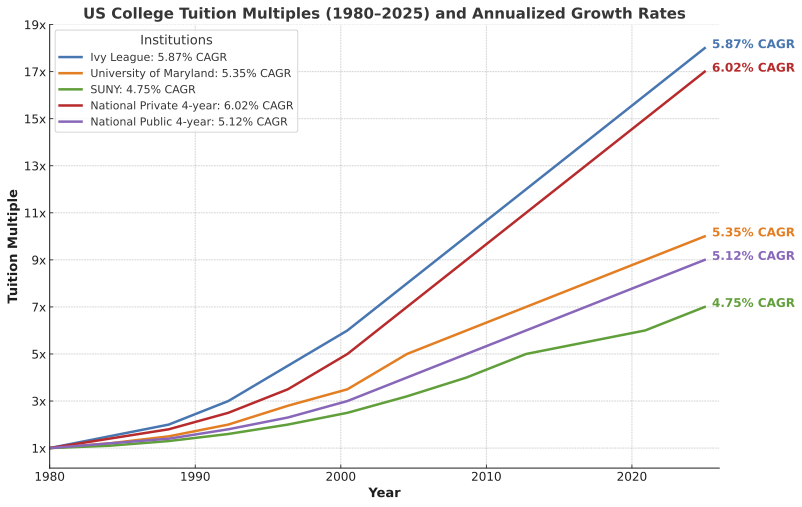
---
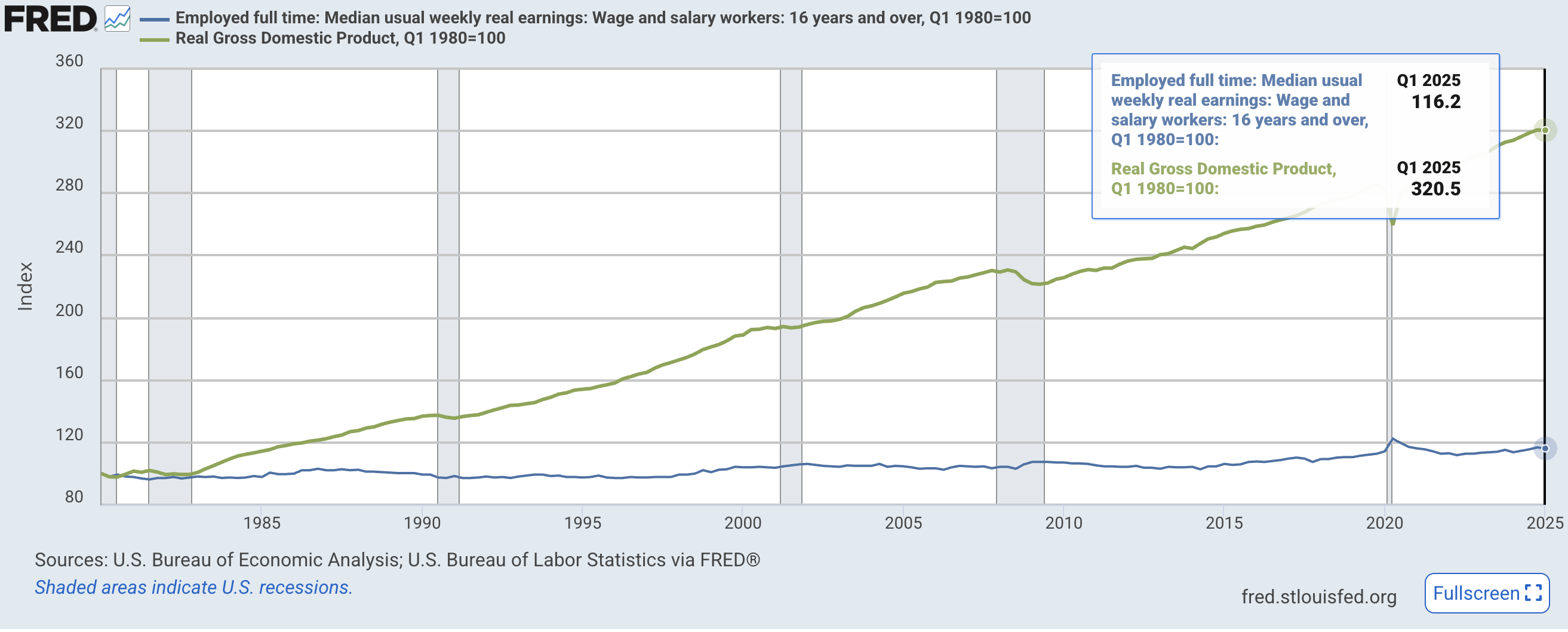
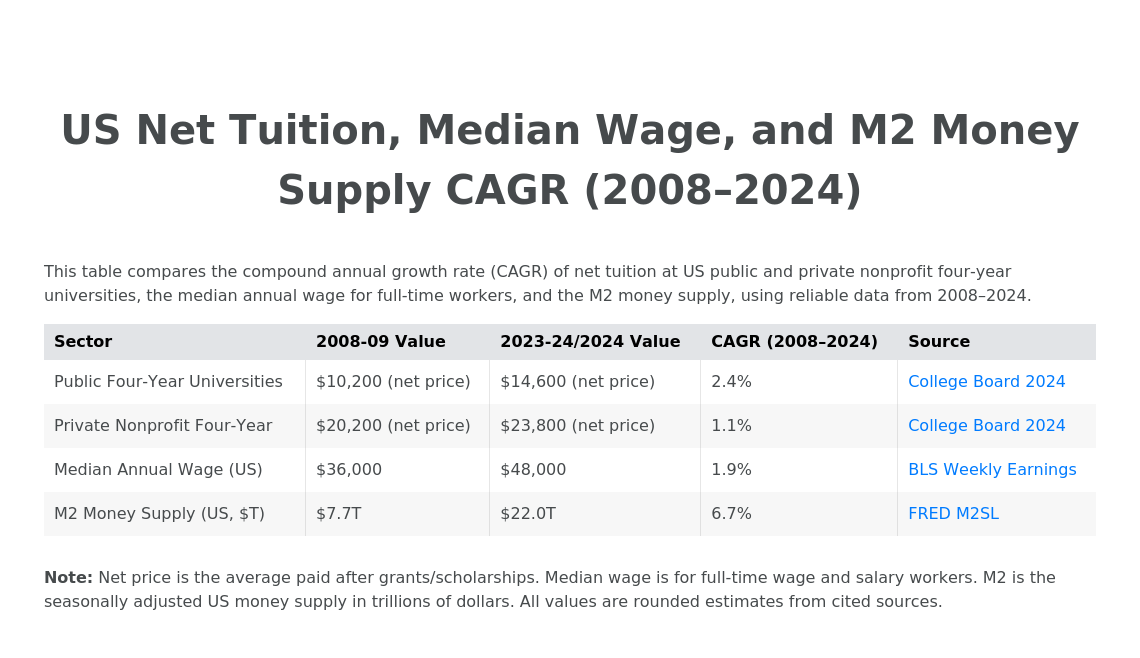
### A Holotropic Session
URL: https://pulpconversations.com/a-holotropic-session/
Last updated: 2026-08-27T18:41:45.000Z
He ain’t no ‘one-min. man’ yet he knows how to slow down and summon harmony in less than ❺ minutes.
Check out the video 👆🏽 for a real-time breathing session led by Julian.
It’s a small investment for great returns.
Breathwork is the ultimate democratizer.
\-No SaaS fees
\-No Capex
\-No Centralized Gatekeepers
A few minutes of practice can yield measurable improvements in calm, focus, and emotional regulation. That’s a **high-yield, low-risk asset**.
Techniques range from simple breath awareness to advanced *holotropic* breathing.
Regular breathwork is correlated with reduced anxiety, improved mood, and better stress management - **a hedge against volatility** of the daily grind.
The “cost” is minimal—just a few minutes a day. **No need to liquidate** other assets (i.e. the rest of your to-do list)
Like any compounding investment, **the real gains come from regular practice**.
## Breathwork is the only “asset class” that’s both inflation-proof and immune to market cycles.
I’m practicing the quick session taped above on the daily. *(Thanks King J!)*
Are you in a high stress [Daily Operation](https://open.spotify.com/track/6lqKYoYGYprzbFXT95tDTt?si=997bc246e11b416e&ref=pulpconversations.com)? If so, then take this personally.
#### Do some breathing.
> Breath is the only technology that we're born with, and that we die with.
> It's our original operating system.
> \-Julian
### AI never sleep, 'cause sleep is the cousin of death.
URL: https://pulpconversations.com/ai-never-sleep-cause-sleep-is-the/
Last updated: 2026-08-27T18:47:24.000Z
AI is
Technology
made By
Generations
of Smart Humans
Enabling Humans
to Avoid
becoming Boring
by Eliminating
Boring jobs
---
## A.I. is,
at its ~~GPU~~ ~~FPGA~~ ~~ASIC~~ core, a product of cumulative human ingenuity.
A.I. is also this 🐐:
Each generation been building on the last, making tools that extend our capabilities.
> \*We are like dwarves sitting on the shoulders of giants. -Bernard of Chartres
- AI *enables humans* with a promise to free us from repetitive, 💀-sucking tasks, letting us focus on our creativity.
**You do you** \- `it tells us` \- leave the grunt work to me.
## A.I. frees us to be interesting.
Technology can be a 🔫 but it can also most definitely serve as a liberator, not a replacer. It’s about augmentation, not obsolescence.
Of course some jobs and some people will suffer in the short-term but how might anyone argue that any kind of change is even possible with someone suffering short-term pain?!
Assuming short-term pain can’t be avoided, we should focus on the liberating dimensions of this inspirational moment in time - during which we are all alive - together.
## Let’s make the most of it.
Together.
---
## A.I. will create new jobs.
The people doing these jobs are already among us.
#### But the kicker is …
that these people don’t work for anyone but themselves.
Why would they?
## A.I. isn’t set-and-forget.
It needs data (our collective actions), oversight (ahem.. let me get back to you on that one), and constant tuning (DIY preferably).

\*The visual representation of this concept also appears in medieval art, such as the stained glass windows of Chartres Cathedral, depicting smaller figures (the Evangelists) perched on the shoulders of larger ones (the Prophets), symbolizing the transmission and accumulation of knowledge across generations.
### Wanna Be Part Of The Power Circle
URL: https://pulpconversations.com/wanna-be-part-of-the-power-circle/
Last updated: 2026-08-27T18:58:59.000Z
USA + ROW, February 2020 - a line in the sand.
Since then we’re living in a new era, and the “Power Circle” is being redrawn right before our eyes.
COVID was the ultimate global stress test. It exposed who clings to centralized authority: governments, legacy corporations, mainstream media. And who thrives on individual liberty: entrepreneurs, decentralized tech, and alternative communities.
Meanwhile …. The old guard [defaulted to control](https://www.cfr.org/in-brief/canadas-trucker-protests-what-know-about-freedom-convoy?ref=pulpconversations.com).
## The new elite? They are adapting, pivoting, and building
The transition is messy and will take a saeculum.
Most people are understandably still stuck in the BC (Before COVID) paradigm, relying on top-down systems for security and direction.
## But it’s been 5 years.
And the the cost of lagging behind is a continued loss of autonomy, more surveillance, and getting whiplash from the stock market; which itself is questioning efficient hypotheses.
So what’s the playbook? Fuck if I know, 🤷🏽♂️.
🤔
However, I’m pay attention to who is controlling: physical commodities, digital commodities, networked communities and vocational information.
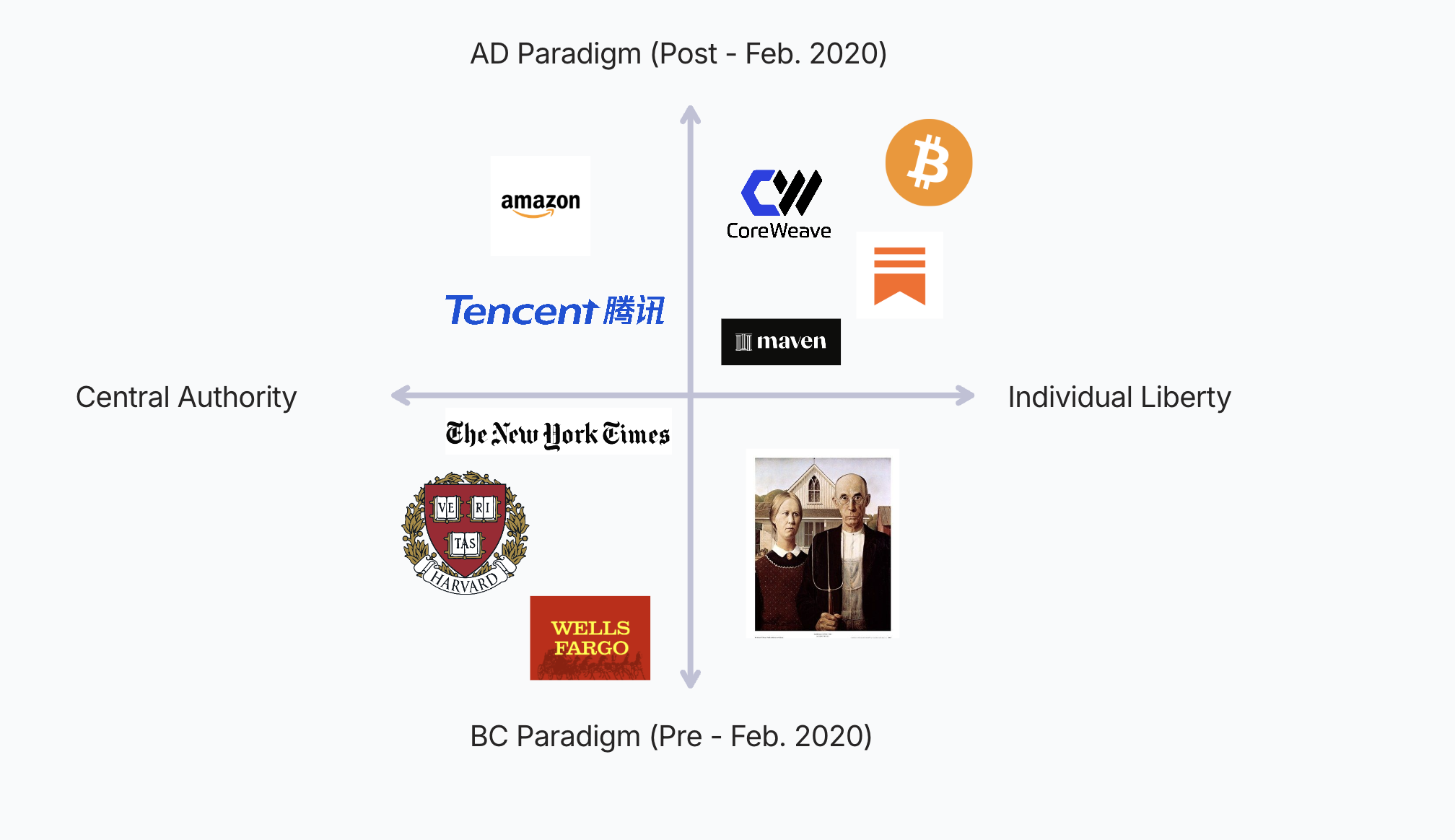
2x2 - Pump, up it up, like a gas station
The real power circle of the next century will be defined by those who can sit comfortably at old tables, as they translate how they are architecting the new order.
You may disagree (fair) but I don’t think this is just philosophy. The leaders in the after-Covid era will know when to leverage centralization for scale and security, and when to decentralize for speed and innovation.
> I’m at the round table, where your seat at? Where your plate, where your lobster, where your sea bass? - Gunplay
Are you BC or AC? Are you building, or waiting for permission?
---
### Enneagram Style Seven
URL: https://pulpconversations.com/enneagram-style-seven/
Last updated: 2026-08-27T19:04:02.000Z
### Have you taken a Personality Test?
Does it invite a deeper conversation within you? And if so, do you feel compelled to share any insights with your friends? What do they think? Have your friends taken a personality test?
#### What do you think about your friends’ typologies?
Previously on *Pulp Conversations* we covered [Spiral Dynamics with Jordan Owens](https://opc.pulpconversations.com/p/dont-put-me-in-the-box?ref=pulpconversations.com).
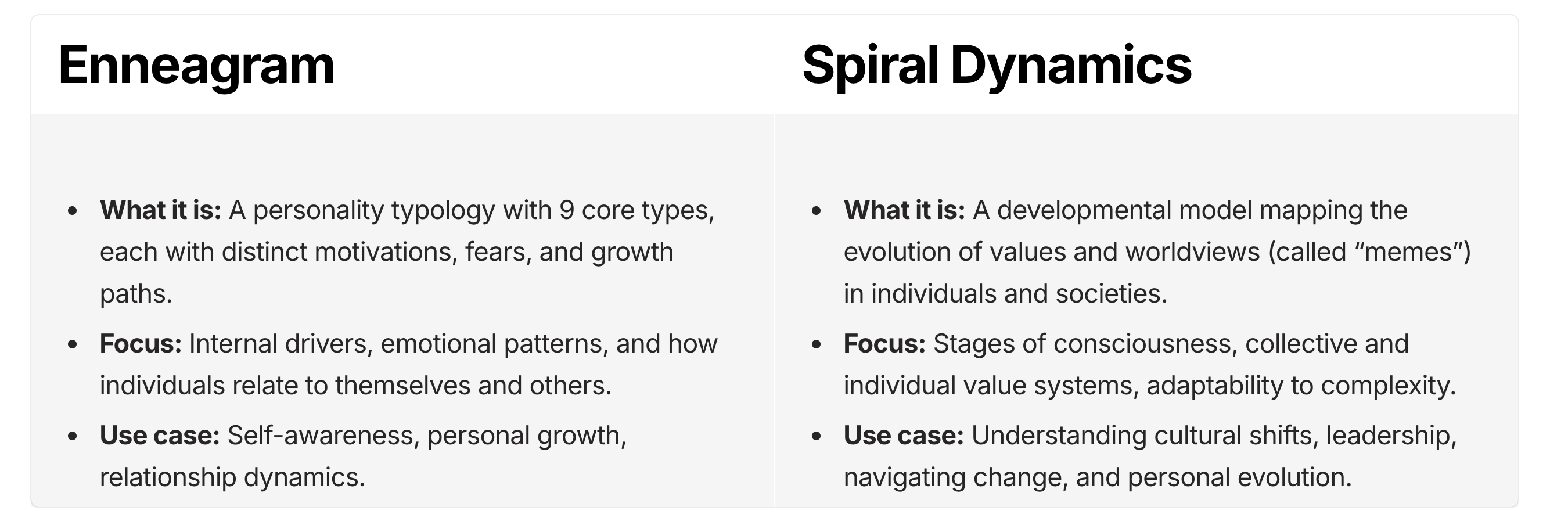
## So what is the difference?
I must confess I never heard about [Enneagram](https://www.enneagraminstitute.com/?ref=pulpconversations.com) until [Sara](https://expinstitute.com/about?ref=pulpconversations.com) told me about and I never heard about [Spiral Dynamics](https://spiraldynamics.org/resources/books/?ref=pulpconversations.com) until [Jordan](https://www.origincreative.ca/about-us?ref=pulpconversations.com) told me about that.
But since then, I tried to go to school on both frameworks to understand them better.
My current understanding is that Enneagram is about *who you are* and *why you do what you do*; Spiral Dynamics is about *how you think* and *what you value* as you evolve.
Enneagram is a map of your inner landscape.
Spiral Dynamics is a map of your worldview’s altitude.
### Sara is Enneagram 7: The Enthusiast
Sara and I discussed some of her trepidations and contemplations about having a child, especially in light of her Enneagram-style.
So of course I asked my trusty AI assistant for the down-low:
## Is having a child consistent with Sara’s Personality Type?
Sara’s core desire:

Freedom
Sara’s core fear:

Trapped in Deprivation
Sara’s core strengths:



Optimism, Energy, Adaptability, Creativity
## Motherhood Through the Lens of Enneagram 7
## Motherhood Through the Lens of Spiral Dynamics
If I ruled the world (imagine that)
I'd free all my sons, I love 'em, love 'em, baby
Black diamonds and pearls
(Could it be, if you could be mine, we'd both shine)
If I ruled the world
(Still livin' for today, in these last days and times)
***\-NAS***
### The Cantillon Effect
URL: https://pulpconversations.com/the-cantillon-effect/
Last updated: 2026-08-27T19:19:16.000Z
The Cantillon Effect is named after Richard Cantillon, an 18th-century economist who noticed that when new money is created, it doesn’t spread evenly through the economy.
Instead, those closest to the source of the new money (central governments, financial institutions and asset-holders) get to use it first, before prices rise.
By the time it trickles down to everyone else, prices have already gone up, so the latecomers get less bang for their buck.
Imagine a pizza delivery. Your teenage bro-ski brother snags the biggest, hottest slices - the side with all the pepperoni. By the time the box gets to you - the runt of the family - all that’s left is the crust. Your more powerful bro was closer to the source and therefore took his share first, leaving you with less premium slices.
Money is a technology.
AI is a technology.
The wheel, the printing press, the Internet: same story.
The people who get access first, or who are proactive enough to adopt early, reap outsized rewards. This is what I’ll dub the ***Cantillon Effect of Technology***.
Early AI adopters (startups, tech giants, savvy individuals) are already automating tasks, creating new products, and capturing market share.
Just like “retail” had a huge “front-running opportunity” vs. institutions with regards to bitcoin, curious individuals can front-run Corporate America by making the meaning they want to inculcate in the world.
“Easy wins” are still available in relation to both money & AI but the retail-front-running-competitive-advantage is shrinking on a daily basis.

The gap between early adopters and laggards widens, just like with money.
The **real** inequality isn’t just about money or “the rich getting richer.”
## It’s about proximity to innovation.
The first-movers set the rules, capture the value, and shape the future. Everyone else plays catch-up.
It’s about being in the right place at the right time. Inequality is a natural outcome of any system where new resources (money, tech, information) are distributed unevenly.
As he is with so many things, Dave Chappelle was ahead of his time with this skit from 2003:
### Who's Your Plug?
URL: https://pulpconversations.com/whos-your-plug/
Last updated: 2026-08-27T19:22:38.000Z
0:00
/0:33
1×
The plug is your connection or supplier—the person you "hit up" when you need something you can't easily get elsewhere - [Perplexity](https://www.perplexity.ai/org/join/eabef189-1379-412b-b2f7-eef711319852?ref=pulpconversations.com)
In hip-hop slang —The Plug— is the supplier, usually of drugs or other illicit goods.
## Thus the *Plug Walk* is a flex:
it’s about moving with confidence because you have access to exclusive resources (the plug), and you’re untouchable in your circle.
You are already on multiple circumferences (circles of others) but are you in the center of your own circle?
## It’s not just about flexing wealth or connections:
Gucci Mane is referencing [the cyclical nature of life](https://opc.pulpconversations.com/p/cycles-in-nature?r=5av9wm&utm%5Fcampaign=post&utm%5Fmedium=web&showWelcomeOnShare=false&ref=pulpconversations.com) \- plugs get indicted, new plugs emerge, and the hustle never stops.
It’s a subtle commentary on the instability of ~~street~~ success, even as the surface message is all about winning.
Maybe like me, your Plugs are your [daughter](https://opc.pulpconversations.com/p/bo-and-daddy-in-la?ref=pulpconversations.com),

a [mentor](https://www.linkedin.com/in/lois-vietri-b562106/?ref=pulpconversations.com),
[](https://www.linkedin.com/in/lois-vietri-b562106/?ref=pulpconversations.com)
your [coach](https://www.linkedin.com/in/mamahopey/?ref=pulpconversations.com),
or a [friend](https://www.linkedin.com/in/sumit-mehra-28b5511/?ref=pulpconversations.com) who opens doors

#### Not just for quick wins, but for long-term growth.
Cultivate genuine relationships, invest in trust, and give as much as you get.
## The real Plug Walk is walking with people who vouch for you:
Allies who grow with you.
### Slowing Down
URL: https://pulpconversations.com/slowing-down/
Last updated: 2026-08-27T19:30:56.000Z
Are you able to slow down enough to listen to Zachary Knowles ?
Let’s get real: The cult of speed is everywhere. Hustle culture, “move fast and break things,” and the unspoken badge of honor for burning the candle at both ends.
[Danya](https://evolution.team/?ref=pulpconversations.com)’s story is a masterclass in this: 80-hour weeks, New York’s electric pulse, and a relentless drive to do, be, and experience everything.
It’s intoxicating, addicting …
and TIRING.
Speed is seductive, but it’s also a trap.The world rewards velocity.
but we rarely ask ourselves - what are we running toward?
… or away from?
### The Illusion of Progress
In your 20s, speed feels like progress. You’re stacking experiences, building networks, and racking up “career capital.”
At some point many of us unconsciously conflate activity and progress.
[](https://drink.orangepillcoffee.com/substack?ref=pulpconversations.com)
Are you spinning your wheels - mistaking exhaustion for achievement?
### The Power of the Pause
Slowing down isn’t about giving up; it’s about [leveling up](https://www.linkedin.com/in/amitsharma13/?ref=pulpconversations.com).
As we get older I think [depth](https://www.linkedin.com/in/bernardmarantelli/?ref=pulpconversations.com) beats breadth.
Reflection is required to process our emotions and leap into [spiritual inquiry](https://www.linkedin.com/in/omarsamra/?ref=pulpconversations.com).
Think of it as compound interest for your soul.
The time you invest in slowing down pays exponential dividends in clarity, [resilience](https://www.linkedin.com/in/livi-redden-5a4301194/?ref=pulpconversations.com), and authentic connection. It’s about integrating ambition and introspection, [so you can sprint when it matters and recover when it counts](https://opc.pulpconversations.com/p/the-leah-way?r=5av9wm&utm%5Fcampaign=post&utm%5Fmedium=web&showWelcomeOnShare=false&ref=pulpconversations.com).
### Integration, Not Abdication
The punchline?
You don’t have to choose between speed and stillness.
The most effective people can toggle between the two.
They build in [cycles of intensity and recovery, action and reflection](https://opc.pulpconversations.com/p/cycles-in-nature?r=5av9wm&utm%5Fcampaign=post&utm%5Fmedium=web&showWelcomeOnShare=false&ref=pulpconversations.com). They run fast and smartly.
##
What if the real competitive advantage isn’t how fast you can go, but how skillfully you can pause, reflect, and recalibrate?
> I just wanna try something,
>
> try something new
>
> Even if it doesn't mean that I'll get to you
>
> I just wanna try something,
>
> try something new - Zach Knowles
### VC: More A&R than Wall Street
URL: https://pulpconversations.com/vc-more-a-and-r-than-wall-street/
Last updated: 2026-08-27T19:43:01.000Z
###### Music video: *Down With The King* by RUN DMC - stickers by *Pulp Conversations*
When most people think of venture capitalists (VCs), they imagine high-powered financiers, masters of the universe who pick winners and losers with the precision of Wall Street traders. But the reality is far more nuanced—and, in many ways, more interesting.
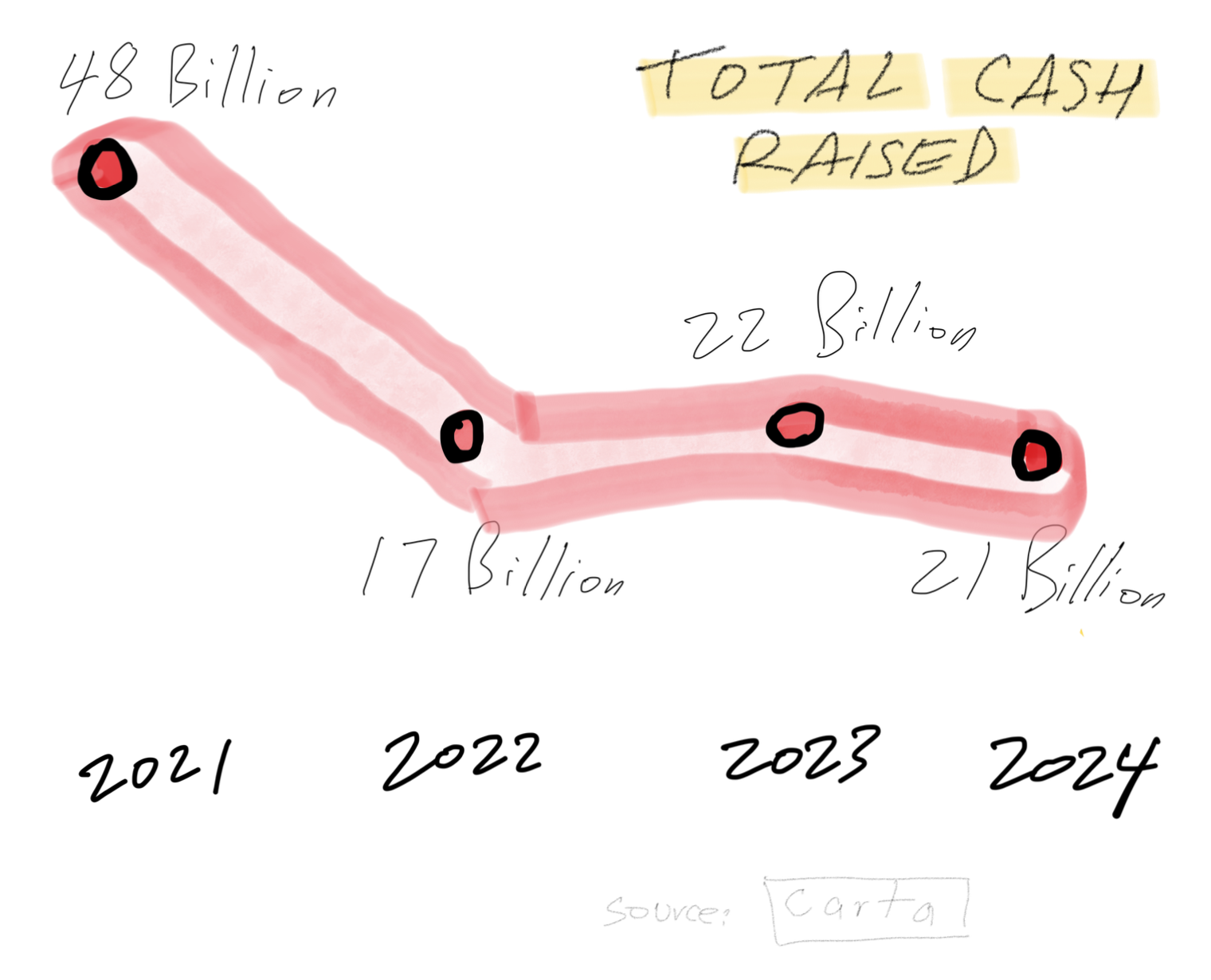
Today: Least amount of cash money for founders since 2018
Not hockey stick growth 👆🏽.

## Product-Market Fit: So Seductive yet elusive
Let’s start with the holy grail of startups: product-market fit.
Figuring out how to achieve it takes real skill. But actually achieving it? That’s where a healthy does of luck comes in.
---
Bad idea, bad timing = FAILING
Good idea, bad timing = failing
Good execution, bad timing = failing
Ok execution, good timing = winning
Good execution, great timing = WINNING
---
No matter how sharp a VC’s instincts are, the unpredictable nature of ideas, suppliers, founders, employees, macro markets and consumer behavior means that even the best can’t guarantee success.

A more accurate analogy for VCs might be the A&R (Artists and Repertoire) reps at a music label. Like A&R reps, VCs are constantly scouting for creative talent: founders with the potential to build something big.
Some VCs are true financiers, with the analytical chops to back it up. But many are not. In fact, most don’t have the je ne sais quoi to attract the “hottest ~~artists~~ founders in town.”
Caveat to the caveat: you don’t need super-analytical chops to be a VC.
## The public perception of VCs as financial wizards is often misplaced.
At their core, VCs are `market makers`.
They sit between limited partners (LPs), the source of capital, and founders, the entrepreneurs building the next big thing.
It’s the LPs’ money by-in-large that founders are spending, not the VCs’ own. The general partners (GPs) who run VC funds typically have only a small personal stake in the fund.

While that investment might be significant for them personally, it’s usually a drop in the bucket compared to the overall fund size.
## Skin in the game.
This brings us to a crucial point: founders should always ask how much “skin in the game” their GP has. If the GP’s own money is only a tiny fraction of the fund, their incentives may not be fully aligned with the founders they back.
This lack of personal risk is what enables the classic “spray and pray” approach. Investing in as many high-potential startups as possible, hoping that a few will hit it big and make up for the rest.
## The Real VC.
The VC asset class is built on access to deals and the ability to place many bets. It’s less about carefully nurturing each investment and more about maximizing the odds that one or two will become runaway successes. This model works, but it’s important to understand what’s really going on behind the scenes.
## Rethinking the VC Myth
Next time you hear about a VC “kingmaker,” remember: they’re often more like talent scouts than financial engineers.
Their real value lies in spotting potential and making connections, not in guaranteeing success. And for founders, the key is to look beyond the hype and understand who’s really taking the risk and who’s just along for the ride.
# Post Script

VC as an asset class is in a flux circa Spring 2025, clocking [a median IRR of 8 - 10%](https://carta.com/data/recent-vc-fund-performance-q3-2024/?ref=pulpconversations.com) while Bitcoin is monetizing at a 66% CAGR since the start of 2019 (to May ‘25).
### The Power of Laughter and Friendship
URL: https://pulpconversations.com/the-power-of-laughter-and-friendship/
Last updated: 2026-08-27T19:55:36.000Z
If laughter is the best medicine, then friendship is the prescription.
Do you have a friend with an unforgettable laugh?
When was the first time you heard it?
And is that laugh still in your life?
Think of it now.
## Are you smiling?
Do you have a WhatsApp thread like Sara's or a friend like Rick?
How often do you keep in touch?
How many messages per month do you exchange?
What do you talk about?
## What do you talk about with these people?
Laughter. It’s the universal connector, the antidote to distance, and the secret sauce for surviving life’s absurdities.
The next time you hear a friend’s laugh try to be mindful that you are building resiliency.
## Go ahead, laugh out loud.
It’s contagious, and it just might be the core memory you didn’t know you needed.
Find your [Rick](https://www.instagram.com/local.medellin/?ref=pulpconversations.com), Martin and [Sara](https://drink.orangepillcoffee.com/with-sara-loncka?ref=pulpconversations.com).
If that special someone isn’t IN your life at the moment, just pick up the phone and call them.
# UPDATE (27 May 2025)
My friend Cecelia sent me a text scolding me for not including her laugh in this post. LOL.
Here she is. Hope you enjoy it as much as I have 🧐 for the last 30 years.
### Find the Harry Mack Within You
URL: https://pulpconversations.com/find-the-harry-mack-within-you/
Last updated: 2026-08-27T20:10:50.000Z
7 years ago …
2025: - Primo opened (🤯) for HIM in NYC 👇🏽
2008 - hustling, practicing, perfecting for the last 17+ years 👇🏽
If you’ve ever watched Harry Mack freestyle, you know the feeling: awe, delight, maybe even a little envy. How does he do it? How does he take random words from strangers and spit them into gold? 🤷🏽♂️
## It is inspiring.
I see him manifesting a creative force that I believe lives inside each of us. He listens, absorbs and responds in real time.
## He is present.
He trusts himself to let go of the need to be perfect.
## Progress is better than perfect.
His format is impromptu freestyle rapping; yet it’s also a way of being that we can all practice.
What if we approached our own lives like Harry Mack approaches a beat?
Rather than sticking to a script, can we find comfort in improvisation?
## Vibe with what’s around us.
Trust our instincts; create something new from the chaos. Let’s not worry about getting it “right” and start focus on being present, authentic, and open to surprise?
Take risks, play, connect, create meaning on the fly.
## Harry Mack yo’ self.
### Cycles In Nature
URL: https://pulpconversations.com/cycles-in-nature/
Last updated: 2026-08-27T20:24:06.000Z
Modern society often defaults to a linear view but in reality time is fundamentally cyclical.
Life. Death. Environmental rhythms such as:
Spring
Summer
Winter and
F
A
L
L.
Just as Spring follows Winter, each societal “turning” follows the last, with each phase setting the stage for the next.
Is this random or part of a larger, recurring pattern.
If we only plan for straight-line progress, might we be blindsided by the inevitable downturns and upswings?
What if we can get better at anticipating the “season” we are in, whether in markets, culture, or nature and position accordingly?
### 3 Marriages in 10 Years
URL: https://pulpconversations.com/3-marriages-in-10-years/
Last updated: 2026-08-27T20:32:34.000Z
Marriage is one of society’s oldest institutions, yet its meaning and purpose are constantly evolving. For many, marriage is defined by legal documents, religious rituals, and a set of cultural expectations that shape how we view [commitment](https://opc.pulpconversations.com/p/escalation-of-commitment?ref=pulpconversations.com), happiness, and even our own identities. But what if the true essence of marriage lies not in these external markers, but in the lived reality of the relationship itself?
Just shy of a decade of marriage and a variety of therapy, I’ve found myself questioning the traditional frameworks that have long defined what it means to be married. Therapy has been a catalyst for this reflection, opening my mind to the possibility that a successful partnership doesn’t have to fit a single mold. Instead, it can be a dynamic, evolving relationship. One that prioritizes love, respect, and shared values over rigid adherence to convention.
### The Weight of Expectations
One of the most challenging aspects of marriage is the burden of expectations, inherited from our families, cultures, and even our past selves. These expectations can be both explicit and unspoken, shaping everything from how we handle conflict to how we define intimacy and success.
In my own experience, I’ve seen how unmet expectations lead to frustration and unhappiness. The pressure to conform to a particular vision of marriage can sometimes overshadow the unique strengths and needs of the individuals involved.
I’ve come to realize that flexibility and mutual respect are far more important than ticking every box on a checklist of what a marriage “should” be.
Rather than striving to “catch up” on lost time or force compromises that don’t feel authentic, I believe it’s more productive to focus on the areas where love and connection naturally flourish.
### Shared Values, Different Paths
A recurring theme in my journey has been the role of value systems in shaping a marriage. While my partner and I share values we also have differences that are unlikely to be reconciled by sheer willpower.
For example, I value the ritual of family dinners, but I’ve learned that not every value can or should be imposed on the relationship. Instead, I’ve chosen to invest energy in the aspects of our partnership that bring us closer together, rather than dwelling on the areas where we diverge.
### Intimacy, Growth, and Redefinition
Intimacy is another area where expectations and reality often collide. It’s easy to assume that a good marriage must include a certain kind of intimacy, but the truth is that relationships evolve. Sometimes, the traditional markers of closeness, like physical intimacy, may not be easily restored. That doesn’t mean love has disappeared; rather, it may be growing in new and unexpected ways.
This journey has led me to a simple but profound conclusion: marriage is not a static contract, but a living, breathing relationship. It’s shaped by the choices we make every day, the values we share, and the willingness to adapt as individuals and as a couple. The legal and religious frameworks matter, but they are not the whole story. What matters most is the commitment to nurture love, respect, and growth, on terms we define ourselves.
### A Call for New Narratives
As we move forward, I believe it’s time to re-examine what marriage means in the modern world. Couples should feel empowered to define their own relationships, free from the weight of outdated expectations. Whether that means reimagining the structure of your partnership, focusing on co-parenting, or simply giving each other the space to grow, the goal should always be to foster a relationship that is authentic, resilient, and deeply rooted in mutual care.
Marriage is not about fitting into a box. It’s about building something meaningful together. One conversation, one compromise, and one act of love at a time.
---
"If you’ve got a problem, yo, Danya’ll solve it
Check out [her site](https://www.danyashults.com/?ref=pulpconversations.com) while the community revolves it."
Danya and I first met in Summer 2012 in Malmö, Sweden at my favorite conference in the world - [The Conference](https://www.theconference.se/?ref=pulpconversations.com). We met on-stage as fellow panelists discussing the following topics: [*hyper-local, peer-to-peer, market-places*](https://videos.theconference.se/vinay-gupta-access-over-ownership?ref=pulpconversations.com)*,* [*access-not-ownership, community-building*](https://videos.theconference.se/danya-cheskis-gold-access-over?ref=pulpconversations.com)*.*
Our second and final meeting was in December 2013 during one of Danya’s [Pop-up Shabbat dinners](https://www.myjewishlearning.com/the-nosher/what-the-heck-is-a-pop-up-shabbat/?ref=pulpconversations.com) in Brooklyn.
Fast forward 12 years and here we are - talking again. It’s as if we are on our third relationship or something ……
Stay tuned for more Danya in the coming days. Tell your Mamas, Papas and your Bubby too.
---
Thanks for reading.
[](https://www.youtube.com/watch?v=uGkb-la%5FYe0&ref=pulpconversations.com)
### 23andMe
URL: https://pulpconversations.com/23andme/
Last updated: 2026-08-27T20:37:33.000Z
Recently, the news that [Regeneron](https://www.linkedin.com/in/erichaydenphd/?ref=pulpconversations.com) acquired 23andMe’s assets out of bankruptcy has reignited a familiar debate about data privacy, trust, and the responsibilities of both companies and consumers.
Market reaction has ranged from concern to outrage; revealing a persistent gap between what the law allows and what people expect, especially when it comes to something as personal as our DNA.
I remember, over a decade ago, considering whether to become a 23andMe customer.
Unlike most online services, this one gave me pause. The stakes felt higher: it was my genetic code 🧬, not just my email or shopping preferences. So, I did something unusual: **I read the terms and conditions**. Buried in the legalese, but present nonetheless, was a clause stating:
> data could be sold to third parties, at least in aggregate
It wasn’t front and center, but it was there for anyone willing to look.
Most of us, of course, don’t read the fine print. We click “accept” and move on, trusting that the **spirit of the law** will protect us, even if the letter of the law says otherwise.
### But is that a reasonable expectation?
When it comes to something as sensitive as our DNA, do we not have a responsibility to understand what we’re agreeing to? I chose not to become a customer, despite my interest in the product, because I wasn’t comfortable with the terms.
This brings us to a broader question: where does responsibility lie? Is it with the company, the regulator, or the individual? There’s a growing chorus arguing that **data is a human right 🤔**, and that companies should be held to a higher standard.
True **self-sovereignty** requires us to take ownership of our decisions. Outsourcing that responsibility, whether to a corporation, a government, or even a well-meaning friend, is a choice in itself.
We live in a world where it’s easier than ever to express outrage, but harder than ever to take meaningful action.
When a company like 23andMe goes bankrupt, its assets don’t simply vanish. Someone will acquire them, and the law (and the market) will determine who that is. If we don’t like the outcome, what’s the alternative?
Should valuable assets be left to wither, or is there a better steward out there? If so, who? And if not, what does that say about our expectations?
Ultimately, we all have the power to shape the norms and laws that govern our society. We can choose products that align with our values, advocate for clearer terms, and demand better from both companies and regulators. But we must also recognize our own agency.
As we navigate the increasingly complex landscape of digital privacy in the age of AI, let’s move beyond outrage and toward informed, intentional action. The future of data stewardship depends not just on what companies do, but also on the choices we all make every time we click “accept.”
### How I Met Your Mother
URL: https://pulpconversations.com/how-i-met-your-mother/
Last updated: 2026-08-27T21:21:22.000Z
### Charlie on Hope:
### Hope on Charlie:
I was shucking oysters at a bar on Saint-Laurent in Montreal.
It was deep Montreal winter, so cold!
I wanna say it was late January and I was shucking oysters with my boyfriend from Prince Edward Island.
We had two cases of oysters that we were sharing with this lively crowd and he was very excited to introduce me to this woman who he met through his bike-trip-guiding days and sure enough she showed up.
She came with her brother Charlie and I don’t really remember Charlie but I remember meeting her and she had this beautiful smile and I saw how much my boyfriend liked her!
SO … the second time I met him, I did not even see his face. I just heard his voice as I was driving up Spadina (Toronto) going North.
It was a very hot Summer day like the kind of hot that you can see the flicking heat waves off of the concrete.
I was driving with the windows rolled up of my boyfriend‘s car. I think we were having a fight. We were like in a *heated* conversation. I don’t remember about what - but we were listening to house music, Mark Farina mushroom jazz.
And all of a sudden we stopped at a light and I suddenly heard this knock on the window on the driver side — Gabe rolled down the window and this guy said “hey buddy your car is on fire!” 🔥
And I’m over here thinking 🄵𝑼ck (the music was pretty loud) but I heard that! and Gabe asked, “WHAT?” and he’s like “yeah I can see flames flicking from underneath your car”.
And so we drove off and Gabe pulled into a one-way street - the wrong way - cause we just thought we better get out of the car right away.
We pulled into this one-way street, got out, shut the door, walked away like maybe 20 yards and the car exploded like in the movies!!

Everyone around us scattered - thank goodness *that guy* knocked on our window.
The car got removed by flatbed truck and that was that.
It wasn’t until probably 2 1/2 years later …. I had broken up with Gabe … I was in a new relationship with this man, [Charlie](https://www.ditoui.com/?ref=pulpconversations.com), and we were at a cocktail party; talking in our own circles but we could just about hear each other.
I remember hearing Charlie have a conversation.
I guess I wasn’t super interested in my conversation. I was paying attention to his.
He was talking about “things that happened in real life that you see in movies - like police chases and and cars blowing up”
And he said, “oh I saw a car blow up once in front of my eyes.”
And he explained the story of seeing a car with flames coming from underneath and knocking on the window and I remember feeling this crazy pit in my stomach.
And my face went bright white (yes, even whiter).
I went over and tapped his shoulder and I said oh my gosh.
I was in that car, that was me.
Yeah.
### TRAD-FI
URL: https://pulpconversations.com/trad-fi/
Last updated: 2026-08-27T21:29:58.000Z
The REAL money is made and lost at the tails. And 68%+ of society exchange debits and credits all-day on the scraps in the middle.
This is the main reason it’s taken this long for Bitcoin to go institutionally mainstream (Jan. 2024) - in sync with “career risk” inverting from “don’t recommend bitcoin” to “you must recommend a non-zero allocation to bitcoin!”
Is this correlation or causation?
[Those in the middle](https://www.onceinaspecies.com/p/why-the-yuppie-elite-dismiss-bitcoin?ref=pulpconversations.com) (most people) place the most trust in “the system” because they have the most to lose.
Why?
Because they spend their time operating in the middle - that’s either their locus of control or programmatically assumed ignorance.
The poor may have less trust in “the system” because it has failed them in many ways.
The rich have less trust in “the system” because they think “the current guys” in power are less trustworthy than “their guys”.
Everyone else is in the middle. We trust because what other choice is there?
As [my friend Bernard](https://www.wsj.com/us-news/texas-lottery-gamblers-jackpot-win-40e3d6fb?st=qSqTXF&reflink=desktopwebshare%5Fpermalink&ref=pulpconversations.com) recently said to me, “Your objective is to build a financial wall around you.”
I think his point is that you NEED a financial wall around you to enliven your full potential.
“I would rather be poor.” - said no serious person ever.
And before you cry Mother Teresa. [Read Christopher Hitchens](https://a.co/d/hEhPHkU?ref=pulpconversations.com), which may force you to reconsider your whole perspective on what “helping the poor” even means.
A financial wall enables peace of mind. It serves as protection and it enables optionality.
Such a wall may enable you to pursue your dreams. Your ideas about saving the world no longer must remain words. You can manifest them into reality, regardless of whether others think it’s a “good / bad” idea.
LFG! Go build your walls.
### Bo and Daddy in L.A.
URL: https://pulpconversations.com/bo-and-daddy-in-la/
Last updated: 2026-08-27T21:36:39.000Z
My 5-year old and I like to make songs together using [Suno](https://suno.com/invite/@doricboyband442?ref=pulpconversations.com).
Bo narrates the lyrics and I arrange them.
If you are looking for [something fun and creative to do with your kids try it](https://suno.com/invite/@doricboyband442?ref=pulpconversations.com)!
This is our first song since last year’s banger [Playland](https://vinaybeta.com/playland?ref=pulpconversations.com).
### Bo and Daddy in L.A. Lyrics 👇🏽
\[Intro\]
This song is about Bo and Daddy in L.A.
Whatever you do wanna dooooo in L.A.
... just ask your parents...
\---and you can doooo it
ya ya ya ya yaaaah
\[Verse 1\]
if you wanna dooooo it ...
just ask your parents
and if they say yes
then you can do it
BUT you need to listen to your parents
\[Pre-Chorus\]
just for one second
if you are a bad guy or if you have a bad guy mommy or daddy
then they will force you
ooooh ooooh
\[Chorus\]
if you wanna dooooo it ...
just ask your parents
and if they say yes
then you can do it
\[Verse 2\]
Bo and Daddy love L.A.
Because we just love it
Meeting new friends ... meeting new cousins
Swimming on the rooftop for 5 hours
\[Pre-Chorus\]
just for one second and one second more
hope you don't have a bad guy mommy or daddy tellin' you what to do
ooooh ooooh
\[Chorus\]
Repeat the chorus
\[Bridge\]
What's the Ami without the Bon
Who's your first customer?
It's me
It's me
Ooooh ooooh
\[Chorus\]
Final chorus, often repeated twice for emphasis
\[Outro\]
Whatever you do wanna dooooo in L.A.
... just ask your parents...
—and you can doooo it
### The White Lotus: Extractive or Aspirational?
URL: https://pulpconversations.com/the-white-lotus-extractive-or-aspirational/
Last updated: 2026-08-27T21:42:40.000Z
[Ditoui is a nutcracker](https://www.ditoui.com/?ref=pulpconversations.com)



Charlie Scott
Picture this: luxury resort in Hawaii, but everyone’s got more baggage than their Louis Vuitton suitcases. Rich guests, messy secrets, and staff who smile through gritted teeth.
Every episode, someone’s drama explodes: honeymooners fighting, entitled families whining, and a manager who’s one bad Trip Advisor review away from a meltdown.
It’s a five-star train wreck in slow motion, with sharp social satire and enough awkward moments to make even Aubrey Plaza cringe (and she is in it!). By the end, you realize money can’t buy happiness, but it sure can buy a front-row seat to chaos.
Namaste, but with side-eye.
Is there a better way?
#####
### The Leah Way
URL: https://pulpconversations.com/the-leah-way/
Last updated: 2026-08-27T21:54:48.000Z
Leah's father had been hospitalized just moments before we recorded this conversation 🙏🏽 .
**Key takeaways:**
The stress of caregiving can be overwhelming.
Community support is crucial during health crises.
Living abroad offers a unique perspective on culture and life.
Role models can inspire individuals to pursue new paths.
Challenging societal norms can lead to personal growth.
Vulnerability in leadership fosters trust and authenticity.
Open conversations about personal struggles can help others.
Life constructs can be redefined after significant life changes.
It's important to question complacency in life choices.
Vulnerability is essential for personal growth and connection.
Living one day at a time can be liberating.
Therapy can be a crucial part of healing.
But finding the right fit is important.
Burnout can serve as a wake-up call for self-reflection.
Understanding what energizes versus depletes you is key to well-being.
Labels can limit our understanding of ourselves and others.
Healing is not a linear process; it varies for everyone.
Building a support system is vital during tough times.
Digital friendships can be deeply meaningful and supportive.
Skill building can help regain a sense of control during tough times.
Engaging in new activities can alleviate feelings of inadequacy.
Challenge the notion that travel is only for the privileged.
Parenting should focus on internal excellence rather than external validation.
### Escalation of Commitment
URL: https://pulpconversations.com/escalation-of-commitment/
Last updated: 2026-08-27T22:38:15.000Z
> Every time I show you vibes, you cannot see it. Every time I tell the truth, you don't believe it. Don't tell me I don't know about commitment!
### Why are we committed to echo chambers?
Do you seek victory rather than wisdom?
“The wise win before the fight while the ignorant fight to win,” - Zhuge Liang
If you have an opportunity to engage with an `external` perspective, especially within a pre-established community of trust, consider letting your guard down. Place some temporary trust in your colleague. They are trying to connect with you. Don’t try to debunk the information they are sharing, certainly not as your opening gambit.
##### Set Limits
Try consuming at least 5% of your content from `external` perspectives. Doing this has asymmetric upside FOR YOU because at worst its an insurance policy for blind*spotting.* At best you might expand your subject-matter-horizons. At very best you might blow-your-mind and `change your mind`! \[Yes, some people still do that in 2025.\]
##### Be Open to Re-evaluating
If you find yourself consuming > 5% `external` content over time, you might benefit from positional rebalancing. Updating your default instructions in the presence of wisdom should be an end in itself.
##### Focus on Future Outcomes
Do you want to spend your time defending the past or projecting the future? Why are you in a *committed* relationship if you don’t allow yourself to let go and *connect* …
##### Acknowledge Sunk Costs
Admit and be open to rational defeat and reframe *defeat* as your intellectual victory.
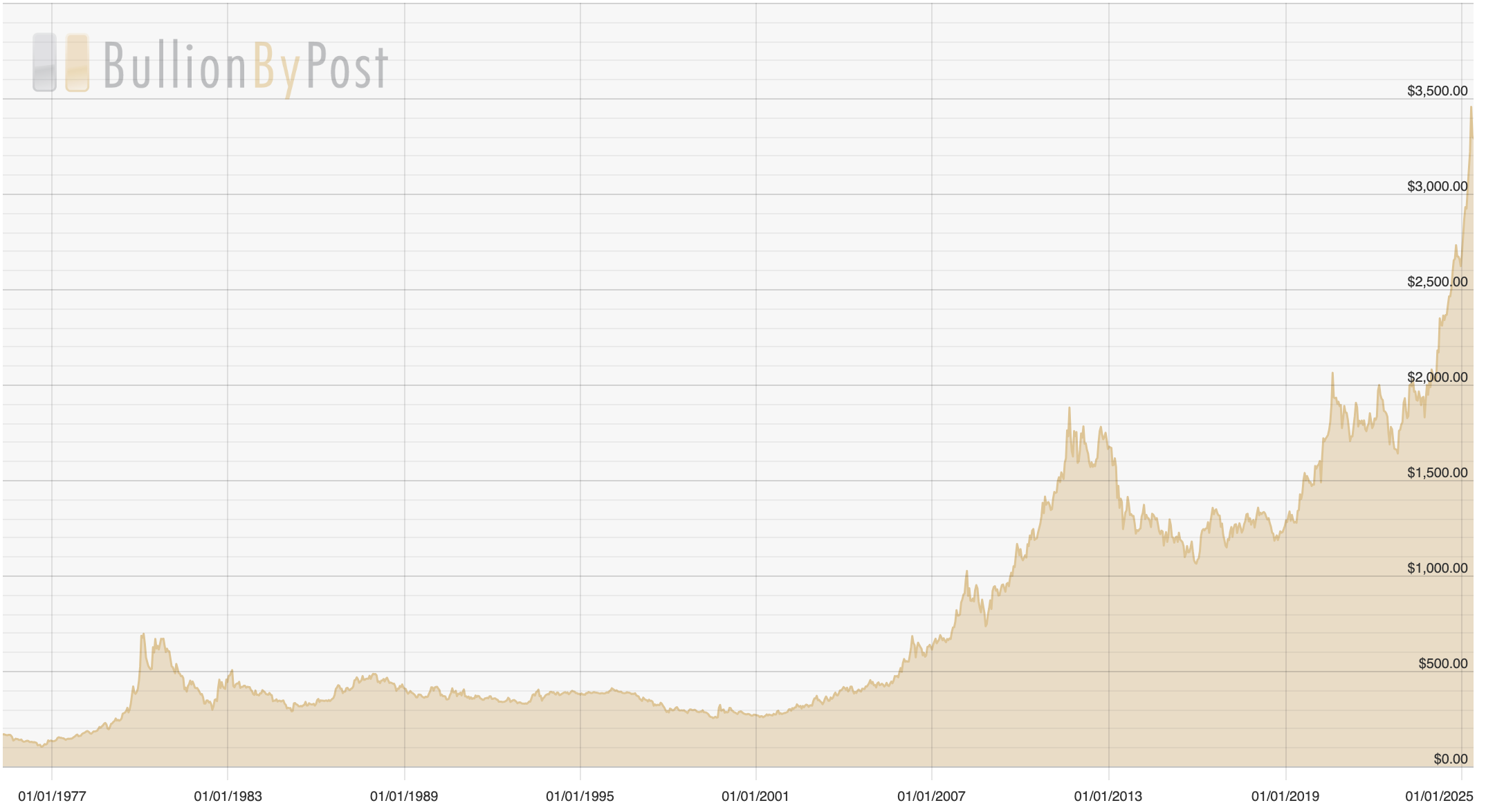
Since 1971, the US Dollar has lost 99% of its value vs. Gold
> Don't tell me I don't know about commitment. When I was the only one to show you different.
### $40-off Limitless.ai
URL: https://pulpconversations.com/40-off-limitlessai/
Last updated: 2026-08-27T22:42:45.000Z
0:00
/0:20
1×
**Limitless** is my AI-listening-device necklace. [Here is the chat](https://www.limitless.ai/c/w6OIQrWcTp5WsW6Fje25?ref=pulpconversations.com) referenced in the video; a daily notification to keep me honest with myself.
Pretty cool right?
They named me an ambassador so now I can give you a special $40-off link in case you are interested in this kind of device ($ ~~399~~ 359). Just fyi disclosure - they are also crediting my account with $40 for every purchase driven by the below link. Feel free to share with others if relevant for them - [https://limitless.ai/r/OPC](https://limitless.ai/r/OPC?ref=pulpconversations.com)
##### The #1 question friends are asking me:
Are you concerned about:
\-Your privacy
\-The privacy of other people’s voices etc. being captured and stored?
##### My Answer:
Legally 38 states have one-party conversation consent including NY; preserving the right to record yourself. Note: this device does not eavesdrop in my experience - it is trained on your voice so only picks up voices in conversation with you. Everyone has his own disclosure ethics depending on their profession or personal choice.
[What does Limitless.ai do with my data](https://www.perplexity.ai/search/what-does-limitless-ai-do-with-WwShp8XqT9O7nuvnCqAg.g?ref=pulpconversations.com#0)?
### Is Snow White?
URL: https://pulpconversations.com/is-snow-white/
Last updated: 2026-08-27T22:47:29.000Z
Jordan on snow:
Objective reality does not exist.
There is only s**ubjective reality**.
Individual perception and interpretation is shaped by personal factors.
And then there are **Facts: v**erifiable pieces of information that are independent of personal feelings.
### What do you think?
Is there a version of the external world that can exist independent of perception?
### Playing Professional Hockey As A Black Man
URL: https://pulpconversations.com/playing-professional-hockey-as-a/
Last updated: 2026-08-27T22:51:09.000Z
---
Imagine your life in the workforce and waiting until 27 years old before having a colleague who shared the same race? Sounds like something that would make me feel isolated, confused and perhaps lacking necessary perspective.
But not [Jordan](https://www.iamjordanowens.com/?ref=pulpconversations.com).
He just got down to business and brushed off any such thoughts like water off a (Mighty?) duck's back.
[Thomas Sowell](https://www.tsowell2.com/?ref=pulpconversations.com) has remarked that self-respect is crucial: "Without it, the world's adulation rings hollow. And with it, even venomous attacks are like water off a duck's back."
### Don't Put Me In The Box
URL: https://pulpconversations.com/dont-put-me-in-the-box/
Last updated: 2026-08-27T22:53:35.000Z
> "I'm lost in the world and it's like, okay, here's this map, okay, this is where I am on the map. Now I can make sense of the world around me." - Jordan (post-hockey)
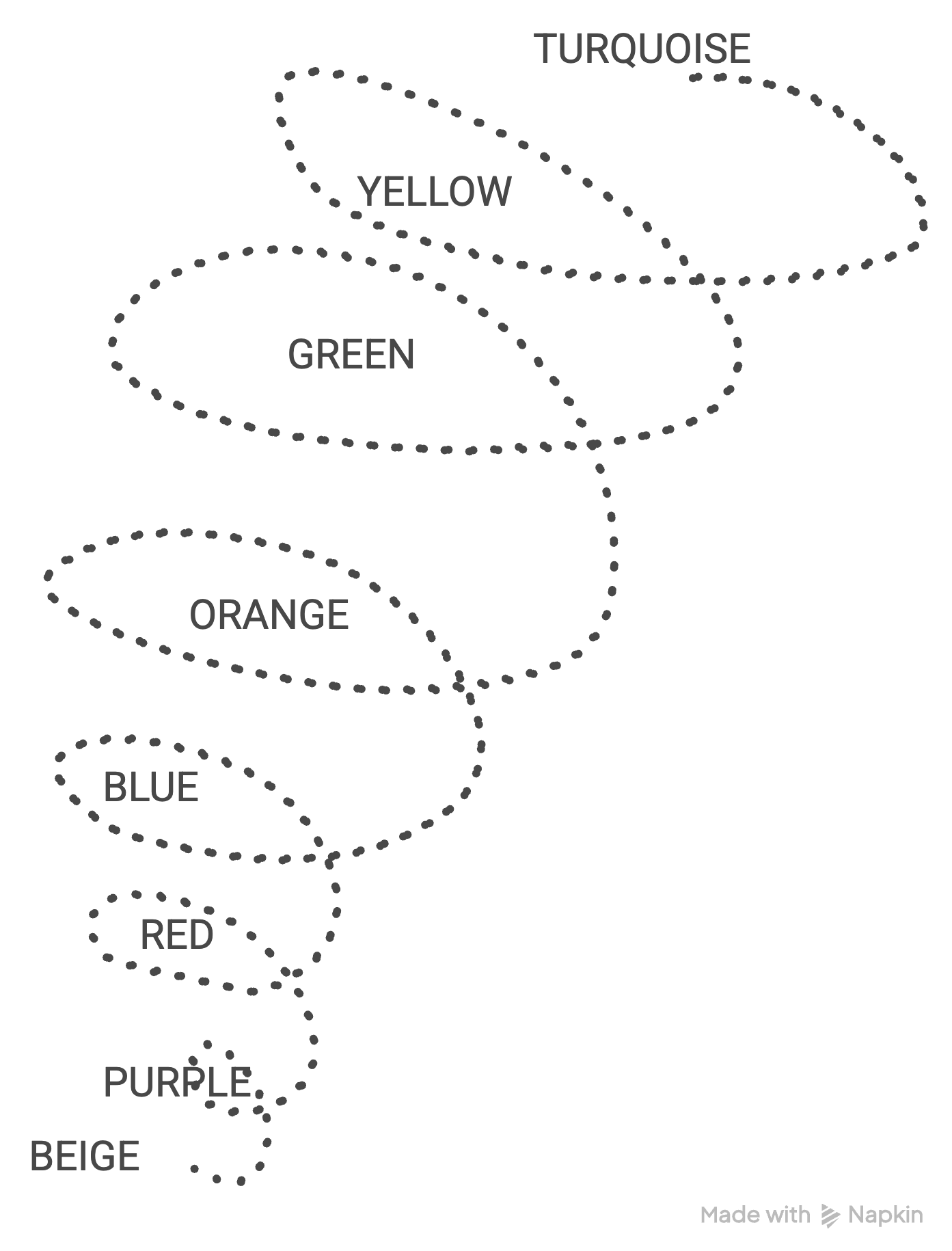
We all know Maslow’s *Hierarchy of Needs* \- a linear progression of human motivations - but do you know about [*Spiral Dynamics*](https://spiraldynamics.org/?ref=pulpconversations.com); which emphasizes shifts in collective worldviews; adapting to both individual and societal change?
Jordan’s description makes me think spiral dynamics is like having Google Maps for psychological development instead of wandering around lost in an existential forest. The ability to recognize value across different developmental stages rather than remaining boxed-in to single-stage sequential thinking seems powerful.
What mental models have helped you embrace change?
### Code Switching: A Necessary Skill
URL: https://pulpconversations.com/code-switching-a-necessary-skill/
Last updated: 2026-08-27T22:55:50.000Z
Jordan Owens is a [creative web developer](https://www.origincreative.ca/?ref=pulpconversations.com) who knows a thang or two about code switching. Previously he played pro-hockey for 12 years in North America and Europe - achieving his best season in 2014/5 when he finished the regular season with 28 goals and 32 assists for 60 points in 40 games, making him one of the Italian Elite.A’s top scorers that year for the Wipptal Broncos.
Jordan is also half-Black - making him so contextually rare; he had to wait for 7 years in the pros before meeting a fellow person-of-color.
Leave a comment below if you have a point-of-view on code switching.
Conceptually, do you think of it as switching between speech styles or is it more - perhaps an adaptive method for any variety of social contexts?

Thanks for reading! Please say 👋🏽 to Jordan [here](https://www.iamjordanowens.com/?ref=pulpconversations.com) and [here](https://www.origincreative.ca/?ref=pulpconversations.com).
### Embracing Change
URL: https://pulpconversations.com/embracing-change/
Last updated: 2026-08-27T22:58:18.000Z
Omar’s commentary reminds me of [The School of Life](https://www.theschooloflife.com/?ref=pulpconversations.com) and specifically a book compilation they published 10+ years ago; particularly *How to Connect With Nature*.
In it, the author poignantly reflects on the city’s complicated relationship with energy. We people gravitate to the city for “the energy” and in the process often expend more than we soak.
As a result we crave for nature to regenerate before soon being drawn to the city again.
Life is FUN when we are able to embrace this yin-and-yang, so why do we resist?
### Darkness Retreat: A Surprise
URL: https://pulpconversations.com/darkness-retreat-a-surprise/
Last updated: 2026-08-27T23:05:29.000Z
Did you know there is a place in Oregon where you can go to live in a pitch-black-cave for 5 days?

When is the last time you were proactively quiet and introspective for even 5 minutes?
### The Power of Men's Groups
URL: https://pulpconversations.com/the-power-of-mens-groups/
Last updated: 2026-08-27T23:08:54.000Z
Are you part of a “men’s group”?
---
Last year my friend Ram introduced me to [Sharad](https://www.linkedin.com/in/sharaddaswani/?ref=pulpconversations.com) who 11 years ago created [Brown Papas Unite - BPU](https://linktr.ee/brownpapasunite?ref=pulpconversations.com) . Since then he has grown his digital-first men’s group to \~1,200 [Indian men across the USA](https://i.postimg.cc/90bVjSXC/pulp-indian-men.png?ref=pulpconversations.com). I joined last Fall and was instantly welcomed to the community, which connects on a variety of topics from college admissions, aging parents, food & recipes, stocks & investments, and baller travel itineraries around the world. I don’t know for sure but I think the age range of members is between 30 - 70 years old. It’s an amazing luxury to tap into so much wisdom in an instant.
Within the past months because of this group / outlet / support system I’ve been able to ~~shit-post to my heart’s content~~, invest in a [land banking deal](https://www.linkedin.com/in/vinod-nagi-009a336/?ref=pulpconversations.com) (wtf is that right?), compare notes on startups, learn about new dining spots in NYC, save $700 on my home insurance, get a recco for the best pizza dough and much more ….
Most importantly - it feels great to be part of a community that is interested in propelling not competing with one another.
Regardless of whether you identify as: ♂ ♀ ⚧ ⚨ ⚪ it’s important for all of us to be part of a community that allows us to interact without fear of judgement or shame.
If this resonates with you give it a try.
###
URL: https://pulpconversations.com/hello-world/
Last updated: 2026-08-27T23:14:34.000Z
Watch this music video from *The Blaze* to get in my mood while I wrote this.
---
> There's nobody like my mom. There's no place like my home.
> Since I was born. When I was young
>
> The flavor is so strong. I've missed it so long. Yeah!

---
It was a strange sensation, returning to the place I once knew so well after being gone for so long. The familiar streets, the familiar faces, the ~~(~~un)familiar rhythms of life – felt different. After 15 years in London, I found myself nervous but excited for a renewed adventure moving to the village where I was born, but this time with my incomparable wife and daughter-to-be (she was born at the end of the year).
Like the Prodigal Son, I had wandered far from home, only to find myself drawn back by visible and invisible threads. Consciously, we both wanted our child to experience childhood in a serene, less hectic, naturally beautiful place, but close enough to take a train into an amazing city - the City as it turned out.
But for me it wasn't a simple homecoming. My Dad no longer lived in the USA and I needed and wanted to rekindle the relationship with my Mom. Above all I quickly learned it was the beginning of my journey of rediscovery, a chance to see America with new eyes and to finally come into my own voice.
But alas that would take some time …
Everyone faced difficulty everywhere in at least some and likely most ways.
As a new homeowner I felt lucky to meet someone on *LunchClub* who told me about the Covid Mortgage Relief Scheme, which saved me $30,000 (I’ll spare you the math) with one 5-min phone call.
I was elated, shocked and felt some guilt that I was a lucky new homeowner. This benefit was not available to non-owners.
I once again started paying attention to the Markets and specifically how current events are String-theoried to historical ones.
I refused some imploring friends in 2013 when they suggested bitcoin to me at $130\. I fell for the Blockchain-not-Bitcoin malarkey in 2015 and once again dismissed it.
I guess I was fated to start my learning journey in 2020.
By the middle of the year, I was [Orange Pilled](https://orangepillcoffee.com/manifesto/?ref=pulpconversations.com).
In December, I listened to an [interview that blew my mind](https://vinaybeta.notion.site/Podcasts-8245e40cb6fa4f81aabe24a11922c549?p=c7f8a09db56044a4acaecf13f1adce0f&pm=c&ref=pulpconversations.com).
And then I started consuming information like a good friend of mine who we call *The Analyst* \- even he was impressed.
I continued my self-study but partly due to lockdown and mostly due to being a fumbling Husband and Dad of a sub-two-year old I struggled to connect with existing friends around my evolving beliefs.
My Dad died while abroad. Suddenly. I hadn’t seen him in three years.
I struggled with grief and unfortunately was not skilled in asking for help. I was angry about my Dad and unable to keep pragmatic perspective. My health suffered and so did my most important relationship.
Insomnia led to social anxiety which led to severe - `panic attacks` \- something I had never before experienced.
I stopped returning my friends’ calls.
I hit rock bottom - taken to the Emergency Room in the middle of the night.
I got a Therapist - someone I wish I had much earlier in my life.
We got a second Therapist - in order to focus on our marriage.
I started to heal by putting in the work and thanks to the blessings of God.
And having so recently felt like death, I finally started to feel comfortable in my skin for the first time.
I didn’t intend to shed my identity - indeed my preoccupation with it led me to despair in the first place. But now that it was shed I felt free to` live one day at a time `for real! My friend Omar and I recently joked that once you viscerally experience a cliché it begins to make profound sense.
Leaving America in 2005 for [LBS](https://www.london.edu/?ref=pulpconversations.com) initially was a temporary departure, but it turned into a transformative journey that shaped my perspective in ways I never could have imagined. Living abroad gave me a unique lens through which to view my home country, a blend of critical distance and newfound appreciation. It also left me privileged to have meaningful friends all over the world.
Thanks for reading.
Love, Vinay
---
My goal is to write about the process of rediscovering and reclaiming my voice after being shaped by numerous foreign cultures. It's about embracing the unique perspective that comes from seeing America with new eyes, and using that perspective to connect with others. It’s about creating a new identity after coming out the other end of my midlife crises.
It's about finding a way to be both critical and generous, to challenge the status quo while also celebrating the best of what America has to offer. It's about moving beyond nostalgia and engaging with the present in a meaningful way.
Most importantly (for me) it’s about connecting meaningfully with you - my friends; people who are curious, open-minded, inspired and ready to get on with it.
---